

Most people rely on 1 or 2 ways of thinking.
But the smartest people?
They use all 7.
Let me show you what makes the difference.
💡 Critical Thinking is where it all starts.
It means asking questions before believing things.
Checking if something is really true.
Not just accepting what you hear.
Think of it as your truth detector.
Without it, you risk making bad decisions
based on wrong information.
💡 Analytical Thinking helps you solve big problems
by breaking them into smaller pieces.
Like solving a puzzle, one piece at a time.
Suddenly, what seemed impossible
becomes totally doable.
💡 Creative Thinking helps when the usual way
doesn’t work anymore.
It’s about seeing new connections.
Finding fresh solutions.
Thinking differently than everyone else.
This is where breakthroughs happen.
💡 Abstract Thinking is about seeing the big picture.
While others focus on tiny details,
you see how everything connects.
You spot patterns others miss.
You understand deeper meanings.
💡 Concrete Thinking keeps your feet on the ground.
It’s about facts you can see and measure.
Real things, not just ideas.
This turns dreams into reality.
💡 Convergent Thinking finds the best answer.
When there’s one right solution,
this helps you find it fast.
Like following clues to solve a mystery.
💡 Divergent Thinking creates lots of options.
One problem, many solutions.
No idea is too wild at first.
More choices mean better decisions.
What most people don’t realize is…
You already have all 7 thinking styles.
You just need to practice using them.
How? Try this:
➟ Question what you hear (Critical)
➟ Break big tasks into steps (Analytical)
➟ Ask “what if?” more often (Creative)
➟ Look for patterns in life (Abstract)
➟ Focus on facts first (Concrete)
➟ Find the best solution (Convergent)
➟ Think of many options (Divergent)
The best leaders switch between these styles
like changing gears in a car.
They know which one to use and when.
Your brain is more powerful than you think.
Most people only use a fraction of it.
Start practicing all 7 styles.
Watch how much smarter you become.
Not because you changed.
But because you finally used what was always there.
P.S. Which of the 7 is most valuable?
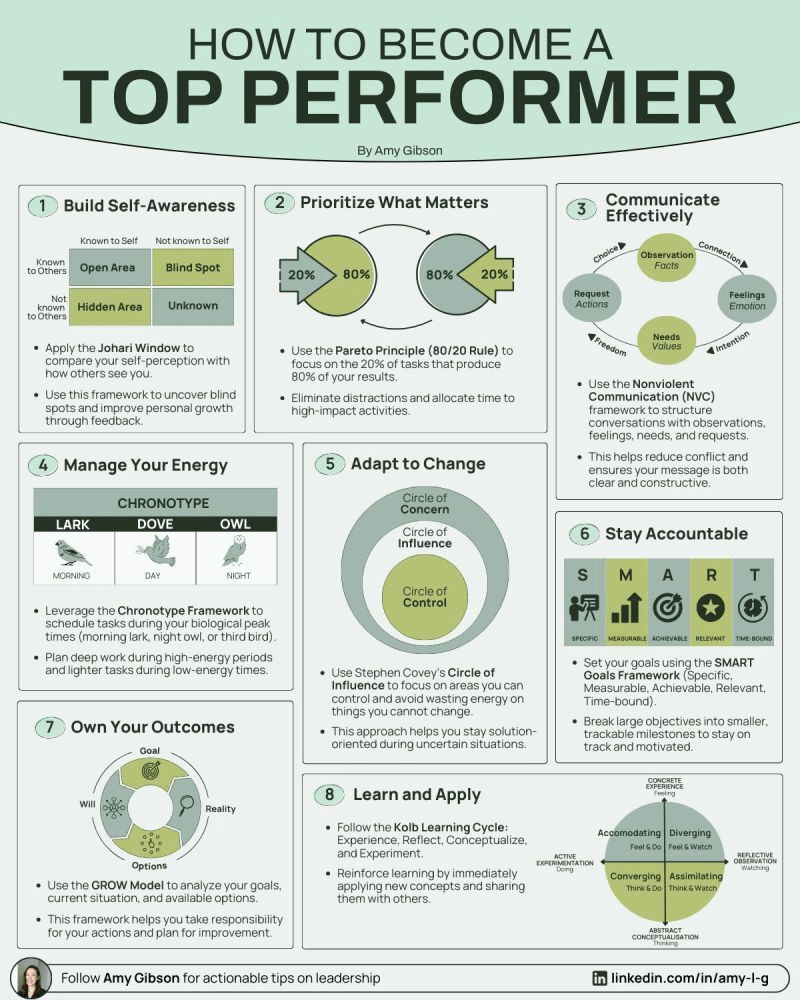
How To Become A Top Performer
No one is born a top performer.
Talent helps, but these matter more:
Your mindset
Your habits
Your grit
8 rare traits I see top performers master—and how you can, too:
✅ They know themselves deeply
↳ Use feedback to spot blind spots and grow
✅ They focus ruthlessly
↳ Put 80% of your energy into the 20% of actions
that have the most impact.
✅ They communicate with purpose
↳ Master communication to deepen relationships.
✅ They match energy to tasks
↳ Know your peak hours and plan accordingly
✅ They focus on what they can control
↳ Stay solution-focused when things get tough
✅ They set clear, trackable goals
↳ Break big dreams into small daily steps
✅ They own their journey
↳ Take full responsibility for outcomes
✅ They never stop learning
↳ Turn every experience into growth
These aren’t just natural gifts.
They’re skills you can build.
Top performers aren’t perfect.
They’re just committed to getting better.
Every single day.
That’s the real difference.
It’s not about being the best.
It’s about being better than yesterday.
You’ve got this.
Take that first step today.
When Your Soul Whispers, Listen

We live in a world that celebrates hustle, glorifies busy, and too often drowns out the quiet wisdom inside us. But your body, your heart, your intuition—they’re always speaking. The question is: Are you listening?
When your body begs for rest, it’s not weakness—it’s a signal.
When your energy dips after spending time with certain people, it’s not coincidence—it’s information.
When a certain dream keeps nudging at your heart, it’s not random—it’s direction.
So often, we override these signs. We tell ourselves to push through the fatigue, to be polite when we feel drained, to be practical when our soul craves passion. But the truth is, your higher self always knows what’s best for you. It’s miles ahead of your to-do list, your deadlines, and your doubts.
Tuning in isn’t selfish—it’s sacred.
Rest isn’t lazy—it’s necessary.
Protecting your peace isn’t rude—it’s wise.
The life you want begins with honoring what you know deep down. Your body is your compass. Your intuition is your GPS. And your joy? That’s your green light.
So slow down.
Tune in.
Pay attention.
Because the most important guidance you’ll ever receive won’t come from the outside world—it’ll come from within. And when you learn to trust it, everything begins to align.
Your Strategy Needs A Strategy

Your strategy needs a strategy… did you know there are five different approaches to strategy that you can choose from? You should, especially the four non-traditional ones. These are the five approaches to strategy.
Picking the right approach to strategy depends on three dimensions:
Unpredictability: the extent to which it is possible to predict how things will unfold in the next couple of years.
Malleability: the extent to which it is possible to influence the course in which things unfold in the next couple of years.
Harshness: the extent to which keeping your organization going is difficult because of internal and external threats and pressures.
Based on these three dimensions, the Boston Consulting Group (BCG) distinguishes five different strategies:
1. Classical Strategy
Perception of context: Predictable, Unmalleable, Promising
Mantra: Plan
Typical activities: Analyze, plan, forecast, formulate
Key success factor: Accuracy
2. Adaptive Strategy
Perception of context: Unpredictable, Unmalleable, Promising
Mantra: Adapt
Typical activities: Experiment, monitor, iterate, adjust
Key success factor: Flexibility
3. Visionary Strategy
Perception of context: Predictable, Malleable, Promising
Mantra: Build
Typical activities: Envision, convince, build, persist
Key success factor: Power
4. Shaping Strategy
Perception of context: Unpredictable, Malleable, Promising
Mantra: Gather
Typical activities: Collaborate, share, evolve, co-create
Key success factor: Connections
5. Renewal Strategy
Perception of context: Harsh (the rest is no longer relevant)
Mantra: Survive
Typical activities: Scale down, focus, reset, preserve
Key success factor: Resilience
Let this sink in a bit more and have a look at all five.
Then ask yourself the following questions:
– How do you perceive the context you’re in on the three dimensions?
– Which of the five strategies would fit that context?
– What does your current approach to strategy look like and does it fit?
– What do you need to do differently?
Coach your Team on Setting Priorities
Training can boost your team’s productivity by 22%.
But if you coach them? Productivity jumps by 88%.
Because coaching does what training alone can’t:
It helps your team:
↳ Cut through the noise
↳ Make wiser decisions
↳ Focus on what moves the needle
How do strong leaders coach their teams
to set priorities?
They don’t just say “do less” or “work smarter.”
They guide them to focus on what matters most.
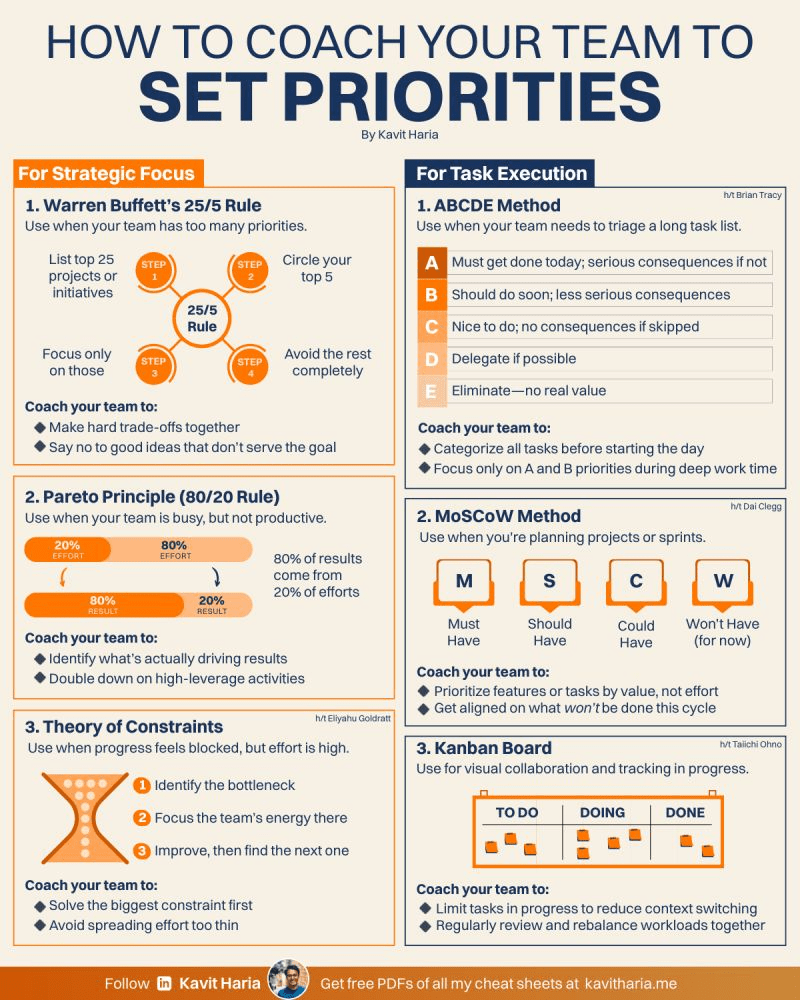
Here are 6 frameworks you and your team can use
to prioritize at work:
1. Warren Buffett’s 25/5 Rule
↳ Ask each team member to list 25 goals.
↳ Then help them narrow it to 5, and eliminate the rest.
↳ This helps them commit to what matters most.
Use when: Your team has too many competing priorities.
2. Pareto Principle (80/20 Rule)
↳ 80% of impact often comes from 20% of work.
↳ Coach your team to identify high-leverage activities
↳ Double down on what’s actually moving the needle.
Use when: Your team is busy, but results aren’t showing.
3. Theory of Constraints
↳ Help your team find the biggest bottleneck.
↳ Focus their energy there until it’s resolved.
↳ Then move to the next constraint one at a time.
Use when: Progress is stalled, but effort is high.
4. ABCDE Method
↳ A = Must do (serious consequences)
↳ B = Should do (less serious consequences)
↳ C = Nice to do (no consequences)
↳ D = Delegate
↳ E = Eliminate
Use when: The task list feels overwhelming.
5. Facilitate project planning with MoSCoW
↳ Must have.
↳ Should have.
↳ Could have.
↳ Won’t have (for now).
Use when: Planning sprints or projects.
6. Kanban Board
↳ To Do → Doing → Done
↳ Make work visible.
↳ Limit multitasking.
Use when: Your team needs visibility and clear task flow.
Most teams don’t need more time.
They need more clarity.
When your team understands what truly matters,
they stop chasing tasks and start making
meaningful progress.
And that starts with your coaching.
Stop Shrinking: You’ve Outgrown the Room, Not the Dream

There comes a time in life when comfort becomes a cage. You start to feel it—not all at once, but in small ways. The conversations no longer stretch you. The routine feels too tight. The expectations feel like ceilings, not springboards.
It’s not that you’ve changed overnight.
It’s that you’ve grown.
And yet, out of habit, loyalty, or fear, you start to shrink. You quiet your ideas. You water down your vision. You make yourself small enough to fit places, people, or roles that no longer reflect who you’ve become.
But here’s the truth:
You weren’t meant to fold yourself into corners you’ve outgrown. You were meant to expand. To stretch into your full potential, even if it means leaving behind what once felt like home.
Growth is not betrayal.
Leaving is not quitting.
And outgrowing something doesn’t mean you’re ungrateful—it means you’re evolving.
So stop apologizing for needing more.
More space.
More challenge.
More alignment.
More you.
Don’t shrink for rooms that can’t hold your light.
Instead, seek the spaces where your full self is not only welcome—but necessary.
Because growth isn’t just about reaching higher.
It’s about refusing to stay small.
KPIs

Don’t make the same mistake I did.
I used to obsess over…
KPIs.
Sales.
Efficiency.
Output.
Numbers, numbers, numbers.
I thought that’s what made me a strong leader.
But all it did?
Was make me blind to what actually matters:
People.
The truth?
Performance doesn’t come from pressure.
It comes from purpose.
And no metric means anything if your team feels:
↳ Unseen.
↳ Unheard.
↳ Uninspired.
These days, I’ve redefined my KPIs:
📌 Keep People Involved
📌 Keep People Informed
📌 Keep People Inspired
📌 Keep People Interested
Because here’s what no spreadsheet will show you:
If your team stops caring, no metric will save you.
But when they feel connected, trusted, and lit up from within.
↳ They’ll outperform every chart on your dashboard.
So no, I don’t ignore performance.
But I know where it starts:
With PEOPLE, not NUMBERS.
Wrong Soil, Right Lesson

We’ve all been there—pouring time, energy, and heart into something that just doesn’t grow. A relationship, a job, a dream, a partnership, a project. You tell yourself to wait a little longer, try a little harder, give a little more. And maybe—just maybe—it’ll all work out.
But deep down, you know the truth. You planted good seeds… in the wrong soil.
The hardest part isn’t walking away. It’s admitting that it’s not going to bloom—not because you weren’t enough, but because the environment wasn’t right.
Sometimes, the conditions aren’t fertile. The support isn’t there. The timing’s off. The values don’t align. And it’s okay. Because recognizing the wrong soil is the first brave step toward finding the right one.
There’s no shame in changing course. There’s wisdom in saying, “This isn’t working. Let me start fresh.” It’s not failure—it’s redirection. It’s knowing your seed deserves better ground.
So if you’ve been staring at barren earth for too long, waiting for something to grow—take a breath. You don’t need to keep waiting. You’re allowed to uproot and replant where there’s light, nourishment, and the possibility of real growth.
Better to walk away with clarity than to wait forever in doubt.
Your next season begins with one bold truth:
The seed is still good. You just need new soil.
Be A Leader You ALWAYS Needed
Your title doesn’t make you a leader.
How you treat people does.
What matters most is your impact
and how you show up for others.
Leadership isn’t rocket science –
it’s heart work.
The best leaders leave a lasting impact because they genuinely care:
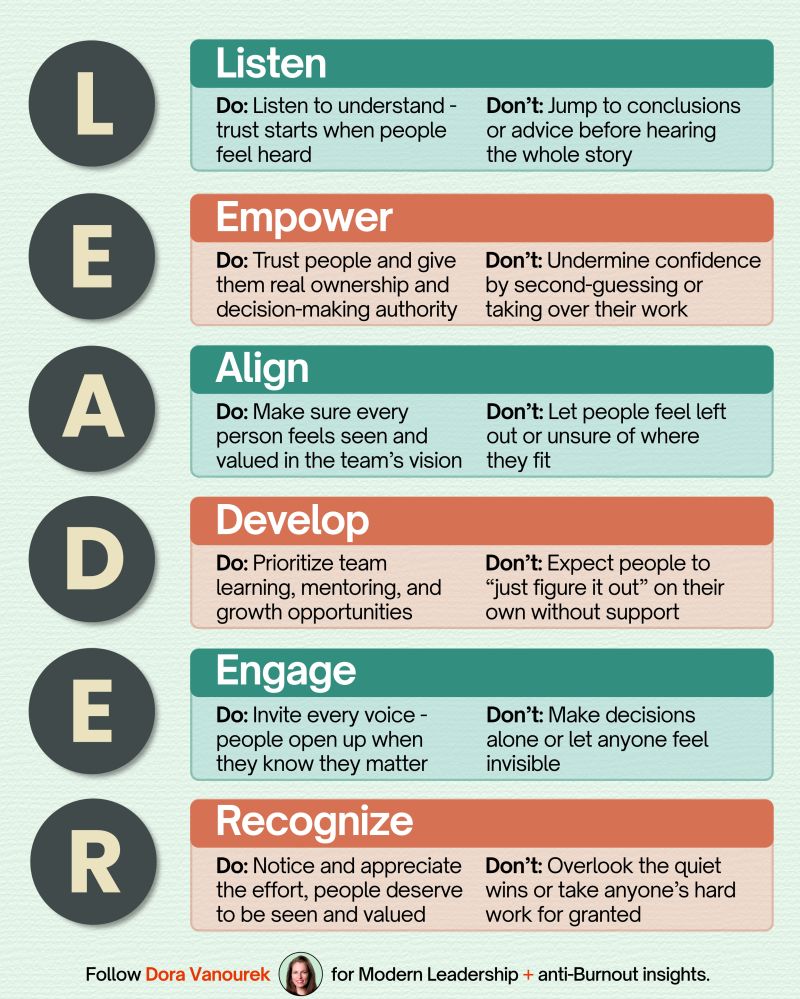
1. Listen
✅ Listen to understand, trust starts when people feel heard
❌ Jump to conclusions before hearing the whole story
2. Empower
✅ Give others real ownership and decision-making authority
❌ Undermine confidence by second-guessing or taking over their work
3. Align
✅ Make sure every person feels seen and valued in the team’s vision
❌ Let people feel left out or unsure of where they fit
4. Develop
✅ Prioritize team learning, mentoring, and growth opportunities
❌ Expect people to “just figure it out” on their own without support
5. Engage
✅ Invite every voice, people open up when they know they matter
❌ Make decisions alone or let anyone feel invisible
6. Recognize
✅ Appreciate the effort, people deserve to be seen and valued
❌ Take anyone’s hard work for granted
Lead with heart, your impact goes further than any metric.
Be the leader you always needed.
Plan vs Strategy
Your plan might be flawless but still fail—
Here’s why:
Because it’s not the plan that wins.
It’s the strategy behind it.
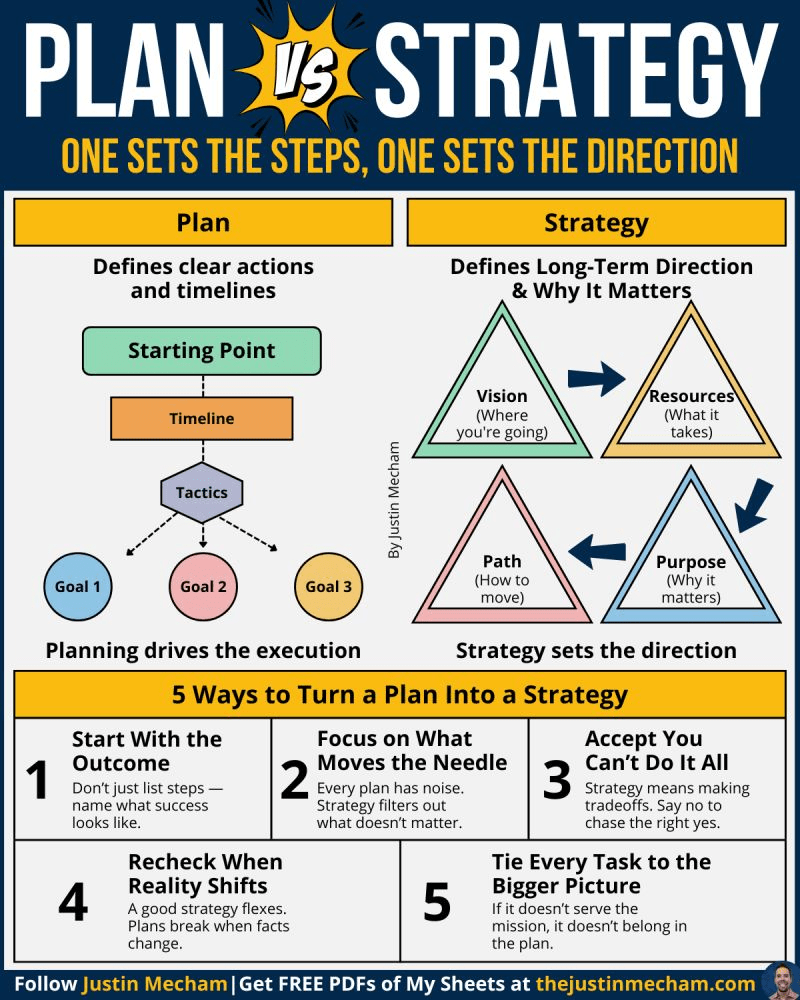
A plan lays out tasks and timelines,
a strategy defines direction and meaning.
Big difference:
A plan says:
➡ Start here
➡ Do this
➡ Reach the goal
But a strategy says:
🔁 Here’s why it matters
🔁 Here’s what it will take
🔁 Here’s where you’re going
🔁 Here’s how to adapt when reality shifts
Without strategy, plans fall apart when:
❌ You don’t know which goal really matters
❌ Unexpected obstacles show up
❌ Resources run thin
❌ Priorities change
Turn plans into strategy by:
✔ Making tradeoffs
✔ Cutting the noise
✔ Flexing with facts
✔ Starting with the outcome
✔ Tying every task to the big picture
Use my sheet to think strategically,
not just tactically.
Plans give you motion.
Strategy gives you meaning.
One keeps you busy.
The other keeps you aligned.
And that’s the difference between
just getting things done—
And actually getting somewhere.
 Kenrick Vaz