

True presence has nothing to do with being loud.
15 quiet ways to own the room:
Everyone’s fighting to be the loudest voice.
But the most influential people?
They command attention without saying a word.
Research shows up to 93% of your impact comes from non-verbal communication.
Your body language speaks before you do.
15 ways to make it count ✨
1) Position yourself in the center of the group
↳ Face people at a slight angle, keep 4 feet distance
2) Stand with feet shoulder-width apart
↳ Keep hands visible, not behind your back or in pockets
3) Take slow, deep breaths
↳ Controlled breathing says confident under pressure
4) Walk slightly slower than normal
↳ Deliberate movement > rushed energy
5) Pause before responding to questions
↳ Shows thoughtful consideration, not reactive impulses
6) Move with purpose, not randomly
↳ Every gesture should have intention behind it
7) Make eye contact for 4-5 seconds at a time
↳ Long enough to connect, short enough to avoid staring
8) Tilt your head slightly when listening
↳ Shows engagement and makes others feel heard
9) Look around the room before speaking
↳ Establishes awareness and command of the space
10) Lean forward slightly when engaging
↳ Demonstrates interest without invading personal space
11) Nod once when acknowledging points
↳ Shows you’re processing, not just waiting to speak
12) Keep palms visible when speaking
↳ Open gestures build trust and credibility instantly
13) Stand tall at the center of the room
↳ Physical positioning signals leadership presence
14) Lower your voice, speak slowly and clearly
↳ Forces others to lean in and pay closer attention
15) Make eye contact with calm, confident presence
↳ Your energy sets the tone for the entire interaction
Authority isn’t earned through volume.
It’s commanded through presence ✨
Which of these do you notice most in others? How can you practice it this week?
How to Prevent Burnout

Burnout isn’t a badge of honor.
It’s a warning sign your body, brain, and soul
are crying out for balance.
Here’s what most people get wrong:
They try to power through instead of
making small, sustainable changes.
I compiled a list of 42 micro-habits that create
real change.
Think of it as your personal menu
for wellbeing.
Here’s how to make it work for you:
1. Start With Your Body
➟ Drink water first thing each morning
➟ Take the stairs instead of the elevator
➟ Get 7-8 hours of quality sleep every night
💡 Physical energy is the foundation.
Without it, nothing else works.
2. Fuel Your Brain
➟ Read a physical book for 20 minutes
➟ Take breaks every 90 minutes
➟ Schedule focused work blocks
💡 Your mind needs white space to thrive.
Give it room to breathe.
3. Nourish Your Soul
➟ Spend time in nature daily
➟ Practice simple gratitude
➟ Connect with people who lift you up
💡 Soul-care isn’t luxury—it’s necessity.
Create your own combination that fits
your life and schedule.
Remember:
Small changes compound over time.
One tiny shift today can transform
your entire year ahead.
Seen, Not Sold: Your Worth Isn’t a Sales Pitch

There’s a quiet power in knowing your worth and not wasting energy trying to prove it.
In a world obsessed with validation—likes, applause, promotions, and praise—we often fall into the trap of overexplaining ourselves, bending over backward to prove that we belong, that we’re capable, that we matter.
But Emily Maroutian puts it plainly:
“Don’t waste your energy trying to convince others of your worth. Those who see it don’t need to be convinced. And those who don’t see it don’t want to be convinced.”
It’s a reminder that worth isn’t something you hustle for. It’s something you carry.
The right people—your tribe, your mentors, your supporters—will recognize your light without you having to shine it directly in their eyes. They’ll see your effort, your integrity, your value, often in the quiet things: how you show up when no one’s watching, the way you treat people when there’s nothing to gain, your consistency, your grace under pressure.
And those who don’t? It’s not your job to drag them into understanding. Some minds are closed not because they lack the capacity to see, but because they’ve already chosen not to look.
So protect your peace.
Focus your energy on building, growing, giving.
Let your work speak for itself, let your presence be your proof.
Because when you stop trying to be seen,
you realize you were never invisible to the right eyes.
Trust your worth. Invest in those who already do.
Lead with heart, command with kindness
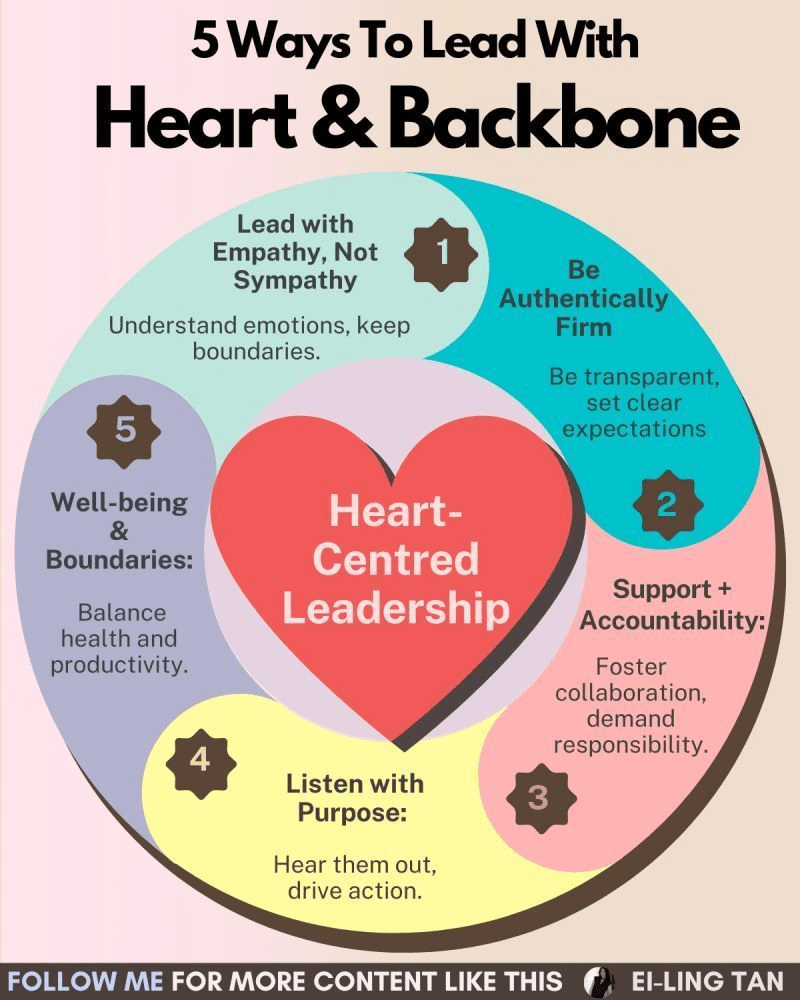
Balance kindness and assertion to unlock true leadership.
As Jim Rohn says, “𝙏𝙝𝙚 𝙘𝙝𝙖𝙡𝙡𝙚𝙣𝙜𝙚 𝙤𝙛 𝙡𝙚𝙖𝙙𝙚𝙧𝙨𝙝𝙞𝙥 𝙞𝙨 𝙩𝙤 𝙗𝙚 𝙨𝙩𝙧𝙤𝙣𝙜, 𝙗𝙪𝙩 𝙣𝙤𝙩 𝙧𝙪𝙙𝙚; 𝙗𝙚 𝙠𝙞𝙣𝙙, 𝙗𝙪𝙩 𝙣𝙤𝙩 𝙬𝙚𝙖𝙠; 𝙗𝙚 𝙗𝙤𝙡𝙙, 𝙗𝙪𝙩 𝙣𝙤𝙩 𝙖 𝙗𝙪𝙡𝙡𝙮”.
True leadership blends both qualities seamlessly.
Join me to learn about leading with both heart & authority.
Here are 5 Steps to Embrace Heart-Centered Leadership Without Being a Walk-Over:
1️⃣ Lead with Empathy, Not Sympathy:
↳Understand your team’s emotions without getting overly involved.
↳Empathy builds trust without compromising boundaries.
2️⃣ Be Authentically Firm:
↳Stay true to yourself while setting clear expectations.
↳Authentic leaders command respect and commitment.
3️⃣ Cultivate a Supportive yet Accountable Culture:
↳Encourage collaboration but hold everyone accountable for their contributions.
↳A balanced environment drives innovation and responsibility.
4️⃣ Practice Active Listening with Purpose:
↳Hear your team out but ensure conversations lead to actionable outcomes.
↳Active listening fosters respect and effective communication.
5️⃣ Prioritise Well-being with Boundaries:
↳Support mental and emotional health while maintaining productivity standards.
↳A balanced approach ensures a happy, efficient team.
Blend grace and grit to drive growth, greatness, and genuine connection.
Bullying at Work

75% of employees have witnessed workplace bullying behavior.
This can significantly impact not just productivity,
but also the mental health of both employees and the entire team.
Here are 8 signs of workplace bullying you should never ignore:
1/ Constant Criticism
Your work is consistently nitpicked and undervalued, no matter how well you perform.
2/ Undermining Your Work
Colleagues or managers take credit for your ideas or deliberately sabotage your efforts.
3/ Micromanagement
You’re constantly watched, questioned, or controlled far more than necessary.
4/ Rumor Spreading
False stories or behind-the-back discussions spread through the workplace.
5/ Silent Treatment
Being ignored or given the cold shoulder by coworkers or even your boss.
6/ Verbal Abuse
Yelling, derogatory remarks, or personal insults are directed toward you, creating a hostile environment.
7/ Manipulating Performance Reviews
Unfairly critical feedback focuses on minor issues, downplaying your true efforts and achievements.
8/ Setting You Up for Failure
You’re given unclear instructions or unrealistic tasks, intentionally designed to make you fail.
Many people overlook these signs,
thinking they can tough it out.
But we must stop tolerating such behavior.
If you notice these behaviors,
speak up!
Leadership Formulas

Leadership isn’t a guessing game—
It’s a system you build on purpose:
Top leaders don’t guess how to lead.
And they don’t lead by reaction.
They build repeatable systems that work.
They use formulas like these:
✔️ Accountability = Expectations + Follow-up
✔️ Good Feedback = Fast + Kind + Clear
✔️ Team Energy = Purpose – Confusion
✔️ Clarity = Simplicity + Repetition
✔️ Trust = Autonomy + Support
✔️ Focus = Less + Priority
If your team is stuck—
Don’t blame effort.
Check the system.
🟠 Do they know what’s expected?
🟠 Do they know what matters most?
🟠 Do they feel seen, trusted, supported?
Most leadership breakdowns
don’t start with people—
They start with missing pieces.
Great leaders rebuild the system:
🔸 Don’t let silence grow into resentment
🔸 Recognize effort in real time
🔸 Speak often and clearly
🔸 Stop gossip with facts
🔸 Address tension fast
And when the output starts slipping—
They don’t panic.
They zoom out:
🔹 Clarity beats control
🔹 Urgency ≠ importance
🔹 Burnout is not a badge
🔹 If it’s not scheduled, it’s not real
🔹 Deep work needs room to breathe
If your team feels lost—
Don’t push harder.
Build better systems.
9 Acts of Kindness
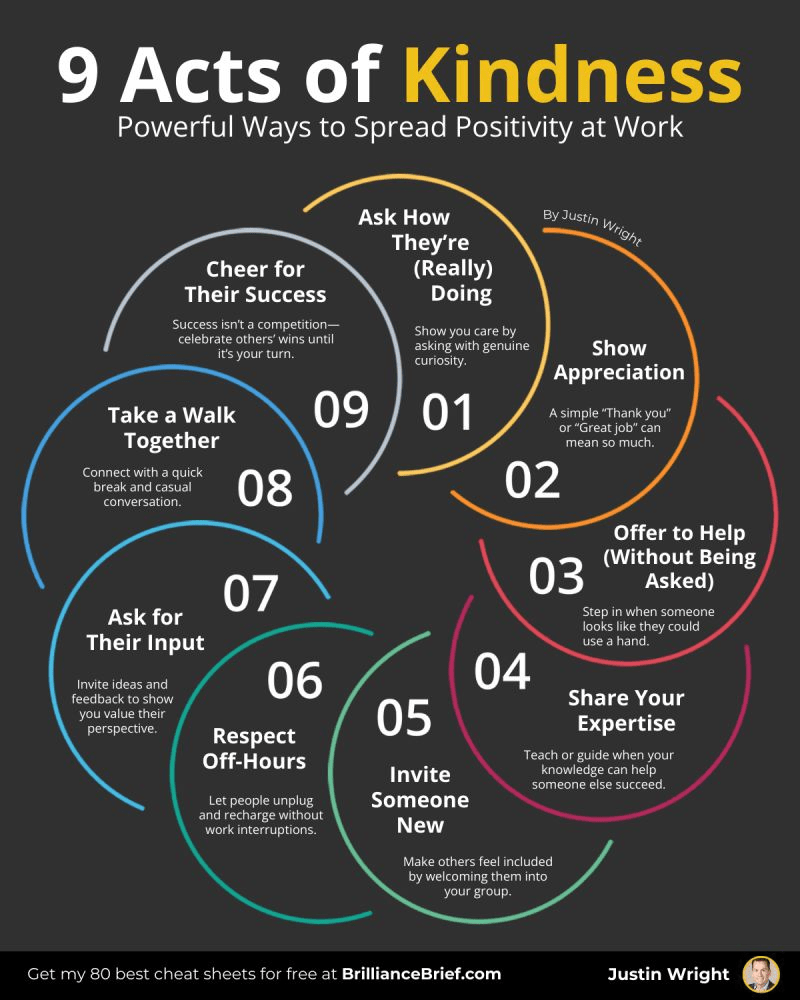
Most people think success comes from:
Being tough.
Pushing harder.
Demanding more.
But here’s what the research shows:
Teams led with kindness are…
➟ 70% more engaged
➟ 40% more resilient
➟ 21% more productive
➟ 4x more likely to stay
Because kindness isn’t weak.
It’s a strength multiplier.
It transforms average teams into exceptional ones.
Think about it:
When someone shows you kindness at work,
you feel seen. Valued.
Ready to give your best.
That’s why great leaders practice these daily:
• They ask real questions, not just “how are you?”
• They defend people who aren’t in the room
• They celebrate others’ wins like their own
• They respect boundaries and off-hours
• They lead with empathy, not authority
• They offer help before being asked
• They include the quiet voices
• They share knowledge freely
• They give credit generously
The truth?
Leadership isn’t about power.
It’s about impact.
And nothing impacts people more than genuine kindness.
Make kindness your competitive advantage.
Your team will thank you.
Your results will show it.
Your legacy will reflect it.
Want to transform your workplace?
Start with kindness.
The rest will follow.
12 Impactful Phrases
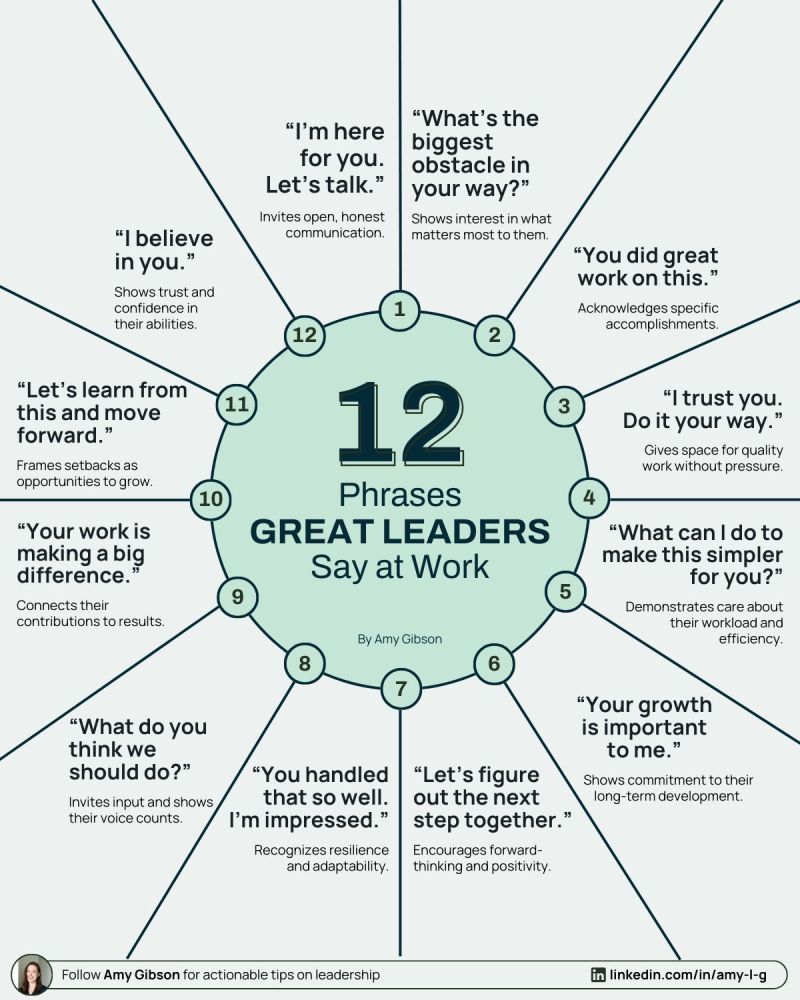
As a leader, your words can build trust or break it.
How you speak and act sets the tone.
Choose wisely.
➟ Listen more than you speak
➟ Keep your promises, always
➟ Share credit, take responsibility
➟ Make people feel seen and valued
➟ Turn mistakes into learning moments
➟ Ask questions before giving answers
➟ Celebrate small wins, not just big ones
The key to great leadership?
It’s not about being the smartest in the room.
It’s about bringing out the best in others.
Want to be a great leader?
Start with your words.
Because sometimes, all it takes is one person
believing in you to help you believe in yourself.
Be that kind of leader.
What phrase would you add to the list?
The Right Ears: Why Venting to the Right Person Changes Everything

We’ve all been there—boiling over with frustration after a long day, a tough conversation, or a crushing disappointment. The urge to vent is natural. It’s how we try to let out the emotional steam building inside us. But have you ever noticed how some venting leaves you feeling lighter and clearer, while other times it makes you spiral further? The difference often lies in who you’re venting to. I saw this illustration on a dear friend’s WhatsApp story and it just made me reflect on this topic.
Not Just a Soundboard—The Right Soundboard
Venting isn’t just about speaking—it’s about being heard, felt, and understood. The right person doesn’t just nod along or escalate your anger; they hold space. They listen without judgment, they ask thoughtful questions, and they gently challenge your perspective when needed. In their presence, your words don’t bounce back as noise—they come back as insight.
Why the Who Matters More Than the What
Venting to the wrong person can feel like shouting into an echo chamber. You may get agreement, even encouragement to stay upset, but not the clarity you’re seeking. Or worse, your vulnerability could be minimized, dismissed, or gossiped about.
But with the right person—someone emotionally grounded, who knows how to hold your feelings without making them their own—your venting becomes a form of emotional processing. You feel seen, your feelings validated, and you start to unravel what’s truly bothering you beneath the surface emotion.
The Science Behind the Release
Psychologically, expressing your emotions in a safe environment reduces the intensity of those feelings. It helps you shift from the reactive limbic brain into the reflective prefrontal cortex—where problem-solving and emotional regulation happen. Venting becomes constructive when it moves you from chaos to clarity.
Signs You’re Venting to the Right Person
They listen more than they speak. They don’t rush to give advice unless you ask. They validate your experience but also help you zoom out. They respect your privacy. After the conversation, you feel calmer, not more agitated.
Turning Venting Into Growth
With the right person, venting becomes more than emotional release—it becomes emotional recalibration. You hear yourself better. You ask better questions. You start finding your way forward.
So don’t bottle things up—but don’t throw them out carelessly either. Choose the right heart, the right mind, the right moment. Because venting isn’t just about letting it out—it’s about letting go.
Remember: It’s not weakness to vent. It’s wisdom to vent well.
How to Set Priorities

Teams that prioritize are teams that perform.
Here are 9 frameworks to prioritize like a CEO:
1. Eisenhower Matrix
↳ Categorize tasks in the 4 quadrants of the Urgent/Important Matrix.
↳ Do, schedule, delegate, or ignore them.
2. 3-3-3 Method
↳ 3 hours for focused work, 3 short urgent tasks, and 3 maintenance activities.
↳ Defining a “productive day” is crucial, or you’ll never be at peace (even with excellent output).
3. Time Blocking
↳ Segment your day for specific tasks. Stick to the schedule.
↳ Show up at the same time consistently.
4. ABCDE Method
↳ Prioritize tasks by grading them.
↳ Only tackle A’s and B’s, delegate or eliminate the rest.
5. MoSCoW Method
↳ Align your team with what is necessary vs. nice.
↳ Break into 4 categories: Must have, Should have, Could have, Won’t have.
6. Kanban Board
↳ Visualize workflow with simple To Do, Doing, Done columns.
↳ Limit work-in-progress to prevent overwhelm and increase throughput.
7. 25/5 Rule
↳ Pick your top 5 priorities.
↳ Ruthlessly ignore the other 20.
8. Pareto Principle
↳ Master identifying the 20% that matters most.
↳ You’ll be more productive without burning out.
9. Theory of Constraints
↳ Fix your bottlenecks first.
↳ Everything else is just noise.
 Kenrick Vaz