Stop Trying to Change People Who Dont Want to Change

Its hard to watch a friend or family member struggling with a problem or making bad decisions. You naturally want to help. You want to make the lives of your friends and family members easier and more joyful. You want to fix their problems and relieve their suffering.

Trying to keep a loved one out of harms way seems like a good idea, except that it doesnt work when they dont want your help.

Not everyone wants to change (or not in the way you think they should) and thats their prerogative. Despite your desire to help, you cant make people change and you cant fix their problems (even when you have great ideas and their best interest at heart!). You simply cant fix or solve other peoples problems and trying to do so often just makes things worse.

If you’re frequently frustrated that someone doesn’t take your advice or want your help, you’re tired of nagging, or you feel like you’re talking to a brick wall, you may be trying to help someone who doesn’t want to change.

Identify which part of the problem is in your control

Most people accept the notion that they cant control other people or solve their problems. But we get sucked into trying to change and fix because were confused about whose problem it is. Sometimes our desire to help, protect, and be the hero clouds our judgment. And sometimes we think we know whats best and foist our ideas upon others regardless of what they want.

We tend to think that problems that affect us are ours to solve. This false belief leads us down a futile path of trying to control things that arent in our control. For example, just because youre affected by your spouses unemployment or your teenagers smoking, doesnt mean these are problems you can solve. You cant get a job for your spouse nor can you make your child quit smoking. However, if your spouses unemployment has left you in debt and feeling anxious, stressed out, or angry, those are problems you can do something about.

And yet, some of us persist in trying to fix or change other people and their problems. This is classic codependent behavior. We abhor having things out of our control. It reminds us of bad things that have happened in the past. And we get anxious and afraid of the catastrophic things we anticipate happening if we dont step in and try to change things.

Accepting whats out of our control and that we cant solve other peoples problems doesnt mean were powerless. Quite the contrary; it allows us to put our energy into identifying what aspects of a problem we can solve and to change the things we can.

Trying to solve other peoples problems often makes things worse, not better

Not only is it impossible for us to solve other peoples problems, we can inadvertently cause a host of fresh problems when we try to help people who dont want to change (in the way we think they should).

To be honest, I often wish that I could solve other peoples problems. But it always ends badly when I try. I get bossy, give unwanted advice, and act like I have all the answers. Its definitely not something Im proud of and I imagine at least some of you can relate.

Sometimes, its downright presumptuous for us to assume that we know what someone else needs or wants. Our efforts to help may actually be conveying this harmful message: I know how to solve your problems better than you do. I dont trust your judgment or abilities. Youre incompetent or unmotivated.

Its not helpful to try to solve other peoples problems because:

  • Nagging and giving unwanted advice leads to more stress, conflict, and negatively impacts relationships
  • When we try to fix, change, or rescue, we assume that we know whats best. We take on an air of superiority and can act condescending
  • Making decisions for others takes away their autonomy and their opportunity to learn and grow
  • We become frustrated and resentful that our efforts to solve other peoples problems dont work and that they arent appreciated
  • We get distracted from solving our own problems. For some reason, fixing other people always seems easier than fixing ourselves!

Instead of doing things for other people, we need to allow them to live their own lives, make their own decisions and mistakes, and deal with the consequences of their choices. Not only does this free us up to focus on what we can control, it respects other peoples autonomy.

How to stop trying to fix, change, or solve other peoples problems

Before launching into fix-it mode, try asking yourself these questions:

  • Is this my issue or problem or is it someone elses problem thats affecting me?
  • Is this a problem I can fix or change?
  • Is changing this person or situation in my control?
  • How can I redefine the problem so that Im focusing on whats in my control?
  • Do I have any influence?
  • Did they ask for my help or ideas?
  • Am I forcing my solutions and ideas onto someone?
  • Am I helping or enabling? Whats the difference?
  • Why am I trying to solve this problem?
  • Is this actually an attempt to manage my own fears and anxiety about what may happen? And if so, how else can I deal with uncertainty and feeling out of control?

If youve been trying to fix or change people for years, it will take time and effort to change these patterns. In addition to being patient and compassionate with yourself along the way, try to focus on whats in your control and the problems that you can solve. Remember, if youre feeling particularly frustrated with your inability to change or solve a problem, you may be trying to solve someone elses problem.

.NET MAUI Reaches General Availability, Replacing Xamarin.Forms

Microsoft’s evolution of Xamarin.Forms, .NET Multi-platform App UI (.NET MAUI), has finally reached General Availability status, providing one framework for both mobile apps and, now, desktop apps.

Announced at the company’s big Build developer conference, the GA release is some six months late, as it was originally planned to debut with .NET 6 in November 2021 but “slipped the schedule.” So the dev team has been playing catch up with a series of previews and three Release Candidates, the latter just shipping a couple weeks ago. With this the conversion from Xamarin.Forms to .NET MAUI is basically complete. Xamarin support will continue through November 2023.

“.NET Multi-platform App UI (.NET MAUI), now generally available, is a new framework for building modern, multi-platform, natively compiled apps for iOS, Android, macOS and Windows using C# and XAML in a single codebase,” Microsoft said. “The framework solves the challenges developers face when building native apps across many operating systems. Instead of having to learn multiple technology stacks, .NET MAUI abstracts them into one common framework built on .NET 6.”

As a jack-of-all-trades tool (except for Linux and web), .NET MAUI uses native UI via app toolkits provided by each platform, and the dev team ships workloads to create applications that exclusively target Android, Android Wear, CarPlay, iOS, macOS, and tvOS directly using the native toolkits from .NET, and the supporting libraries AndroidX, Facebook, Firebase, Google Play Services and SkiaSharp, for examples.

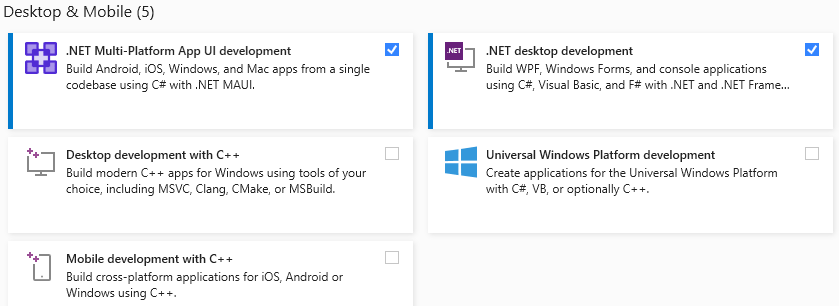
What’s more, .NET MAUI can incorporate web components built with Microsoft’s Blazor framework for creating web apps primarily with C# instead of JavaScript. .NET MAUI features the BlazorWebView control, which permits rendering Razor components into an embedded Web View. By using .NET MAUI and Blazor together (Blazor Hybrid apps with .NET MAUI), developers can reuse one set of web UI components across mobile, desktop and web. As shown in the graphic below, .NET MAUI Blazor App is now a Visual Studio 2022 project type.

“Native apps look and feel like the operating system on which they belong by default and layouts are fully adapted to each device automatically, with no additional code,” Microsoft said this week. “APIs are available directly from C# to access over 60 platform features, including isolated storage, sensors, geolocation and camera. Visual Studio 2022 includes Hot Reload technology to make developers much more productive building .NET MAUI apps. Developers can also take advantage of the latest debugging, IntelliSense and testing features of Visual Studio to write better code faster.”

How To Train Your Brain To Become More Positive?

We face many challenges in our personal life as well as in our career. In fact, career is one aspect of life which constantly makes us uncertain and at times leads us to the negative loop. From the quest of choosing the right career to the competitive peers, from ever nudging relatives to an un-supportive family and what not! There is something that you can do about all your woes. That is, to train your brain to see good in everything.

Remember that ridiculously cheery, borderline creepy scene from Mary Poppins where the children (rightfully so) complain about having to clean up their room?

I was never a huge fan of the film — but I could always relate to the kids in that scene.

Why?

Cleaning sucks.

Doing things that you don’t like sucks.

But looking back, I have to admit… maybe Mary Poppins was on to something.

Right before breaking into song, she declares:

“In every job that must be done, there’s an element of fun. You find the fun, and SNAP, the job’s a game.”

We assume that by its very nature, a job isn’t meant to be fun. That’s why it’s called a JOB.

But what if a simple formula could snap you out of boredom, lethargy and negativity — and make you excited, happy and motivated?

The key? You have to train your mind to see the good in every situation. Even situations that initially seem negative.

Here are three ways to start training your mind to see the good in every situation:

#1: Realize that success takes time — and it’s totally OK to be bored in the process

Something weird happens in our brains when we’re bored with our goals.
First, we experience the irritating feeling of listlessness — which is uncomfortable in and of itself.

But that feeling of listlessness is usually followed by aggravation.

We’re bored with our lives. Then we get mad at ourselves for getting bored. Then we get we try to think of a way to get un-bored, and the only thing we can think of doing are the things that bored us in the first place.

Try this mental reframe: From now on, I want you to begin viewing boredom not as a sign of stagnation, but as a sign of consistent, steady progress.

As long as you’re doing the little things that you need to do every single day in order to succeed, then success is inevitable. It’s ok to be bored from Point A to Point B.

Just don’t stop.


#2: Create a system to start tracking your progress

Sometimes, the biggest reason why we fail to see the good in everyday situations is because we lose perspective on how far we’ve come. You’re missing the forest for the trees.

Remember coming back from summer vacation and seeing the people who’d grown six inches? You didn’t see them for months — so their growth was quite apparent. But to them, the growth probably didn’t feel noticeable.

Point being, you have to start taking notice of the little, day-to-day improvements that you make. Over time, this will allow you to see how far you’ve come, and it will give you a reference point for where you want to go.


#3: Remember that you can still make it — even when others discourage you

It’s hard to pursue your dreams when your family, friends and coworkers don’t believe in you. It feels good to have people that you care about support your vision.

But whenever someone tells you that you can’t do something, that a goal is “impossible” or downright laughs in your face, don’t get frustrated.

Instead, train your mind to see their disbelief as a challenge.

Instead of saying, “They’re probably right. I can’t do it” — train yourself to think, “Okay. Now, I’ll SHOW you what I can do.”

Every time someone disparages you in an opportunity to show them how strong your vision is.

Turn their negative energy into your rocket fuel and blast off.


By positive thinking I don’t mean that you shut your eyes towards reality and practicality but that you approach unpleasant situations in a more positive manner. You start searching the best in the worst. Don’t think that these things will have a magical effect overnight but yes you will certainly turn into an optimist with time and will come one step closer to happiness.

Measure of Your Character

Through our lives we encounter different types of people who are successful. Some we look up to and some who teach what we should not be. No matter how educated, talented, rich or cool you believe you are, how you treat people ultimately tells all. And this is exactly what came to my mind when I saw this pic when I was scrolling through my Instagram feed.  I think it’s a message we forget all too often, especially in our celebrity-worshiping, superiority-complex-having society. 

The media taught us from a very early age that beauty is measured by what’s on the outside, that those with money deserve power, that power demands respect, and that education is synonymous with intelligence.

Worst of all, we’re taught that those with any or all of the above are somehow better than us. That their lives matter more. 

There is one thing- and one thing alone- that determines the type of person you truly are: how you treat people.  All people. That starts by realizing that we’re all equal.

We need to let go of this idea that one person is somehow better than another just because they make more money, went to school longer, dress better, have a smaller waist or a more viral Instagram account. None of those things make you better than me or me better than you.

Judge a person not by how he treats you, but how he treats others. The former reflects what he wants you to think of him, the latter truly reflects who he is

Betty Jamie Chung

Let me tell you, money can’t buy a personality or brains. Four years of Ds can still earn you a degree. Outer beauty fades. Waistlines expand. In other words, none of those things are real and none of them tell you a single thing about a person’s true nature.

When you strip away the size of your bank account, following, or IQ, you’re left with the true measure of your worth- the size of your heart (metaphorically speaking, of course). If you ask me, I think a big heart beats a big bank account or brains any day!

I was raised to treat the janitor the same as I treat the CEO.

Janelle Monae

It’s easy to admire those with a certain title or job position but what we can’t tell from those things is who that person is. Although we may look up to someone for their achievements, true admiration comes when we see someone treat another person with respect and kindness even though they have no obligation to. 

It is easy to go through life only thinking of yourself and what your needs are, but when you extend compassion to others is when you truly contribute to the world. When you give the same respect to every person, you effect people more than you realize. The small acts of kindness you extent turn into a snowball of happiness through people passing it forward. 

I’m sure we have all experienced an interaction with someone that brightened our day. These come from true connections with people who show compassion towards us and can completely alter our attitude. Let’s all shine a light in other people’s lives by interacting with empathy and leading with character!

You Have EVERYTHING You Need

Have you ever stopped and wondered why you do the things that you do? Have you ever questioned why you spend so much time consuming content on the internet, television, or social media?

It’s easy to tell yourself the story that you won’t be happy or complete until you achieve x, y, and z. Or you need a, b and c to start on your dream. But what if I told you that you’re not lacking an answer. You don’t need more information or more resources or different people to support your goals.

Do you know how you can stop procrastinating?
Do you know how to stop wasting your time?

By realizing that you already have everything you need. It might sound like a simplistic way of looking at life, but there’s truth in it.

The reason we believe we need more stems from the idea that you yourself are not enough. You’re not enough as is so you have to collect accomplishments and material wealth to be seen as someone. We feel like there’s more to be done to become our best selves. You can work on self-improvement if you like, that’s a positive thing if it’s done right, but you have to first understand you have what you need and you’re enough as you are.

If you pull up a search on what it takes to be successful guess what you’ll find? The majority of the things listed are traits. They’re inside your mind, they’re part of your body. There’s always knowledge to consume, there’s always something to learn, but you have to stop underestimating yourself and start understanding that you have everything you need to succeed. It’s all within you waiting for you to tap into it.

For me, it took a long time to understand that the successful people I looked up to achieved what they did because of their internal motivations and their internal traits. They recognized that they had what they needed, they drew from a place of abundance, and they found that extra mile to run when everyone else gave up. With everyone around them looking for more support, more information, more experience, more physical resources, they relied on what they had and it was enough.

If I could wish for anything for you, it would be that you could understand that. That you’re enough and that you have everything you need.

There’s no pot of gold at the end of your rainbow, there’s no unicorn waiting for you to ride off into the sunset. None of that is real, but what is real is you and your abilities. The worst thing you can do is believe you need more than what you have because that, my friend, is simply an excuse to avoid your life’s work.

 You’re already enough, you already have enough, but you have to learn how to live that truth.

Appreciate

If you already have everything you need and you don’t know it, then the problem is you need to focus on appreciating this simple fact. Start building a habit of noticing what you have, being grateful for it, and stop taking everything for granted.


Respect

If you appreciate someone or something, then you more than likely treat it with respect. Respect the people around you, respect the things around you, and when you start the practice you’ll notice that it shows in your actions. It’s much easier to believe and recognize that you have everything you need when you respect the things you have and the people you meet.


Support

If you have enough why do you spend so much time worrying about it? Wouldn’t it make more sense to do for others? A lot of people in this world are suffering, is there something you can do to make a difference?

There’s a range of issues going on in the world and people are touched by all kinds of difficulties. What can you do to ease some of those ills? Of course, you can’t do it alone, but any contribution is a step in the right direction.


It’s difficult to remain present and appreciate life with everything going on in the world. You’re not immune to difficulty or pain, but that doesn’t mean you don’t already have everything you need. The more often you do the above three points, the quicker it will become second nature and you’ll recognize the profound miracle that is your life. You already have everything you need, all you need to do is see it.

Journey vs Destination

There’s nothing more natural than using path- and travel-related metaphors. We’ve all spoken of “long roads ahead”, “heading in the right direction”, or “taking a wrong turn.”

The destination is like a dot on the map, it’s the desired end-state of all our striving. If you’re trying to lose 20 pounds, then 20 pounds lighter is the destination. Thinking about the destination highlights the difference between where we are now and where we want to be: Knowing there is an ideal state and they are not there yet, that gap motivates people. It’s not just the beauty of our goal, it’s the pain of not yet having achieved it.

Journey metaphors, by contrast, draw a line from your current state to your future state and illuminate what it looks like. Thinking about the journey calls our attention to all the things we’ll need to do, the obstacles and milestones, the highs and lows along the way.

Big goals can be exciting, but they don’t come with directions. It’s easy to say “I’m going to get into great shape this year,” but that doesn’t tell us what to do tomorrow. Therefore, thinking about the journey is especially important right at the beginning.

Success is a journey, not a destination. The doing is often more important than the outcome.

Arthur Ashe

Focusing on the journey also helps us to map out the milestones and sub-goals that we’ll need to reach along the way. At the outset, focusing only on the final destination can be discouraging if we don’t have a clear path to get there. Setting out milestones gives us immediate direction, allows us to experience small successes along the way, and builds in opportunities to review whether our companions and equipment are still right for the next stage in the journey.


“Would you tell me, please, which way I ought to go from here?”
“That depends a good deal on where you want to get to,” said the Cat.
“I don’t much care where—” said Alice.
“Then it doesn’t matter which way you go,” said the Cat.
“—so long as I get SOMEWHERE,” Alice added as an explanation.
“Oh, you’re sure to do that,” said the Cat, “if you only walk long enough.”

–Lewis Carroll, Alice’s Adventures in Wonderland


When you’ve achieved a goal, take some time to reflect on how you got there. Think of the ups and downs on the way and link the behaviours that you used with the positive change that you experienced. To make this reflection more powerful document your progress along the way. Take photos if it’s a physical change. Journal and take notes along the way, the more personal the better. If you haven’t recorded your journey, it’s still worth doing. Close your eyes and think for a few minutes about what happened last month. What changed in the last month? These are the things we want to make a connection to using this journey mindset. Either way, the key is to find a sense of positive growth and link it to the behaviours that helped you achieve your goals.


Stay Strong

If movie soundtracks have taught us one thing, it’s that it can’t rain all the time and the sun will come out tomorrow. The hard part, though, is knowing how to stay strong until the storm passes. Life would be so much easier if it were all rainbows and sunshine every day, wouldn’t it? Sadly, that’s not reality. Hard times are an inescapable fact of human existence. Sometimes, life gets so hard that we don’t know how we’ll possibly manage to stay strong in the face of what’s happening. From dealing with global crises to personal tragedies, how do you find your inner strength?

You never know how strong you are, until being strong is the only choice you have

Bob Marley

Without adequate mental strength, life’s inevitable challenges will likely fill you with self-doubt and anxiety. Those uncomfortable feelings can lend way to negative thinking. And negative thinking will affect your behavior–which can inadvertently turn your catastrophic predictions into a self-fulfilling prophecy.

Staying strong in the midst of hardship requires you to manage your thoughts, feelings, and behavior. Paying attention to all three areas will help you emerge from your struggles even stronger than before. To remember how to stay strong during life’s toughest challenges, follow the ABC formula.

Accept reality.

Acceptance doesn’t mean agreement. Instead, it’s about acknowledging what is happening from a realistic standpoint. Digging in your heels and saying “I shouldn’t have to deal with this” only wastes your valuable time and energy. Accepting what is happening right now–regardless of whether you think it’s right–is the first step in deciding how to respond.

For example, one person stuck in a traffic jam says, “This isn’t fair! Why do these things always have to happen to me?” His thoughts cause him to feel angry, frustrated, and anxious. He starts banging his fists on the dashboard and screaming at other drivers.

Another driver who is stuck in the same traffic jam reminds himself, “There are millions of cars on the road every day. Traffic jams are bound to happen sometimes.” His point of view helps him stay calm and he listens to a podcast while he waits for cars to start moving again.

Accepting reality is about recognizing what’s within your control. When you can’t control the situation, focus on controlling yourself.


Behave productively.

Accepting reality helps you manage your thoughts and regulate your emotions–which are key to productive behavior. The choices you make when you’re faced with problems determine how quickly you’ll find a solution.

Even when you’re faced with a problem you can’t solve–like the loss of a loved one–you make choices about how to respond.

Unproductive behavior, like complaining or throwing a pity party, will keep you stuck. Those behaviors will rob of mental strength.

So it’s important to ask yourself, “What’s one thing I can do right now to help myself?” Whether productive behavior involves facing a fear, or doing something you really don’t want to do, take action.


Control upsetting thoughts.

Your mind can be your best asset or your biggest enemy. If you believe your negative thoughts, your self-limiting beliefs will prevent you from reaching your greatest potential.

Thinking “This will never work. I’m not good enough” or “I can’t stand one more minute of this” will derail you from reaching your goals. It’s important to recognize when your inner monologue becomes overly pessimistic. Remember that just because you think something, doesn’t make it true.

Talk to yourself as you’d talk to a trusted friend. When your thoughts become catastrophic or unhelpful, respond with a more realistic statement that confirms your ability to handle your struggles.


The hardest thing about finding your strength is that you only really discover it through tough times. Sure, you can build yourself up ahead of time and prepare to stay strong, but we can only find out if our strategies work when our strength is truly tested. Kind of like how you don’t know if your favorite tree will survive a hurricane until it actually does. So, yes, you can build yourself up beforehand, but remain flexible enough to adjust your strategies when the hurricane hits. Last but not least, remember, you can stay strong because you are strong.

Can’t Keep your Head Up?

Do you ever feel purposeless, like you’re not sure what’s the whole point of life? Do you feel like you have a pointless life? I get it. I’ve been there. When life feels pointless, it’s hard to keep getting up every morning to go through the motions.

Some days we blame our pointless life on our stupid jobs, or our bills, or our flagging and flailing relationships. But when we change our circumstances and still end up feeling like something’s missing in life, that’s when it starts to get weird.

What if the problem is with ME, not with my circumstances?

Maybe the problem is with you. Maybe you’re making yourself miserable by buying into some of the most common misbeliefs that make us feel like life is pointless. Here are 7 misbeliefs guaranteed to make you feel like life is pointless.

Misbelief 1: Living with Purpose Will Make Me Feel Happy.

Happiness and purpose are not the same thing. Although these two types of well-being are related, there does not seem to be evidence that one causes the other. Lots of people who have pursued meaningful goals and passions have been quite unhappy. 

The truth is, having a strong sense of purpose in life is ultimately more satisfying. Just take care not to confuse the two. The misbelief here is expecting to find happiness from pursuing your purpose, then giving up on meaningful goals when they fail to yield that return.


Misbelief 2: It’s Pointless to Do Stuff Nobody Ever Knows About.

“If a tree falls in the forest and nobody is around to hear it, did it make a sound?”

Some people feel that it’s pointless to do stuff that nobody ever knows about. Like the tree that falls in the forest with no observer, they feel that their personal projects and dreams have to be verified by other people before becoming truly “real.”

So don’t let yourself trip up on those long, dreary days in the forest when nobody can hear or see your efforts. Instead, believe that everything you’re doing is part of the larger process.


Misbelief 3: It’s Pointless to Do Stuff Nobody Else Cares About.

There are a lot of reasons why you might be feeling like life is pointless. It could be a recently ended relationship, losing your job, or feeling overwhelmed about where life is heading. Whatever the case, you’ve dutifully made a list of all the things that interest you. You’ve thought up anything you could possibly imagine being passionate about.

Then, taking a long look at your list, you rip it to shreds. Nobody cares about this stuff! You tell yourself harshly.

If you’re telling yourself that it’s pointless to do things that nobody cares about, you’re missing out on an expression of your most authentic self.

At the end of the day, you’ll be hard pressed to find something that nobody cares about. Personally, I think it’s weird to make videos about dropping mentos into Coke bottles, and I think it’s weird to be excited about cryptography, but that hasn’t stopped people from becoming rich and famous by pursuing these interests.


Misbelief 4: It’s Terrible to Have Uncertainty About My Purpose in Life.

It’s terrible to have uncertainty about my purpose in life, right?

Well, maybe not. Maybe I make myself feel terrible about it by giving myself permission to label the situation as “terrible.” Feeling a bit aimless and adrift is uncomfortable indeed, but it’s not as bad as losing my wife or having my eye gouged out.

Try it. Reframe your aimless situation as “uncomfortable” rather than “terrible.” Say out loud, “this situation is really uncomfortable, but I can endure it.” Doesn’t it feel like you’re in so much more control?

By taking care how we label our world, we avoid serious misbeliefs that will make us feel like life is pointless.


Misbelief 5: There’s One Single Purpose for My Life, and Everything Hinges on Me Finding It.

Your life purpose is not some etherial destiny “out there” waiting for heroic discovery. You do NOT need to change your mind a dozen times, waiting for the aha moment. You are living purposefully now, today, living out your purpose in humble little ways every moment. Don’t fall for the misbelief that there’s only one purpose in your life — it’s guaranteed to make you feel like your current (probably monotonous) life is pointless.

After a certain amount of soul searching, life experience, and introspection, there’s a point where we have to realize that what we’re doing now is already more than meaningful.


Misbelief 6: Everything in Life Has a Purpose

Spoiler alert: this misbelief is followed by the corollary, “nothing in life has a purpose.”

The idea that everything in life has a purpose is often encountered in overly spiritualized contexts. When bad things happen, it is karma. When your child dies an agonizing death, it was God’s will. A random act of kindness must have been related to your horoscope. And so on…

People can literally make themselves insane by trying to find reasons for the things that happen to them. Why are little girls raped? Why are little boys beaten by alcoholic dads? Why do innocent babies die?

I am a person of faith. I think I have partial and limited answers to these questions. But I don’t have complete answers that can adequately explain the mysteries of depravity and tragedy. And I’m not so spiritual as to believe that everything that happens has a purpose that we are meant to figure out.

While many things in life have meaning, not everything does. It’s ok to admit that some things happen without any reason. If you staunchly campaign for the position that everything in life happens for a reason, at some point you’re guaranteed to start feeling pretty awful. Trust that things happen for the best!


Misbelief 7: Nothing in Life Has a Purpose

Misbelief 6 stated that everything has a purpose. The opposite is also an unhelpful misbelief: nothing has a purpose.

The narrative usually goes something like this:

  • There’s no meaning in life.
  • You can create “meaning” for yourself, but it would just be a mask over an absurdly meaningless life.
  • The truly strong, brave people don’t need this mask — they can look life straight in the eyes and admit it’s meaningless.
  • The weak people need the mask — they create a subjective sense of meaning or else drown in despair.

Somehow, we have lost a sense of connectedness with the bigger context. Viewing ourselves as separate from family structures, urban ecosystems, and environmental connections will certainly allow us to buy into the misbelief that nothing in life has meaning.


I may or may not have met you, but I’m convinced that your life is not pointless.

You are way too valuable to this planet to allow yourself to fall for any of these misbeliefs that will make you devalue yourself to that point. Your life is important. Weeding out these damaging misbeliefs will help you to truly believe what I believe: that your life matters!

Spend Time with your Family

Spending time with family can never be a luxury but a necessity. This statement – “your family is more important than your job” – is one of the most valuable lessons I have learned over the last two years through the pandemic. So important, in fact, it has been one of the more frequent statements that I have shared with others in conversations about job decisions, especially when they have come to me struggling over what the best decision is for their family.

At the end of your life, you will never regret not having passed one more test, not winning one more verdict, or not closing one more deal. You will regret time not spent with a husband, a friend, a child, a parent.

Barbara Bush

One of the most important lessons I learned during my Jesuit days is that I am not irreplaceable. No one is! I figured out that, other than in my own mind, none of my accomplishments came with me. Don’t get me wrong here – the experience came with me, which was very valuable in helping me to do the job well. Especially when you move into a new role people don’t know and don’t care what I had done someplace else. And all of a sudden, the only thing I had left to support and encourage me was my family. I realized that I had actually been pouring my energies into accomplishment at work at the expense of my family. I also realized that at any time I could lose or leave that job, but if that happened and I lost everything that came with my work (including recognition and accomplishment), I would still have my family. Like switching on a light, I suddenly understood that my family was more important than my job. Life moves on, jobs and careers change, and although I may have some influence and leave behind an impact, just about the only thing that goes with me moving forward is my family. So if my job is costing me my family, the job needs to go before my family does.

This is one of the most important lessons you could learn. It is a “meaning and contentment of life” type of statement. No one is irreplaceable. When you leave an organization or a job, remember that they will move on without you, but your family will be the one thing goes with you. Never forget that your family is more important than your job.

Ultimately, deciding where you spend your time and how you prioritize your career and your family comes down to a choice you make. However, there are not many things in life that are purely black and white. Instead, it takes balance and precision to manage your time in a way that you can succeed in your job and also care adequately for your family.

Everyone’s situation is different, so once you decide what is right for you, dedicate yourself entirely to that decision and make it happen (guilt-free, of course)!

Dream Big, Aim High

Everyone has a dream. No matter what dreams you are trying to pursue, regardless of whether it is to save humanity, to end world hunger, to overcome poverty, or to simply get a promotion or to change a better car, the truth is that your dreams matter. Many a time when we are young, we tend to doubt whether we will achieve our dreams. We start to say let us start small and we also sometimes land up pleasing others just to keep our sanity.

Here are some examples which prove that age is just a number

  • Mark Zuckerberg founded Facebook at age 19, became a billionaire, and the rest is history.
  • Matthew Mullenweg used to work for CNET Networks. In 2005, he founded WordPress, a content management system used by over 60 million websites.
  • Catherine Cook, the creator of MyYearBook.com started the website at the age of 15.
  • Tumblr, the famous blogging website owned by Yahoo was founded by David Karp after he turned 21 years old.
  • Ryan Block started Engadget when he was 26.

You are never too old to set another goal or to dream a new dream.

C. S. LEWIS

It is never too late or too young to have a dream or to realize your ambitions and goals. Take the first step by daring to dream big dreams. Here are 10 good reasons why it is important to dream big and aim high

1. It is inspirational and motivating

When you aim high and dream big, one of the most obvious benefits is that you will feel driven and be inspired by your dreams.

A lot of people fail to reach their goals because the goals they set are not exciting and motivating enough.

People are not lazy. They simply have impotent goals – that is, goals that do not inspire them.

Tony Robbins

2. It boosts your creativity

When something is big and exciting enough, it forces you to think outside the box to reach it. And this is why thinking big and aiming high can boost your creativity.

The challenge comes when you set a big goal that requires you to do something different. When you aim high, you will need to think creatively to achieve it.

This is because if you do what you have always been doing, you will always be getting back the same old results.


3. It takes you out of your comfort zone

Yes, pursuing big dreams requires you to get out of your comfort zone.

You see, if you keep doing what you’re comfortable with, you will never grow. You will be getting the same results over and over again. Until you change what you do and move out of your comfort zone, nothing changes.

In order to make a change, you need to do something different. And this is why you should aim high. When you expand your comfort zone and do something uncomfortable, you will start to see progress. And different results will come to you.

Man cannot discover new oceans unless he has the courage to lose sight of the shore.

Adre Gide

4. It makes you grow

As we have talked about above, pursuing big goals requires you to get out of your comfort zone. And when you do that, that’s where growth happens.

You can never improve and grow if you keep doing the same thing. It is only when you do something differently, you will experience growth.

And to be successful, you need to grow. You need to improve, learn, and become better each day. This is why aiming high is so important.

There is no way you can grow if you are thinking and playing small because that’s what everyone else is doing.


5. It inspires others

Besides growth, you will also inspire others in your journey to pursuing big dreams. If your goal is to get a raise or a promotion, you will only inspire yourself, and maybe your spouse.

But if your goal is to build a product that can save people’s lives or end the child’s abuse, it becomes interesting and inspiring.

Your playing small does not serve the world. Who are you not to be great?

Nelson Mandela

Why do you have to stop yourself from unleashing your true potential? Why do you need to limit yourself by playing small?


6. It attracts opportunities

When your dream is big enough that it inspires others, rest assured that it will also attract bigger opportunities.

You become what you think about most of the time. If you are thinking and playing it small, you will attract small opportunities. But when you are thinking and playing big, big things will come to you.

This is why successful people who have accomplished extraordinary results have big visions.

Champions and professional athletes aim for Olympics gold medalist, mediocre people don’t dare to even think about winning the competition held in their districts.


7. It encourages long-term thinking

We all know that success is not a one-night thing. It will never come to you in the short-term.

Real success is long-term. It is not an overnight result. If you are wishing to make quick money in the short-term or without any effort, you are not going to achieve real success.

When you dream big, it encourages you to think long-term. And when you think far into the future, you will not be intimidated by the short-term reward.

I hated every minute of training, but I said, ‘Don’t quit. Suffer now and live the rest of your life as a champion.’

Muhammed Ali

8. It unleashes your true potential

How do you know how much potential you have? Well, you can’t. The only way you can know your own limit is to go all the way.

For instance, you can set a goal to earn INR 100,000 a month, but what if you have the potential to earn INR 500,000 a month?

As I said, you will never know your true potential until you do. Hence, this is why you want to dream big and aim high. Your thinking will unleash your potential.

What if you’re a genius but because you don’t dare to dream big, you play it small your entire life?

Don’t you think that you’ve wasted your entire life?


9. It gives you better results

Aiming high actually gives you better results. When you achieve your big goals, you win. 

If you set your goals ridiculously high and it’s a failure, you will fail above everyone else’s success.

James Cameron

The problem with most people is that they don’t even aim for the ceiling in their house. And then they wonder why they are not successful.

I know, it is not easy. Success isn’t easy, if it is, everyone would be successful.

And because it is hard, it makes you someone extraordinary when you dare to dream big and work for it.

You see, most people don’t dare to dream big and they don’t work for it. Therefore, if you are willing to aim high and put in the effort, you will do far better than most people out there.


10. It gives you greater experience

When something is easy to get, you will never appreciate it.

This is why we experience the sweetest victory when we poured in hard work and work through defeats and failures.

Victory is sweetest when you’ve known defeat.

Malcolm Forbes

You see, if you want to make these dreams come true, you must first start with thinking big. And since you are going to be thinking and dreaming anyway, why don’t you do think and dream big?