Leaping without knowing where you’ll land on the other side can be extremely scary. But taking risks is necessary for growth. All of the greatest things in life require a leap of faith. You cannot fall in love if you don’t let down your walls and leap. You most likely won’t advance in your career if you don’t allow yourself to put in the hard work to make it happen. And you cannot connect with the Universe unless you lay down your sword and learn to lead with and embrace love.
It’s called a leap of faith for a reason. But what is faith exactly?
Faith is the belief in something larger, grander and more powerful than you. Faith is the belief that you cannot fail, you can only learn. Faith is the belief that you’re always being guided by love.
I like to think of my faith as an interconnected network of tree roots: No matter what storms may come my way, I will remain unshakeable and stand tall; I may bend, but I shall never break; I am grounded yet boundless. And yet, despite all of the strength I garner from my faith, it can still be difficult to accept this truth.
Fear is powerful, but faith persists. Fear says, “why try?” but faith says, “why not?” Fear whispers that you need to ration your love, but faith whispers that love is the only thing that lasts. Fear builds walls, but faith builds bridges.
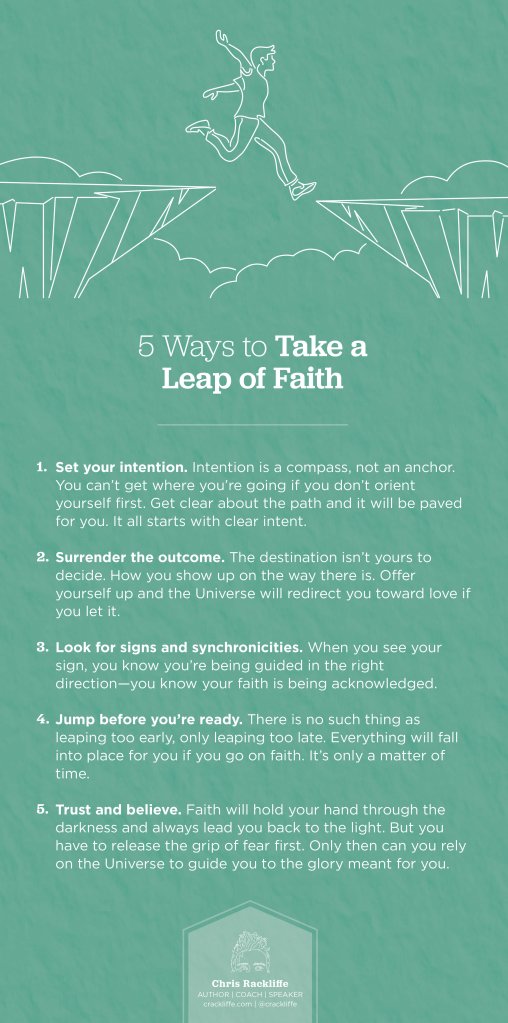
So how do you take a leap of faith? I came across this lovely infographic by Chris Rackliffe
Here are the 7 things that will likely happen when you take a leap of faith in yourself and throw yourself into the unknown. Because, hey, the sky is the limit and the world is your oyster!
1. You will discover who you truly are 2. You will learn to make yourself feel “whole”. 3. You will always feel excited and anew. 4. You will have no fear. 5. You will be more intuitive. 6. You will feel a complete sense of freedom. 7. You will achieve great things.
If you look at the world’s greatest leaders, they have always followed their passion and used their innate talents to become successful. Listen to your heart and follow that. It may take a few years to figure it out. It may take a decade to get to where you want to go as the straight way through might be too risky. However, you just have to start now. Don’t feel scared or feel that you’re inadequate. You can achieve what you believe you can. Most important of all, you need to have faith in yourself.
Upma used to be served everyday in a hostel of 100 inmates. Out of the 100 students, 80 complained and asked to be given different tiffin items every day. But 20 students were happy to eat upma every day.
In order to come to a decision, the warden arranged for voting. Whichever tiffin gets the majority will be served. The 20 students who wanted upma voted promptly. The remaining 80 students voted as per their choice:
Absolutely love this story on doing all you can while you are alive.
A rich Goan landlord once asked his parish priest : ‘Why does everybody call me stingy when everyone knows that when I die I will leave everything I have to this church?’
The priest answered: ‘There once was a pig and a cow in this village. The pig was unpopular and the cow was loved by all in the village. This puzzled the pig.
The pig said to the cow: ‘People speak warmly of your good nature and your helpful attitude. They think you are very generous because each day you give them milk, butter and cheese. But what about me ? I give them everything I have. I give them the famous Goa sausages, bacon and ham. I also provide ingredients for mouth-watering sorpotel. Yet no one likes me. Why is that?’
The priest continued: ‘Do you know what the cow answered ? The Cow said: Perhaps it’s because I give while I am still living’!!!
Once upon a time, what happened did happen…..or you wouldn’t be hearing this story!! A merchant on a casual jaunt through a market, came across a fine specimen of a camel for sale. The merchant and the camel seller, both skilled negotiators, struck a hard bargain. The camel seller pleased with his skill of worming out what he felt was a very good price, parted with his camel and the merchant chuffed that he had struck a fantastic bargain, proudly walked home with the latest addition to his large livestock.
On arriving home, the merchant called to his servant to come and help him take out the camel’s saddle. The unwieldy heavily padded saddle being too difficult for the servant to manage on his own. Hidden under the saddle, the servant found a small velvet pouch which on opening he discovered to be filled with precious jewels!!
The servant was overexcited!!! “Master you bought a camel…..but see what came FREE along with it!!!”
The merchant was astonished as he looked at the jewels in his servants’ palm. They were of extraordinary quality sparkling and twinkling in the sunlight. “I bought the camel” he said, “not the jewels. I must return them to the camel seller immediately.”
The servant was aghast…..his master was really foolish. “Master…..no one will know.”
But the merchant headed right back to the market and handed over the velvet pouch back to the camel seller. The camel seller was very happy, ” I had forgotten that I hid these jewels in the saddle for safe keeping.” “Here, choose one of the jewels for yourself, as a reward.” The merchant said “I paid a fair price for the camel and the camel only, so NO thank you, I do not need any reward.”
But as much as the merchant refused, the camel seller insisted.
Finally the merchant said, sheepishly smiling, ” Actually when I decided to bring the pouch back to you, I already took two of the most precious jewels and kept them for myself.”
At this confession the camel seller was a bit flabbergasted and quickly emptied the pouch to count the jewels. However he was very confused. “All my jewels are here. What jewels did you keep?
“The two most precious” said the merchant.
” My INTEGRITY and my SELF-RESPECT “
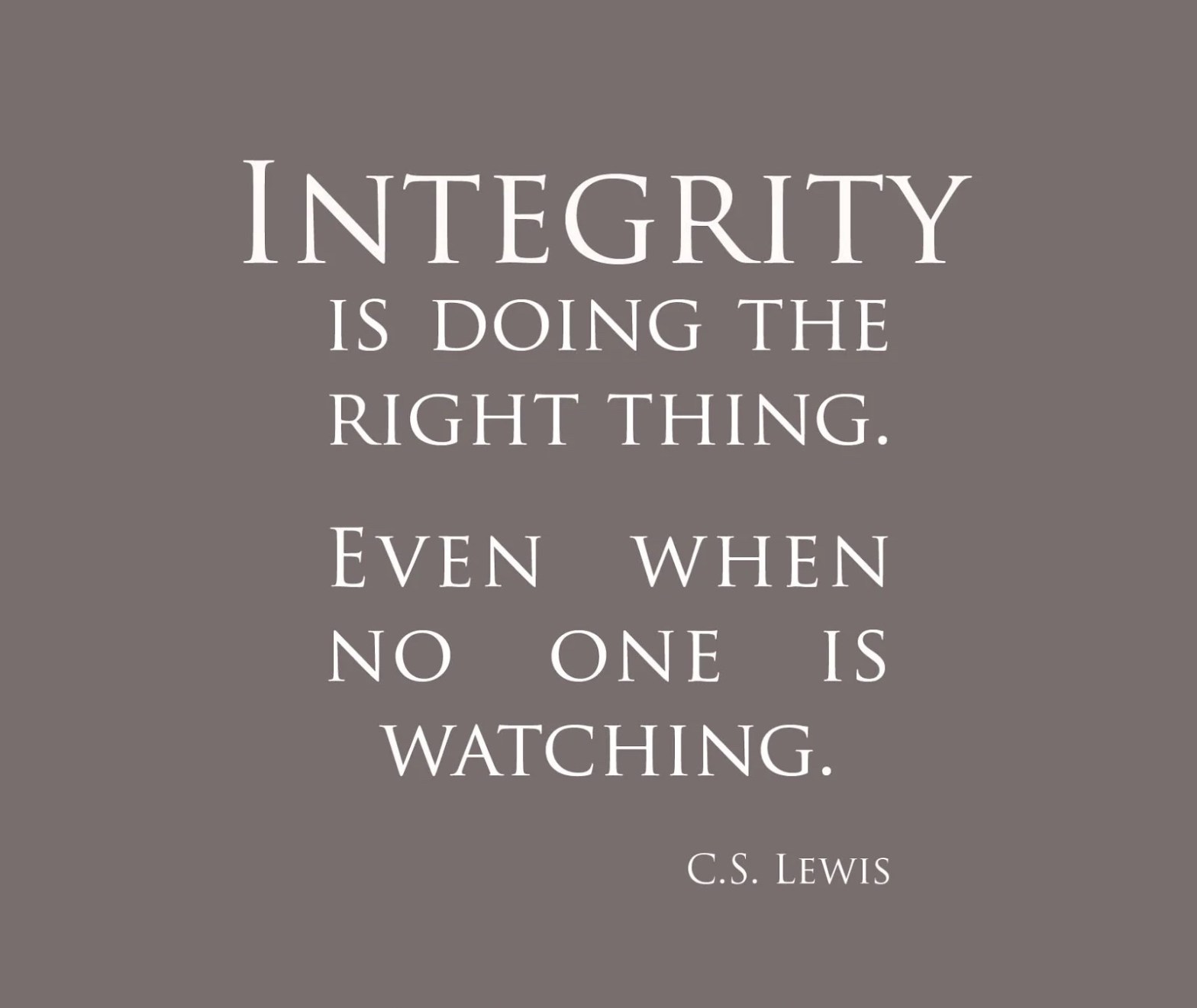
Integrity is the ability to do the right thing or choosing to do the right thing when you could get away with doing the wrong thing.
When I saw this quote, the following story immediately came to mind. On March 10, 1748, John Newton, a 22-year-old English seaman who had worked in the slave trade, was traveling home on a merchant ship after a series of misadventures, including being captured and enslaved in Sierra Leone. On that day, a violent storm struck just off the coast of Donegal, Ireland. Rocks ripped a hole in the side of the ship, and it seemed unlikely that the vessel would make it safely to shore. Newton prayed and committed to devote his life to Christianity if the ship was spared. At that moment—the story goes—the ship’s cargo shifted, covering the hole and allowing the ship to limp to port.
Newton kept his promise, eventually becoming an Anglican priest. Most famous perhaps for composing the hymn “Amazing Grace,” the former slave trader dedicated himself to ending the slave trade. In 1787, he joined efforts with others to found the Society for Effecting the Abolition of the Slave Trade. Their members included Olaudah Equiano, a former slave whose storytelling abilities and autobiography made the horrors of slavery real. Josiah Wedgwood, an industrialist, created a logo for the campaign that inspired empathy and connected with the horrifying inhumanity of slavery. The emblem pictured an enslaved man on his knees, in chains, encircled by the words “Am I not a man and a brother?” It appeared on snuffboxes, cufflinks, and jewelry throughout Europe. Newton himself wrote a pamphlet titled Thoughts Upon the African Slave Trade, which detailed conditions on slave ships, and which he sent to every member of parliament.
Together they created what is often regarded as the world’s first infographic: a cutaway map of the Brookes slave ship, showing how slaves were stacked and chained. They posted these images in taverns and pubs throughout Europe. (See image below.)
Copies of this cutaway map of a slave ship, created in 1787, were posted in taverns across Europe. Regarded by some as the world’s first infographic, it made a powerful case against slavery. (Image courtesy of the British Library)
As part of their campaign, they launched a boycott of sugar, a product purchased mostly by women, who made most decisions about the foods and products their families consumed. The campaign reduced the demand for sugar by 30 percent, showing that the tie between economic dependence on slave labor and products in demand across Europe could be severed.
Their work eventually succeeded. In 1807, Parliament passed the Abolition of the Slave Trade Act, which banned British ships from engaging in the slave trade. Their efforts are widely regarded as one of the first social justice campaigns. What these men accomplished contains the hallmarks of any effective campaign and conveys lessons we can apply today.
So what does make people care?
The questions which come to mind: Why should I care about you? Why should I care about your problems, your challenges, whether or not your day is going well, your child is sick, or your job is stressful? I don’t even know you and may never even meet you. Why do you, a stranger, matter to someone who will never know your name?
In simple words: Because it’s the right thing to do.
Each of us expresses this care in different ways, some in anger, some in tears, some in debates and discussions. But the way I love best is by actions. Deeds not words, Facta non Verba (my school motto!), walking the talk. There are soooo many needs and there are many ways to show you care. There are children going hungry all around the world. There are seniors unable to pay their bills. There are animals being abused, retired military men and women left alone after their service to the country, people in every neighborhood struggling with mental illness, drug abuse, and worse.
We need each other. We have to come together, to give of ourselves and to offer an outstretched hand. It isn’t easy work and sometimes we can get overwhelmed by all the need. But, in those moments, maybe we can retreat for a day or so and nurse ourselves a bit until we feel strong enough, and then get back out there.
Why should I care about you? Because we’re all in this together.
On 6th May 2021, as I was recovering from covid, I had decided to get back to writing and sharing with the world a little of what goes on in my head every day. Today I complete a year of sharing an article a day (sometimes even 2 articles a day!). The journey hasn’t been easy, but I absolutely loved putting this all together and more importantly for the lovely feedback I kept getting right through the year!
I shall still keep writing, not as frequently as I have been doing, but yes, will keep it going for sure! :)
Unfortunately, we humans have not been very good stewards of the Earth over the years. To protect the environment and preserve the planet for our children and future generations, we all need to take proactive steps toward cleaner living habits.
Whether it’s gas, food, clothing, cars, furniture, water, toys, electronics, knick-knacks or other goods, we are all consumers. The key is not to stop consuming, but to start being mindful of our consumption habits and how each purchase or action affects the ecosystem.
The good news is that it’s often not too difficult, expensive, or inconvenient to become more environmentally friendly. It can even be a fun challenge to implement among your family or coworkers. And though small changes at the individual level may seem trivial, just think how much cleaner the planet would be if everyone adopted even a few of the following behavior modifications.
Here are 8 ways you can start to protect the environment today:
1. Consume less.
Curbing consumption can have a huge impact on the environment. The three “R’s”—reduce, reuse and recycle— get a lot of attention, but the planet could benefit from some focus on the most important and most underrepresented “R”: refuse.
When you refuse, you say “no,” which is not always easy. Freebies at events, cheap goods on clearance, the hot new children’s toys or the latest gadgets that promise to make your life better—none of these are essential. And they almost always end up either in the trash or forgotten in the back of a closet. Next time you’re tempted to purchase or accept a non-essential item, think about whether it would truly improve your life. If not, it’s ok to just say, “No, thanks!”
2. Compost.
Another “R” that doesn’t get much attention but has important environmental implications is “rot.” As in, let your food and yard waste rot naturally in the soil instead of sending it to the landfill. In other words: compost.
Composting your food scraps and yard waste offers double rewards: it keeps an incredible amount of trash out of the waste stream, and it produces free, rich soil to use in your garden. Some cities now pick up organic waste alongside regular trash and recycling pick up. If your area doesn’t offer this service, no worries— you can set up a low-maintenance compost pile in your backyard.
3. Choose reusable over single-use
Think about how many people you see each day drinking beverages from disposable cups or disposable bottles, sipping from disposable straws, carrying disposable grocery bags, eating from disposable plates or containers and using disposable utensils. All that single-use plastic has to go somewhere, and it’s had a devastating effect on our soil, oceans and marine life.
All of the above items (and more) have more environmentally responsible counterparts. Switch to reusable items and make a commitment to use them as often as possible. You’ll have less trash piling up at your curb, and you’ll be helping to protect the environment in a major way.
4. Upcycle more.
Get creative with your useless or unwanted items by upcycling—basically, turning trash into treasure. Creating something new such as artwork, toys or jewelry is both satisfying and one of the best ways to protect the environment. Not only does it keep items out of the trash, it can prevent having to purchase new items, which require lots of resources to produce. Children love making things; so instead of heading to the craft store, check out your recycle bin first and let their imaginations soar!
5. Recycle properly.
If you can’t refuse it…and you can’t rot it…and you can’t reduce it…and you can’t upcycle or reuse it…then it’s time to turn to the final “R”—recycling. Educate yourself on what can and cannot be recycled in your bins at home. Throwing the wrong items in the recycle bin can result in an entire load being rejected, which means … back to the landfill.
You can also easily find out how to recycle special items such as electronics, batteries and appliances. Check with your local municipality for drop-off sites, and make an effort to get your items to the proper disposal sites.
6. Buy local.
With regards to shopping, it’s important to think about the path your stuff takes just to get to you. All that packaging, combined with the fuel needed for delivery, really takes a toll on the environment. Instead, check out your local farmers market for fresh, package-free food; try eating at a farm-to-table restaurant; and buy from local artists, clothing makers, and retailers before you click for that two-day shipping.
7. Use fewer chemicals.
Want to protect the environment? Use fewer harmful chemicals and you’ll be on the right track. It’s hard to be sure about the long-term negative effects chemicals can have, both on our bodies and on the planet, so it’s best to avoid them if possible. Opt for chemical-free lawn and garden care; all-natural beauty and hygiene items; natural household cleaners; and organic food. The Earth will thank you!
8. Use less water.
Conserving water at home is one of the easiest ways to protect the environment. Think of all the times you consume water, both inside and outside your home; then, make adjustments as you can. For example:
Turn off the tap while you brush your teeth.
Fix leaky faucets.
Make your water use more efficient by aerating faucets, using sprinklers that reduce runoff and installing low-flow toilets and efficient shower heads.
Collect and use rainwater for watering plants.
Shorten your shower by a few minutes.
Only run your dishwasher or washing machine when it’s full
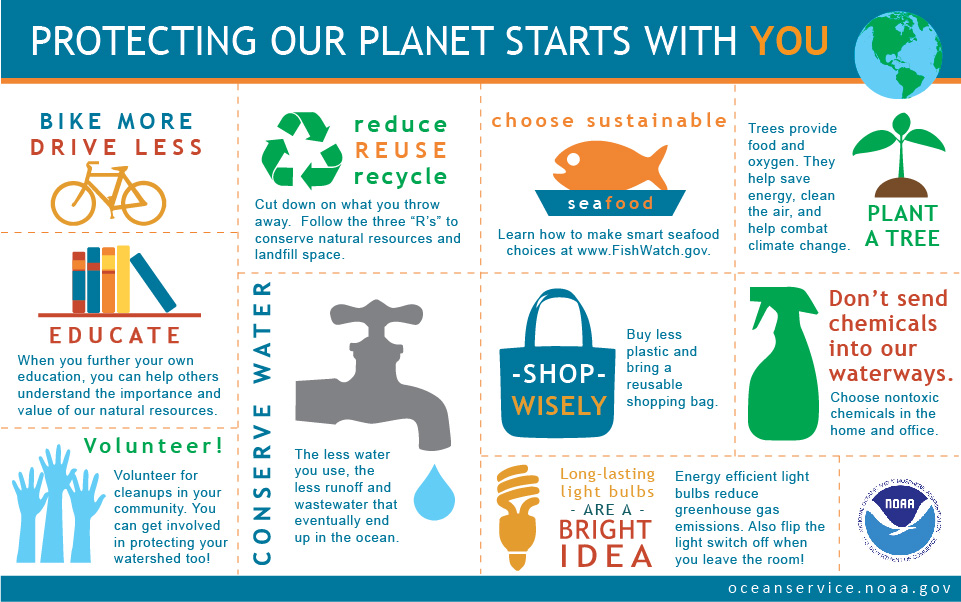
I came across this lovely infographic from oceanservice.noaa.gov
Protecting our planet starts with you. Here are just a few of the things you can do.
Do you catch yourself spending a lot of time focusing on your future, meticulously planning it to the last detail and sacrificing the present moment for some illusory sense of happiness. Often we are too busy thinking of the future, seeing what we will do after we get that dream job, plan our dream vacation. Under the pretext of chasing our dreams, we destroy ourselves by neglecting our mental and physical needs and striving for happiness as a reward for our hard work. We fail to realise that by focusing too much on the future, we completely miss the beautiful present moment which is all we’ll ever have.
Most of us have a blueprint of the perfect life we want to lead and then we live life like a zombie trying to complete all the tasks on our to-do lists and belittling ourselves when we fail to reach the impossible standards we’ve set for ourselves. While making a plan of where we want to go is definitely a good idea, it is okay to steer off course a bit sometimes and simply follow the whims of our hearts. In fact, instead of planning every moment, it is more beneficial to simply throw yourself into things and go with the flow. Instead of wasting time sketching out the future and procrastinating, it is better to start doing things even if you don’t have the end in mind.
It is a lot like writing a novel. Instead of trying to work out the ending and fates of every character from the beginning itself, it is okay to start with a rough sketch and then experiment and let intuition guide you.
If you want to be successful, then you must appreciate the importance of living in the present. Always remember, the best preparation for tomorrow, is doing your best today. Here are some tips to motivate you to make the most of the present.
1. Be Grateful For The Little Things: Start a gratitude journal or take time out to appreciate the things going well in your life, or the things you take for granted. Find the good in every situation and look for miracles in the mundane.
2. Train Yourself To Do One Thing At A Time: Don’t work on too many projects no matter how big your ambitions are. Finish one task at a time. Take it one day at a time, and soon you’ll be surprised at how much you’ve managed to accomplish.
3. Ask Yourself Questions To Be In The Present: Remind yourself of where you are by asking yourself, ‘Is this what I should be doing right now?’, ‘Am I feeling happy doing this thing?’, ‘What is the one thing I can do to make today count?’ Become self-aware and listen to your feelings.
4. Schedule Some ‘Me Time’ And Make The Most Of It: Make some time out of your busy schedule to indulge in a creative hobby, enjoy the beauty of nature or whatever it is that you do to chill. Not only will it help you relax, it will also aid you in focusing better at your tasks.
In other words, instead of waiting to get started, START NOW. If we really want to be prepared for tomorrow, we need to give our best effort today rather than only worrying about the uncertain tomorrow.
Have you ever worked alongside someone who was a drainer of your energy? You know the sort – the people who are constantly negative, focused on what could go wrong and spend most of the day gossiping about other people… even if they don’t know them.
Unfortunately, some teams seem to be filled with these people where the culture has become infested with a dark, heavy energy that drains the fun and joy away and negatively impacts productivity, creativity and results. Even more disturbing is how contagious a negative energy can be… spreading like wildfire through a team and even the entire organisation.
So the real question here is – are you an energy giver or taker?
Every day you get to choose who you are when you turn up at work. You get to choose if you are seen to bring lightness, joy and possibility to the team or if you bring with you a heavy cloud filled with negativity and doom. It’s you choice. You decide.
And the higher up you go and the more people you lead or influence on a daily basis, the more important it is to manage your energy and attitude.
So here are 5 simple questions to ask yourself to assess the energy you bring to the team.
1. Is your glass half full? Do you generally move past the drama of a situation and see the opportunities that present even when it seems like everything is going against you? Do you instinctively look for the positives and learning from a situation rather than dwell on what went wrong and looking to “blame” and explain.
2. Are you a problem solver? Organisations are hungry for problem solvers! Many teams become paralysed by a tendency to “admire” their problems rather than getting into action and creative solution mode. You will become enormously valuable to any team if you become the go-to girl for finding and implementing innovative solutions that work.
3. Do people respond positively when your name pops up on caller ID? This is an interesting concept to think about. Do people grimace, hit the reject button or answer the phone with a sinking feeling of dread…. Or do they run to answer the call, no matter what, with a bright and breezy hello? Be honest. Which is it? Which do you want it to be?
4. Is your bubble one of lightness and joy? Imagine for a moment that you have a bubble of energy surrounding you.
How would other people describe the energy in your bubble? Would it be light, playful, caring, possibility focused, interested, curious, courageous, loving or bold? Or would it be heavy, dark, aggressive, angry, bored, indifferent, flat or unkind.
I believe that we all carry with us a bubble or an aura that rubs up against and leaves an impression or even impacts everyone we meet. Make sure yours is what you want it to be.
5. Do you smile a lot? I know that this might sound strange … but do you smile a lot while at work? If you are not in a place where you can smile a lot… then you are probably in the wrong place. Further more, you are quite possibly an energy taker and you are probably not the person that everyone wants on the team. Harsh … but true!
If you ever feel overwhelmed by your surroundings and busy schedule and need a way of re-charging your battery to continue with your day, there are many ways of incorporating energy givers into your routine. On the other hand, there are also multiple energy takers people unconsciously experience in their daily lives without realizing the effect. If people work to notice these energy takers, then people have the power to eliminate them from their lives.
Below is a list of energy givers and takers to note:
Energy Givers
Giving compliments to people
Outdoor time for at least 30 minutes a day
Exercise
Watching your favourite TV show
Drinking tea (or coffee)
Petting animals (if allergies permit!)
Music
Spas, Face masks
Wearing an outfit that makes you feel confident
Waking up early for sunrise or late for sunset
Eating your guilty-pleasure snack
Turning the lights off and watching a movie
Walks for fresh air
Grabbing a coffee at a café even if you own a coffee maker
Writing a card for someone
Dancing
Listening to an old song
Hugs
Fuzzy blankets
Picking out your outfit the night before
Complimenting yourself in the mirror once a day
Taking care of plants
Eating a home-cooked meal
Energy Takers
Spending time with people who put you down
Spending too much time on social media
Excessive screen time
Comparing yourself to others
Speaking negatively on repeat
Not eating enough food or drinking enough water
Neglecting self-care
Not sleeping enough
Oversleeping
Sitting in one spot for too long
Not changing scenery/environment
Trying to please everyone
Overworking yourself
Wearing uncomfortable clothes
Not seeing enough sunlight
Not setting a routine
Not setting aside me-time
Eating unhealthy study snacks only or too many sugary energy drinks
Rushing to get ready instead of giving yourself time
Now that you have a list of general energy givers versus takers, feel free to combine your favourite ones into a list of your own. Experiment with new activities that you learn from slowly adopting the above energy givers. As for energy takers, be mindful that not everyone feels drained from the same negative stimuli (the same goes for positive), so feel free to make a list that better pertains to your needs and reflects the activities that bring down your mood.
We were all children at some point in our lives and that kid didn’t just up and leave the moment you became the responsible adult you are today. They’re still a part of you and we should learn to embrace them. Why? We shall see in a bit.
But first let us quickly see the definition of “Inner Child”
Too many adults have lost their childlike spirit. If you can harness and embrace your inner child, you will likely be a happier, more satisfied adult.
Reason 1 — To Imagine & Create
With the limitations of an archaic educational system born from the industrial revolution, global economic disruption, rising wealth and social equality in emerging markets and the technological advances of today, an ability to be creative and imaginative is critical, if you are to take advantage of the opportunities that are all around you.
Children possess a natural instinct to be creative, but this incredibly valuable ability is suppressed during adulting, as we seek to “conform” to a more “mature” state of being.
An ability to rethink and relearn what we have already learnt is key.
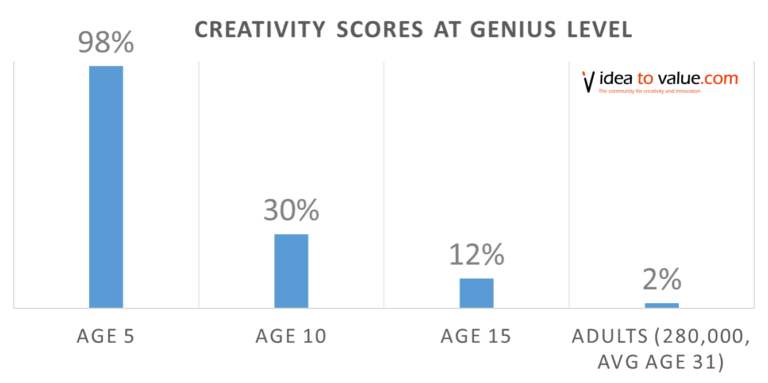
In 1968, George Land conducted a study to test the creativity of 1,600 children (three-to-five years old) who were enrolled in a Head Start program. This was based on the same creativity test he’d designed for NASA to help select innovative engineers and scientists.
He re-tested the same children at 10 years of age, and again at 15 years of age. These were the results.
Land concluded, “it is not that children lose the ability to be creative, but that it is taught out of them”.
How To Get Creativity Back:
1 — Reject the fallacy that you are “either born with creativity or you are not”. All humans are born with creativity, you just haven’t practiced it in a while, so start by believing that you can.
All great things start with a belief that it can be done. A child falls over 100 times before it walks, and never once does it say to itself that it can’t.
2 —Follow Your Curiosities — James Webb Young defines ideas as merely the ability for one to be able to take on information and find relationships between many separate parts. Use a journal, planner or notes on your phone to capture the information you discover each day. You can’t see it now perhaps, but everything you’re witnessing, hearing and experiencing will lead towards an idea or an ‘Aha moment!’ — write it all down.
You can’t connect the dots looking forward; you can only connect them looking backwards. So you have to trust that the dots will somehow connect in your future. This approach has never let me down, and it has made all the difference in my life
Steve Jobs
3 — Time & Space — The reason we’re conditioned to suppress our creativity is due to two types of thinking: divergent (imagination and new ideas) and convergent (judgements and criticising).
They are totally opposed to each other. George Land refers to one being an accelerator (divergent) and one being a brake (convergent).
Make time and find a safe place where you can free yourself of judgement and criticism to allow your mind to wander. Just like how a gym is used to build your fitness and muscles, you need to allocate time and energy to train the brain.
Reason 2 —To Learn New Things
As children, the human brain is very plastic and malleable to new information. Therefore, their ability to learn is greatly enhanced in relation to an adult brain.
As neuroscientist Takao Hensch from Harvard University observes, this is for evolutionary reasons. If the brain is constantly being rewired due to new experiences, it will fail at being the super-processing computer that it is.
Studies show that by our mid-20’s our brains begin to set like plaster but there are ways to recover neuroplasticity and maintain our ability to learn new things.
How To Get Brain Plasticity Back:
Senior Lecturer at MIT and neuroscientist, Tara Swart, recommends constantly stimulating your brain or setting yourself “energy intensive” challenges.
“[Look for challenges that require] conscious decision making, complex problem solving, memorising complex concepts, planning, strategising, self-reflection, exercising self-control and willpower.”
Swart goes on to highlight that repetition and practice are essential components for new neuropathways to be created, “Depending on the complexity of the activity, [experiments have required] 144 days or even three months for a new brain map, equal in complexity to an old one, to be created in the motor cortex.”
1 — Commit to an 8 month plan, not just 30 days. Studies show that it takes, on average, 66 days to form a new habit, but depending on the individual it can take anywhere from 18 to 245 days. Define the why you’re doing something (not the what) and write down the benefits of the outcome clearly before starting — this will become your motivation.
2 — Start simple Something important to you is definitely worth working on but make it practical and feasible. Allocate 30 minutes every day or every other day to work on it (set reminders!).
It’s taken you at least 25 years to get to this point, you won’t change in one week. Keep it simple and repeatable.
3 — Form a Trigger or Get an Accountability Buddy or Both! Remember, repetition and practice are essential. Creating triggers will help remind you to make the time and energy towards the change you want. Put up a daily action list on your fridge, your wardrobe, your phone wallpaper. We are what we repeatedly do!
Research shows that you’re also 70% more likely to complete a goal when you write a weekly update to a friend or associate about how you’re progressing. Ask a friend, family member or a likeminded soul you’ve met on Twitter or Reddit to help out.
Reason 3 — To Discover New Gifts, Passions & Potential
Children have an incredible gift to be curious and follow their wonder of the world around whatever grabs their interest.
Adults conversely like to understand a logic or reasoning before allowing their mind to wander. Our desire to understand before we attempt, comes from a place of fear more than they come from a place of amazement.
Wonder is the beginning of wisdom.
Socrates
How To Get Your Sense of Wonder Back:
1 — Surround yourself with the amazing things people have achieved and consider why.
Why did they start? Why did they create the things they’ve created? Why project their curiosity as a piece of art, a book, a study, a school of thought.
People have done some extraordinary things and we live in an extraordinarily diverse society — embrace it!
2 — Travel: Go To New Places It’s a cliche, I know, but new sounds, smells, language, tastes, sensations, and sights spark different synapses in the brain.
Foreign experiences increase both cognitive flexibility and depth and integrativeness of thought, the ability to make deep connections between disparate forms.
Adam Galinsky, professor at Columbia Business School
Visit a place with a different culture, don’t just visit a different country.
3 — Follow your Interests & Speak With Likeminded People Sounds simple, but there are so many people who will get up tomorrow and continue doing the same things they’ve done for the last 5 years, that are mundane and boring to them. You may even know someone exactly like this.
It is, unfortunately, a common occurrence but it can be beaten. First, use the minds of others to help nurture your understanding and shape what actually interests you about the topic.
The feeling of being interested can act as a kind of neurological signal, directing us to fruitful areas of inquiry.
Learn to embrace your inner child and you will be a much more satisfied adult.
Living a life full of wonder, appreciation for the small things, humor, kindness, resilience, and big dreams is exactly what your inner child would want you to do.
It is not easy to manage your emotions and remain calm under pressure. Stress is a normal part of modern life, but if you’re often faced with stressful situations and feel panicked or overwhelmed trying to deal with them, you may benefit from learning some coping strategies that can help you to stay calm. Nowadays, simply tuning in to the daily news is likely to be stressful. Add on the stresses of daily life — such as handling work demands or adjusting to retirement, dealing with family issues, coping with illness, or caregiving — and you may begin to greet each day with apprehension and worry. In other words, you can become anxious.
Pressure can put the body into “fight or flight” mode – an evolutionary tactic that releases hormones designed to get you ready to either fight or run from danger. In modern times, stress triggers these hormones but they’re not so helpful when the “danger” comes from giving a presentation at work rather than being faced with a wild animal. If you frequently find yourself feeling anxious, or panicked, your fight or flight mode is probably being triggered too easily and it’s helpful to learn how to calm yourself down when you’re entering this state.
Under Stress, We Regress
Many psychologists believe that we regress, or return to, behaviors we used in childhood when faced with an emotional threat. As a child, I would run away and hide in my room or just sit sullenly if things weren’t going my way. Today, my stress reaction is to “shut down” and to shut people out. And of course, if you were a child who threw tantrums—or objects—when things didn’t go your way, you may be a “screamer” under stress at work.
If you can keep your head when all about you are losing theirs…
Rudyard Kipling
So how do successful people do it? How do they remain calm under pressure? How do they overcome the normal and natural reaction to regress, when under stress?
#1 They Take Care of Their Bodies I remember a Snickers commercials that claims “you aren’t you when you’re hungry”. Our environment is the biggest variable when it comes to behavior, and our body is the immediate environment of our minds.
Successful people are intentional about when and what they eat. Your new mantra: Food is fuel! There is probably nothing more controversial in the health and fitness world than what and when to eat. High protein diets, vegan diets, intermittent fasting, so many options!
Successful people are also intentional about their sleep. In his book, 15 Secrets Successful People Know About Time Management, Kevin Kruse interviewed 13 Olympic athletes and their number one secret was to get more sleep. Eight hours of sleep isn’t realistic for most of us, but instead of focusing on the quantity of sleep, you should focus on the quality of sleep (ie, maximizing time in deep sleep).
#2 They Exercise Numerous studies have shown that exercise reduces stress, anxiety and even depression. This is because exercise increases the amount of feel-good hormones like serotonin, and reduces cortisol which is the primary stress hormone. If you like to exercise as much as I do, you are probably groaning at this recommendation. Thankfully, you don’t need to become an overnight gym rat to control your stress. You just need to move in a way that gets your heartbeat way up for twenty minutes a day. A fast walk around the neighborhood, a yoga session, or after work a basketball game would all be great. I felt the difference when I started making it a point to go for my morning walk/jog regularly.
#3 They Train Their Minds Many of the most emotionally grounded people have strengthened their minds through meditation. If you’re unfamiliar with meditation, it is not about just sitting quietly or trying to channel some mystical energy of the universe. If you understand how lifting weights can make your muscles grow, meditation is the same thing—it literally grows your brain. One Harvard study showed that after eight weeks of meditation there was growth in the hippocampus (the area of the brain that regulates emotion) and a reduction in the brain cell volume in the amygdala, the part of the brain that is responsible for anxiety and stress. The great news is that, unlike a physical workout at the gym, doing a meditation mental workout only takes a few minutes, can be done anywhere, and doesn’t require a change of clothes.
#4 They Are Grounded in Gratitude Highly successful people have an attitude of gratitude. Negative emotion is easily washed away by positive feelings of gratitude. No matter how bad our situation is, if we pause, it’s usually very easy to see how much better off we are than others. Similar to meditation, having a solid gratitude practice literally changes our brains. Research done at the Mindfulness Awareness Research Center at UCLA shows that gratitude practices impact the brain at the neurochemical level, and acts as a catalyst for neurotransmitters like serotonin, dopamine, and nor-epinephrine–all of which have a major impact anxiety and stress response.
One way to adopt a gratitude practice is to simply spend five minutes a day writing in a “gratitude journal”. Personally, as part of my morning ritual, I think of three things that I can feel grateful for. It only takes a minute, I can do it while still in bed or in the shower or even driving to work. The key is you have to pick things that you can actually feel grateful for.
#5 They Reframe With a Growth Mindset When we feel overwhelmed with too much to do, or angry at someone’s incompetence, or frustrated because our flight was canceled, or disappointed when we failed to close the deal, it is very easy to think: why is this happening to me?
Highly successful people reframe negative experiences into growth experiences. Instead of, “Why is this happening to me” they think “Why is this happening for me?”
#6 Surround yourself with positive people You probably have a few people in your life who can make you feel stressed just by being around them. While it’s not always possible to cut these people out of your life entirely, when you’re under pressure try to spend more time with friends and family who are helpful, positive, and will lift you up rather than drag you down
Here is a lovely poem by Rudyard Kipling
If
If you can keep your head when all about you Are losing theirs and blaming it on you, If you can trust yourself when all men doubt you, But make allowance for their doubting too; If you can wait and not be tired by waiting, Or being lied about, don’t deal in lies, Or being hated, don’t give way to hating, And yet don’t look too good, nor talk too wise:
If you can dream—and not make dreams your master; If you can think—and not make thoughts your aim; If you can meet with Triumph and Disaster And treat those two impostors just the same; If you can bear to hear the truth you’ve spoken Twisted by knaves to make a trap for fools, Or watch the things you gave your life to, broken, And stoop and build ’em up with worn-out tools:
If you can make one heap of all your winnings And risk it on one turn of pitch-and-toss, And lose, and start again at your beginnings, And never breathe a word about your loss; If you can force your heart and nerve and sinew To serve your turn long after they are gone, And so hold on when there is nothing in you Except the Will which says to them: ‘Hold on!’
If you can talk with crowds and keep your virtue, Or walk with Kings—nor lose the common touch, If neither foes nor loving friends can hurt you, If all men count with you, but none too much; If you can fill the unforgiving minute With sixty seconds’ worth of distance run,
Yours is the Earth and everything that’s in it, And—which is more—you’ll be a Man, my son!







 Kenrick Vaz