
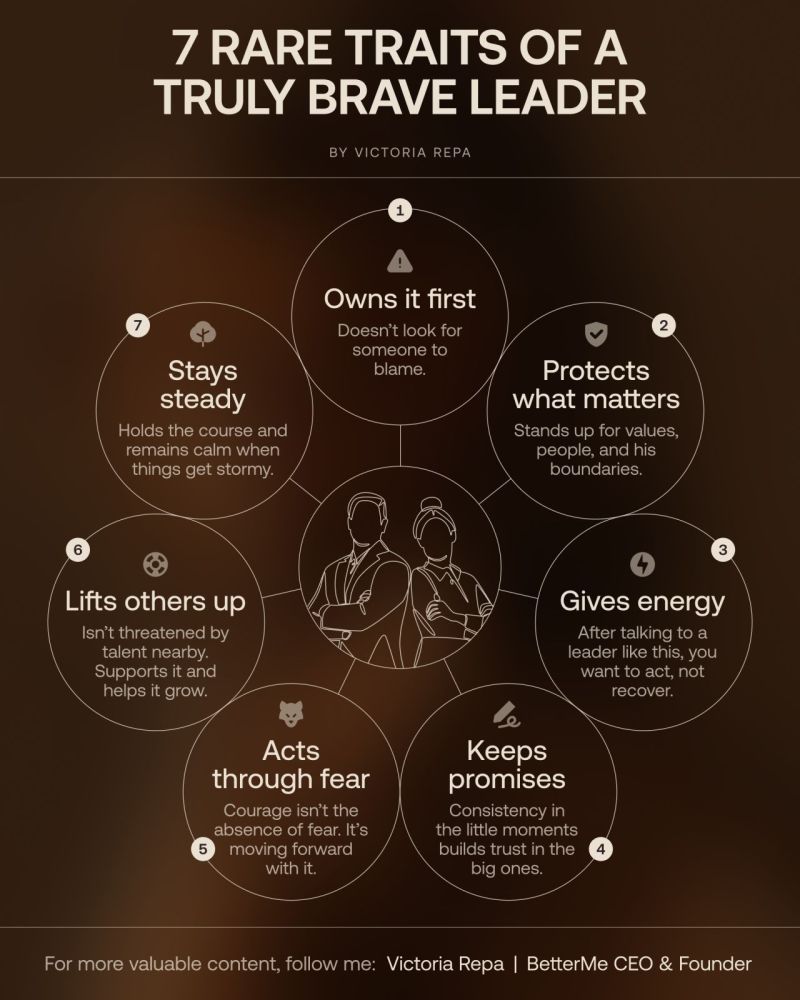
Credit to Victoria Repa . Follow her for more.
📌Which trait do you think most sets truly brave leaders apart?
Original post below:
—–
I spent years focusing only on results before I learned an important truth:
Brave leadership isn’t about being fearless.
It’s about taking ownership.
Protecting what matters.
Staying steady when it’s uncomfortable.
Courage isn’t seen in wins.
It’s seen in the choice you make every day.
In the small decisions.
Here are the traits of leaders people truly trust:
1/ Owns it first.
Doesn’t look for someone to blame.
2/ Protects what matters.
Stands up for values, people, and his boundaries.
3/ Gives energy.
After talking to a leader like this, you want to act, not recover.
4/ Keeps promises.
Consistency in the little moments builds trust in the big ones.
5/ Acts through fear.
Courage isn’t the absence of fear. It’s moving forward with it.
6/ Lifts others up.
Isn’t threatened by talent nearby. Supports it and helps it grow.
7/ Stays steady.
Holds the course and remains calm when things get stormy.
The real test of leadership is what you do
when it would be easier to avoid, delay, or shift responsibility.
That’s where brave leadership is built.
One decision at a time.
Most leaders want trust.
Brave leaders earn it.
Because when people see integrity and steadiness,
they don’t just follow you.
They rely on you.
Don’t Dim to Fit
There’s a strange kind of pressure a lot of us grow up with.
Not the loud, obvious kind. Not the pressure to perform, win, or achieve. I’m talking about the quieter pressure. The one that tells you to soften your opinions, lower your expectations, hide your emotions, and become easier to handle.
Be less intense.
Be less sensitive.
Need less.
Expect less.
Take up less space.
And if you do that long enough, something subtle starts to happen.
You become more acceptable to others… but less familiar to yourself.
That’s the part no one talks about enough.
A lot of people are afraid of being “too much.” Too emotional. Too passionate. Too expressive. Too ambitious. Too honest. Too needy. Too loving. Too deep.
But what if the real danger isn’t being too much?
What if the real danger is slowly editing yourself down until you barely recognize the person in the mirror?
That kind of shrinking doesn’t happen overnight. It happens in tiny negotiations with yourself.
You don’t say what bothered you because you don’t want to seem difficult.
You pretend you’re okay with crumbs because asking for consistency feels “high maintenance.”
You laugh off things that hurt because you don’t want to look dramatic.
You keep making yourself more understandable to people who have made no effort to understand you.
And somewhere along the way, you start mistaking self-abandonment for maturity.
You call it being patient. Easygoing. Flexible. Chill.
But sometimes it’s not peace. Sometimes it’s just quiet resentment dressed up as emotional intelligence.
There’s a huge difference between being adaptable and being invisible.
Healthy relationships—whether it’s friendship, family, love, or even work—do require compromise. Of course they do. Not every preference needs to become a principle. Not every moment needs to become a confrontation.
But compromise should never cost you your core.
You should not have to betray your values to keep someone comfortable.
You should not have to mute your voice to be considered “safe” to love.
You should not have to lower your standards because someone else refuses to rise.
And you definitely should not have to apologize for having needs.
That last one is important.
Some people have a very limited emotional range. Limited capacity. Limited accountability. Limited willingness to communicate. Limited ability to show up consistently.
That doesn’t automatically make them bad people.
But it does make them the wrong people to use as a measuring stick for your needs.
If someone can only offer confusion, inconsistency, avoidance, or bare minimum effort, the answer is not to convince yourself you suddenly need less.
The answer is to tell yourself the truth: their capacity is low, and your needs are valid.
That truth can be uncomfortable because many of us have been conditioned to believe that having needs makes us difficult. That asking for clarity makes us demanding. That wanting reciprocity makes us entitled.
It doesn’t.
It makes you human.
You are allowed to want communication.
You are allowed to want consistency.
You are allowed to want honesty.
You are allowed to want effort that doesn’t feel forced.
You are allowed to want relationships where you don’t have to decode everything.
And yes, you are allowed to walk away from places where you are constantly asked to make yourself smaller just to keep things going.
One of the hardest lessons in life is realizing that not everyone has the capacity to meet you where you are. And an even harder lesson is realizing that it’s not your job to become less so they can feel like enough.
Read that again.
It is not your job to become less so someone else can avoid growing.
That applies everywhere.
In your personal life, it means not settling for emotional half-presence while pretending it’s love.
In friendships, it means not always being the one who reaches out, understands, forgives, and adjusts while the other person coasts on your generosity.
At work, it means not constantly downplaying your ideas, instincts, or standards because other people are intimidated by excellence, clarity, or conviction.
Being “too much” is often just what low-capacity environments call people who know who they are.
Sometimes “too sensitive” means emotionally aware.
Sometimes “too intense” means deeply invested.
Sometimes “too demanding” means you’ve stopped accepting the bare minimum.
Sometimes “too much” simply means you’ve outgrown spaces that only knew how to value the smaller version of you.
That doesn’t mean every feeling is right, or every expectation is reasonable. Self-awareness still matters. Growth still matters. Reflection still matters.
But shrinking should not be your default survival strategy.
You can be self-aware without self-erasing.
You can be kind without becoming convenient.
You can be loving without becoming endlessly accommodating.
You can be patient without becoming passive.
You can be understanding without abandoning your own understanding of what you deserve.
And maybe that’s the real work—not becoming louder for the sake of being noticed, but becoming more loyal to yourself.
Because once you stop betraying yourself to keep the peace, a lot becomes clear.
You notice who only liked you when you were easy to manage.
You notice who benefited from your silence.
You notice who called your boundaries “attitude” because they were used to unlimited access.
You notice who disappears when you stop overfunctioning.
And while that can feel lonely at first, it’s also freeing.
Because the people who are truly meant for you won’t require a reduced version of you.
They won’t need you to be smaller to stay connected.
They won’t punish honesty.
They won’t weaponize your needs.
They won’t make your fullness feel like a flaw.
The right people may not agree with you all the time. They may not mirror you perfectly. They may even challenge you in healthy ways.
But they won’t make you feel like your authenticity is a burden.
That’s how you know the difference.
So if you’ve been carrying the fear of being “too much,” maybe it’s time to reframe it.
Maybe your depth isn’t the problem.
Maybe your standards aren’t the problem.
Maybe your honesty, tenderness, ambition, intensity, or emotional fluency aren’t the problem.
Maybe the real problem is how often you’ve tried to fit all of that into places too small to hold it.
Stop measuring yourself against people who only know how to receive fragments.
Stop turning your needs into negotiable items just because someone else lacks the capacity to meet them.
Stop calling self-erasure maturity.
You do not need to become less real, less expressive, less honest, less loving, less alive to be easier for other people.
You just need to stop auditioning for spaces that require you to disappear.
Because there is a cost to shrinking.
And eventually, the cost becomes your own reflection.
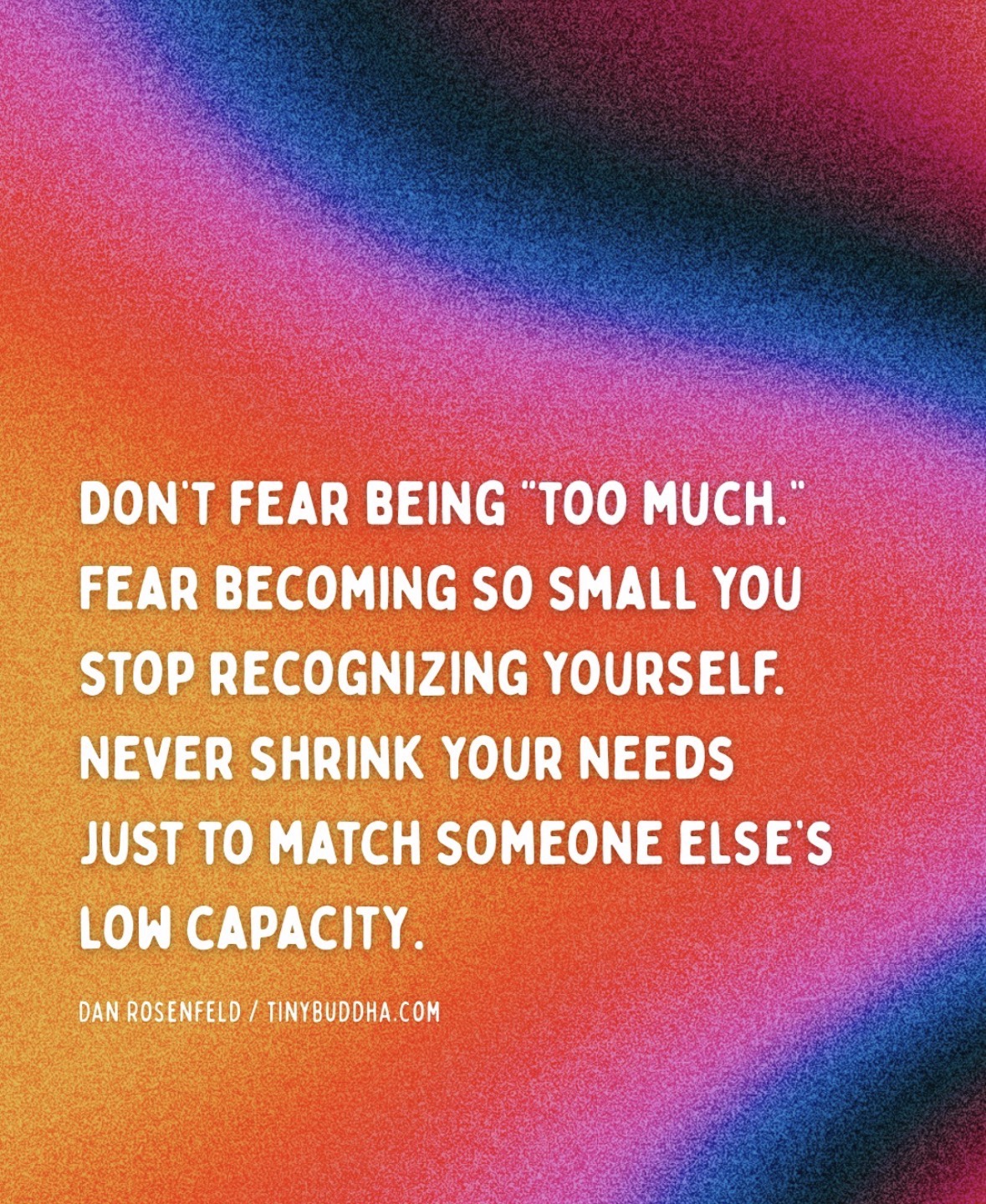
So no—don’t fear being “too much.”
Fear the day you become so edited, so muted, so manageable, that the truest parts of you no longer feel at home inside your own life.
And then choose differently.
Choose the hard honesty of being fully yourself over the temporary comfort of being easily accepted.
Choose standards over scraps.
Choose wholeness over approval.
Choose to stay recognizable to yourself.
What Leadership is

The best leaders rarely announce themselves.
You notice them in the way people speak up.
In how teams stay calm under pressure.
In how growth happens without fear.
Because real leadership isn’t loud.
It’s 𝗾𝘂𝗶𝗲𝘁.
And it’s intentional.
🧭 5 Quiet Habits That Reveal a Truly Great Leader:
1/ Listening comes first
↳ Not listening to reply
✅ Listening to understand
2/ Safety beats authority
↳ People don’t speak up because they have to
✅ They do it because they feel safe
3/ Trust replaces control
↳ You hire experts and let them lead
✅ Not hover over every decision
4/ Pressure is filtered, not passed down
↳ You shield your team from unnecessary chaos
✅ So they can focus on meaningful work
5/ Leaders create leaders
↳ You’re not threatened by smart people
✅ You multiply them
🧨 The Hard Truth:
Anyone can manage tasks.
Very few know how to lead humans.
Because quiet leadership takes patience.
Humility.
Consistency.
No applause.
No spotlight.
Just daily choices that compound.
And that’s why the strongest leaders
are often the hardest to spot.
❓Which quiet habit do you think most leaders overlook?
Where You’re Truly Irreplaceable
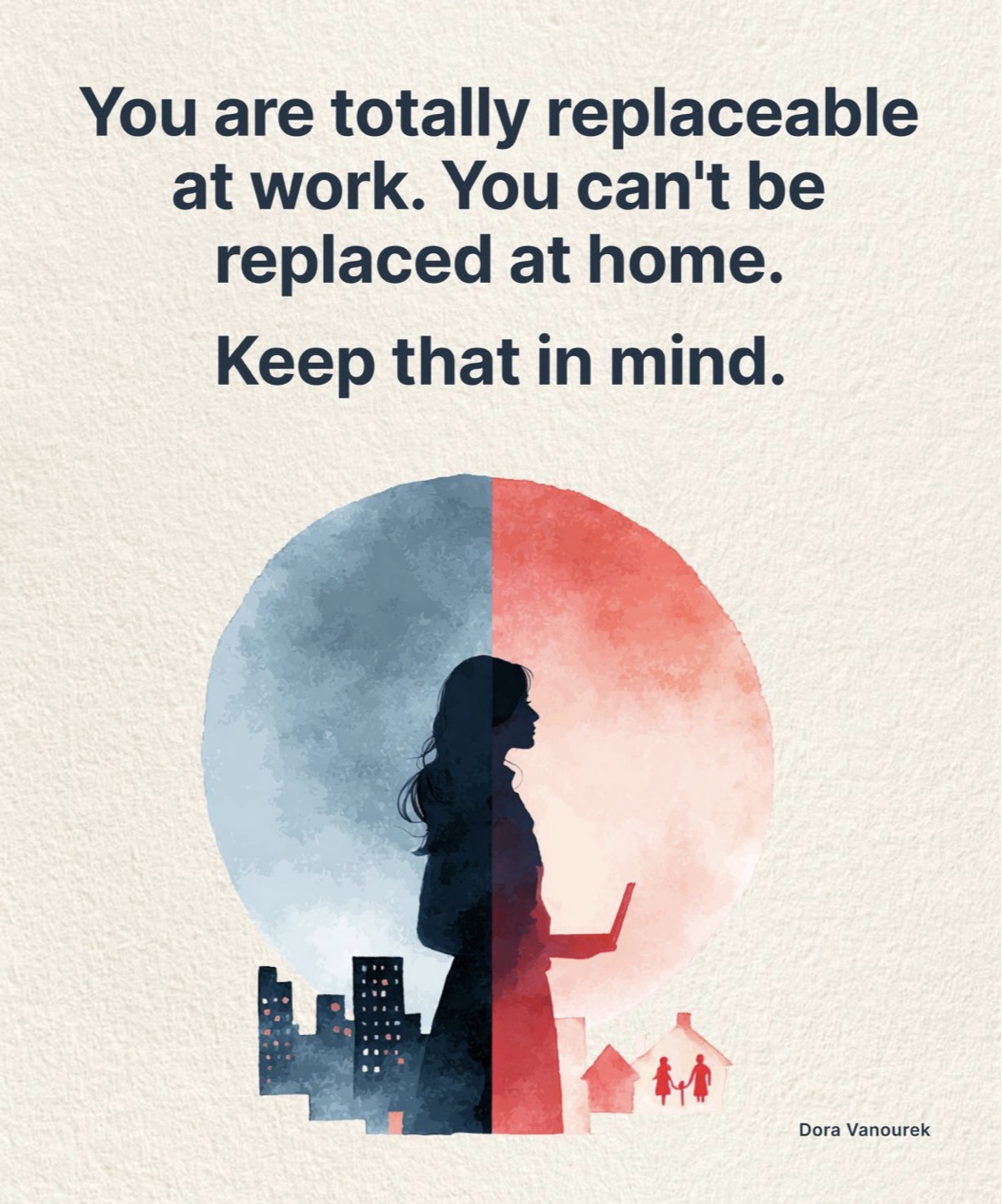
It’s a hard truth, but a healthy one: you are absolutely replaceable at work.
No matter how talented you are, how many late nights you put in, how many fires you put out, or how often people say, “We couldn’t do this without you,” the reality is… they eventually will. Companies move on. Roles get backfilled. Priorities shift. Org charts change. New leaders come in. Old strategies disappear. The machine keeps running.
That’s not meant to sound cynical. It’s just how work works.
But home? Home is different.
At home, your role is not listed in a job description. There’s no replacement hire for the way your child lights up when you walk through the door. No substitute for the comfort your spouse feels just because you’re there. No backup resource for the conversations, hugs, routines, inside jokes, bedtime stories, prayers, laughter, and even your quiet presence on the hard days.
You may be one of many at work.
But at home, you are someone’s whole world.
That perspective matters more than most of us admit.
A lot of us live like work is the main stage and home is what happens in the background. We tell ourselves we’re doing it for our family, and often that’s true. We work hard because we want to provide, build stability, create opportunities, and be responsible. There is honor in that. Ambition isn’t the enemy. Excellence isn’t the problem. Wanting to grow in your career isn’t wrong.
The danger begins when we confuse professional importance with personal significance.
Because the office will always ask for more.
One more email before dinner. One more deck to finish tonight. One more call to take on the drive home. One more weekend check-in. One more “urgent” thing that somehow becomes more urgent than the people sitting across from you at the table.
And little by little, without even noticing, you can start giving your best energy to people who would replace you in two weeks… while the people who would miss you forever get whatever’s left.
That’s the part that stings.
Most people don’t regret not answering enough emails.
They regret being physically present but mentally absent.
They regret missing the small moments because they were chasing big milestones.
They regret being too tired to listen, too distracted to engage, too busy to notice.
And the truth is, the moments that shape a family rarely announce themselves as “important.”
They look ordinary.
A toddler asking you to read the same book again.
A spouse wanting to talk when you’d rather scroll.
A parent calling just to check in.
Dinner around the table.
A walk after work.
A random Saturday morning with nowhere to be.
These moments don’t feel career-defining.
But they are life-defining.
That’s what makes this reminder so powerful. It cuts through the illusion that the loudest demands are the most meaningful ones. Work is loud. Deadlines are loud. Metrics are loud. Notifications are loud.
Love is often quiet.
It waits in the next room.
It asks for your attention in simple ways.
It doesn’t always compete well with urgency.
But it’s the part of life that actually lasts.
Years from now, nobody from work is going to remember that you replied at 10:47 p.m.
But your family will remember how you made them feel.
They’ll remember whether you were rushed or relaxed.
Whether you looked up from your phone.
Whether you listened.
Whether you laughed.
Whether you showed up fully.
That doesn’t mean you stop caring about work. It means you put it in its proper place.
Do great work.
Be dependable.
Be ambitious.
Build things you’re proud of.
Lead well.
Show discipline.
Chase excellence.
Just don’t sacrifice what’s irreplaceable for what’s interchangeable.
Because success at work can be visible and impressive and still leave you empty if the people who matter most only get the leftovers.
Sometimes the most mature thing you can do is close the laptop.
Not because the work isn’t important.
But because you know what’s more important.
Go home.
Sit on the floor and play.
Stay at the dinner table a little longer.
Take the walk.
Have the conversation.
Read the extra story.
Be present for the ordinary moments that become the memories everyone carries.
Work will replace your position.
Home will feel your absence.
That’s why the real flex in life isn’t just being valuable in the boardroom. It’s being deeply present in the living room.
And if you ever have to choose where your heart should be fully known, fully invested, and fully remembered…
Choose the place where you are not replaceable.
10 Silent Killers Of Team Motivation
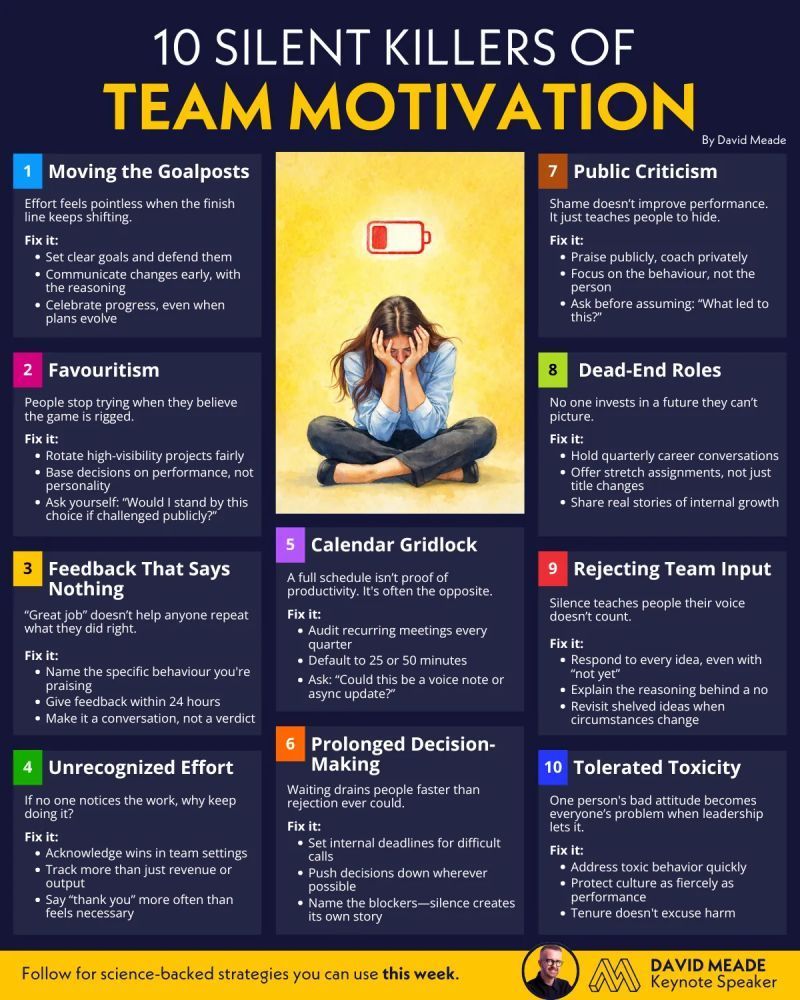
Motivated teams drive 23% higher profitability.
That’s not a motivational poster.
That’s a lesson for all you wonderful leaders out there.
But let me ask you this…
If motivation is worth nearly a quarter of our bottom
line, why aren’t more of us protecting it?
I think I know the answer.
Most motivation killers don’t show up in quarterly
performance reviews.
They slip in quietly.
(Like Santa slinking down your chimney…
if Santa stole morale instead of mince pies.)
It’s not the big drama that drains performance.
It’s the slow fade.
↳ Ideas met with silence
↳ Goals that keep shifting
↳ Feedback that says nothing
↳ Recognition that never comes
Small things.
But stacked?
They cost you—big time.
But don’t stress. There’s a fix.
Protect your 23% with these five shifts:
1. Lock in goals.
↳ If priorities shift, explain why. Don’t leave people in
the dark.
2. Recognise effort.
↳ Small wins, hard work, unseen progress, call it out.
3. Make feedback insultingly clear.
↳ Be specific. Focus on what to repeat or improve.
4. Show what’s next.
↳ If growth isn’t the standard, people assume it’s
not possible.
5. Fix issues early.
↳ Bad behaviour spreads fast if it’s ignored.
Motivation isn’t a vibe.
It’s a value-driver.
Your best people won’t announce they’re demotivated.
They’ll just leave.
And that’s good for nobody.
Fix the small stuff.
Or risk the 23%.
The Quiet Miracle of Ordinary Days
A while back, I caught myself doing something I think a lot of us do without even realizing it. I was complaining in my head about a completely normal day. Too many emails. Too many things to juggle. A long to-do list. A delayed response I was waiting on. Dinner felt rushed. The house was messy. Life felt… heavy.
Nothing was actually wrong. But in that moment, it felt like everything was.
And then, almost by accident, my mind went somewhere else.
What if the thing I’m waiting on had been bad news instead of just a delay? What if the people I love weren’t safe and well, but hurting? What if the noise in the house wasn’t clutter and chaos, but silence? What if the bills, the errands, the schedule, the interruptions — all the things I was resenting — were suddenly gone because the life that created them had changed?
It sounds dark at first, but stay with me.
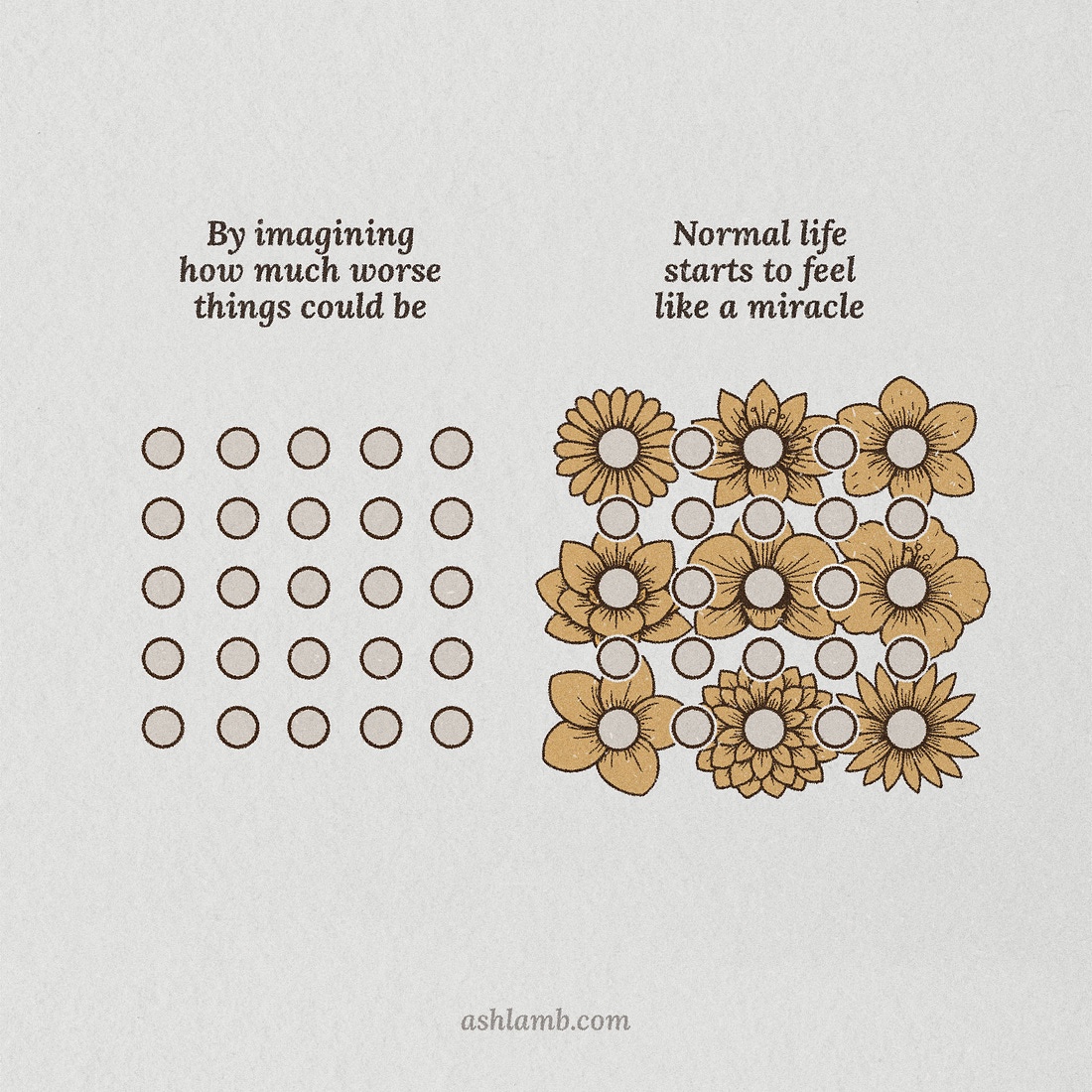
Sometimes the fastest way back to gratitude isn’t forcing yourself to “look on the bright side.” It’s allowing yourself to imagine, just for a second, how much worse things could be. Not to scare yourself. Not to spiral. Just to get honest perspective.
Because perspective has a strange power.
It can turn a stressful morning into proof that you have work to do, people who need you, and a life that’s moving. It can turn a noisy home into evidence of laughter, family, and presence. It can turn inconvenience into privilege. It can turn “I have too much on my plate” into “I’m fortunate enough to have a plate that’s full.”
We often think gratitude should arrive in big, cinematic moments. The promotion. The answered prayer. The recovery. The breakthrough. The vacation. The major milestone.
But real gratitude usually shows up much quieter than that.
It lives in the boring Tuesday.
It lives in the drive you’ve taken a thousand times.
It lives in the coffee that’s still warm.
It lives in the child asking for your attention when you’re trying to finish one more thing.
It lives in the text from someone who always checks in.
It lives in the routine you barely notice because it has become so familiar.
And that’s the trap, isn’t it? Familiarity can make blessings feel ordinary. The more often we experience something good, the less amazed we are by it. We adapt quickly. What once felt like an answer to prayer slowly becomes background noise.
The home you worked so hard for becomes “just the house.”
The healthy body that carried you through another day becomes “just tired.”
The people who love you become “just there.”
The peace you once desperately wanted becomes so normal that you stop recognizing it as peace.
That’s why this mindset matters.
When you pause and imagine how fragile everything actually is, you don’t become fearful. You become awake.
You realize that normal life is not guaranteed.
A calm morning is not guaranteed.
The people sitting at your table are not guaranteed.
The chance to try again tomorrow is not guaranteed.
The ability to walk into your routine, do your work, make your plans, hear your favorite voices, and end the day safely — none of that is small.
It’s massive.
It’s miraculous.
And I think we need that reminder more than ever, because we live in a world that trains us to constantly move the goalpost. We are always chasing the next thing. The next achievement. The next upgrade. The next version of life that will finally make us feel content.
But if we’re not careful, we’ll spend our whole lives trying to improve a life we never stopped to appreciate.
That doesn’t mean you shouldn’t want more. It doesn’t mean ambition is wrong. It doesn’t mean hard seasons aren’t real or that pain should be ignored. Some days are genuinely hard. Some burdens are not just “perspective problems.” They are heavy and real.
But even in those seasons, there is often still something quietly holding you up.
A roof.
A breath.
A person.
A meal.
A moment of peace.
A sliver of strength.
A reason to keep going.
Sometimes gratitude doesn’t look like joy. Sometimes it looks like simply noticing what didn’t fall apart today.
That matters too.
I’ve found that one of the healthiest habits is asking a simple question when life starts to feel frustrating, dull, or unfair:
“If this had gone worse… what would I be praying for right now?”
That question changes things.
Suddenly, what you already have becomes visible again.
You stop overlooking the ordinary.
You stop treating stability like it’s boring.
You stop assuming that “normal” means “nothing special.”
Because normal life is special.
A normal day with ordinary responsibilities, familiar people, repeated routines, and unremarkable moments can actually be one of the greatest gifts we ever receive.
The miracle is rarely in the dramatic.
More often, it’s in the everyday life we’ve stopped noticing.
So maybe today, before rushing to the next thing, pause for a moment.
Look at your life as it is.
Not the version that still needs fixing.
Not the version you wish were easier.
Not the version you compare to someone else’s highlight reel.
Just this one.
This ordinary, imperfect, beautiful life.
And imagine, briefly, how different it could have been.
You may find that the day you were calling “average” is actually full of quiet miracles.
12 Ways to Lead with Presence
Mindful leadership isn’t a personality trait
It’s a daily practice
And one of the fastest ways to:
→ Make better decisions
→ Build deeper trust
→ Lead without burning out
𝗧𝗛𝗘 𝗥𝗘𝗔𝗟𝗜𝗧𝗬:
Most leaders run on autopilot
Back-to-back meetings
Reactive decisions
Always “on” but rarely present
The best leaders do something different
They pause
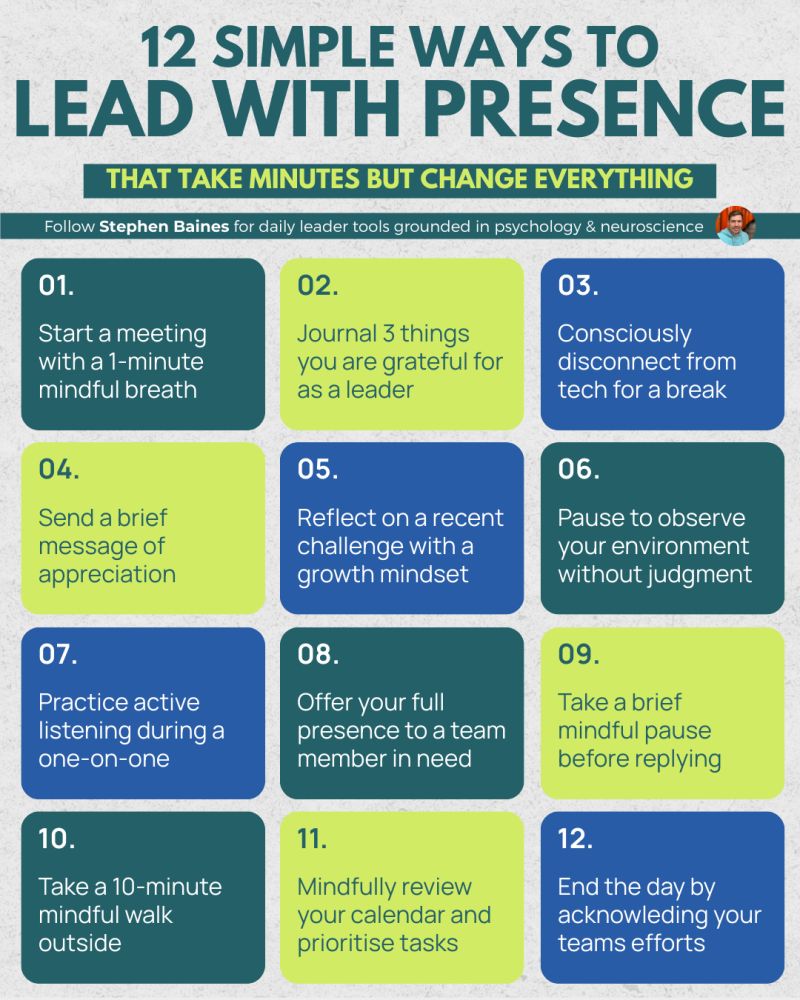
𝟭𝟮 𝗦𝗜𝗠𝗣𝗟𝗘 𝗔𝗖𝗧𝗦 𝗢𝗙 𝗠𝗜𝗡𝗗𝗙𝗨𝗟 𝗟𝗘𝗔𝗗𝗘𝗥𝗦𝗛𝗜𝗣:
1/ Start a meeting with a 1-minute mindful breath
2/ Journal 3 things you’re grateful for as a leader
3/ Consciously disconnect from tech for a break
4/ Send a brief message of appreciation
5/ Reflect on a recent challenge with a growth mindset
6/ Pause to observe your environment without judgment
7/ Practice active listening during a one-on-one
8/ Offer your full presence to a team member in need
9/ Take a brief mindful pause before replying
10/ Take a 10-minute mindful walk outside
11/ Mindfully review your calendar and prioritise tasks
12/ End the day by acknowledging your team’s efforts
𝗛𝗘𝗥𝗘’𝗦 𝗧𝗛𝗘 𝗧𝗛𝗜𝗡𝗚:
None of these take long
Most take minutes
But together?
They change how you lead
And how your team experiences you
Presence beats productivity theatre
Every time
Before You Judge, Try This First
Empathy gets talked about a lot, but honestly, it’s still one of the most misunderstood qualities in life and work.
People often think empathy means being soft. Or agreeing with everyone. Or taking on other people’s emotions until you’re drained. But real empathy is none of that.
Real empathy is awareness. It’s discipline. It’s the ability to pause long enough to understand what might be happening beneath the surface before reacting from your own assumptions.
And in a world where everyone is moving fast, responding fast, and judging even faster, empathy has quietly become one of the rarest strengths you can have.
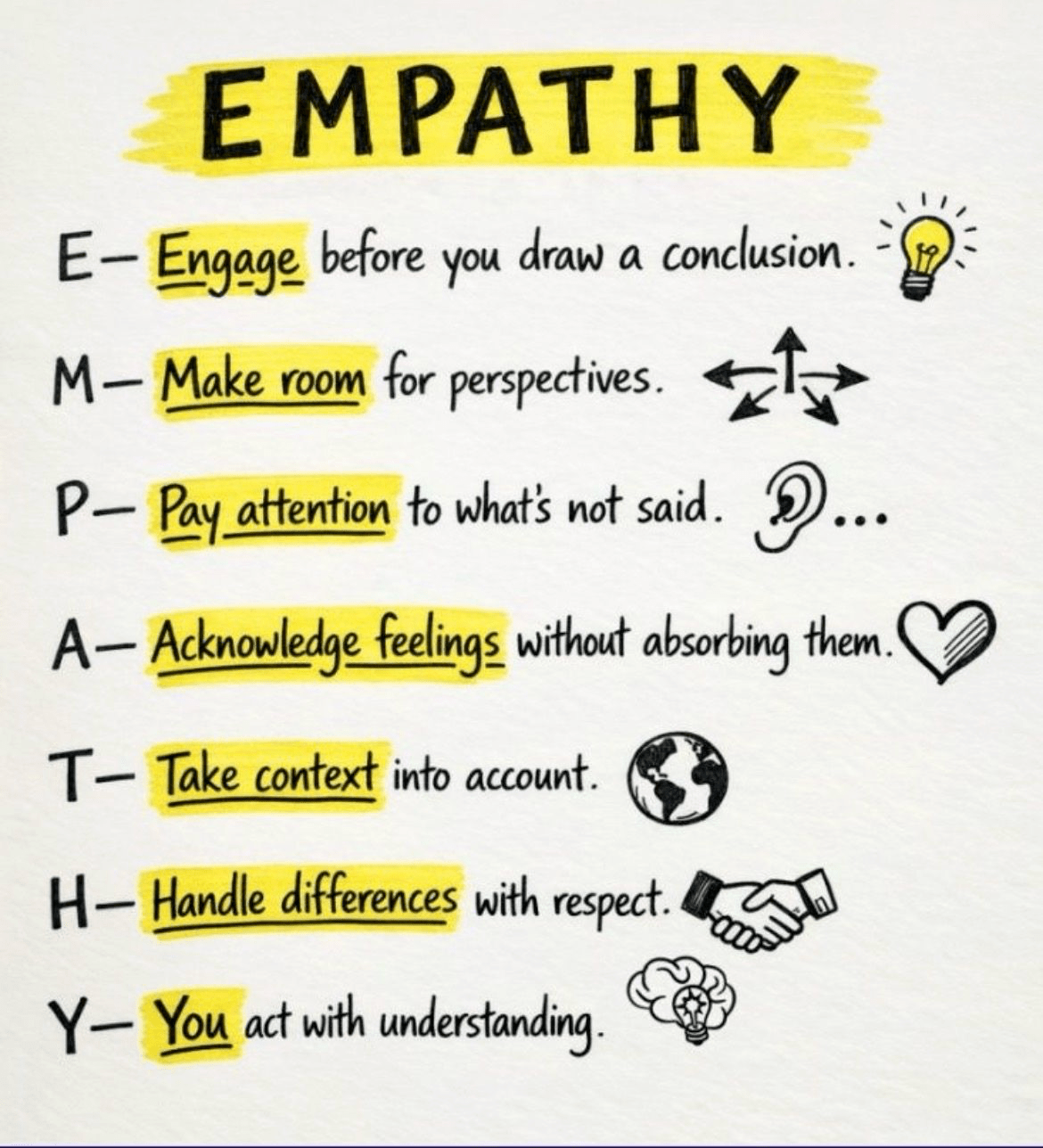
It starts with something simple: engage before you draw a conclusion.
That sounds obvious, but most of us do the opposite more often than we realize.
Someone responds with a short message, and we assume they’re upset. Someone misses a deadline, and we assume they’re careless. Someone seems distant, and we assume they don’t care.
But assumptions are usually stories we tell ourselves in the absence of context.
Empathy asks for a different approach. It asks us to lean in before we label. To ask before we decide. To understand before we react.
That one shift alone can change relationships, teams, and entire conversations.
Then comes the next part: make room for perspectives.
This is where empathy gets harder.
Because it’s easy to be understanding when someone sees the world the way you do. It’s much harder when their behavior, opinion, or response doesn’t make sense to you.
But empathy isn’t reserved for people who are easy to understand. It matters most when someone’s perspective is different from your own.
Maybe they’re reacting from fear and not logic. Maybe they’re carrying pressure you can’t see. Maybe their life experiences shaped them in ways you haven’t considered.
You don’t have to agree with someone’s perspective to respect that it exists.
That’s maturity.
That’s emotional intelligence.
And that’s often the difference between a conversation that creates distance and one that creates trust.
Another part of empathy that people overlook is this: pay attention to what’s not said.
Not everything important is spoken out loud.
Sometimes the loudest signals are in the pauses, the hesitation, the change in tone, the “I’m fine” that clearly doesn’t mean fine.
Some people won’t tell you they’re overwhelmed.
Some won’t admit they’re hurt.
Some won’t say they feel left out, unsupported, or exhausted.
But if you pay attention, you’ll notice.
Empathy isn’t just about listening to words. It’s about noticing energy. Body language. Patterns. Silence.
And sometimes, what someone can’t say directly tells you more than what they do.
That doesn’t mean you become responsible for fixing everything. Which brings us to one of the healthiest reminders in your illustration: acknowledge feelings without absorbing them.
This one matters.
Because empathy without boundaries turns into emotional burnout.
You can care deeply without carrying everything.
You can be supportive without becoming overwhelmed.
You can hold space for someone without losing yourself in their pain.
That’s not coldness. That’s balance.
A lot of people confuse empathy with emotional overextension. But the most grounded people know how to say, “I see what you’re feeling. I understand this matters. I’m here with you,” without drowning in it.
That kind of empathy is sustainable.
That kind of empathy is strong.
And it gets even better when you remember to take context into account.
Context changes everything.
A harsh response from a stranger is one thing.
A harsh response from someone who’s been under nonstop pressure, navigating family stress, and barely sleeping is another.
A teammate missing one detail may look like carelessness.
But if they’ve been holding together three different priorities and quietly putting out fires all week, the story looks very different.
Context doesn’t excuse bad behavior forever.
But it often explains what judgment alone never can.
And when you understand context, you respond better.
You become less reactive.
Less rigid.
Less likely to turn a temporary moment into a permanent label.
That’s what empathy protects us from: reducing people to one bad day, one awkward moment, one misunderstood decision.
Then there’s a part we need more of everywhere right now: handle differences with respect.
Not everyone will think like you.
Not everyone will communicate like you.
Not everyone will process emotions, conflict, pressure, or change the same way you do.
And that’s okay.
Empathy doesn’t mean erasing differences. It means learning how to navigate them without disrespect.
It means staying human in disagreement.
It means being firm without being cruel.
It means remembering that someone can be different without being wrong in every way.
Some of the strongest people I’ve met aren’t the ones who dominate conversations or win arguments.
They’re the ones who know how to stay respectful even when emotions run high.
That’s not weakness.
That’s control.
That’s character.
And finally, empathy becomes real when you act with understanding.
Because empathy isn’t just something you feel. It’s something you do.
It shows up in the extra question you ask before reacting.
In the pause before sending that sharp reply.
In the grace you give someone who’s clearly not at their best.
In the way you make space for someone to explain themselves.
In the way you choose curiosity over ego.
That’s what makes empathy powerful.
Not the quote.
Not the concept.
The action.
The truth is, empathy doesn’t always solve everything.
It won’t remove conflict.
It won’t make every relationship easy.
It won’t guarantee everyone understands you back.
But it does make you better.
It makes you wiser with people.
Safer to talk to.
Harder to misunderstand.
Easier to trust.
And in a world full of quick opinions and short patience, that’s a rare kind of strength.
So the next time you’re tempted to jump to a conclusion, assume the worst, or react before you understand—pause.
Engage first.
Make room.
Pay attention.
Acknowledge.
Consider context.
Respect differences.
Then act from understanding.
That’s empathy.
And more often than not, it changes everything.
𝟔 𝐖𝐚𝐲𝐬 𝐓𝐨 𝐒𝐮𝐜𝐜𝐞𝐞𝐝 𝐀𝐬 𝐚 𝐋𝐞𝐚𝐝𝐞𝐫
Leaders are made, not born. There is no genetic code or gene for leadership.
Here is my definition of leadership:
“𝐋𝐞𝐚𝐝𝐞𝐫𝐬𝐡𝐢𝐩 𝐢𝐬 𝐚 𝐰𝐚𝐲 𝐨𝐟 𝐚𝐜𝐭𝐢𝐧𝐠 𝐨𝐫 𝐛𝐞𝐡𝐚𝐯𝐢𝐧𝐠 𝐭𝐡𝐚𝐭 𝐢𝐧𝐬𝐩𝐢𝐫𝐞𝐬 𝐨𝐭𝐡𝐞𝐫𝐬 𝐭𝐨 𝐩𝐞𝐫𝐟𝐨𝐫𝐦 𝐚𝐭 𝐭𝐡𝐞𝐢𝐫 𝐛𝐞𝐬𝐭 𝐨𝐧 𝐭𝐡𝐞𝐢𝐫 𝐰𝐚𝐲 𝐭𝐨𝐰𝐚𝐫𝐝 𝐚 𝐬𝐩𝐞𝐜𝐢𝐟𝐢𝐜 𝐨𝐛𝐣𝐞𝐜𝐭𝐢𝐯𝐞.”
To be successful, you must learn how to lead others. And when you do, you are by default creating Leaders At All Levels.
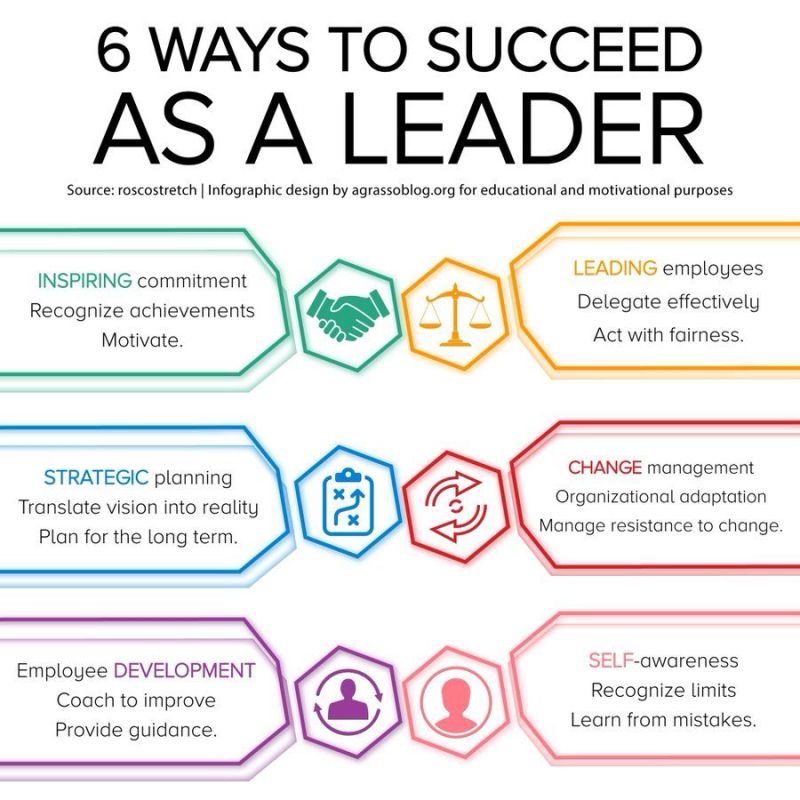
Here are six things you can work on in your quest to develop your leadership skills:
1️⃣ INSPIRE OTHERS
🔸 When you inspire others, they become more committed.
🔸 Recognize others’ achievements, skills, goals, strengths, and positive qualities.
2️⃣ LEAD PEOPLE
🔸 Delegate strategically. Delegate work to grow others; don’t delegate junk because you’re too busy.
🔸 Be kind. Be fair. Treat everyone as equals. This is respect.
3️⃣ BE STRATEGIC
🔸 Know where you’re going. Have a vision and communicate it often.
🔸 Turn your vision into reality by collaborating with your team, setting objectives and tasks aligned to the vision.
4️⃣ BE A CHANGE MASTER
🔸 Help people adapt to change. Communicate often and bring people together to exchange ideas on ways to improve.
🔸 Manage resistance to change by allowing people to create the change through innovation and creativity.
5️⃣ DEVELOP YOUR PEOPLE
🔸 Train people on personal leadership. You need leaders at all levels!
🔸 Make sure you understand where your people want to go and grow, and give them development opportunities.
6️⃣ DEVELOP YOUR SELF-AWARENESS
🔸 Self-awareness is the first step in emotional intelligence. When you are self-aware, you become other-aware.
🔸 Know your strengths, but also know your limitations and weaknesses. And be humble by admitting your mistakes openly.
In the end, be courageous. “Courage,” as Churchill said, “Is rightly esteemed the first of human qualities because it has been said, it is the quality which guarantees all others.”
Urgent vs Important
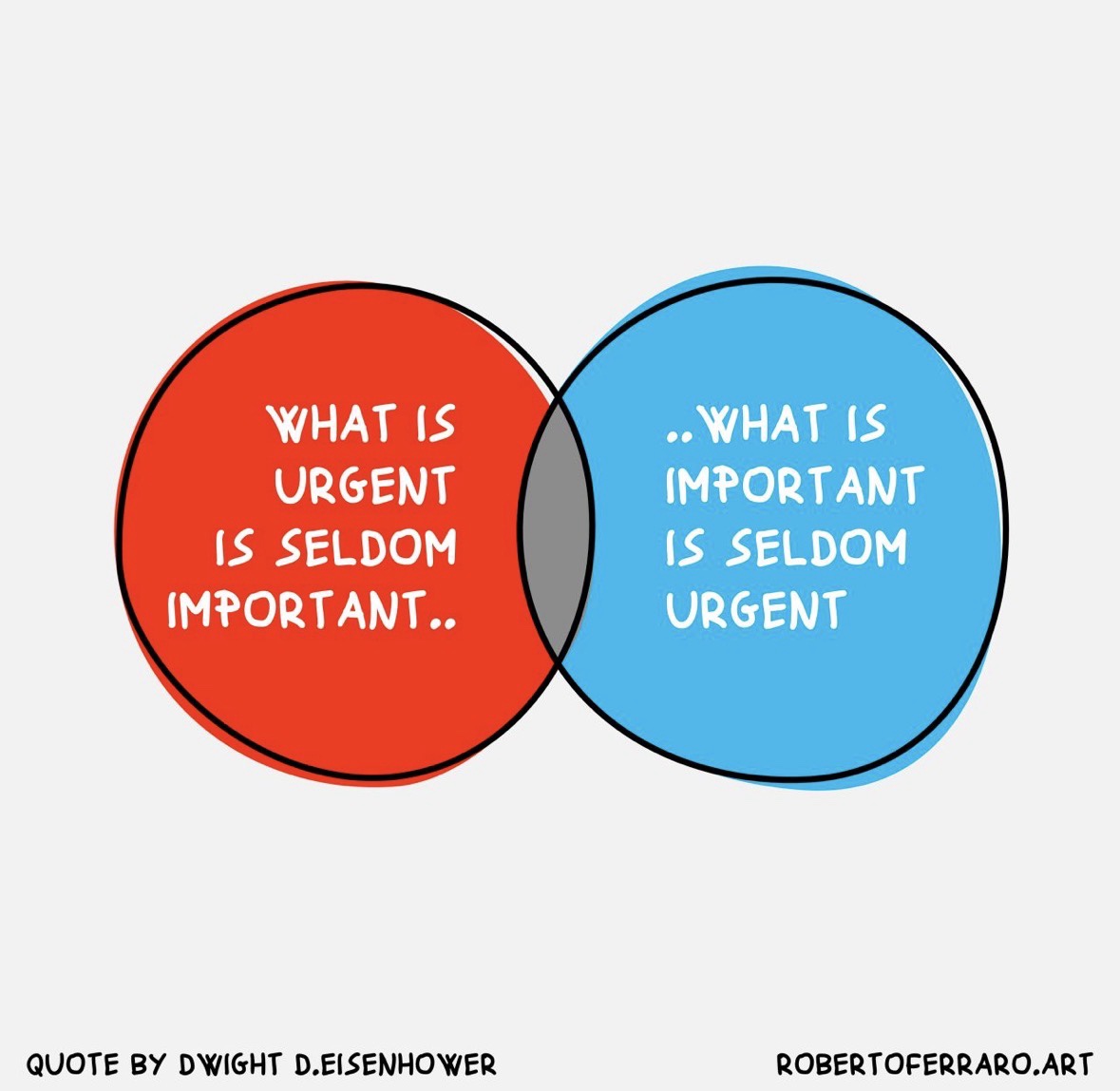
A few years ago, I noticed something about the way most of us spend our days. We rush from one notification to the next, one meeting to another, one “quick thing” that somehow turns into five more. By the end of the day we feel exhausted… but if someone asked what meaningful progress we made, the answer is often fuzzy.
The strange thing is that most of what fills our days feels urgent. Emails marked “ASAP.” Messages that demand an immediate response. Calendar invites that appear out of nowhere. Deadlines that seem impossible to ignore.
Urgency has a way of raising its voice.
Importance usually doesn’t.
Urgent things push themselves to the front of the line. They buzz, ring, vibrate, and interrupt. They demand attention right now. And because they feel pressing, they trick us into believing they must also be important.
But they rarely are.
Many urgent tasks are simply other people’s timelines colliding with our attention. A message that could wait. A request that feels critical in the moment but fades in relevance a week later. A meeting that fills an hour without moving anything forward.
They feel urgent because they are loud.
Important things, on the other hand, are strangely quiet.
Important work is rarely screaming for attention. It doesn’t send reminders every five minutes. It doesn’t sit in your inbox with a flashing red icon.
It waits.
Important work looks like thinking deeply about a problem instead of reacting to ten small ones. It looks like building something slowly that will still matter a year from now. It looks like investing time in relationships, learning a skill properly, or creating something meaningful instead of just maintaining motion.
The irony is that the things that shape our lives the most are usually the ones we postpone.
We postpone the idea we want to write about.
We postpone the skill we want to learn.
We postpone the conversation we know we should have.
We postpone the project that actually excites us.
Not because they aren’t important.
But because they aren’t urgent.
Urgency gives us a strange comfort. When we are constantly responding to something, it feels like productivity. Our days feel full. Our calendars look impressive. Our inboxes show evidence of activity.
But activity and progress are not the same thing.
Real progress often feels slower, quieter, and sometimes even uncomfortable. It requires protecting time for work that doesn’t scream for attention. It means saying no to small urgent things so that something meaningful can grow.
That kind of work rarely produces instant results. It compounds over time.
A single thoughtful idea can shape a career.
A consistent habit can transform health.
A focused effort on one meaningful project can create opportunities that dozens of rushed tasks never will.
None of these begin as urgent.
They begin as important.
And the people who seem to move forward in a steady, intentional way usually aren’t better at handling urgency. They’re just better at recognizing when urgency is trying to hijack their day.
They respond when needed, but they don’t let it run everything.
They protect small pockets of time for the work that matters most.
Thinking time.
Creative time.
Learning time.
Relationship time.
Those hours rarely feel dramatic in the moment. No alarms are going off. No one is chasing them down for updates. Sometimes it even feels like you should be doing something more “pressing.”
But that quiet work is often where the real progress happens.
Because what is urgent will always find you.
What is important requires you to choose it.
 Kenrick Vaz