
A leader’s title means nothing—
Their actions mean everything:
What you say matters—
but what you do matters more.
People watch how you handle pressure.
They remember how you respond to mistakes.
They notice how you treat others.
They feel when you show up or check out.
The truth?
Your actions teach people how to show up too.
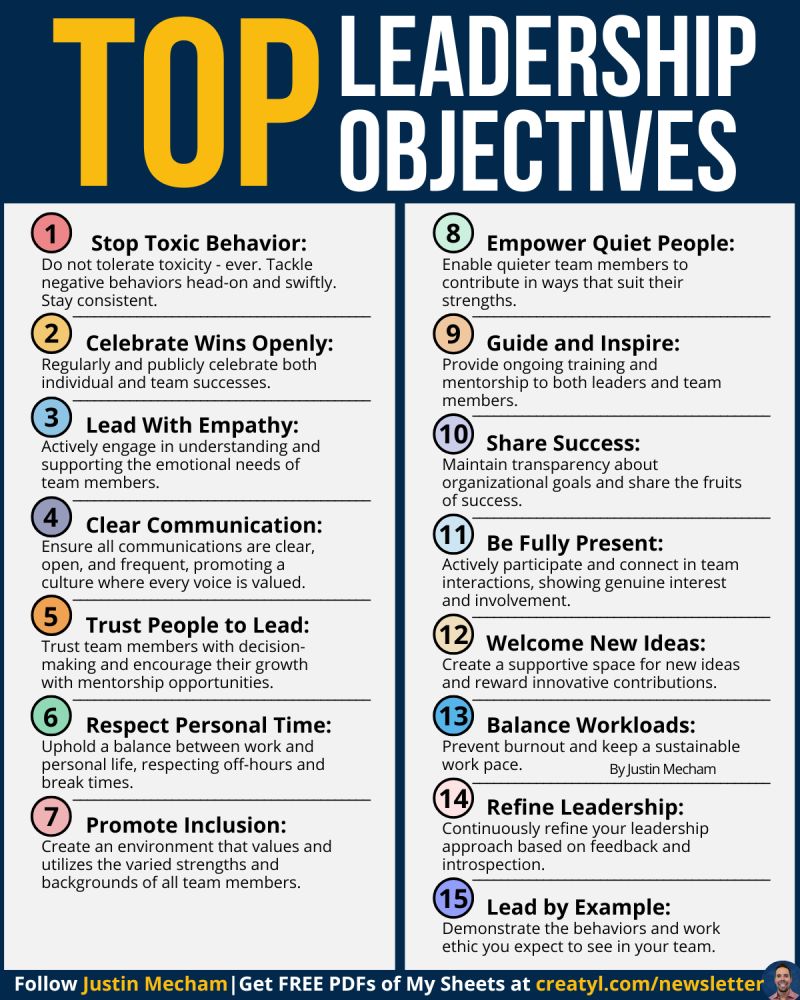
Here are 15 leadership objectives that truly matter:
➜ Celebrate wins
➜ Lead by example
➜ Guide and inspire
➜ Balance workloads
➜ Stop toxic behavior
➜ Welcome new ideas
➜ Respect personal time
➜ Empower quiet people
➜ Communicate clearly
➜ Trust people to lead
➜ Lead with empathy
➜ Promote inclusion
➜ Refine leadership
➜ Be fully present
➜ Share success
Great leaders make people feel safe and seen.
They create space for honest work
and real connection.
Leaders will leave marks or scars.
Marks are what people carry with pride.
Scars are what people carry in silence.
Which one will you leave?
Collective Leadership Compass

Great leadership isn’t about one person:
It’s about collective intelligence.
Want to excel in this area?
This framework will definitely help:
The Collective Leadership Compass.
It assists teams and organizations navigate leadership with 6 core dimensions:
1. Wholeness
Creating a shared vision and fostering collaboration.
2. Possibilities
Future-focused, decisive, and ready to empower change.
3. Engagement
Building strong processes, connections, and collective action.
4. Innovation
Encouraging creativity, adaptability, and excellence.
5. Humanity
Leading with empathy, mindfulness, and balance.
6. Intelligence
Leveraging diversity, learning, and high-quality dialogue.
Leadership isn’t about authority:
It’s about creating a system where teams thrive.
P.S. Which of these dimensions do you focus on the most?
The Leadership Paradox

The leadership paradox:
Less control actually creates more influence.
Leadership isn’t what most people think it is.
We often confuse:
Management with leadership
Authority with respect
Title with influence
The truth?
Being in charge doesn’t make you a leader.
You become one when people want to follow you.
Here’s how:
1. You Give Clear Direction
People crave certainty in an uncertain world.
They don’t follow confusion.
When you break down complex goals into
simple steps, you create a path others willingly walk.
2. You Own Your Mistakes
Nothing destroys respect faster than blame-shifting.
Real leaders admit when they’re wrong and
focus on solutions, not excuses.
They hold themselves accountable first, always.
3. You Make Tough Calls (Fast)
Hesitation breeds chaos.
Decision paralysis kills momentum.
Great leaders gather insights, weigh risks,
and then act decisively.
Remember: no decision is perfect, but indecision
is always worse.
4. You Stay Calm Under Pressure
Your energy sets the tone for everyone around you.
When you control your emotions and focus on
solutions, your composure becomes contagious.
People naturally follow those who remain steady
when everything isn’t.
5. You Push People to Grow
The best leaders don’t just support their teams,
they challenge them.
By giving high-ownership opportunities and
setting ambitious standards, you help people
discover capabilities they didn’t know they had.
6. You Keep Your Promises
Trust isn’t built on inspiring speeches.
It’s built on reliability.
When you follow through on commitments, you build
the kind of credibility that no title can give you.
What you need to know:
Leadership isn’t a position or title, it’s a decision
you make every day.
Which of these 6 qualities are you already strong in?
Which needs work?
Start with just one area this week and watch
how your team responds.
Applause Doesn’t Pay the Soul

No matter what you do, someone will always have an opinion. Some will cheer you on, some will quietly judge, and others won’t even notice. It’s the strange, unspoken truth of life — no matter how hard you try, you’ll never be everyone’s favorite story. And the moment you make peace with that, something beautiful happens — you start living for yourself.
We spend so much of our lives chasing approval. It starts early — a gold star in school, a pat on the back at work, a few likes on a post. Somewhere along the way, applause starts to feel like oxygen. We crave it. We shape our choices around it. And without even realizing it, we begin living someone else’s version of our life.
But here’s the thing — applause fades. Opinions change. People move on. What stays is the feeling you have when you look in the mirror at the end of the day. Did you do something that made you proud? Did it bring you peace? Did it feel right for you? Because that’s what lasts — the quiet satisfaction of knowing you chose your path, not because it was loud or liked, but because it was yours.
It’s not easy to tune out the noise. We’re wired to care. But peace begins when you start listening more to your inner voice than the outer crowd. When you stop performing for others and start showing up for yourself. When joy becomes your metric instead of attention.
So do it for yourself. Build the life, make the move, take the risk — not because it’ll impress anyone, but because it will make you feel alive. Remember, the loudest applause in the world can’t replace the quiet contentment of being at peace with who you are.
Your peace is the standing ovation that truly matters.
7 Things Great Leaders Do Differently
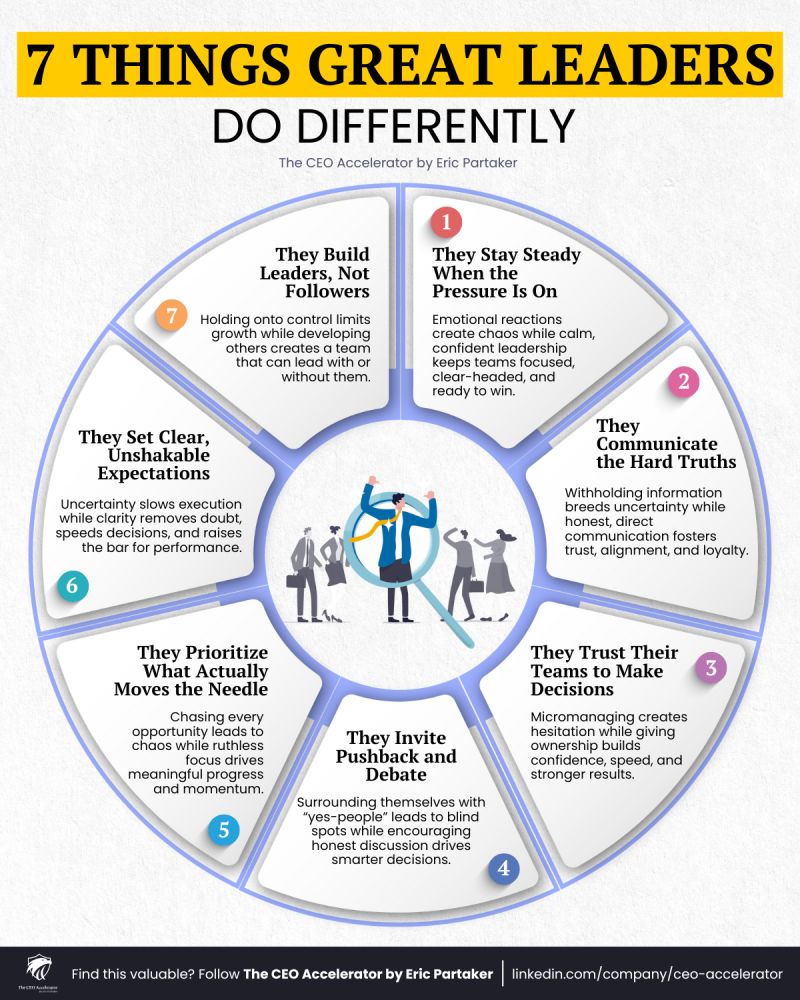
7 leadership skills most leaders never master.
(But the rare few who do? They change everything.)
After coaching 100s of CEOs over 2 decades,
I’ve seen what sets the exceptional apart.
Here’s what they do differently:
1️⃣ They Stay Steady Under Pressure
Panic disrupts effective execution.
Composed leaders keep teams sharp and focused.
2️⃣ They Communicate the Hard Truths
Sugarcoating or withholding information kills trust.
Direct, honest communication keeps teams aligned.
3️⃣ They Trust Their Teams to Make Decisions
Micromanaging weakens team confidence.
Give clear ownership to accelerate stronger,
better results.
4️⃣ They Invite Pushback and Debate
Surrounding yourself with “yes-people” is a fast
track to failure.
The best leaders demand honest feedback.
5️⃣ They Prioritize What Actually Moves the Needle
Being busy doesn’t mean being effective.
Great leaders cut the noise and focus on impact.
6️⃣ They Set Clear, Unshakable Expectations
Ambiguity slows execution.
Define success, then plan a strategy.
Make sure your team knows exactly what
winning looks like.
7️⃣ They Build Leaders, Not Followers
Holding onto control limits growth.
Developing leaders ensures long-term success.
The key lesson:
Every great leader was once a work in progress.
The difference?
They embraced the challenge, did the work,
and kept raising the bar.
The best didn’t aim for perfection—they aimed for progress.
So the question isn’t if you’ll make mistakes
(because you will).
The question is: How much will you learn from them?
Managing Stress

Stress isn’t the enemy.
It’s actually your brain trying to protect you.
But without the right tools, stress can take over:
↳ Snappy reactions
↳ Racing thoughts
↳ Sleepless nights
Your mind shifts into survival mode. 🧠
Here’s the shift that changes everything:
❌ Stress isn’t something you eliminate.
✅ It’s something you learn to manage.
Here’s how to do it right: 👇
(From The American Psychological Association)
1/ Learn to recognize your triggers
↳ Is it pressure? Uncertainty? Lack of control?
↳ Track what sparks the tension
2/ Focus on what you can influence
↳ You may not control your boss
↳ But you can control your boundaries, reactions, and recovery
3/ Build daily recovery rituals
↳ A 10-minute walk
↳ Deep breathing before meetings
↳ Journaling or stillness before bed
4/ Reframe the story
↳ Instead of “I’m overwhelmed” try “I’m being stretched”
↳ That one shift rewires your response
5/ Ask for help when you need it
↳ You don’t get extra credit for burning out
↳ Strong people use support systems
The truth is:
Your nervous system is just trying to keep you alive.
But you can train it to help you thrive. 💪
Are you managing your stress or is your stress managing you❓
Team Building
What does it take to build a strong team?
Start by understanding what drives people.
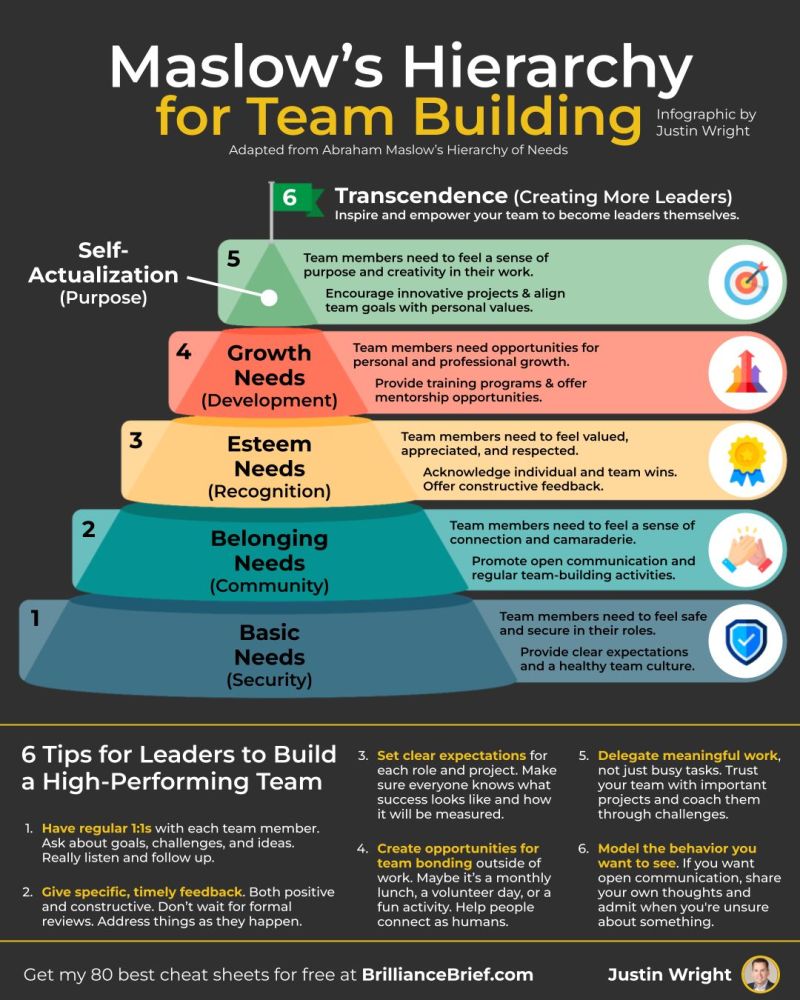
Maslow’s Hierarchy of Needs isn’t just a theory.
It’s a guidebook for team-building.
Let’s break it down:
1. Set a Foundation of Security
↳ Ensure clear roles and job stability.
↳ Trust and safety are non-negotiable.
2. Build Community
↳ Create real connections.
↳ Regular team-building is essential.
3. Create a Culture of Recognition and Respect
↳ Say “thank you” often. Celebrate wins.
↳ Make appreciation a habit, not a rarity.
4. Support Growth and Development
↳ Invest in training and mentorship.
↳ Support their personal and professional journey.
5. Instill a Sense of Purpose and Creativity
↳ Align team goals with individual passions.
↳ Encourage innovative thinking and passion projects.
6. Create Leaders, Not Just Followers
↳ Mentor your team to become future leaders.
↳ Empower them to take ownership and grow.
Why does this matter?
When you meet these needs,
your team isn’t just working…
They’re thriving.
The impact?
➟ Higher employee engagement
➟ Better team collaboration
➟ Increased productivity
➟ Healthier culture
➟ More fun
How do you make it happen?
✅ Lead with empathy.
✅ Understand their needs.
✅ Unlock your team’s potential.
The Energy I Choose

Somewhere along the way, I realized how exhausting hate really is. It drains you quietly, like a phone on low battery that never quite charges back up. You tell yourself you’re fine, that holding onto that resentment or anger is justified — but deep down, you know it’s just heavy. It eats at your peace, your sleep, your joy. And for what? To prove a point no one remembers or to hold a grudge no one cares about?
I don’t have energy for that anymore. I don’t want to keep replaying the things people said or did, or how unfair life seemed at certain moments. I’d rather save my energy for things that fill me up — for people who make me laugh till it hurts, for small acts of kindness that ripple outward, for moments that feel like light breaking through a cloudy day.
So now, it’s simple: I either love you, wish you well, or hope you heal. If you’ve brought goodness into my life, I love you for it. If our paths don’t align anymore, I still wish you well — genuinely. And if you’ve hurt me or left scars where there used to be trust, I just hope you heal. Because hurt people hurt people, and I refuse to keep that cycle spinning.
There’s so much freedom in letting go. You stop trying to understand every wrong or rewrite every ending. You stop being defined by who disappointed you. You start to reclaim your peace — and peace feels like power. Not the loud, showy kind, but the quiet confidence of knowing you’re not ruled by bitterness.
The world can be harsh enough on its own. I’d rather not add more hate to it. So I choose love when I can, grace when it’s hard, and distance when it’s necessary. No drama, no revenge, no explanations. Just a calm “I hope you heal,” and I move forward.
Because at the end of the day, my energy is sacred. And I want to spend it on what lifts me, not what drains me.
Self-Awareness
The hardest person to lead—
Is yourself:
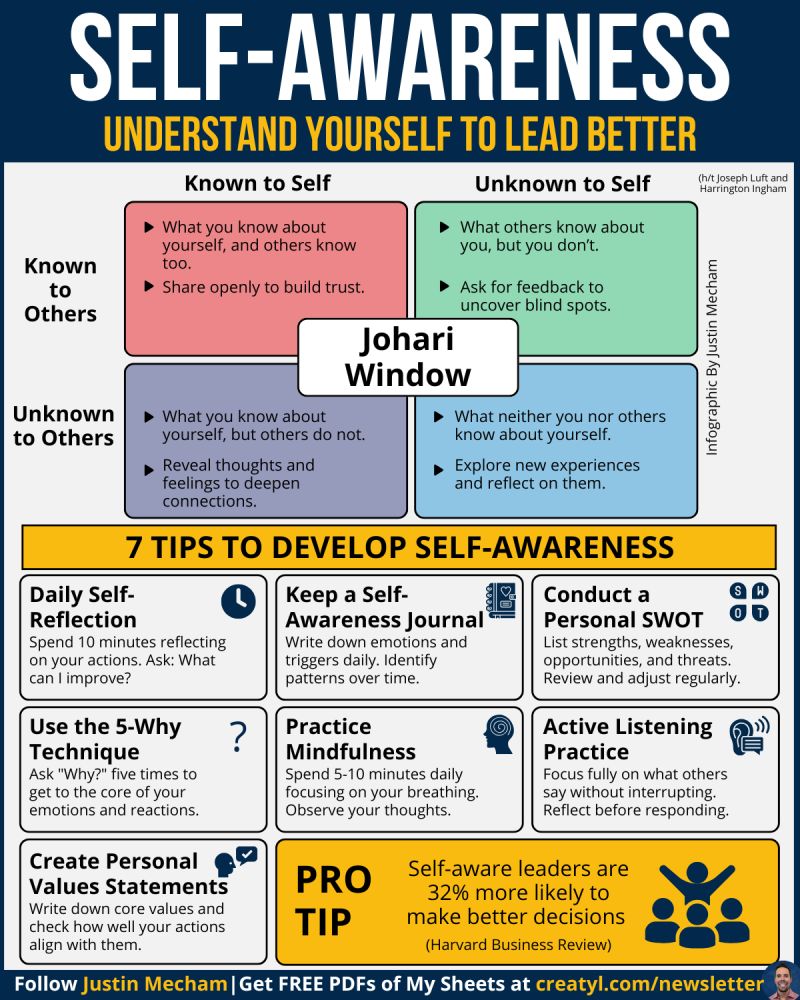
When you know yourself, you make better choices.
➜ You see your own habits.
➜ You notice how others see you.
➜ You understand how you act under stress.
➜ You learn from feedback instead of ignoring it.
Without self-awareness, leaders can:
🚫 Lose trust without even knowing why
🚫 Push their stress onto the team
🚫 Blame others for their mistakes
🚫 Misunderstand their feelings
🚫 Miss chances to grow
But self-aware leaders:
🟢 Learn and grow every day
🟢 Listen when others speak up
🟢 Understand their own feelings
🟢 Ask for help when they need it
🟢 Take responsibility for their actions
Self-awareness builds trust—
first with yourself, then others.
It’s not the end of growth.
It’s the start of real progress.
The Periodic Table of Sales KPIs
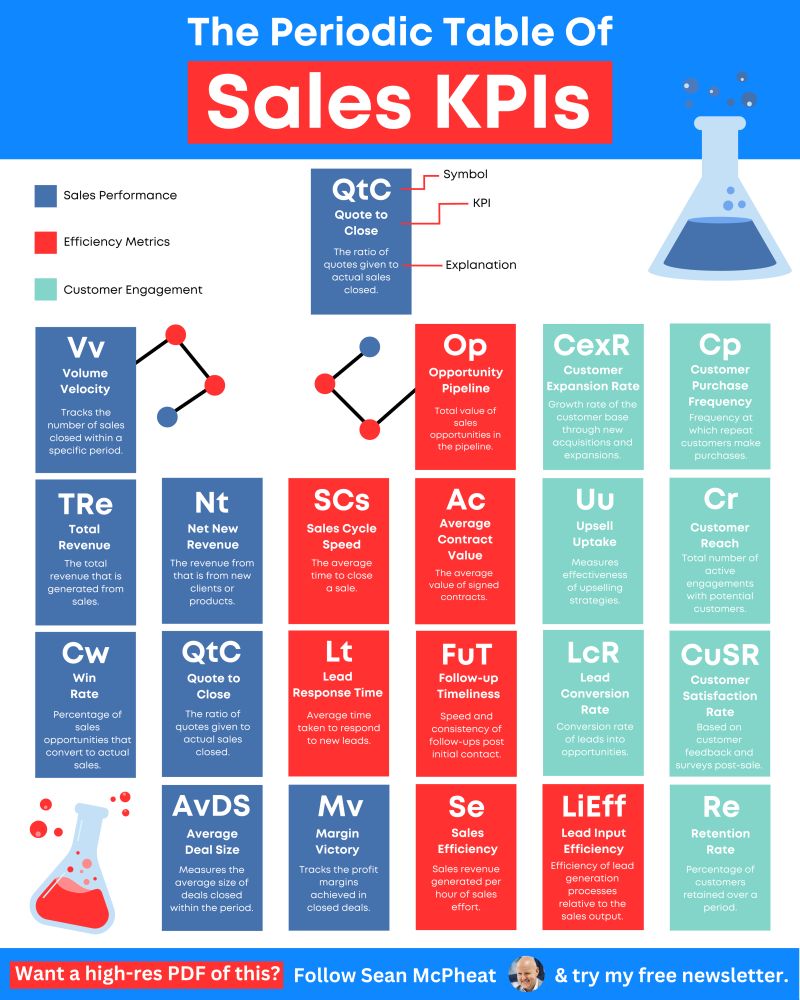
Vanity sales metrics look nice.
But they don’t pay the bills ⬇️
What really drives growth?
Tracking the right performance, not just any performance.
Most sales teams get buried in dashboards.
They’ve got data, but no direction.
There’s a flood of numbers, but no real clarity.
They measure activity without understanding impact.
They track everything except what actually moves the needle.
The result?
Missed targets, wasted time, and unclear priorities.
If you want to grow revenue, retain clients, and
sharpen your sales strategy, focus on these
three KPI categories:
→ Sales Performance
The outcomes that directly affect your bottom line.
These are the numbers that show whether the strategy
is working or not.
→ Efficiency Metrics
How effectively your team turns time and effort into results.
It’s about doing more with less, without burning out or losing steam.
→ Customer Engagement
Your connection with the buyer, post-sale and beyond.
How well you’re building relationships that last, renew, and expand.
Here are a few underrated KPIs that bring real insight:
→ Vv – Volume Velocity
How many deals you’re closing in a set timeframe.
→ QtC – Quote to Close Ratio
How often a proposal turns into a signature.
→ SCs – Sales Cycle Speed
How quickly leads become customers, speed matters.
→ Mv – Margin Victory
How profitable your deals are after discounts and costs.
→ Ac – Average Contract Value
The average value of each deal signed.
→ Se – Sales Efficiency
Revenue earned per hour of actual selling time.
→ CexR – Customer Expansion Rate
How much new business comes from current accounts.
→ Uu – Upsell Uptake
How often clients accept an upsell.
→ Cr – Customer Reach
The breadth and frequency of your outreach and follow-up.
→ CuSR – Customer Satisfaction Rate
A clear signal of future loyalty, retention, and referrals.
🧠 Remember; Metrics shouldn’t just look good,
they should mean something.
Track what matters. Drop what doesn’t. Lead with focus.
 Kenrick Vaz