What’s your goal?

My goal isn’t perfection. It’s not hustle for the sake of hustle, or applause, or proving anything to anyone. My goal is simpler, quieter, and somehow much bigger than all of that.

I want to wake up every morning feeling overwhelmingly grateful for the kind of life I have created for myself.

Not the kind of gratitude that shows up only on vacations or milestone days. Not the highlight reel version. I mean the ordinary-morning kind. The kind that shows up before the phone is checked. Before the day begins asking things of me. The kind that sits there gently and says, you’re okay. You built something that fits you.

Gratitude like that doesn’t come from luck. It comes from alignment. From a thousand small choices made consistently, often quietly, often when no one is watching. It comes from deciding what matters, and then having the courage to let other things matter less.

For a long time, I thought a good life was something that happened after you arrived somewhere. After the promotion. After the recognition. After the chaos settled down. But the truth is, life doesn’t pause while you’re chasing the next thing. It’s happening while you’re becoming. And if you’re not careful, you can build a life that looks impressive from the outside but feels exhausting from the inside.

The kind of life that inspires real gratitude is one that feels honest. One where your days aren’t constantly at war with your values. Where the way you spend your time actually reflects what you say you care about. Where success doesn’t cost you your peace, your health, or your relationships.

It’s waking up knowing you don’t have to pretend today. Knowing you don’t have to abandon yourself just to keep up. Knowing that even on hard days, you’re living in a direction that makes sense to you.

Gratitude, I’ve learned, isn’t passive. It’s built. It’s designed. Sometimes it’s protected fiercely. It means saying no more often than feels comfortable. It means choosing rest when the world rewards burnout. It means choosing presence when distraction is easier. It means redefining winning so it includes joy, not just progress.

Some mornings, gratitude looks like contentment. Other mornings, it looks like relief. And on the best mornings, it looks like quiet excitement. Not because everything is perfect, but because nothing feels wildly out of place.

I want a life where my mornings don’t begin with dread. Where Sundays don’t feel like a countdown. Where success doesn’t require me to shrink parts of myself that matter. I want a life that leaves room for laughter, for faith, for stillness, for growth that doesn’t feel violent.

That kind of life doesn’t arrive fully formed. It’s shaped slowly, through intentional living. Through learning what drains you and what fills you back up. Through paying attention to how your body responds to your choices. Through honoring seasons instead of fighting them.

And yes, there will always be more to want. More to fix. More to chase. But gratitude isn’t about having everything. It’s about recognizing when you have enough, and letting that be a source of joy rather than guilt.

If one day I can wake up, take a deep breath, and feel genuinely thankful for the life I’ve built, the pace I’ve chosen, the people I’ve kept close, and the person I’m becoming, then I’ll know I did something right.

Not because life was easy.

But because it was mine.
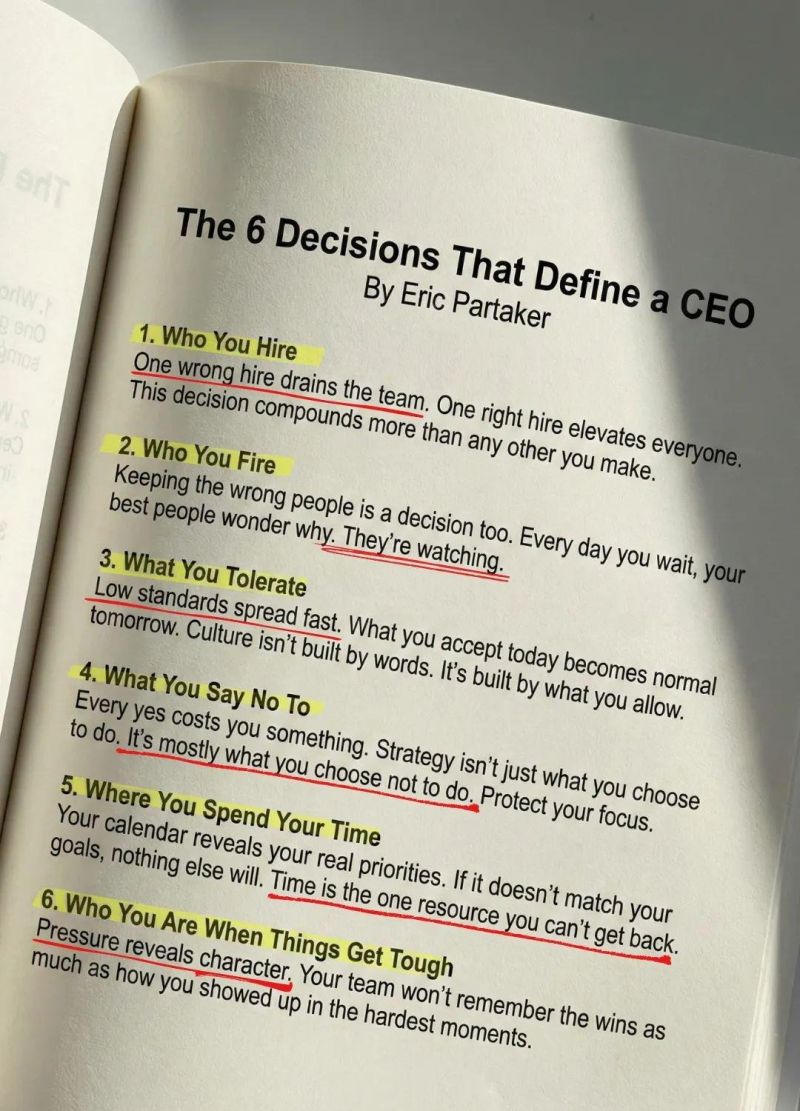
6 Decisions That Define A CEO

The #1 thing that separates the best CEOs from the rest:

It’s not their vision.
It’s not their strategy.
It’s not even their intelligence.

It’s 6 decisions they make every single day.

Most people think being a CEO is about the big moves.

The acquisitions.
The product launches.
The inspiring speeches.

I used to think that too.

But after years of leading teams, I’ve learned the truth:

Your company is shaped by the small decisions you make repeatedly.

Not the ones that make headlines.

The ones nobody sees.

Here are the 6 that matter most:

1️⃣ Who you hire

One wrong hire drains everyone around them. One right hire elevates the entire team. No decision compounds faster than this one.

2️⃣ Who you fire

Keeping the wrong person is a decision too. Every day you wait, your best people are watching. And wondering why.

3️⃣ What you tolerate

Low standards spread like wildfire. What you accept today becomes normal tomorrow. Culture isn’t built by what you say. It’s built by what you allow.

4️⃣ What you say no to

Every yes costs you something. Strategy isn’t just what you choose to do. It’s what you choose NOT to do. Protect your focus like your future depends on it.

5️⃣ Where you spend your time

Your calendar never lies. It reveals your real priorities. If it doesn’t match your goals, nothing else will.

6️⃣ Who you are when things get tough

Pressure doesn’t build character. It reveals it. Your team will forget the wins. They’ll never forget how you made them feel in the hard times.

You’re already making these decisions.

Whether you realize it or not.

Every person you keep is a decision.

Every meeting you attend is a decision.

Every behavior you tolerate is a decision.

The question isn’t whether you’re making them.

It’s whether you’re making them on purpose.

The best CEOs don’t leave these to chance.

They treat them as sacred.

Because they know the truth:

Your company will never outgrow the standards you set at the top.

Which of these defines a CEO’s legacy most?

How to Disagree

Great CEOs don’t avoid conflict. They master it.

(Here’s how.)

The average CEO spends 76%
of their time communicating.

61% in meetings. 15% on calls.

How they handle disagreements in those moments
shapes their culture more than any mission statement,
ever could.

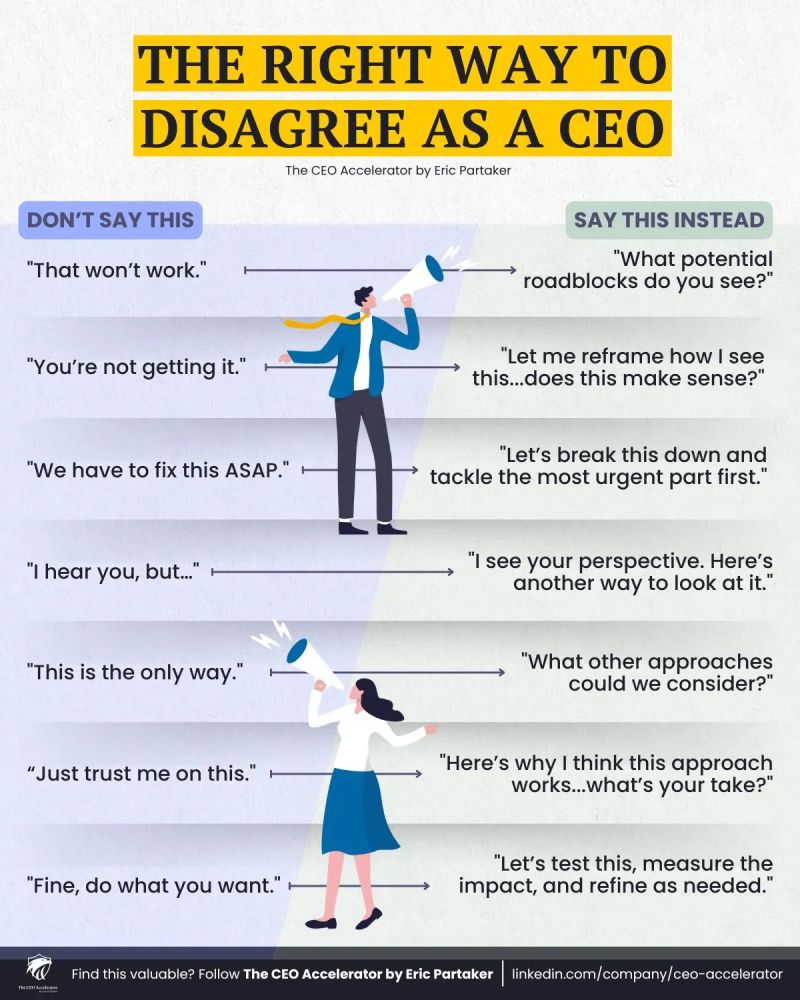
If you shut down ideas with phrases like:

“That won’t work.”
“You’re not getting it.”
“We have to fix this ASAP.”
“I hear you, but…”
“This is the only solution.”
“Just trust me on this.”
“Fine, do what you want.”

…you signal that honest input isn’t welcome.

The best CEOs know productive disagreement
builds stronger companies.

Here are 7 proven ways to lead smarter by changing
how you handle disagreement:

1. Ask About Roadblocks
↳ Turn “That won’t work” into an invitation
to solve problems together.

2. Reframe Your Perspective
↳ Replace frustration with better framing
when communication breaks down.

3. Break Down Problems
↳ Shift from urgent demands
to practical step-by-step solutions.

4. Validate, Then Expand
↳ Eliminate the “but” that erases
everything you just acknowledged.

5. Explore Alternatives
↳ Move beyond single solutions
to discover better possibilities.

6. Explain Your Reasoning
↳ Offer context instead of demanding blind trust
and invite their perspective.

7. Test and Measure
↳ Replace passive aggression with
data-driven decisions everyone owns.

Here’s the reality…

Strong CEOs don’t fear disagreement.

They use it to make better decisions.

The right words don’t just change conversations.
They change companies.

Which phrase will you replace today?

The Door That Knows Your Name

There’s a quiet frustration that comes with standing in front of closed doors. You knock. You wait. You wonder what you’re missing. You replay conversations in your head and second-guess choices you made years ago. You tell yourself that if this one door would just open, everything would finally make sense.

But what if the door isn’t stubborn? What if it’s specific.

The truth most of us don’t want to hear is this: some doors are designed to open only for a certain version of us. Not the edited version. Not the exhausted version. Not the one shaped by fear or people-pleasing or old survival habits. The real one. The one that has done the work. The one that has let go of who they needed to be just to get by.

It’s tempting to believe that success, peace, love, or purpose is about finding the right opportunity. But more often, it’s about becoming the right person to carry what’s on the other side. Some doors lead to responsibility you aren’t ready for yet. Others lead to freedom you don’t fully trust yourself to handle. A few lead to joy that would feel unfamiliar, even uncomfortable, if it arrived too soon.

So the door stays closed. Not as punishment. As protection.

Growth has a way of feeling invisible while it’s happening. You don’t wake up one morning and announce that you are now wiser, braver, calmer, more grounded. It happens quietly, in the choices no one applauds. In the boundaries you hold even when it costs you. In the conversations you finally have. In the ones you walk away from. In the moments you stop trying to prove and start trying to align.

And alignment changes everything.

When you stop contorting yourself to fit doors that were never meant for you, something shifts. You become steadier. Clearer. Less desperate. You stop knocking as loudly. You stop begging for access. You start walking differently. You carry yourself with a confidence that doesn’t need validation.

That’s usually when the right door opens.

Not because you forced it. Not because you waited long enough. But because you arrived as the version of yourself that belonged there all along.

It’s worth saying this gently: not every closed door is a mistake. Some are redirections. Some are invitations to grow before you go further. Some are simply saying, not yet, because the you that walks through this door needs to be stronger, softer, wiser, or more honest than you are today.

And that’s okay.

Becoming yourself is not a linear journey. You’ll outgrow identities you once clung to. You’ll release roles that once defined you. You’ll disappoint people who preferred the old version because it was easier to predict, easier to control, easier to keep small. Let that happen. Doors that require you to shrink were never worth opening.

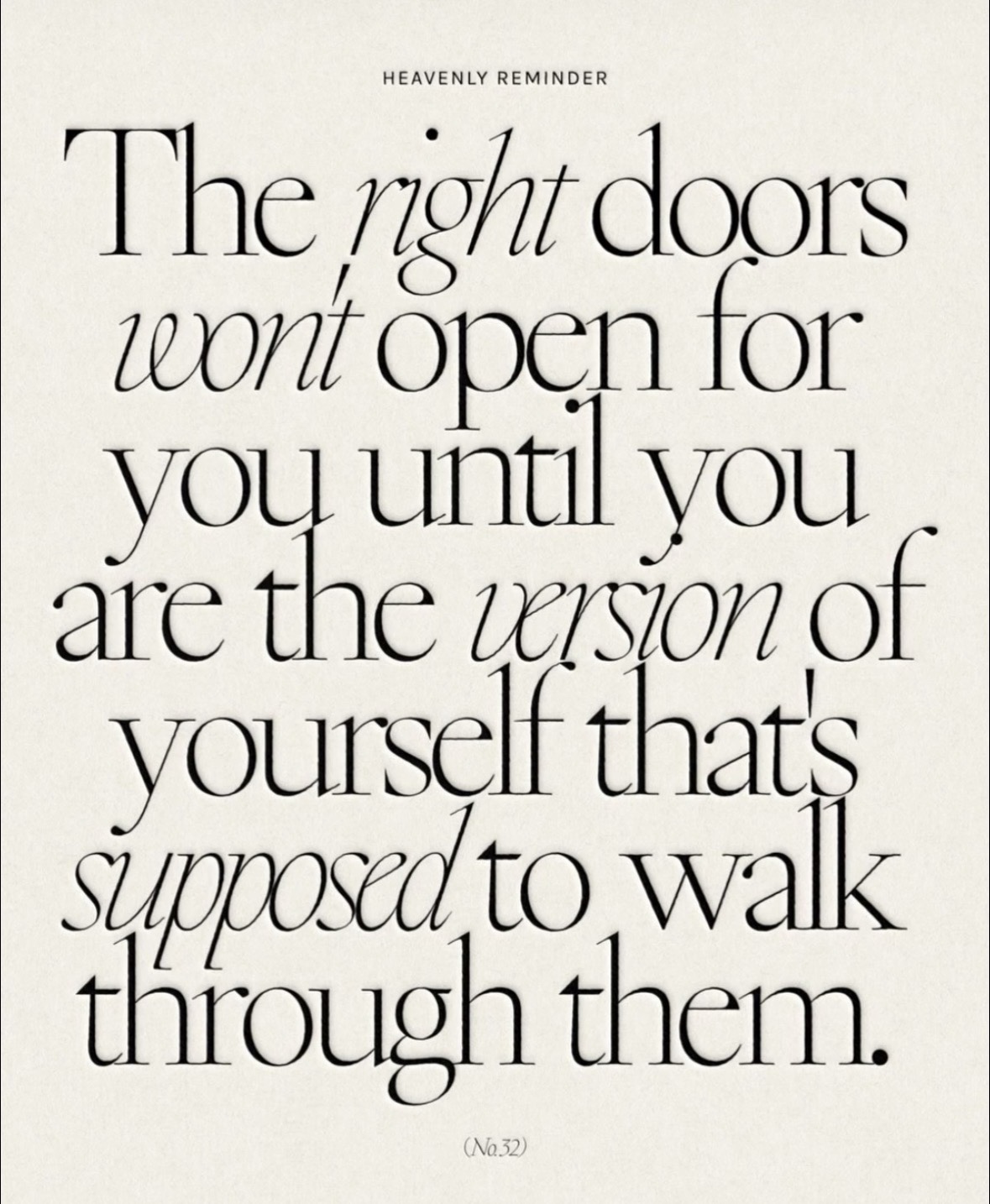
The right doors recognize you. They respond to your presence, not your performance. They open when who you are finally matches what they require.

So if something hasn’t opened yet, don’t assume you’re failing. You might still be becoming.

Keep doing the inner work. Keep choosing honesty over approval. Keep showing up as yourself, even when it feels risky. Especially then.

One day you’ll realize the door didn’t change.

You did.

And when it opens, you won’t have to force your way in.

You’ll just walk through.

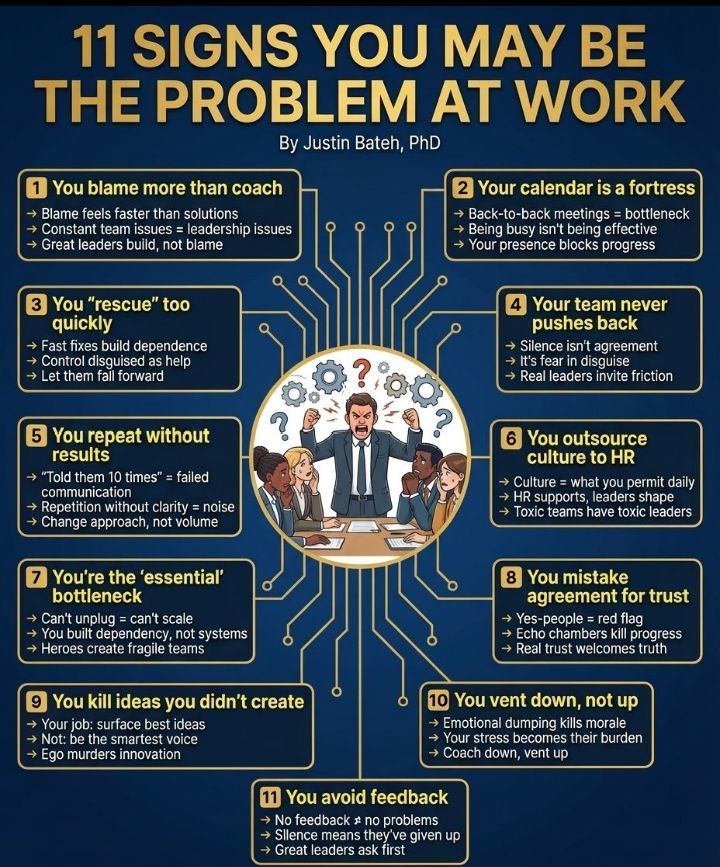
When Leadership Becomes the Constraint: 11 Self-Checks That Matter

Most leadership challenges are not talent problems.
They are awareness problems.
Here are eleven signals worth examining and how effective leaders respond:
1. Problems always belong to “the team”
When issues repeat, ownership sits higher than we think.
Leaders who grow people coach first and blame last.

2. Your schedule leaves no oxygen
A diary packed with meetings often signals control, not productivity.
Impact comes from leverage, not constant presence.

3. You step in before others finish learning
Solving everything creates short-term relief and long-term dependence.
Progress requires space to try, fail, and adjust.

4. No one ever disagrees with you
Agreement without debate is rarely alignment.
Healthy teams are allowed to challenge upward.

5. Messages are heard but not acted on
Repetition is not clarity.
When outcomes don’t change, communication must.

6. Culture is treated as an HR function
Culture is built in daily decisions, not policy documents.
Leadership defines what is acceptable.

7. Work cannot move without you
If everything funnels through one person, growth stalls.
Systems scale; individuals do not.

8. Compliance is mistaken for confidence
Nods and “yes” responses are not trust indicators.
Trust shows up when truth is spoken freely.

9. Ideas are filtered by ego
Leadership is about elevating the best thinking, not protecting authorship.
Innovation thrives where credit is shared.

10. Pressure flows downward
Unprocessed stress damages teams.
Strong leaders manage emotions upward and develop capacity downward.

11. Feedback is avoided or delayed
Silence is not peace,it is disengagement.
Leaders who grow ask early and listen actively.

Leadership strength is not measured by control, visibility, or authority.
It is measured by self-awareness, restraint, and the ability to build others.

The Second Letting Go

There is a quiet kind of exhaustion that comes from replaying things you cannot change. Conversations that already ended. Decisions already made. Outcomes already set in motion. Your hands are empty, but your mind keeps gripping anyway.

We tell ourselves we are being responsible. That if we think about it long enough, worry hard enough, revisit it one more time, something might shift. As if mental effort could reach back into the past or lean into the future and bend it our way. But most of the time, that effort only drains us. It steals sleep. It dulls joy. It turns ordinary moments into background noise while our thoughts are somewhere else entirely.

There is a difference between caring and carrying. Caring is human. Caring is love, commitment, hope. Carrying is when you take responsibility for things that no longer belong to you. Carrying is when your mind keeps clocking overtime for a job you were never hired to do.

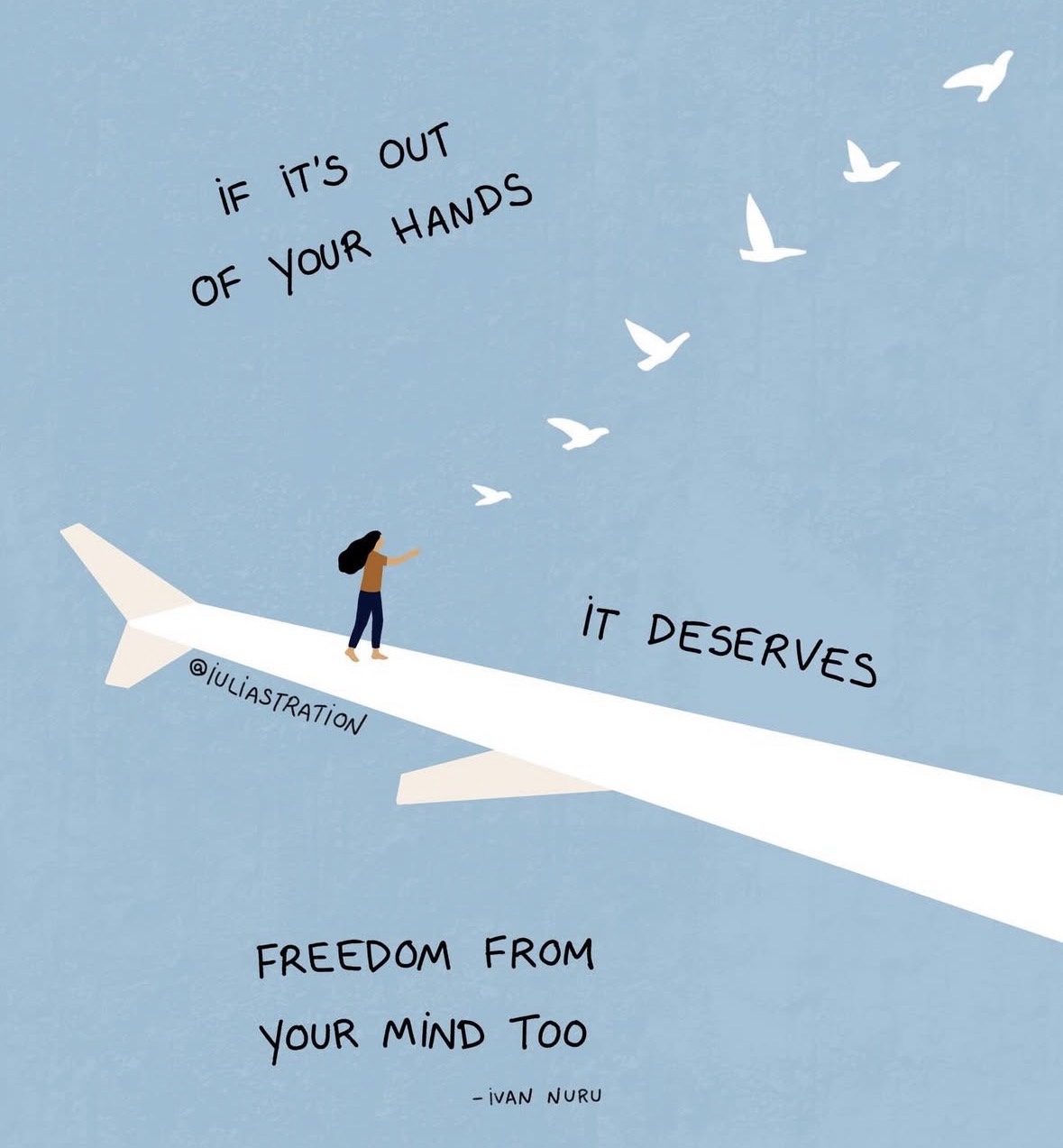
If it is out of your hands, it deserves freedom from your mind too. That is the second letting go. The harder one.

The first letting go is practical. You did what you could. You showed up. You tried. You spoke your truth. You made the call with the information you had. That part is often clear, even if it was painful. The second letting go is emotional. It is deciding not to rehearse the same worry again tomorrow. Not because it does not matter, but because your constant attention will not improve the outcome.

This is where a simple prayer has helped me more than any overthinking ever has.

God, grant me the serenity to accept the things I cannot change,

courage to change the things I can,

and wisdom to know the difference.

There is something grounding about those words. They gently separate life into two piles. What is mine to act on. And what is mine to release. Most of my anxiety comes from mixing the two.

When I slow down and really sit with that prayer, I realize how often I am asking for courage when what I actually need is serenity. How often I am trying to fix what is not fixable, instead of investing my energy where it can actually make a difference.

This does not mean pretending you do not care. It means respecting the boundary between effort and obsession. Between influence and illusion. Between what is yours to solve and what is simply yours to accept.

Most of our stress lives in that illusion. The belief that if we keep something in our mind, we are still somehow in control of it. But control does not come from fixation. It comes from clarity. And clarity often arrives only after you loosen your grip.

Think about how much mental space is quietly occupied by things that are already decided. Someone else’s opinion. A response you cannot force. Timing you cannot rush. A path that closed. A version of events that will never be rewritten. Your mind keeps visiting these places, not because it is productive, but because it is familiar.

Familiar does not mean helpful.

There is relief in saying, I have done my part. There is strength in choosing peace over constant analysis. There is humility in admitting that not everything requires your intervention.

What you can control is how gently you treat yourself now. How fully you show up for the people in front of you. How honestly you listen to what your body and heart are asking for. How willing you are to let today be about today.

Freedom of mind is not indifference. It is trust. Trust that life does not need you to micromanage every outcome to move forward. Trust that what is meant to stay will stay without force. Trust that what leaves is making space for something else, even if you cannot see it yet.

So when your thoughts circle back to something beyond your reach, pause. Say the prayer again if you need to. Ask for serenity before courage. Ask for wisdom before action. Then release it, not with frustration, but with intention.

If it is out of your hands, it deserves freedom from your mind too. And so do you.

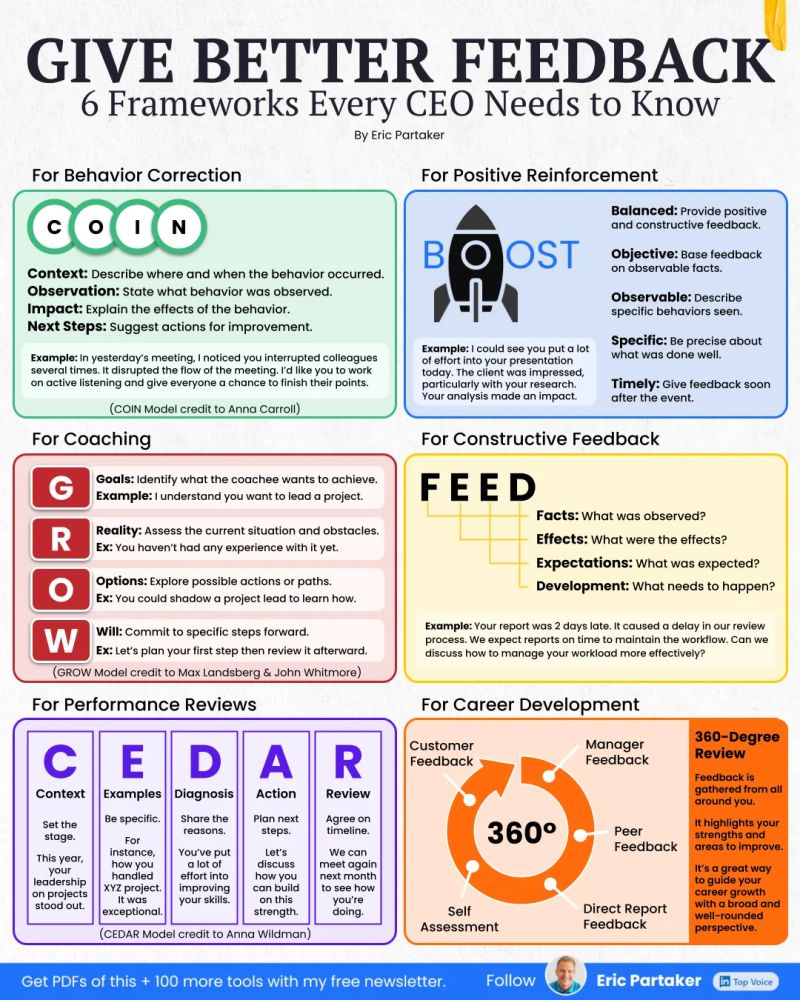
Give Better Feedback

6 feedback frameworks every leader needs to master.

(Most people only know one)

Giving feedback is one of the hardest parts of leadership.

Say too little and nothing changes.

Say too much and you crush someone’s spirit.

The secret?

Having the right framework for the right moment.

Use these 6 powerful approaches to transform
how you give feedback:

1) COIN – For Behavior Correction
↳ Context, Observation, Impact, Next Steps.
↳ Perfect when you need to address something
that went wrong without making it personal.

2) BOOST – For Positive Reinforcement
↳ Balanced, Objective, Observable, Specific, Timely.
↳ Because vague praise like “good job” means nothing.

3) GROW – For Coaching Conversations
↳ Goals, Reality, Options, Will.
↳ Helps your people find their own answers
instead of you handing them solutions.

4) FEED – For Constructive Feedback
↳ Facts, Effects, Expectations, Development.
↳ Keeps difficult conversations grounded in
what actually happened.

5) CEDAR – For Performance Reviews
↳ Context, Examples, Diagnosis, Action, Review.
↳ Makes annual reviews feel useful instead of dreaded.

6) 360-Degree Review – For Career Development
↳ Gathers input from all directions.
↳ Gives your people the full picture of how they show up.

After 20+ years of leadership, I’ve learned:

The framework matters less than the intention behind it.

If your people know you genuinely care
about their growth,

they’ll receive even tough feedback as a gift.

If they sense you’re just checking a box,
no framework will save you.

Choose the right tool for the moment.

Lead with kindness.

And watch your team transform.

Save this cheat sheet. You’ll need it.

Right in the Middle Is Where Love Lives

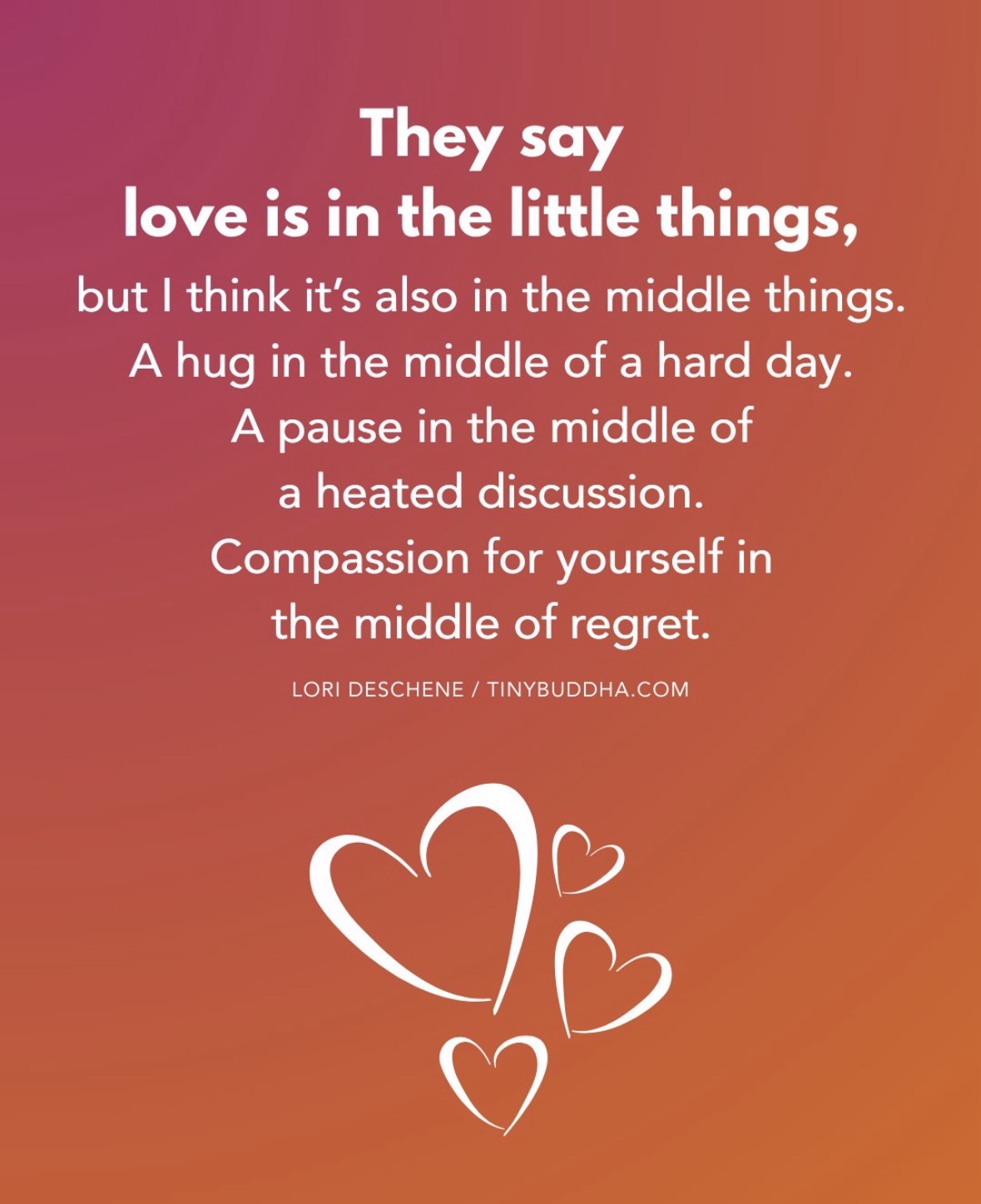
They say love is in the little things, and that is true. It shows up in morning coffee made just the way you like it, in quick check-in texts, in remembering the small details that make someone feel seen. But I think we sell love short when we limit it to only the little moments.

Because love also lives in the middle.

The middle of the day when you are already tired, but still have hours to go. The middle of a conversation when emotions are running high and it would be easier to win than to understand. The middle of a season when things did not turn out how you hoped and the regret feels heavier than the lesson.

That is where love does some of its most important work.

A hug in the middle of a hard day is different from one at the beginning or the end. At the start, you still have energy. At the end, relief is already in sight. But in the middle, when you feel stuck, overwhelmed, or unsure how you are going to make it through, that hug says, “You are not alone in this part.” It does not fix the problem, but it steadies you. It reminds you that you can keep going.

A pause in the middle of a heated discussion might be one of the most underrated acts of love there is. Not storming out. Not escalating. Just stopping long enough to breathe and choose your next words with care. The pause says, “This relationship matters more than being right.” It creates space for listening instead of reacting, for connection instead of damage.

And then there is compassion for yourself in the middle of regret. This one might be the hardest. We are often kind to ourselves when things are going well and surprisingly gentle once enough time has passed. But in the middle, when the mistake is still fresh and the consequences are still unfolding, we tend to be ruthless. Love, in that moment, looks like acknowledging the regret without letting it define you. It sounds like saying, “I made a choice I wish I had made differently, and I am still worthy of grace.”

The middle is uncomfortable because it is unfinished. There is no clean resolution yet. No tidy ending. That is exactly why love there matters so much. It is easy to show up when things are light and easy. It is meaningful to show up when things are messy, tense, or unresolved.

Think about the people who stayed with you in the middle of your story. Not just at the beginning when excitement was high, and not only at the end when clarity arrived, but right in the thick of it. The ones who listened without rushing you. The ones who offered patience instead of pressure. The ones who reminded you of who you were when you forgot.

Chances are, those are the people you trust the most.

And maybe the quiet invitation here is to be that person, too. For others, yes. But also for yourself. To offer presence instead of perfection. To choose kindness when frustration would be easier. To remember that growth, healing, and love rarely happen at the edges. They happen right in the middle, where life is actually being lived.

So if you are there right now, in the middle of something hard, unresolved, or uncertain, take heart. Love has not missed you. This is one of the places it shows up best.

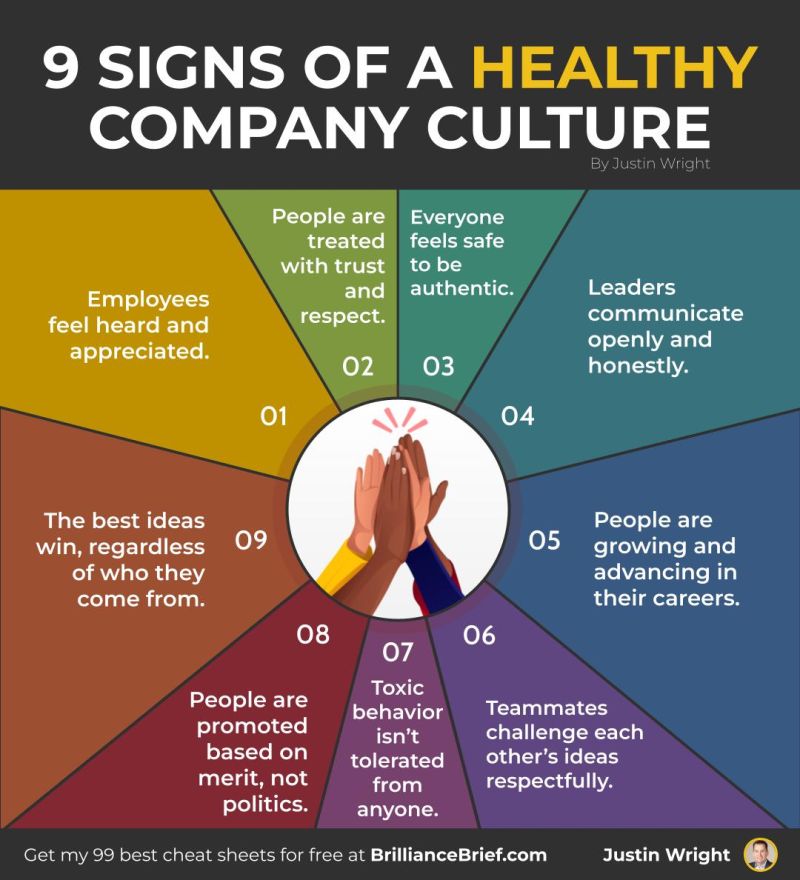
9 Signs of a Healthy Company Culture

Good people quit toxic work cultures, not jobs.

9 signs of a healthy culture:

(Hint: It’s not about the perks. It’s about the people.)

1. Employees feel heard and appreciated.
↳ They know their contributions are valued.

2. People are treated with trust and respect.
↳ Regardless of their role or level.

3. Everyone feels safe to be authentic.
↳ No need to put on a persona or mask.

4. Leaders communicate openly and honestly.
↳ They welcome questions and feedback.

5. People are growing and advancing in their careers.
↳ Hard work and dedication are rewarded.

6. Teammates challenge each other respectfully.
↳ Healthy debate is encouraged.

7. Toxic behavior isn’t tolerated from anyone.
↳ Everyone is held to the same standards.

8. People are promoted based on merit, not politics.
↳ Performance and potential are what matters.

9. The best ideas win, regardless of who has them.
↳ Good ideas are recognized and implemented.

A healthy culture isn’t just good to have.

It’s a must-have for attracting and retaining top talent.

When you prioritize your people over your profits,
both will grow faster

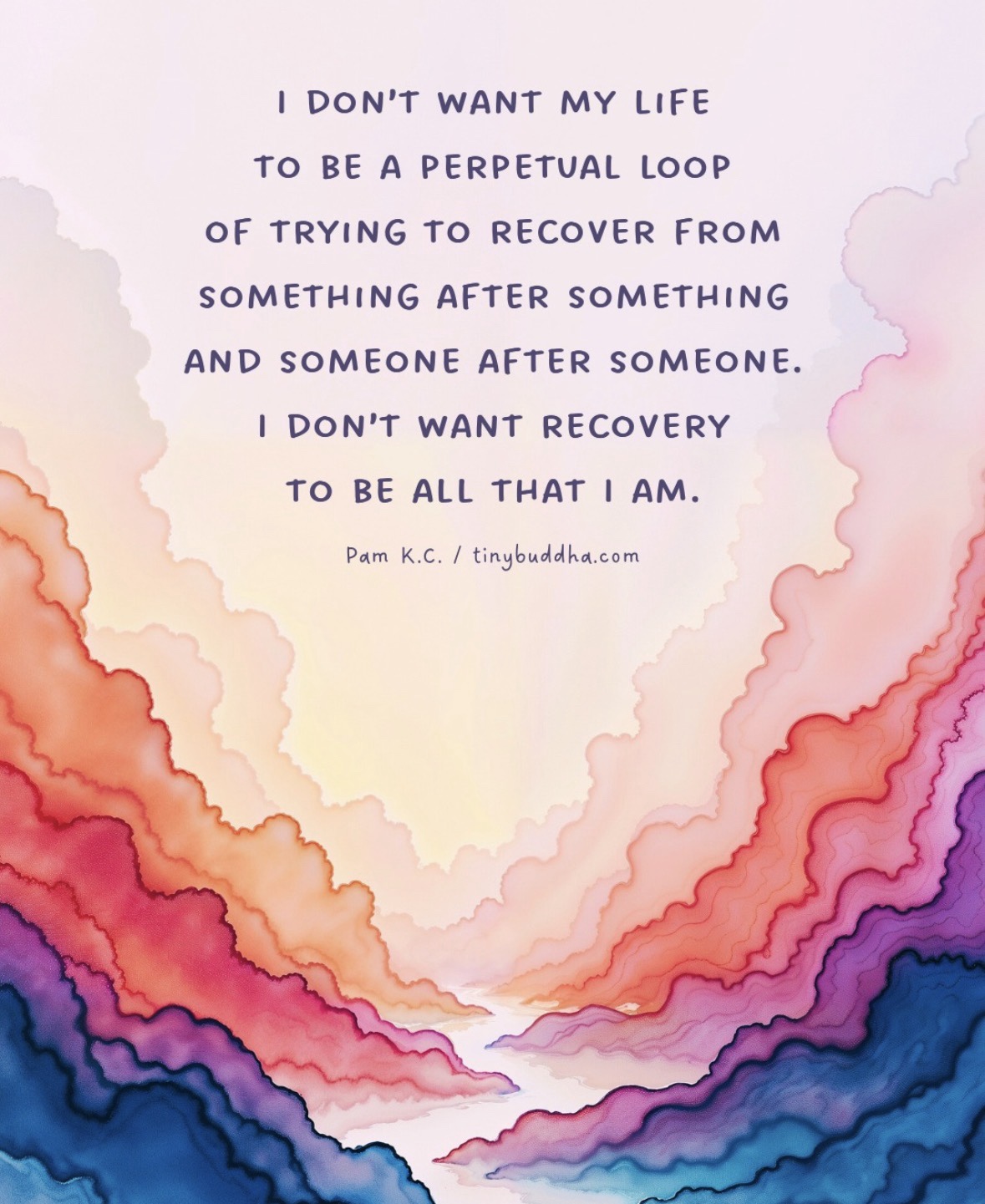
I Don’t Want Recovery to Be My Personality

I don’t want my life to feel like a reset button I keep pressing out of exhaustion.

I don’t want to move from one thing to the next, always cleaning up emotional debris. Always regrouping. Always telling myself, Okay, just get through this part first. It’s draining to realize how much of your energy goes into undoing damage instead of creating something meaningful.

There’s a subtle trap in being “good at recovery.” People admire it. You start to admire it too. You wear it like proof that you can handle hard things. And you can. But handling hard things over and over doesn’t automatically mean you’re living well.

It just means you’ve gotten used to pain having a seat at the table.

When recovery becomes routine, you stop asking harder questions. Why does this keep happening? Why do I keep ending up depleted? Why does rest feel like repair instead of renewal? Somewhere along the way, survival quietly replaced intention.

And that’s not a dramatic realization. It’s a tired one.

I don’t want every chapter of my life to begin with loss and end with healing. I don’t want growth to always come from being worn down first. I don’t want relationships, environments, or ambitions that demand I break a little just to belong.

This isn’t about avoiding difficulty. Life will always have its weight. But there’s a difference between challenges that shape you and patterns that erode you.

Recovery should be a season, not a lifestyle.

There’s something deeply human about wanting steadiness. About wanting days that don’t require processing afterward. About wanting joy that doesn’t arrive as relief. Wanting that doesn’t make you fragile—it means you’re paying attention.

Maybe the shift isn’t about becoming tougher.

Maybe it’s about becoming more selective.

More selective with time.

With people.

With expectations.

With the version of “strength” you keep proving at your own expense.

I don’t want to look back and see a life defined by how often I had to pull myself together. I want to remember what I built when I wasn’t busy recovering. I want to know who I was when I finally chose spaces that didn’t demand resilience as the entry fee.

Recovery has its place. It always will.

But I don’t want it to be all that I am.