
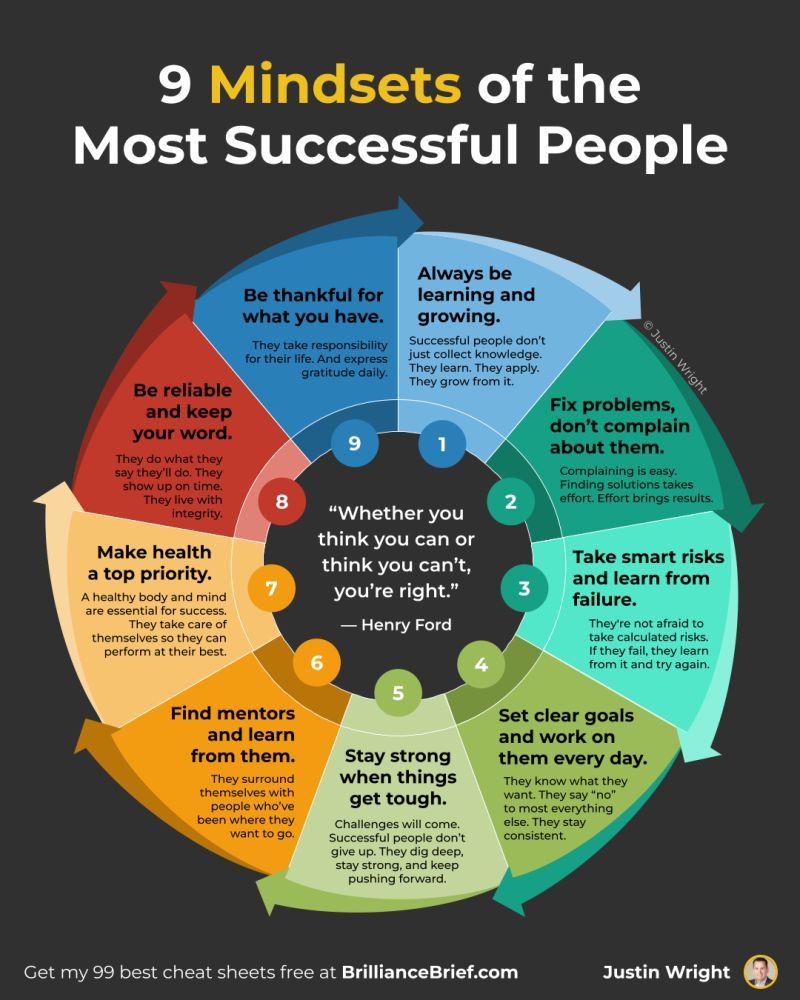
They’re not born with them.
They develop them through daily habits.
And you can too. Here’s how:
1. Embrace curiosity.
↳ Ask questions. Invite new perspectives.
↳ Learning isn’t a phase. It’s a lifelong pursuit.
2. Focus on solutions.
↳ When problems arise, take a breath.
↳ Then ask: What can I do to fix this?
3. Reframe failure.
↳ Setbacks happen. Success is how you respond.
↳ Persistence beats talent every time.
4. Prioritize ruthlessly.
↳ Set clear goals. Say no to distractions.
↳ Consistency compounds. Small steps = big results.
5. Be resilient.
↳ Challenges will come. Prepare yourself mentally.
↳ When they hit, dig deep. Stay strong.
6. Seek wisdom.
↳ Surround yourself with people who inspire you.
↳ Listen to their stories. Learn from their mistakes.
7. Invest in yourself.
↳ Your health is your greatest asset.
↳ Prioritize sleep, nutrition, and exercise.
8. Keep your commitments.
↳ Long-term success is built on integrity.
↳ Do what you say. Show up on time.
9. Take responsibility. Give gratitude.
↳ Own your life. Your wins. Your losses.
↳ And be thankful for all of it.
Mindset is a choice.
You can’t control everything that happens.
But you can always control your response.
Success is the sum of your daily choices.
It’s not easy. But it’s always worth it.
No One Is Coming – and That’s the Point
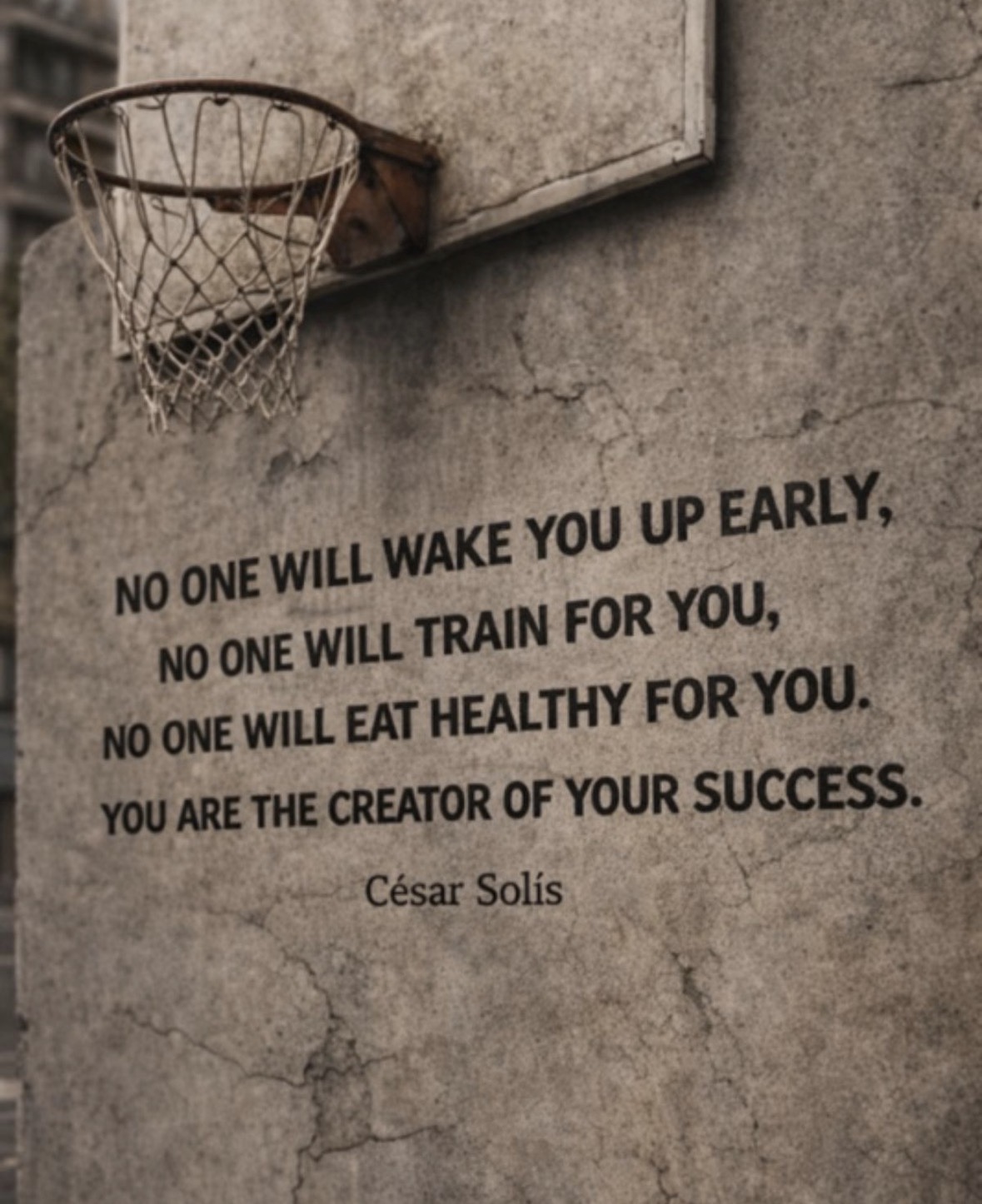
There’s a quiet truth most of us bump into sooner or later, usually when life stops nudging and starts waiting. No one is coming to wake you up early. No one is going to drag you to the gym, sit beside you while you learn a new skill, or gently swap out your late-night snacks for something healthier. Not because people don’t care—but because this part was never theirs to do.
That realization can feel heavy at first. Almost unfair. Wouldn’t it be nice if motivation showed up like a personal assistant? If discipline was contagious? If someone else could just do the hard parts for us while we enjoyed the results?
But that’s not how it works. And once you really accept that, something interesting happens.
Your day starts exactly where you decide it does. Not when someone reminds you, not when circumstances are perfect, not when you “feel like it.” Just when you choose to get up. That moment—bleary-eyed, half-awake, tempted to hit snooze—is where a lot of outcomes quietly begin. No applause. No audience. Just a small decision that stacks up over time.
The same goes for effort. Training, learning, practicing—whatever your version of growth looks like—it’s deeply personal. People can cheer you on, share advice, even open doors for you. But they can’t walk through them on your behalf. They can’t carry the discomfort. They can’t build the muscle or the skill or the resilience for you. That work has your name on it.
And then there’s health. Probably the most honest mirror we have. You can read all the articles, follow all the right people, buy all the good intentions. But at some point, it comes down to what you put in your body and how you treat it when no one’s watching. That’s not about perfection. It’s about ownership. About realizing that consistency beats intensity, and small choices repeated daily matter far more than dramatic resets.
This isn’t meant to sound harsh. It’s actually freeing.
When you stop waiting for external pushes, you stop giving away your power. You realize that your progress doesn’t depend on the perfect routine, the perfect mentor, or the perfect timing. It depends on you showing up—imperfectly, sometimes reluctantly—but regularly.
And here’s the part we don’t talk about enough: this applies to success in every form. Career. Relationships. Peace of mind. Confidence. No one will believe in you on your behalf if you don’t. No one will take the risk for you. No one will become disciplined so you can benefit from it indirectly.
You are the common denominator.
That doesn’t mean you have to do everything alone. Support matters. Community matters. Rest matters. But responsibility? That’s non-transferable.
Once you accept that you’re the creator of your success, excuses lose their grip. You stop negotiating with your potential. You stop outsourcing your future to hope or luck or someday. You start asking better questions: What can I do today? What’s one small thing I can control? What choice would the version of me I respect most make right now?
Some days you’ll nail it. Some days you won’t. That’s normal. The goal isn’t to be relentlessly motivated. It’s to be gently relentless. To keep going even when it’s boring, even when it’s quiet, even when no one notices.
Especially then.
Because the life you want isn’t built in big, cinematic moments. It’s built in ordinary mornings, repeated efforts, and private decisions. And the good news—maybe the best news—is that all of those are already within your reach.
No one is coming to wake you up.
And that’s exactly why you can.
Anchor in Your Own Truth

At some point in life, we all realize something uncomfortable and strangely freeing at the same time: people are going to have opinions about us no matter what we do. Loud ones. Quiet ones. Half-formed ones based on a single moment, a single sentence, or a version of us that no longer exists. And if we’re not careful, those opinions start to feel heavier than they deserve to be.
The real danger isn’t that people think things about you. The danger is when what they think starts to outweigh what you know.
You know your intentions. You know the nights you stayed up worrying, the mornings you showed up anyway, the choices you made when no one was watching. You know the reasons behind your silences, your pauses, your boundaries. Other people don’t. They see fragments. Highlights. Sometimes shadows. And then they fill in the gaps with their own experiences, insecurities, and assumptions.
That’s not cruelty most of the time. It’s just human nature.
The problem begins when you start outsourcing your self-worth to those incomplete narratives. When a raised eyebrow makes you question your values. When a careless comment makes you rewrite your story. When praise becomes oxygen and criticism becomes gravity.
It’s subtle. It creeps in disguised as self-awareness or humility. Maybe they’re right. Maybe I should tone this down. Maybe I’m too much… or not enough. And slowly, you begin negotiating with yourself. Trimming parts. Softening edges. Explaining things that don’t need explaining.
But here’s the quiet truth: the people who misunderstand you the most are often the ones who haven’t taken the time to really see you. And the people who truly see you rarely feel the need to label you at all.
You don’t owe everyone clarity. You don’t owe everyone access. And you certainly don’t owe everyone the power to define you.
There’s a difference between listening and absorbing. Listening can help you grow. Absorbing everything will only dilute you. Wisdom lies in knowing which voices are mirrors and which are just noise. Mirrors reflect who you are. Noise just echoes what others carry.
Confidence isn’t loud. It doesn’t announce itself or win every argument. Real confidence is quiet and steady. It’s the ability to stand still inside yourself even when the room is restless. It’s knowing that being misunderstood doesn’t make you wrong. It just means you’re not living for applause.
Some seasons will teach you this lesson the hard way. You’ll do your best and still be judged. You’ll act with integrity and still be doubted. You’ll stay true and still be talked about. And that’s when the line becomes clear: you can either defend yourself endlessly, or you can anchor yourself deeply.
Anchors don’t chase waves. They hold.
Let people think what they want. Let them project, assume, speculate. Their thoughts are shaped by their journeys, not yours. What matters is that when everything goes quiet—when it’s just you and your own reflection—you recognize yourself. You trust yourself. You respect yourself.
Because at the end of the day, the voice you live with is your own.
Never let what someone else thinks about you detract from what you know about yourself. That knowing wasn’t given to you lightly. It was earned. Through growth. Through mistakes. Through resilience. Protect it. Stay rooted in it. And keep walking forward—unapologetically, calmly, and in your own truth.
Why Nadal Arranged His Water Bottles The Same Way

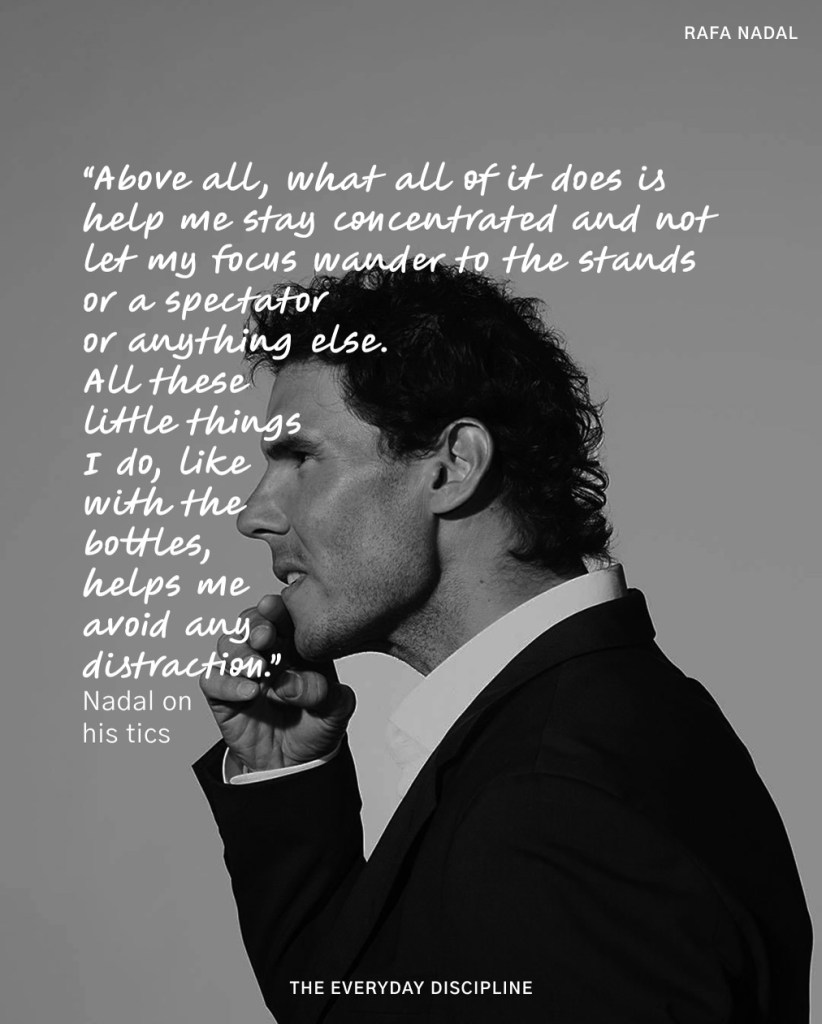
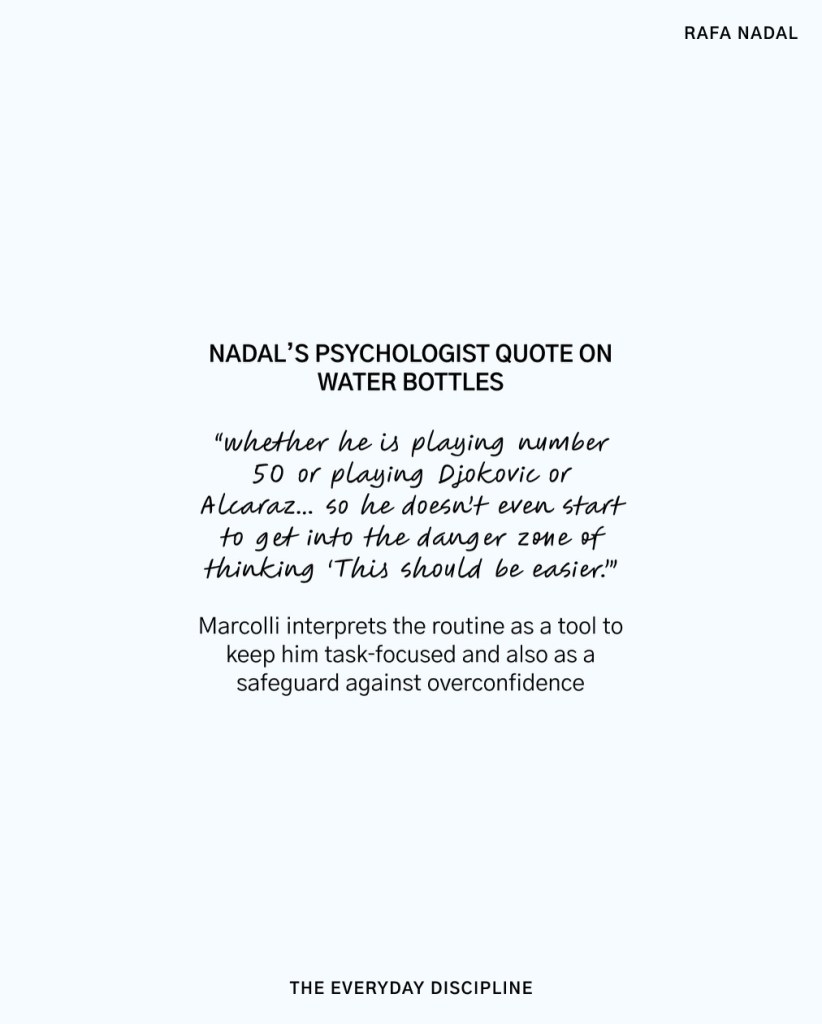
There’s a moment before every Rafael Nadal serve that fans know by heart. The towels. The footsteps. And then the bottles—placed carefully at his feet, one slightly behind the other, angled just so, facing the court. To some, it looks obsessive. To others, superstitious. But Nadal himself explained it best when he said it isn’t superstition at all. It’s order.
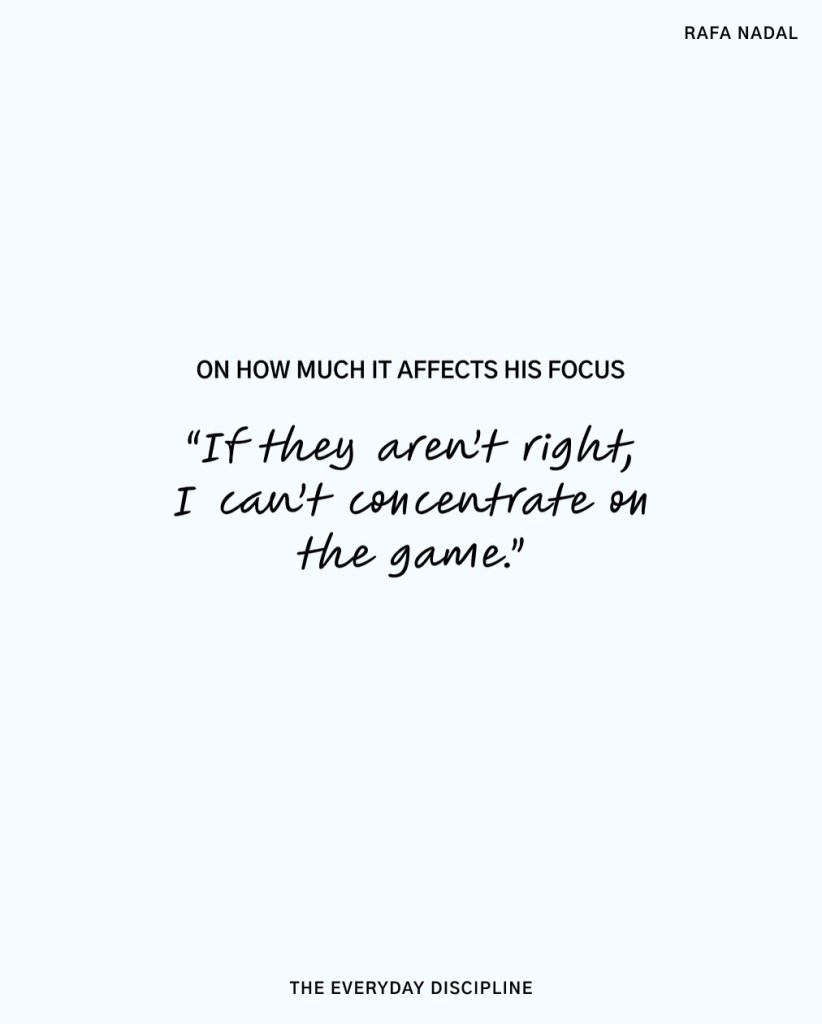
What struck me about that explanation isn’t the bottles. It’s the honesty behind it. If it were superstition, he says, he’d only do it when he’s winning. But he does it whether he’s ahead or behind, confident or struggling. Because the act isn’t about controlling the outcome. It’s about controlling the inner space he steps into before the point begins.
That’s such a subtle but powerful distinction.
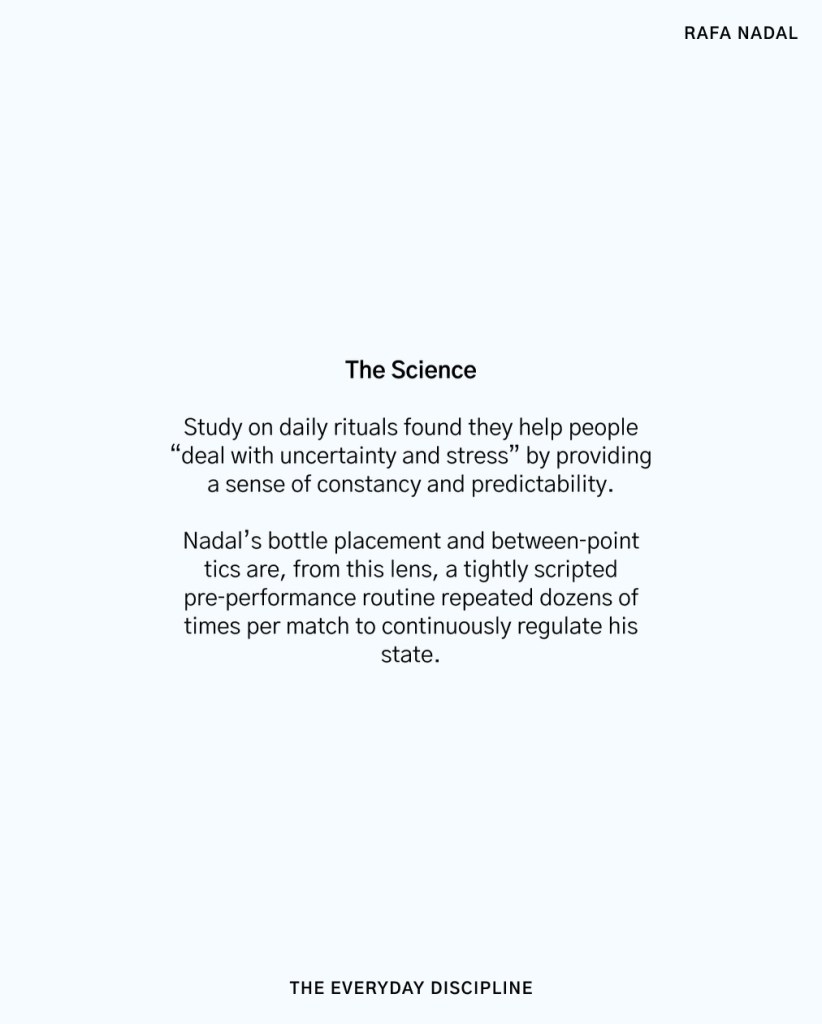
We often confuse rituals with magical thinking. We assume they’re about luck, fear, or trying to bend fate in our favor. But the best rituals aren’t about the future. They’re about the present. They’re about alignment. Nadal isn’t trying to convince the universe to let him win a point. He’s bringing his surroundings into harmony with the clarity he wants in his mind.
In a world that constantly pulls at our attention, that kind of intentional order feels almost radical.
Think about it. Most of us don’t walk onto a tennis court with 15,000 people watching, but we all step into moments that demand focus—important meetings, difficult conversations, creative work, decisions that matter. And before those moments, our minds are usually anything but ordered. They’re cluttered with noise, expectations, doubts, and unfinished thoughts.
So we rush in unprepared, hoping things will somehow “work out.”
Nadal doesn’t rush. He pauses. He creates a small island of control in the middle of chaos. Two bottles. Same position. Same orientation. Not because they guarantee success, but because they remind him: this is where I am, this is what I’m doing, and this is how I enter the moment.
There’s something deeply human about that.
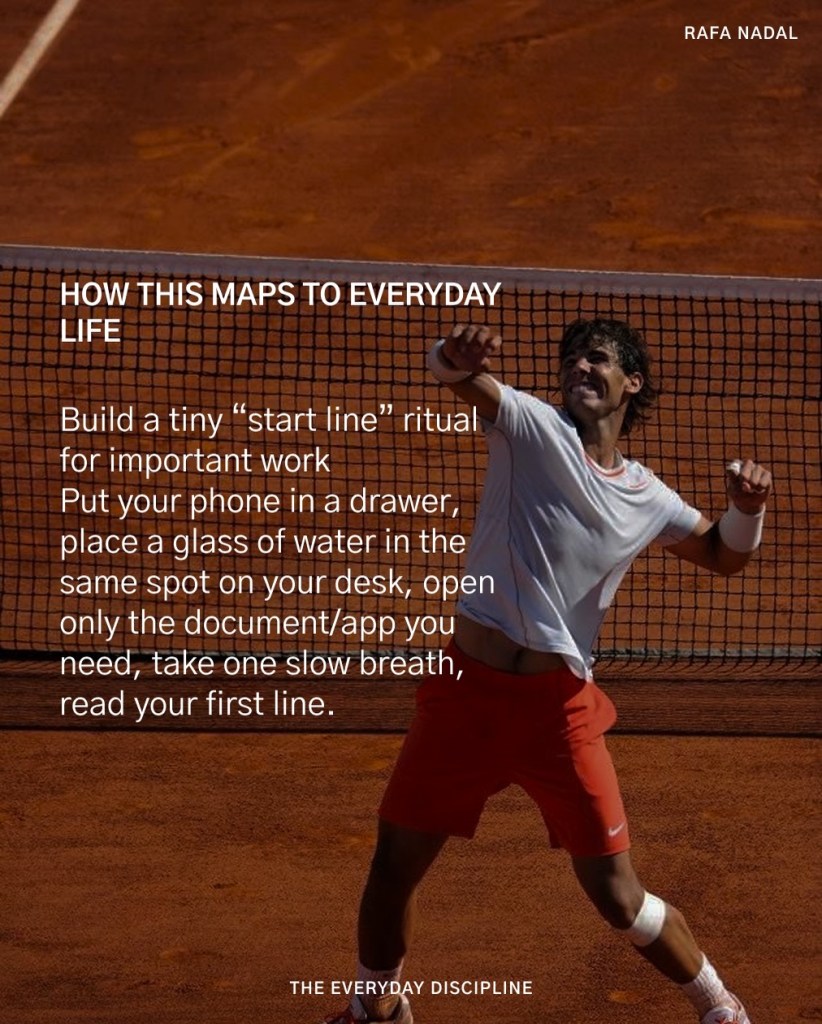
We all have our versions of the bottles, even if we don’t call them that. The way you arrange your desk before starting deep work. The playlist you put on before a long drive. The quiet breath you take before speaking up. These aren’t superstitions. They’re signals. They tell your mind it’s time to be present.
What I love most about Nadal’s insight is the idea of “ordering the outside to match the order I seek inside.” That flips the usual narrative. We often wait to feel calm before we act. He acts in a calm way so calm can arrive. The ritual comes first. The mindset follows.
Maybe that’s the real lesson here.
You don’t need grand gestures or dramatic routines. Sometimes all it takes is a small, repeatable act that grounds you. Something you do consistently, regardless of whether things are going your way. Not to control results—but to center yourself.
Because at the end of the day, performance isn’t just about talent or effort. It’s about the state you show up in. And if placing two bottles just right helps one of the greatest athletes of all time find that state, maybe it’s worth asking yourself: what helps you place yourself in the moment?
Not superstition. Just order.
I Love My Job (and That Shouldn’t Be Rare)
I love my job.
Saying that out loud still feels a little strange, almost like I need to qualify it or soften it. Like I should quickly add, “Not every day,” or “I know I’m lucky,” or “Of course, there are hard parts.” And all of that is true. But none of it changes the core statement. I love what I do.
What’s interesting is how often that sentence is met with surprise. Sometimes with admiration. Sometimes with quiet disbelief. As if loving your work is some rare outcome reserved for a handful of people who stumbled into the right path at the right time. As if fulfillment at work is a bonus feature, not something we should reasonably expect.
I don’t think it should be that way.
Work takes up too much of our lives for love and meaning to be optional. It takes our best hours, our sharpest thinking, our emotional energy. It spills into our evenings, our weekends, our conversations at home. When work feels empty or misaligned, it doesn’t stay neatly contained between office hours. It seeps into everything.
I’ve had phases in my career where work was just something to get through. Where the goal was to survive the week, collect the paycheck, and recover on the weekend. There was nothing dramatic or broken about those jobs. They were “fine.” And that’s exactly the problem. Fine slowly numbs you. It lowers your expectations without you realizing it.
Loving my job today doesn’t mean I love every task. There are long days. Hard decisions. Pressure. Moments of doubt. But underneath all of that is a sense of alignment. The feeling that what I’m building matters. That my voice is heard. That I’m growing, not shrinking. That I don’t have to leave my values at the door to be effective.
That feeling changes everything.
It makes effort feel purposeful instead of draining. It makes challenges feel worth leaning into. It makes you care, not because you’re forced to, but because you want to. And when people care, they bring more of themselves to the work. Creativity shows up. Ownership shows up. Pride shows up.
What bothers me is how often fulfillment at work is framed as luck. As if the rest of the workforce should quietly accept disengagement as normal and be grateful for stability alone. That framing lets systems off the hook. It turns a design problem into a personal failing. If you’re unhappy, the message is often: manage it better, hustle harder, be more resilient.
But fulfillment isn’t something you can squeeze out of thin air after hours. It’s shaped by how work is designed. By culture. By leadership. By whether people are trusted, respected, and allowed to be human. Jobs don’t accidentally become soul-crushing. They’re built that way, slowly, through choices.
And if choices created the problem, choices can also change it.
I love my job not because it’s perfect, but because it allows me to care deeply without burning out. Because curiosity is encouraged, not punished. Because growth is expected, not feared. Because the people around me value meaning as much as metrics.
That shouldn’t make me an outlier.
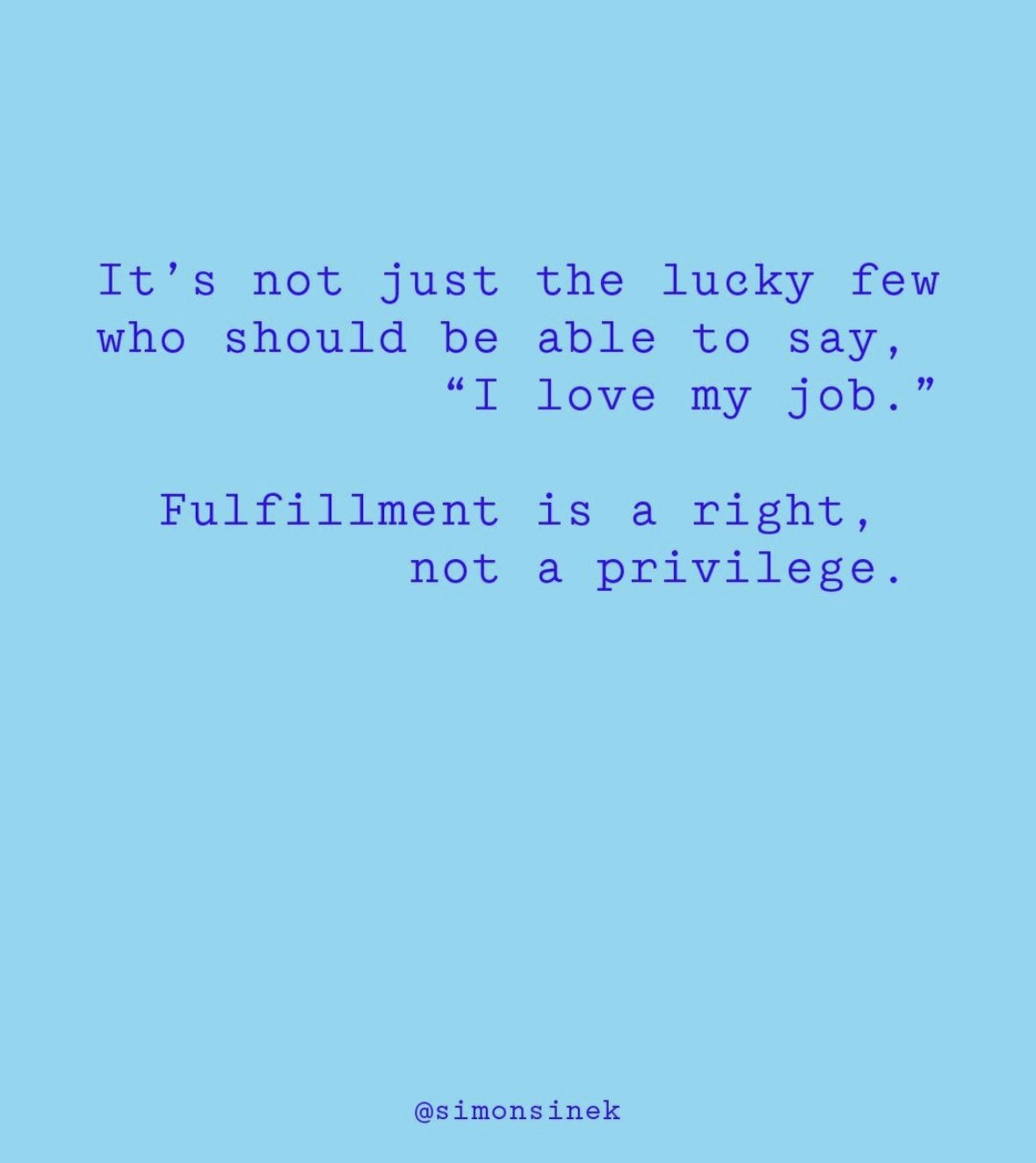
Wanting to love your job doesn’t make you entitled. It makes you honest. It means you recognize that fulfillment isn’t a luxury add-on to life. It’s part of a life well lived. We shouldn’t need to apologize for wanting work that aligns with who we are.
I don’t believe fulfillment should belong to the lucky few. I believe it should be something we actively design for, talk about openly, and refuse to dismiss as unrealistic. Because when people are fulfilled, everyone benefits. The work is better. The energy is better. The lives around that work are better.
I love my job.
And I hope one day that sentence feels ordinary, not exceptional.
Give Them a Front-Row Seat
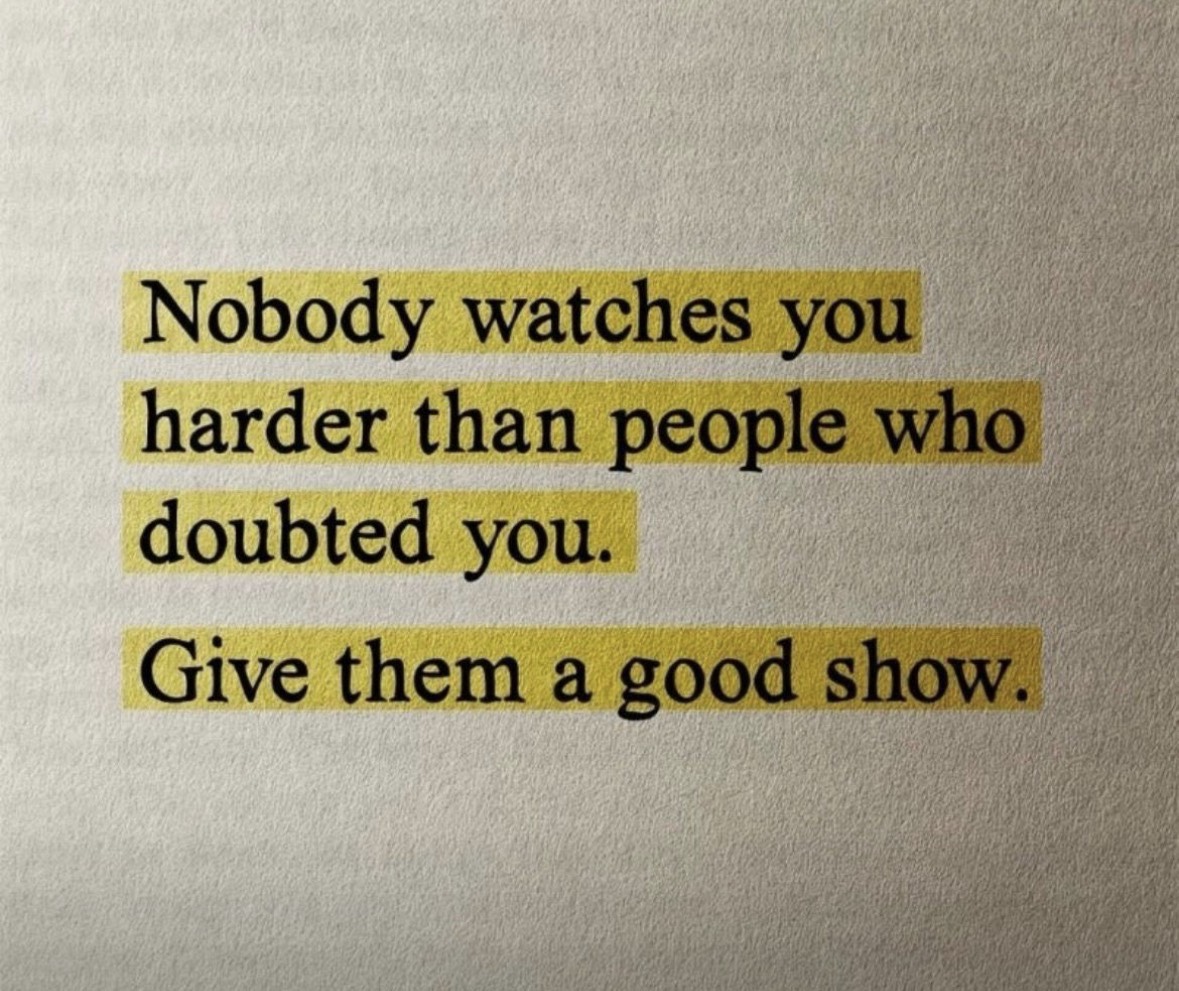
There’s a strange truth we don’t talk about enough: nobody studies your life more closely than the people who once doubted you. Not the ones cheering you on. Not the ones who believe in you no matter what. It’s the skeptics. The quiet critics. The people who smiled politely while filing you away under not quite enough.
They may not say it out loud, but they’re watching. Watching how you respond when things don’t go your way. Watching whether you stay consistent or fade out. Watching if you become bitter, smaller, louder, quieter, or better.
And honestly, that awareness can mess with your head if you let it.
At first, it can feel uncomfortable. Like you’re constantly being evaluated, even when no one is asking questions. You replay old conversations. You remember dismissive comments that were disguised as advice. You recall the raised eyebrows, the half-hearted encouragement, the subtle way expectations were kept low. Those moments stick. They shouldn’t, but they do.
The temptation is to prove something. To move fast, talk louder, show receipts, chase validation. To make sure everyone knows they were wrong.
But the real power move is quieter than that.
It’s choosing to live well without making a spectacle of your resentment. It’s letting your growth speak before your mouth ever does. It’s focusing so deeply on becoming who you’re meant to be that you forget to check who’s watching, until one day you realize they never stopped.
People who doubt you often do it from a place of their own limits. They measure you using the ruler they use for themselves. If they couldn’t imagine taking the risk, changing paths, starting over, or enduring the discomfort you accepted, they quietly assumed you wouldn’t either. Doubt, most of the time, isn’t personal. It’s projection.
And that’s why your consistency rattles them.
Not the big announcements. Not the milestones you post about. It’s the unglamorous discipline. The fact that you kept going when the novelty wore off. That you didn’t disappear when things got hard. That you stayed grounded instead of becoming defensive. That you learned instead of sulking. That you evolved without asking for permission.
There’s something deeply unsettling, yet inspiring, about watching someone outgrow a version of themselves you were sure they’d stay stuck in.
Here’s the thing though. The “good show” isn’t about flexing. It’s not about rubbing success in anyone’s face or crafting a highlight reel for people who once underestimated you. That kind of performance is exhausting, and it still gives your doubters too much control over your story.
The real show is integrity.
It’s the way you carry yourself when no one is applauding. The way you treat people who once overlooked you. The way you stay curious instead of arrogant. The way you let results accumulate quietly over time. The way your confidence becomes calm instead of loud.
That kind of progress is undeniable. And it’s impossible to fake.
Somewhere along the way, you’ll notice a shift. The same people who questioned you start asking questions. The skepticism softens into curiosity. Sometimes into admiration. Sometimes into silence. Not everyone will come around, and that’s okay. Growth doesn’t require unanimous approval.
What matters is that you didn’t let doubt shrink you.
You didn’t turn cynical. You didn’t abandon yourself just to fit someone else’s expectations. You didn’t stop dreaming because the room was small-minded. You stayed focused. You stayed human. You stayed moving.
And yes, they noticed.
They noticed that you didn’t burn bridges. That you didn’t become bitter. That you didn’t rush the process. That you didn’t need to announce every win. That you let time do what time always does, reveal truth.
So if you ever feel that quiet pressure, that sense of being watched by people who once doubted you, don’t let it weigh you down. Let it remind you of how far you’ve come. Let it sharpen your discipline, not your ego. Let it push you toward excellence, not performance.
Because the best response to doubt was never an argument.
It was a life well lived.
Give them a good show, not by trying to impress, but by becoming undeniable.
The Storm That Made Sense Later
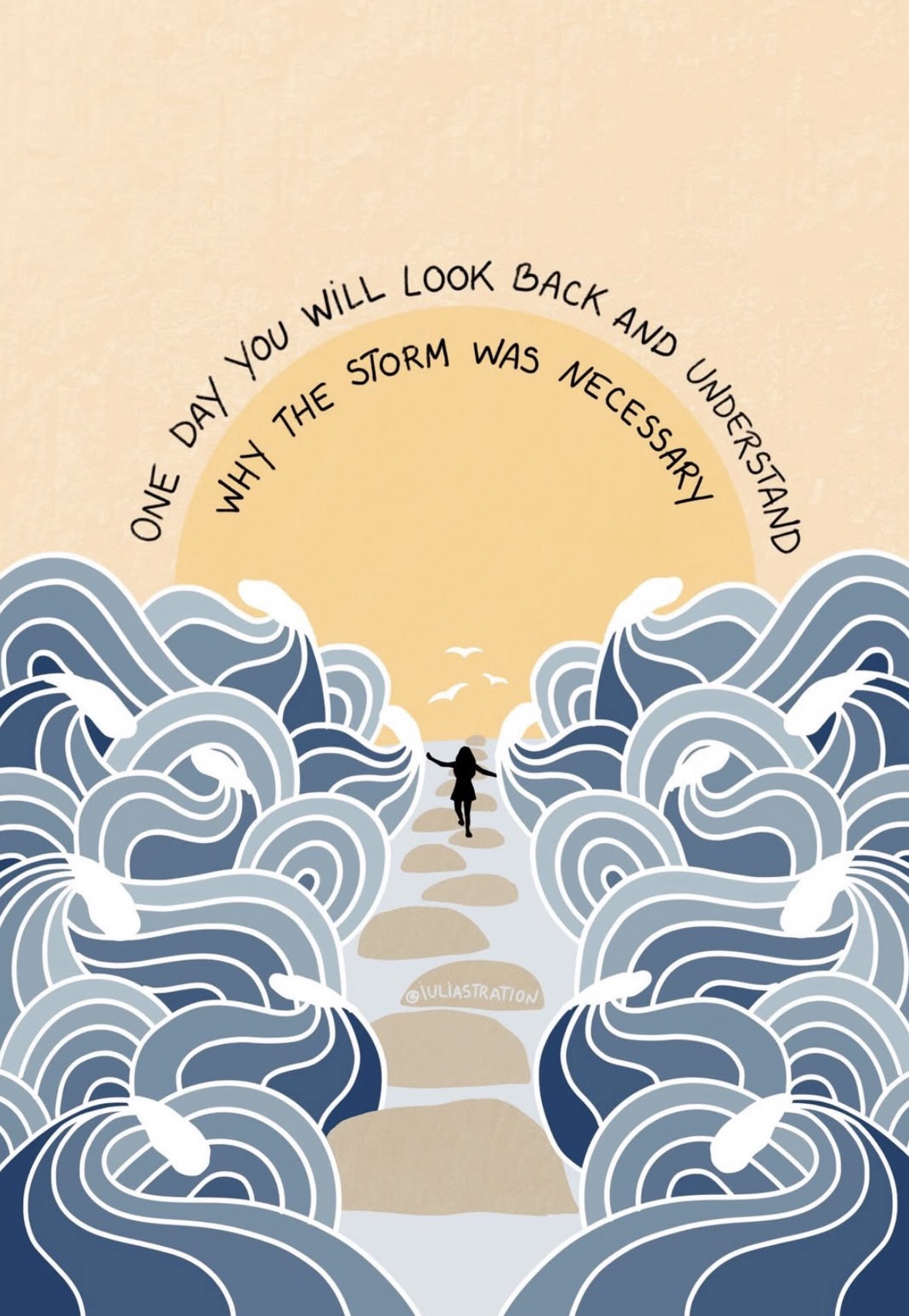
There are seasons in life that don’t make sense while you’re in them. Everything feels loud, messy, and unsettled. You’re doing your best just to keep your footing, wondering what you did wrong, or what you could have done differently to avoid the chaos. When you’re in the middle of a storm, perspective is a luxury you don’t have.
Storms have a way of stripping life down to its basics. They take away the noise you didn’t realize was distracting you. They expose the cracks you learned to live with. They interrupt routines that felt comfortable but quietly kept you from growing. In those moments, it feels unfair. You didn’t ask for the disruption. You didn’t sign up for the confusion or the loss of control. Yet there you are, standing in it.
What makes storms especially hard is that they don’t come with explanations. There’s no clear timeline, no checklist, no promise that things will make sense on the other side. All you can do is move forward, one decision at a time, trusting instincts that feel shakier than usual. It’s exhausting to live without clarity. It’s even harder to keep believing that something meaningful could come from something so uncomfortable.
But storms change things. They force honesty. They make you confront truths you may have been avoiding—about relationships, priorities, habits, even about yourself. They show you what actually matters when everything extra is taken away. And while it doesn’t feel productive at the time, something is quietly happening underneath the surface.
Strength is being built, even when you feel weak. Resilience is forming, even when you’re tired of holding on. Wisdom is growing, even when you feel lost. The storm is shaping you in ways comfort never could. It’s teaching you how to adapt, how to let go, and how to stand up again without the same illusions you had before.
Looking back, this is often the part people forget. They remember the outcome, not the nights filled with doubt. They talk about growth, not the discomfort that made it possible. But growth rarely arrives gently. It usually comes disguised as disruption, as endings, as moments where life forces you to pause and rethink everything you assumed was permanent.
One day, with distance, you’ll see it. You’ll recognize that the storm redirected you when you were stuck. That it cleared space for something healthier, truer, or more aligned with who you were becoming. You’ll notice how certain doors had to close for others to open. How certain versions of you had to be challenged so a stronger one could emerge.
That doesn’t mean the pain was necessary in a simplistic way. It doesn’t mean everything happened for an easy, comforting reason. It means that despite the pain, something meaningful was forged. Meaning often comes later. Understanding usually lags behind experience.
When that day comes, you won’t romanticize the storm. You’ll just respect it. You’ll acknowledge that it changed you, sharpened you, and prepared you in ways calm seasons never could. And maybe you’ll feel a quiet gratitude—not for the struggle itself, but for the clarity, strength, and direction that followed.
Until then, if you’re still in the middle of it, give yourself grace. You don’t need to have it all figured out. Surviving the storm is enough for now. The understanding will come later.
They Weren’t You, and That Was the Lesson
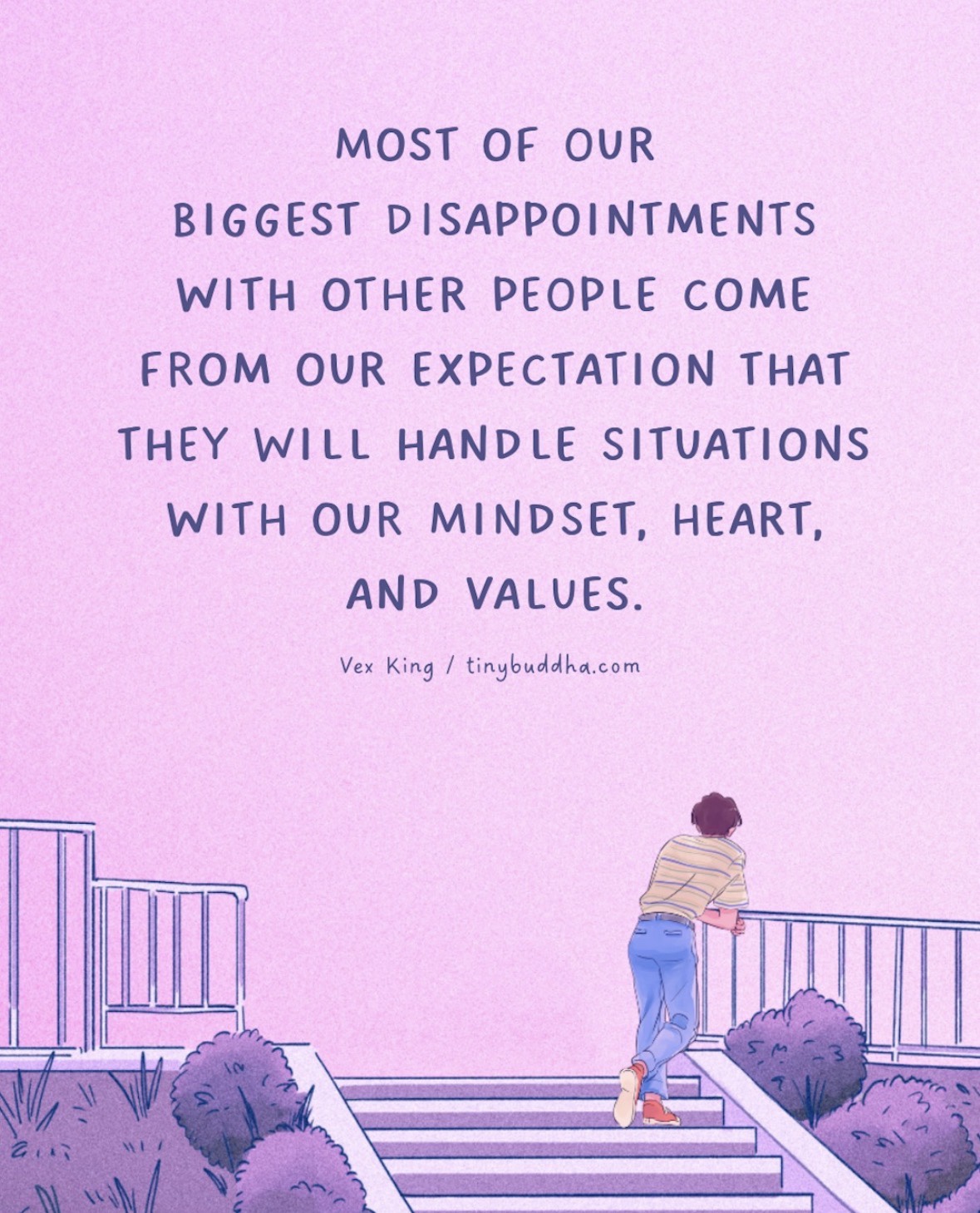
Most of our biggest disappointments with other people don’t come from what they did. They come from what we quietly assumed they would do.
We assume they’ll respond the way we would. Think it through the way we would. Feel it as deeply as we would. Act with the same urgency, empathy, honesty, or care that feels obvious to us. And when they don’t, it stings. Not just because of the outcome, but because it feels personal. Like a mismatch we didn’t sign up for.
But here’s the uncomfortable truth: we often walk into situations carrying an invisible rulebook that only we’ve read.
We expect people to bring our mindset to the table. Our values. Our way of weighing consequences. Our emotional depth. And when they don’t, we label it as indifference, immaturity, selfishness, or lack of character. Sometimes that judgment is fair. Often, it’s just misplaced.
Because people don’t see the world the way we do. They’re shaped by different histories, fears, priorities, and survival strategies. What feels like common sense to you may feel unnecessary or even risky to them. What feels like the “right thing” to you may not even register on their radar.
And that gap—between who they are and who we expected them to be—is where disappointment lives.
A lot of frustration comes from assuming alignment without ever checking for it. We assume shared values because we care deeply. We assume shared standards because we would never behave that way. We assume shared emotional language because it feels universal to us. But none of that is guaranteed.
Someone can be kind and still avoid confrontation. Someone can be smart and still lack emotional awareness. Someone can care about you and still not show it in the ways you recognize as care. That doesn’t automatically make them wrong. It makes them different.
The real problem starts when we treat difference as betrayal.
We replay conversations in our heads thinking, “If I were them, I would have…” That sentence alone is a trap. They weren’t you. They don’t have your wiring, your wounds, your instincts, or your moral reflexes. Expecting them to operate from your internal compass is like being upset that someone speaks a different language fluently.
This doesn’t mean you excuse bad behavior or lower your standards into the ground. Boundaries still matter. Accountability still matters. Values still matter. But clarity matters more than assumption.
Disappointment shrinks dramatically when expectations are spoken instead of imagined.
When you stop assuming people “should just know.” When you stop projecting your inner world onto others and calling it fairness. When you recognize that alignment is something you discover over time, not something you declare in your head and hope reality complies with.
There’s also a quieter lesson hiding here: sometimes the disappointment isn’t about them at all. It’s about grieving an image we created. A version of them that existed only in our expectations. Letting go of that image can hurt more than letting go of the person.
But that grief is also freeing.
Because once you see people clearly—without overlays, without fantasy, without silent contracts—you can make better choices. You can decide who gets access to your inner circle. You can adjust expectations without bitterness. You can stop asking people to meet you in places they’ve never shown the capacity to reach.
And maybe most importantly, you stop taking everything so personally.
Not everyone is meant to handle situations with your heart. Not everyone is wired to carry your depth. Not everyone values what you value. That’s not a flaw in you, and it’s not always a flaw in them. It’s just reality.
The moment you accept that, disappointment stops being a constant surprise and starts becoming useful information.
Don’t Chase the Snake
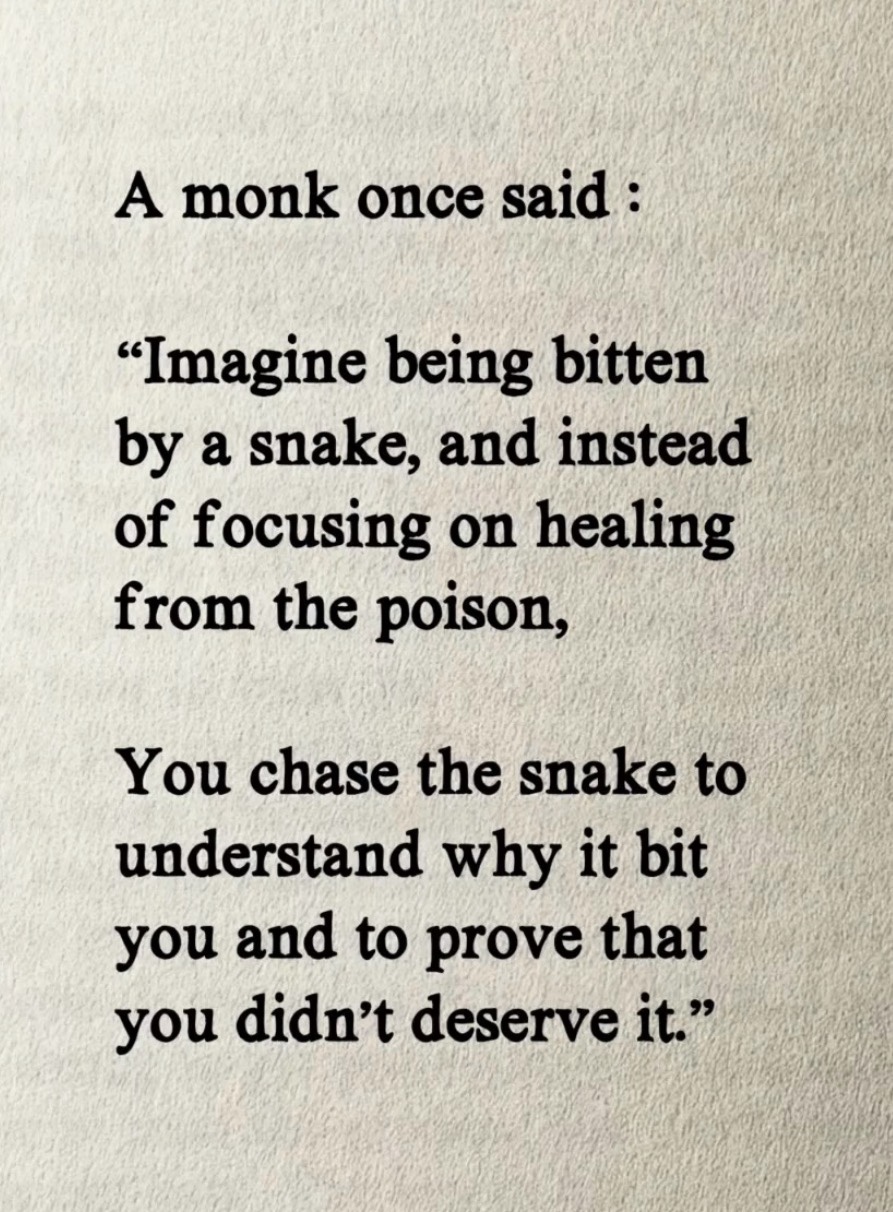
Came across this quote sometime back and it has stayed with me long after I first heard it. Imagine being bitten by a snake, and instead of focusing on healing from the poison, you chase the snake. You want to know why it bit you. You want to prove that you didn’t deserve it. You want answers, explanations, justice. Meanwhile, the poison is still in your body, quietly doing its damage.
Most of us live like this more often than we’d like to admit.
We replay conversations in our heads. We dissect texts, tones, silences. We revisit moments where someone hurt us and ask the same questions again and again. Why did they do that? What did I do wrong? Why wasn’t I enough? We tell ourselves we’re just trying to understand, but deep down, we’re chasing validation. We’re hoping that if we can make sense of the bite, it will hurt less.
It rarely does.
The truth is, pain has a way of hijacking our attention. When we’re hurt, our instinct is to look outward, to find a cause we can point to. A person. A decision. A betrayal. It feels productive to analyze it, to build a case, to assign blame. It gives us the illusion of control. But while we’re busy chasing the snake, the poison keeps spreading. The resentment hardens. The sadness settles in. The bitterness becomes part of how we see the world.
Healing doesn’t begin with answers. It begins with care.
There’s something deeply uncomfortable about that idea because it feels incomplete. We want closure. We want explanations. We want the other person to admit they were wrong or at least acknowledge our pain. But life doesn’t always offer that. Sometimes the person who hurt you doesn’t understand it themselves. Sometimes they’re not capable of giving you the clarity you’re seeking. Sometimes they’re not even aware they left a wound behind.
Waiting for them to fix it is like waiting for the snake to apologize.
Focusing on healing doesn’t mean what happened didn’t matter. It doesn’t mean you’re minimizing your pain or letting anyone off the hook. It simply means you’re choosing yourself first. You’re saying, “I may never fully understand why this happened, but I refuse to let it keep poisoning my life.”
That shift is subtle, but it’s powerful.
Healing looks quieter than chasing. It’s less dramatic. It’s choosing rest over rumination. It’s setting boundaries instead of crafting arguments you’ll never get to deliver. It’s talking kindly to yourself on days when the memory resurfaces. It’s acknowledging that something hurt you and allowing that to be enough, without turning it into a lifelong investigation.
There’s also humility in healing. It requires accepting that not everything will make sense, and not every wound will come with a neat explanation. We like to believe that understanding equals peace, but often peace comes first. Understanding, if it arrives at all, comes later.
Or not at all.
And that’s okay.
Chasing the snake keeps you tethered to the moment you were hurt. Healing loosens that grip. It doesn’t erase the past, but it stops letting the past dictate your present. You begin to notice that your energy returns. Your thoughts become less heavy. The world feels a little wider again.
The monk’s wisdom isn’t telling us to ignore pain. It’s reminding us where our attention belongs. Not on the one who caused the wound, but on the wound itself. Not on proving you didn’t deserve it, but on helping yourself recover from it.
Because whether or not you deserved the bite is irrelevant now. You’re already hurt. The only question that matters is what you do next.
You can spend your days chasing the snake, reliving the moment, hoping for answers that may never come. Or you can tend to the wound, draw out the poison, and slowly, patiently, heal.
One of those paths keeps you stuck.
The other gives you your life back.
You’re Not Here to Be Liked. You’re Here to Be Real.
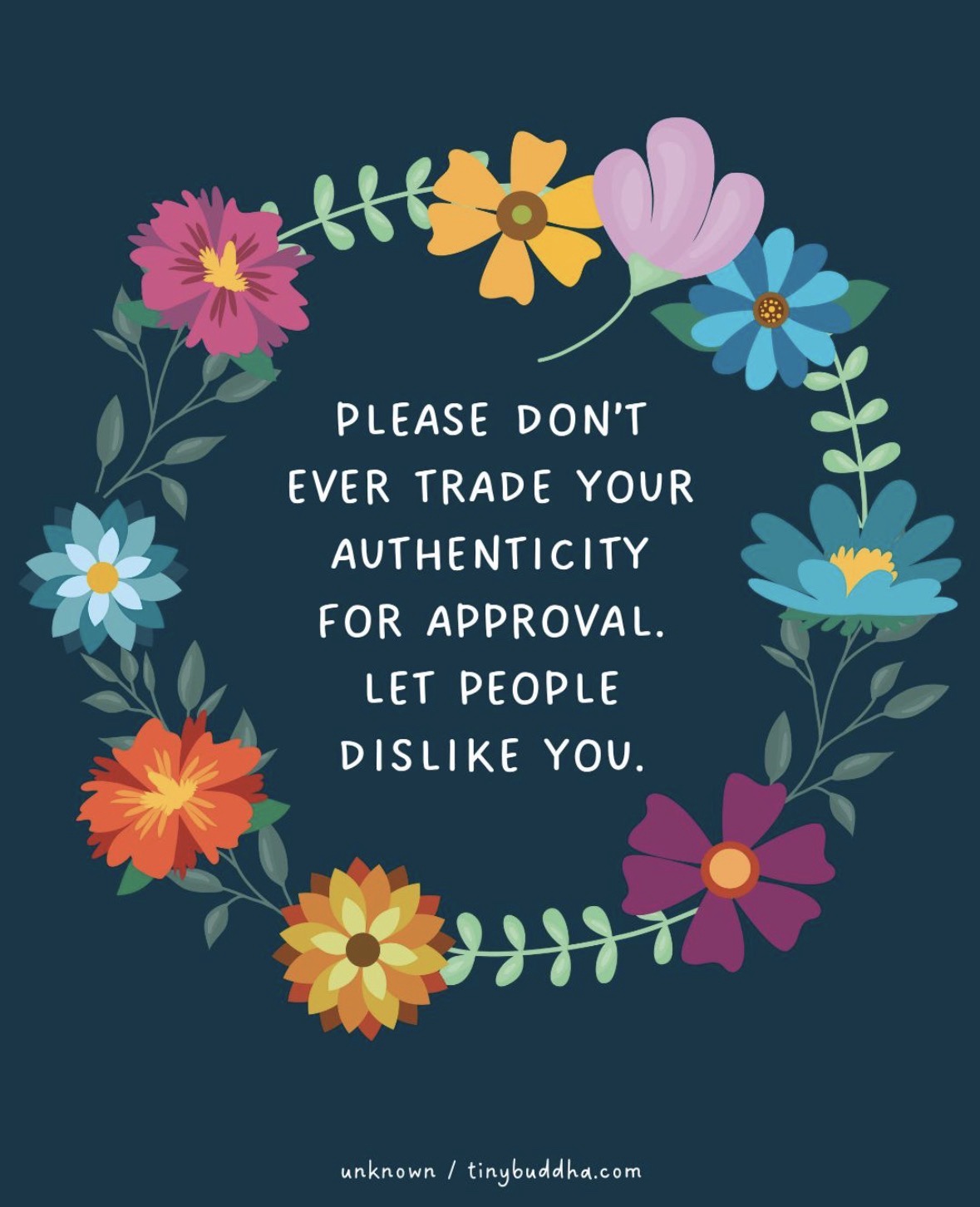
There’s a quiet pressure most of us carry, often without realizing it. The pressure to soften our opinions. To dilute our personality. To round off our edges so we’re easier to accept, easier to like, easier to keep around. It shows up in meetings when you don’t say what you really think. In friendships where you laugh along even when something feels off. In life choices where you follow the applause instead of your gut.
And slowly, without any dramatic moment, you start trading authenticity for approval.
The problem is, approval is a terrible currency. It’s unstable. It depends on moods, contexts, power dynamics, and who happens to be in the room. What earns you praise in one season can get you criticized in the next. When you build your identity around being liked, you’re constantly adjusting yourself to fit other people’s expectations. You become reactive instead of grounded.
Authenticity, on the other hand, is expensive upfront but priceless over time.
Being real costs you something. It might cost you popularity. It might cost you invitations, validation, or being everyone’s favorite. Some people will misunderstand you. Others will decide you’re “too much,” “too opinionated,” or “not their vibe.” And that can sting, especially if you’re someone who genuinely wants harmony and connection.
But here’s the part we don’t say out loud enough: not everyone is supposed to like you.
When someone dislikes you for being authentic, they’re doing you a favor. They’re saving you years of performing, pretending, and slowly resenting yourself for shrinking to stay palatable. The people who only like the edited version of you don’t actually like you. They like the mask. And maintaining a mask is exhausting.
There’s also a subtle arrogance in trying to be universally liked. It assumes you should be compatible with everyone, when in reality, humans are meant to be different. Different values. Different rhythms. Different boundaries. Friction isn’t failure; it’s feedback. It tells you where alignment exists and where it doesn’t.
Think about the people you admire most. The ones who feel grounded, calm, and unmistakably themselves. They’re not trying to win every room. They’re not constantly explaining or justifying who they are. They’ve made peace with being misunderstood by some and deeply respected by a few. That peace didn’t come from approval. It came from clarity.
And clarity changes everything.
When you stop chasing approval, your decisions get cleaner. You say yes with intention and no without guilt. Your work improves because it’s no longer filtered through fear. Your relationships deepen because the ones that remain are built on honesty, not performance. You might have fewer people around you, but the connections are real, and real always outweighs many.
This doesn’t mean being rude, dismissive, or reckless with your words. Authenticity isn’t about being unkind. It’s about being aligned. You can be respectful and still firm. You can be compassionate without abandoning yourself. You can evolve without betraying who you are at your core.
The irony is that when you stop trying to be liked, you often become more magnetic. Not to everyone, but to the right people. The ones who see you clearly and don’t need you to contort yourself to belong. That kind of belonging doesn’t require effort. It feels like exhaling.
So let people dislike you.
Let them project. Let them misunderstand. Let them walk away if they need to. You’re not here to manage everyone’s comfort. You’re here to live a life that doesn’t require you to look back and wonder who you could’ve been if you’d just been braver.
Approval fades. Authenticity compounds.
Choose the thing that lets you sleep at night knowing the person you showed the world is the same one you recognize in the mirror.
 Kenrick Vaz