SMART Goals

Many people feel as if they’re adrift in the world. They work hard, but they don’t seem to get anywhere worthwhile.

A key reason that they feel this way is that they haven’t spent enough time thinking about what they want from life, and haven’t set themselves formal goals. After all, would you set out on a major journey with no real idea of your destination? Probably not!

Goal setting is a powerful process for thinking about your ideal future, and for motivating yourself to turn your vision of this future into reality.

The process of setting goals helps you choose where you want to go in life. By knowing precisely what you want to achieve, you know where you have to concentrate your efforts. You’ll also quickly spot the distractions that can, so easily, lead you astray.

You set your goals on a number of levels:

  • First you create your “big picture” of what you want to do with your life (or over, say, the next 10 years), and identify the large-scale goals that you want to achieve.
  • Then, you break these down into the smaller and smaller targets that you must hit to reach your lifetime goals.
  • Finally, once you have your plan, you start working on it to achieve these goals.

This is why we start the process of setting goals by looking at your lifetime goals. Then, we work down to the things that you can do in, say, the next five years, then next year, next month, next week, and today, to start moving towards them.

To give a broad, balanced coverage of all important areas in your life, try to set goals in some of the following categories (or in other categories of your own, where these are important to you):

  • Career – What level do you want to reach in your career, or what do you want to achieve?
  • Financial – How much do you want to earn, by what stage? How is this related to your career goals?
  • Education – Is there any knowledge you want to acquire in particular? What information and skills will you need to have in order to achieve other goals?
  • Family – Do you want to be a parent? If so, how are you going to be a good parent? How do you want to be seen by a partner or by members of your extended family?
  • Artistic – Do you want to achieve any artistic goals?
  • Attitude – Is any part of your mindset holding you back? Is there any part of the way that you behave that upsets you? If so, set a goal to improve your behavior or find a solution to the problem.
  • Physical – Are there any athletic goals that you want to achieve, or do you want good health deep into old age? What steps are you going to take to achieve this?
  • Pleasure – How do you want to enjoy yourself? (You should ensure that some of your life is for you!)
  • Public Service – Do you want to make the world a better place? If so, how?

A useful way of making goals more powerful is to use the SMART  mnemonic. While there are plenty of variants (some of which we’ve included in parenthesis), SMART usually stands for:

  • S – Specific (or Significant).
  • M – Measurable (or Meaningful).
  • A – Attainable (or Action-Oriented).
  • R – Relevant (or Rewarding).
  • T – Time-bound (or Trackable).

For example, instead of having “to sail around the world” as a goal, it’s more powerful to use the SMART goal “To have completed my trip around the world by December 31, 2027.” Obviously, this will only be attainable if a lot of preparation has been completed beforehand!


Now that you know how important goals are, it’s time to take the first step toward setting goals and achieving them.

Whether it’s personal goals for yourself or company-driven goals for your team, the goal-setting process can help you find purpose and meaning in your life.

Don’t put too much pressure on yourself and your team members. Even if you don’t reach all of your goals, just having them written down can provide a deeper sense of fulfillment and satisfaction.

Still not sure how to set goals and achieve them? Or do you just need more help on your goal-setting journey? Get in touch with me!

Why It’s So Hard to Feel Worthy of Success

Think about the cumulative effect of all the negative things you’ve told yourself about yourself. Even for relatively happy, normal, well-adjusted people, it’s almost impossible to turn off that voice that tells you you’re not good enough.

The irony of it? We think about ourselves, constantly, all the time, but when it comes to using that self-obsession to make our lives better, the effectiveness of our minds suddenly drops.

We all want to be successful. Sure, that definition changes depending on who you ask. Yes, most of us have had successes in our lives and live pretty good lives, too. But few of us feel like we’ve maxed out our potential and really gave it our all at something we cared about.

Deep down, many of us feel unworthy of our dreams.

Do you feel this way? I know parts of me did when I was trying to accomplish my goal of writing to share my thoughts and convictions.

You think to yourself, “Who the hell are you to have these dreams? Basically no one pulls off a dream like this off. Do you really think you’re different? Really? Think of all your mistakes. You have no evidence that shows you’ll ever change. Why try?”

We all have some iteration of this conversation with ourselves. We’re hurtful to ourselves. Truly mean and cruel in a way we’d never be to other human beings.

Where does this come from? Why do we do this to ourselves? How can we fix it? How can you succeed?

You’re Fighting an Uphill Battle From Birth

It doesn’t help that you learn to view your own behavior through the lens of right and wrong, mostly wrong, from a very young age. You spend your whole life being told what not to do.

When you’re little it’s “don’t touch that.” When you get older, almost everything you learn is predicated on avoiding failure instead of achieving success. It’s not so much that you wanted to get good grades. You didn’t want to get bad grades and feel shame. Not so much that you wanted to get the degree, but that you didn’t want to be a disappointment or you didn’t want to be a part of the “out crowd” who doesn’t have that piece of paper.

You’re always playing defense. Always trying to avoid making mistakes. Looking bad has always been weighted more heavily than feeling good.

Our entire society is a comparison trap. Grades could easily be pass or fail — the arbitrary nature of the grades has nothing to do with whether you really know the information or not.

You take “standardized tests” as if human beings are standard issue and achieve success using the exact same rubric. Everything is standardized — standard home, car, degree, job, neighborhood. And our goals are set by society — don’t fall below these standards.

Create a Mental Flywheel For Success

The good news? Competence does create confidence. Once you create enough evidence for your own success you’ll no longer have to rely on tricking yourself and faking it.

It’ll work the same for you with your dream. 80 percent of your effort goes towards hitting critical mass, the tipping point, breaking that wall, and then achieving your dream is just a matter of time — the other 20 percent. The beginning phase of building any dream is so fraught with doubt and difficulty that it basically destroys most people dead in their tracks almost right away.

But if you understand that it’s the hardest part and that you won’t always feel that heavily full of doubt, you can take your bumps and bruises upfront until you reach the other side. And the crazy thing about it? Your mind is mostly in the way. The actual steps aren’t that bad.

You will have to face rejection. But do you know what rejection and embarrassment really are? They’re just physiological responses — you get that heart in your stomach feeling for a few seconds and then it goes away. Feeling bad or discouraged about anything is just your interpretation of what happened. You know this, but over time, you’ll know this.

You will start to feel worthy as time moves forward. The first time you pull off something you thought was outside your capabilities, you’ll fully understand how limiting your beliefs are. I still have limiting beliefs about some of the big hairy audacious goals I still have. But now I know that my current normal life would seem absurd to my past self, so I let go of the need to have one hundred percent belief in myself and I just keep doing the work.

Remember Who You Really Are

When was the last time someone told you that you’re good enough? How often do you tell yourself that? Unfortunately, we lack positive reinforcement in our society and even in our own upbringing sometimes. But you can always be your own support system.

Start thinking of yourself as a friend and start taking care of yourself. Make a conscious effort to do that. I’m weird. I literally talk to myself. Sometimes looking in the mirror. I try to remind myself of who to trust — not my irrational monkey mind liar, but me.

That negative-self talk voice isn’t you. You know that, right?

“This is just the way I am.” Not true. It’s the way you’re choosing to be. It’s the way you default to being because you listen to that negative voice instead of listening to yourself.

I can’t even imagine what’s going on in your mind on a day to day basis because I personally have a hell of a nasty self-talk voice.

At the end of the day, you have to seriously take care of yourself and take your relationship with yourself seriously. You won’t always have good days. But, what choice do you have? Either you try your best to make it work or you give up and let your lizard brain run your life for you.

Keep having those conversations with yourself.

You owe it to yourself to live a better life.

You deserve to live a better life and you know it.

Here’s what will happen if you do decide to listen to yourself. One day you’ll look back on everything you’ve ever done and you’ll thank yourself that you were there for yourself.

You’ll have a level of confidence no one can take away from you ever. Success doesn’t solve all your problems, but it does give you the peace in knowing you cared about yourself enough to follow through with something you cared about.

There’s no feeling quite like it.

5 Lessons the Storms of Life can Teach Us

Nature’s storms have a beauty of their own, even though they can be frightening and unpredictable. It’s breathtaking to see the night sky illuminated by flashes of light and watch the power of the wind sweep rain across the landscape.

Storms are the perfect reminder of the power of God. No matter how far technology has advanced, man still can’t stop storms.

Natural storms and personal storms are similar because:

  • They often arrive suddenly.
  • They bring darkness, uncertainty, and a sense of foreboding disaster.
  • They do not last forever.
  • At times they bring devastation requiring clean up.
  • We have no control over them.
  • They may be followed by sunshine and rainbows.

Like natural storms, personal storms often arrive with little warning. Broken relationships, the loss of a job, a health crisis, financial hardship, the death of a loved one, or a tragic accident can change our lives in a moment. Storms  uproot our lives and leave a behind a path of destruction in the form of rearranged lives, depression, discouragement, and lifestyle changes.

Thankfully, storms pass in time. Some of the darkest moments in our lives happen just before we experience a breakthrough to better things. It is difficult to find beauty in our personal storms when we are going through them, but we can take comfort in knowing they will eventually end.

It’s not just that storms teach. It’s that there are lessons we can only understand in a storm.

1. Storms teach us real gratitude

It’s easy to be grateful when things in life are going well. When the bank account is full and all is going well. But even in difficulty we can find things to be grateful for. Stopping to look for God’s good hand and keep a daily gratitude list helps us see that God is at work all around us even when circumstances are hard.

2. Storms teach us real joy

After I left the Jesuits in 2010, I wondered if I’d ever feel real joy again. I thought it would come months later, after I’d processed the grief. To my surprise, God brought moments of joy in the midst of grief. Evenings with friends. Birthday celebrations with family. Little surprises in my day.

Storms show us that real joy comes in the hard, not after.

3. Storms teach us real treasure

The world tells us we need bigger, newer and more. In the storms that shatter life as you know it, what’s really valuable becomes crystal clear.

4. Storms teach us real strength

We can usually handle the mild annoyances and problems that surface on easy days. But trials bring us to the end of ourselves.

In those times, we realize we’re completely dependent on God. We need him to give us wisdom, to replace our fear with faith and to give us strength to battle the storm. But that’s a good place to be. God designed us to be utterly dependent on him. “But he said to me, ‘My grace is sufficient for you, for my power is made perfect in weakness.’”

5. Storms teach us real faithfulness

It’s easy to quote the promises of God when life is good. But do they hold up in the hard?

Storms prove they do! We can see God’s faithfulness in ways we never see on sunny days. That’s when we can cement our own faith, when it becomes deeply personal because we see firsthand how God meets our needs and takes care of us in the hard. It’s in the storms we so often see God do things we couldn’t even ask or imagine. “All the ways of the Lord are loving and faithful for those who keep the demands of his covenant.”

None of us are immune from the storms of life. While we don’t know how or when they will hit, God has assured us they will come.

But just like hurricanes, we can prepare.


The Beauty of Storms
Darshak Rana

Storms are the beauty of life.
It draws out of us-our inner powers,
that the calm seas fail to discern.

Those, who wait for the storms to pass,
Often ends up in sadness and stress,
while the one who embraces the thunder
emerges victorious.

A person of faith finds the storm
as a sunny day, 
where the rainbow of hope smiles
and fills the life, 
with joy and happiness.

While the person of fear finds the gentle winds
as the majestic storms,
because the fear murders hope,
and dries out happiness
from the pastures of life.

Those, who believe in the beauty of storms,
find solace amidst the chaos!

Because they don’t try to control the storm,
but they themselves become a storm
of resilience and determination.

8 Steps to Move On

There are some events that give us a lot of sleepless nights. Nights when we are was so worried about something that had happened in the past that we let it dictate our future. We’ve all been there at some point. You’re not alone.

Whether it’s something small, like making a terrible first impression, or saying something you wish you hadn’t, to something big, like having to shutdown your business or change tracks in your career. Harping on negative experiences is painful and, when we hold on to that pain, we can’t move on to something more positive.

That’s why it’s important that you let it go and leave the past behind with these eight tactics.

1. Learn from the past but don’t dwell there.

Yes. Those negative experiences you had can actually be used for learning and future experiences, no matter how painful they are. Take some time to reflect on the experience and look at ways at it can actually benefit you down the road.

You can learn from your experiences by reflecting on these few simple questions:

  • What really happened? Answer only by confronting the facts.
  • What emotions do I feel? I personally like to write them down.
  • How can I use this to empower myself and my feelings?

After answering these questions, it’s time to move on. While reflecting on the past for a little bit of time is acceptable, dwelling on it will only keep those negative thoughts and feelings around.

2. Express yourself.

Don’t hesitate to get the pain you’re feeling off your chest. Whether it’s talking to the individual who has harmed you or who you harmed, venting to a friend or writing it down, expressing your feelings can assist you in sorting out what, if anything, needs to be done to move on.

More importantly, it’s good for your health. Dr. Edmund Bourne, author of The Anxiety and Phobia Workbook, warns that holding onto your feelings leads to anxiety, depression, headache and high blood pressure.

When it’s time to express your feelings, make sure to use “I” messages. Describe the degree of your emotions, and share them with someone who will listen and not pass judgment. This will help you express the grief you’re going through.

Gloria Horsley, Grieft Expert

3. Stop pointing fingers.

Playing the role of the victim is easy and sometimes feels pretty good, especially compared with accepting the truth. The problem is, blaming others prevents you from going forward. Most often, pointing fingers is just complaining.

Blaming others gives power to someone else and makes us small. When we blame, we automatically enter the negative zone. We loathe someone else or some external factor because we were not able to mold life into our own favor.

Ruchika Batra, Life Coach

4. Focus on the present.

One of the most effective ways to let go of the past is to embrace the present. Instead of reliving the past and getting consumed with negativity, keep yourself active and enjoy the current moment. Learn a new skill. Meditate. Exercise. Have dinner with a friend. Make a new friend. Whatever it is, just live in the moment – even if it’s just sitting at your desk and watching the clouds roll by.

Living in the moment, also called mindfulness, “involves being with your thoughts as they are, neither grasping at them nor pushing them away.” Psychology Today states that “mindful people are happier, more exuberant, more empathetic, and more secure.”

5. Disconnect for a while.

Allow yourself to take some time away so that you can clear your head. You don’t have to go backpacking through Europe. Just remove yourself from the situation by distancing yourself from the people, places and things that remind you of the past. Practicing ways to disconnect for a while will give you the chance to experience something positive — even if that’s just camping at a nearby campground without any access to social media.

When you return, you’ll have a perspective on the past.

6. Think about the people around you.

Take inventory of the people around you. Who is negative and always bringing you down? Who are the people associated with the past that you’re trying to move away from? You may need to move away from these individuals to find more positive people who will empower you.

There are more than enough ways to meet new people, such as attending local meetups and conferences. Don’t be shy. Get yourself out there and find a new group of friends and acquaintances who can help you move forward.

7. Forgive those who wronged you — including yourself.

If you’ve been hurt by someone, the last thing that you may want to do is forgive them. But, as Dr. Wayne Dyer says, “Forgiving others is essential for spiritual growth.”

While you’re at it, forgive yourself. No one is perfect and we all make mistakes. Instead of kicking yourself for your past mistakes, cut yourself some slack and focus on the lessons that you’ve learned.

Once you’re not carrying that anger and resentment, you’ll be able to move on.

8. Make new memories.

Finally, start making new, positive memories to replace those negative memories from the past. Spend your time with the people who make you happy, the things that bring you joy and in the places that bring you peace. Making new memories is better being stuck in the past.

In fact, it’s been discovered by scientists that having too many old memories makes it more difficult to make new memories. So, out with the old and in with the new.


Here’s to living in the now!

The Impact of Gossip and Rumours

Gossip and rumours happens so frequently during our growing years, that some people have come to accept it as a normal part of life. But when it involves toxic friendships and spreading rumors, that is anything but normal. In fact, for those who are impacted, gossip can be downright painful and almost impossible to ignore – especially if social media is being used to spread it.

Gossip and rumors can alienate friends, ruin reputations, and even lead to ostracizing behavior and other forms of relational aggression. Kids who are being gossiped about are negatively impacted. For instance, gossip and rumors can destroy a person’s self-confidence and affect their self-esteem. It also can lead to depression, suicidal thoughts, eating disorders, anxiety, and a host of other issues.

Let’s try to see the differences between rumours and gossip.

Rumors are pieces of information or a story that has not been verified. What this means, is that the person telling the story does not know for certain if it is true or not. Most of the time, people who spread rumors do not bother to determine if there is any truth to what they are saying. 

Typically, rumors are spread from person to person and can change slightly each time they are told. As a result, they can become exaggerated and altered over time.

Gossip is slightly different from a rumor. Usually, gossip involves a juicy detail of some sort, which means the information is shocking or personal. What’s more, gossip is usually spread behind a person’s back and can be very hurtful.

Gossip usually involves love, relationships, sex, and other issues that people usually do not talk about publicly. Additionally, gossip almost always causes pain and humiliation for the person it is about. People share gossip without any thought of how it might impact the person it is about.

Rumours

  • Unverified pieces of information
  • Often involves speculation
  • Unknown if information is true
  • May change slightly as retold
  • Information usually not harmful to another person

Gossip

  • Juicy or scandalous story
  • Hurtful for another person
  • Unknown if information is true
  • Usually involves things not discussed publicly
  • May humiliate the person it’s about

So why do people gossip?

To Feel Better 

When people feel bad about themselves, they sometimes will target other people to try to make themselves feel better. As a result, they talk about others as a way to deflect attention from themselves. 

To Feel Accepted 

If everyone else in their circle of friends is gossiping or spreading rumors, we feel like they have to do the same thing in order to be accepted. Many times peer pressure will play a factor in spreading rumors or gossiping.

To Get Attention 

When we know a secret that nobody else knows, or they are the first person in the group to hear a rumor, it makes them the center of attention. As a result, people that are trying to fit in or climb the social ladder might use gossip and rumors as a tool to gain popularity.

To Gain Power 

Some of us want to be in control and at the top of the social ladder. When we are at the top of the social ladder or are determined to climb higher, we sometimes accomplish that by diminishing the status of another person. Spreading rumors or gossiping is one of the primary ways people jockey for social status.

To Get Revenge 

When we are envious of another person’s looks, popularity, or money, we might use gossip and rumors to hurt that person. We also tend to use gossip and rumors to get back at someone who we feel deserves to be hurt. Making up a rumor or spreading gossip sometimes satisfies their need for revenge.


To Relieve Boredom 

Research indicates that boredom is often the number one reason why teens spread rumors. These teens are bored with their lives because there is no drama. As a result, they resort to rumors and gossip to spice things up and make life more exciting.


When we are being gossiped about or if someone is spreading rumors, there are a number of things that we can do to cope with it. For instance, you could stop dwelling on what other people are saying or go directly to the source and confront the issue. The key is to find a way to address the gossiping and rumor spreading that is comfortable for your child. 

Hard Work Pays Off

We all need a little bit of encouragement and motivation from time to time. Even the most inspirational people in the world have times when nothing happens. And that’s completely ok. We are all entitled to be down for a bit.

It’s during the moments of zero inspiration, zero motivation and low points that we discover who we are. It’s in our weakest moments that our strength, resilience and courage is built.

Here are three stories that keep me going on days like these

1. Michael Jordan

I guess everyone knows who Michael Jordan is. But what you might not know is that Jordan, who many agree was the greatest basketball player of all time, didn’t even make his high school basketball team when he tried out during his sophomore year. Needless to say, Jordan used this episode to motivate himself to succeed on the basketball court.

Jordan explained in a Newsweek article:

“Whenever I was working out and got tired and figured I ought to stop, I’d close my eyes and see that list in the locker room without my name on it. That usually got me going again.”

By the end of his high school career, Jordan had been named a McDonald’s All-American.

But Jordan never stopped practicing — even when he was excelling at the highest levels. MJ spent the off-season shooting hundreds of jump shots each day. Phil Jackson, who coached him for many years, said Jordan became so great not because of his inherent skills, but because he understood how hard he needed to work to succeed.


2. Tim Ferriss

If you haven’t heard of Tim Ferriss, here’s a quick primer: He’s the author of The 4-Hour Workweek, a book published in 2007 that offers advice on how you can trim the fat off your workday and, through a series of prioritizations, determination, and outsourcing, theoretically end up being able to log a four-hour week.

While the prospect of actually being able to pull that off is a bit iffy for me, Ferriss’s book, perhaps unsurprisingly, has become tremendously popular over the better part of a decade. To date, it’s sold over 1.3 million copies across the globe. But Ferriss had no way of knowing this would ever be the case.

It turns out that the first 25 publishers Ferriss contacted about his book said no. According to the Harvard Business Review, the 26th publisher said yes not because they loved the concept of the book, but because they believed Ferriss would do everything within his power to make sure it sold.

As demonstrated, persistence and determination pay off.


3. Vincent van Gogh

You are undoubtedly familiar with at least some of Van Gogh’s 900 paintings. You’ve probably seen Starry NightBedroom in Arles, or Café Terrace at Night, to name a few.

Starry Night, Vincent van Gogh

But what you might not have known is that Van Gogh only sold one painting during his entire lifetime. In other words, he went to the grave thinking that he was a failed artist.

Most failed artists who died in the 1800s don’t have their own Wikipedia pages.

Though Van Gogh might not have benefited from fame or fortune in his lifetime, he remained committed to realizing his artistic vision. While no one was interested in buying his paintings when he was alive, Van Gogh continued pouring his heart and his soul onto his canvases. Over time, that commitment paid off; Van Gogh is routinely included among the greatest painters of all time.


Like Jordan, Ferriss, and Van Gogh, you might not succeed right away. But hard work and determination do pay dividends sooner or later.

10 Financial Proverbs For Our Times

There are quite a few old proverbs and adages that we’ve all been saying and hearing for years (if not centuries). After a while we stop really hearing them, though, and start to take their meaning for granted. But most wisdom is timeless – and smart money advice is worth hearing in any century. So here are a few great financial proverbs that are just as true today as when they were first uttered:


NEVER SPEND MONEY BEFORE YOU HAVE IT.

Unknown

Spending money you don’t have is the first step on the slippery slope of debt. Of course, it’s pretty impossible to buy everything you need with cash these days, so some debt (home loan, car loan, student loans, etc.) is a given. It’s the non-essentials that will get you, so when it comes to credit purchases be careful.


SPENDING IS QUICK; EARNING IS SLOW.

Russian proverb

Spending is quick, alright. Thanks to modern technology, the “convenience” of buying has never been greater – we can spend thousands of rupees in the swipe of a card, the click of a mouse and the tap of a smartphone. Just remember, no matter how easy it is to spend your money, it’s not getting any easier to make that money.


A FOOL AND HIS MONEY ARE SOON PARTED.

Dr. John Bridges

Don’t take this one the wrong way. Smart people and money are parted all the time, too. It just means that all money decisions are important and you can’t take it for granted that your money will always be there. The more you do to educate yourself about finances, the better equipped you’ll be to make positive choices with your money.


CREDITORS HAVE BETTER MEMORIES THAN DEBTORS.

Ben Franklin

As much as we’d like to be able to forget our bad money decisions and let our old debts drift away into obscurity, that just isn’t happening. And just because you can’t remember who you owe and how much, trust me – they know. So keep good records and don’t lose track of your debts.


RATHER GO TO BED SUPPERLESS THAN RISE IN DEBT.

Ben Franklin

Don’t take Franklin too literally here. If using credit is your only option, that’s far better than starving. The real point here is that some wants may feel like needs, but you should never forget that borrowed money is still borrowed money and in the (figurative) morning it will be due.


IF YOU BUY WHAT YOU DON’T NEED, YOU STEAL FROM YOURSELF.

Swedish proverb

This is a great saying that you don’t hear enough, because it’s absolutely true. When you buy something you don’t need today, it’s the future you that will suffer. Or, to put it another way, spending money on today’s wants means you might not be able to afford tomorrow’s needs. 

Even if you feel financially secure right now, that might not last forever, so you should still be cautious with your money.


SAVE FOR A RAINY DAY.

Aesop

Never take the value of savings for granted, because (to use another popular old adage) when it rains, it pours.  We’re hardly ever as prepared as we need to be for major financial setbacks, so it’s important to remember that disaster can strike at any time. The more you save today, the faster your recovery will be.


A PENNY SAVED IS A PENNY EARNED.

George Herbert

This saying used to make no sense to me. In my mind, a penny saved is a penny saved and a penny earned is a penny earned. They’re two totally different things! Unless you’ve got a savings account with 100% interest, which would be awesome.

However, it turns out I was misinterpreting the proverb. It really means that the money you save is just as valuable as the money you earn – so don’t discount the importance of saving. And that I totally agree with.


INTEREST ON DEBT GROWS WITHOUT RAIN.

Yiddish

Crops, trees, flowers, grass – all organic plant life needs the right conditions to grow and thrive. Debt, on the other hand, can grow in a vacuum. So just remember that it doesn’t matter what happens to the house you buy, or the degree you finance, or the new business you invest in – the interest on your debt will accumulate no matter what.


LEND YOUR MONEY AND LOSE YOUR FRIEND.

William Caxton

Borrow money from the bank. Seriously. You’re very unlikely to have a super tense, passive aggressive Thanksgiving meal with the bank. 

In all seriousness, it’s possible to lend to or borrow money from friends or family, but it’s difficult and, more often than not, it puts an unnecessary strain on your most important relationships. So stick with the bank as far as possible. The bank doesn’t care if you say nasty things behind its back. It’s probably used to it. Thankfully I have never had to face awkward moments with family and friends I may have lent money to, but you may not be as fortunate as me!

Don’t Let Negative People Bring You Down

It is so difficult to remain focused on achieving your goals with all the noise around us from family, friends, colleagues and even strangers! Some people are just big balls of darkness who never seem to see the positive side of anything and who are very vocal about the problems they perceive.

Being around a negative person can be very draining. Some want to complain about their lives. Some want to complain about the world. Some want to complain about you. The one thing they all have in common is that the problem is never them. They are clearly superior to us simpletons and are doing us all a service in correcting our behavior.

Even though some may say never put up with a toxic person, especially at work, sometimes it is just not possible. We won’t leave a job because of a negative co-worker. We won’t abandon a family member. We won’t dump a friend. How then do we deal with them if we can’t just cut them out of our lives? Here are a few tips to help you deal with the negative people you can’t avoid without letting them damage your own attitude.

Do Not Engage

If you have had to deal with these people, you probably already know that engaging with them only makes it worse. They are not suddenly going to become sunny happy people because you pointed out they were being too negative. They will double down. Some will even get ridiculous about it.

You can be quiet without being rude. Learn how to make non-committal sounds or remarks that show you are listening but that won’t give them fuel for their fire.

If you can find a neutral topic to change the subject to, do so. Maybe you can ask about a show you know they enjoy or about an upcoming event. But be aware that the change of subject may not work. Or they may just start spewing negativity about the new subject.

Avoidance or Limitation

I assume that if you could cut off contact with the negative person in your life, you would have already. You have a reason you are still interacting with them. You need your job. They are family that you care about or you feel obligated toward. Whatever the reason is, there may be options for avoiding or limiting your contact with them.

If it is someone you work with, do your best to not be around them. If they corner you, let them rant for a bit and them tell them you have to get back to work. You don’t have to be rude. You are at the office to work.

If it is family, then decide the best way to limit your time with them. What may works better is to keep your exposure to them in smaller doses. You will have to decide for yourself based on your situation and your own temperament what will work best for you. If you are not sure, you can experiment. The negative person does not have to know you are experimenting on them. You can make up some excuse for why you are doing things differently. If the old way works better, it is easy enough to go back to it. If the new way makes it easier for you, then just suggest to them that you like this new way of doing things and plan to keep doing it.

Remember Who You Are

Many of these negative people have been that way for so long that they will never change. You have to accept that. Acceptance does not mean you approve. It also does not mean you have to be like them.

It is very important to not allow the negative person to drag you into their negativity. If you can’t change the subject at least don’t feed it. If you can escape into your own mind. They probably won’t notice that you’ve tuned their complaints out. Think about something positive. It can be something good that happened to you or something you enjoy.

Before you have to see the negative person, try to pump yourself full of positive thoughts. Things that make you happy. Maybe blast happy music on the drive there. Whatever works to put you in a good headspace.

After you leave them, repeat the process. If you are too stressed to go straight to happy, try to aim for calm. Listen to relaxing music. Play with your child or pet. Hug your spouse and tell them how much you appreciate them. Fill your inner self with positive feelings until the negative vibes from that person dissipate.


Negative people can be an incredible drain on your well-being. But by planning ahead and learning how to protect yourself, you can limit the damage they do to you. You are in control of your own mental well-being. You don’t have to let negative people drag you down.

The Power of Admitting a Mistake

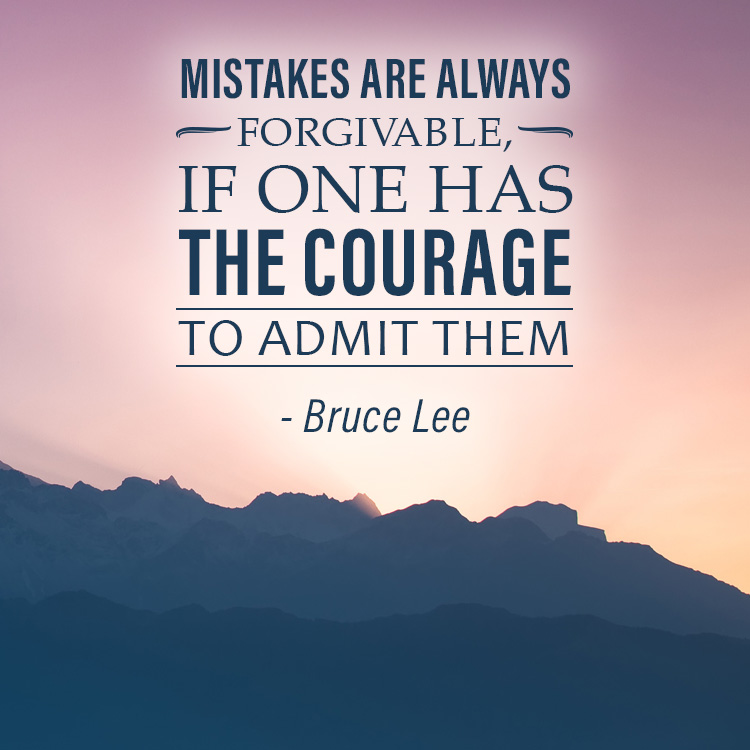
Admitting that you’ve made a mistake can be a hit to your ego. But arguing with or blaming others or trying to dodge by saying something vague like “Mistakes were made…” will only make things worse. It’s much better to take responsibility for the situation so that you can clear the air and move on. Swallow your pride and simply say “I was wrong,” offering a brief explanation without making excuses.

If your error had a negative effect on others, acknowledge it. Really listen to their reactions — don’t get defensive or interrupt. Then explain what you’re doing to remedy the mistake. Be open to feedback about what how you plan on rectifying the siutation. And tell those affected by your error what you’ve learned about yourself and what you’re going to do differently in the future.

If you make a mistake and do not correct it, this is called a mistake.

Confucius

Many times when a mistake is made, we try to pretend that it did not happen. We attempt to justify the wrong position or try to cover it up, which leads to additional mistakes. This situation reminds me of another quote — “When you find yourself in a hole, stop digging.”

Quite often, more damage is done to credibility, relationships, trust and integrity by the actions taken after the original mistake. This is true in personal relationships and especially true when a leader makes a mistake. How many times have we seen high-profile people get prosecuted, not for the original crime, but for the attempt to cover it up by lying?

Of course there is another choice when a mistake is made—admit it, learn from it, correct it and apologize to those that were adversely affected. There is power in properly admitting a mistake.

Anyone who has never made a mistake has never tried anything new

Albert Einstein

Here are some of important reasons why we need to admit a mistake:

  • Averts the need to continue to defend a difficult or incorrect position.
  • Increases leadership credibility.
  • Avoids additional mistakes trying to cover up or “adjust” for the original mistake.
  • Reduces personal stress and tension.
  • Provides a “reset” from others in both personal and professional relationships.
  • If you take responsibility for a mistake on-behalf of others who participated, it builds loyalty.
  • Provides a learning situation for you and others.
  • Builds trust—others see that you are human, honest and truthful.
  • Allows quick correction, which saves time and resources.
  • Gives others a chance to express views and provide new information.
  • Shows others that they are valued and that their input counts, which builds collaboration.
  • Sets the tone for risk-taking, open communication and makes you more approachable.
  • Provides concrete examples to reinforce critical aspects of culture: decisiveness, truthfulness, openness, integrity and quick correction.
  • Removes the “elephant-in-the-room” situation where everyone knows about the mistake, but no one talks about it.
  • Helps offset the bad feelings for those that may have wasted their time.

Admitting and correcting mistakes does not make you look weak; it actually makes you look stronger.

Bruce Rhoades

There are several principles to keep in mind to achieve the best outcome when admitting and correcting a mistake.

  • Don’t blame others. Take responsibility. If someone else needs coaching, do it in private.
  • Do not try to get others to admit the mistake on your behalf. When others are asked to do the “dirty work,” your credibility goes out the window.
  • Stick to the facts and do not make it look like an excuse. Indicate what information was incorrect.
  • This is not a time for cynical humor used to disguise an excuse or blame.
  • Indicate what you and/or the team/friends should learn from the mistake and how not to repeat it.
  • Ask for more input from others.
  • Apologize to those who have wasted their time.
  • If possible, state the new direction, or decision, then indicate who is accountable to implement.
  • If there is not an immediate correction, provide the process and timeframe for correcting the mistake.

Your best teacher is your last mistake

Ralph Nader

All of us make mistakes—it is part of learning and growing. Admitting and correcting mistakes does not make you look weak; it actually makes you look stronger. When you admit mistakes, you help establish a culture of open communication and a willingness to improve by demonstrating an attitude of, “Let’s learn from this.”

Remember, mistakes are almost never “secret”—most are visible, and the longer they go without correction, the more difficult and expensive it is to change—not to mention that the longer it continues, the worse the leader appears.

When Ignorance Screams, Intelligence Shuts Up

The donkey told the tiger: The grass is blue.

The tiger replied: No, the grass is green​.

The discussion became heated, and the two decided to submit the issue to arbitration, and to do so they approached the lion.

Before reaching the clearing in the forest where the lion was sitting on his throne, the donkey started screaming: ′′Your Highness, isn’t it true that the grass is blue?”​

The lion replied: “True, the grass is blue”​.

The donkey rushed forward and continued: ′′The tiger disagrees with me and contradicts me and annoys me. Please punish him”​.

The king then declared: ′′The tiger will be punished with 5 years of silence”​.

The donkey jumped with joy and went on his way, content and repeating: ′′The grass is blue”​..

The tiger accepted his punishment, but he asked the lion: ′′Your Majesty, why have you punished me, after all, the grass is green?”​

The lion replied: ′′In fact, the grass is green”​.

The tiger asked: ′′So why do you punish me?”​

The lion replied:

That has nothing to do with the question of whether the grass is blue or green. The punishment is because it is not possible for a brave, intelligent creature like you to waste time arguing with a donkey, and on top of that to come and bother me with that question

The worst waste of time is arguing with the fool and fanatic who doesn’t care about truth or reality, but only the victory of his beliefs and illusions. Never waste time on discussions that make no sense… There are people who for all the evidence presented to them, do not have the ability to understand, and others who are blinded by ego, hatred and resentment, and the only thing that they want is to be right even if they aren’t.

When ignorance screams, intelligence shuts up. Your peace and tranquility are worth more.