
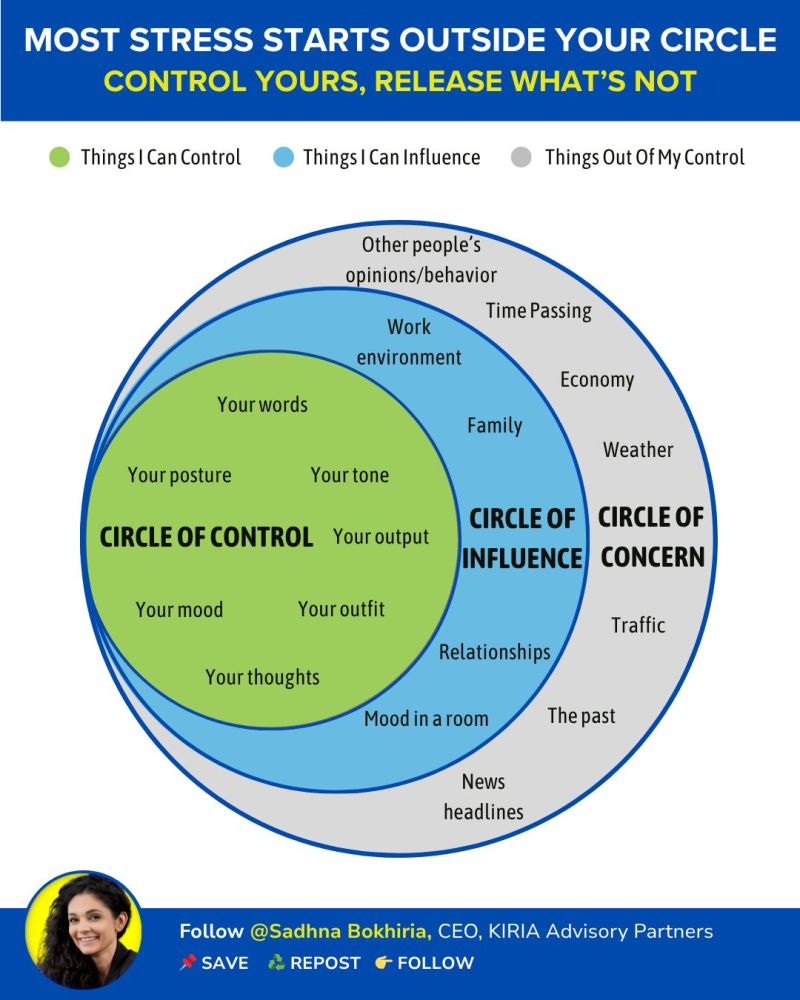
‼️ Nearly 47% of Americans are constantly stressed – often about things they can’t even control.
So check your circles👇
🔵 CIRCLE OF CONTROL
⤷ You act and something changes. This is your zone of power.
🔵 CIRCLE OF INFLUENCE
⤷ You can shape outcomes, but can’t force them. Nudge. Suggest. Model.
🔵 CIRCLE OF CONCERN
⤷ No amount of effort moves the needle. Stress thrives here.
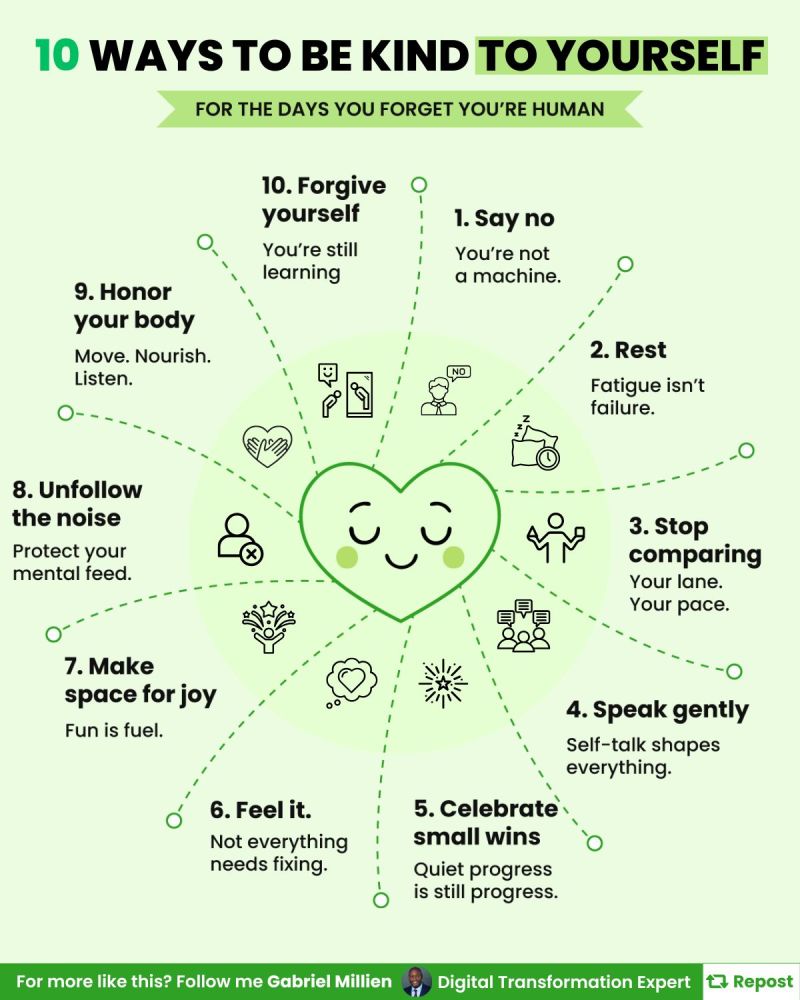
10 Ways to be Kind to Yourself
We’re praised for pushing through.
But rarely taught how to be gentle with ourselves.
That’s not strength. That’s survival mode.
And it comes at a cost.
When you:
→ are tired but keep going
→ are hurting but show up smiling
→ give to everyone but forget yourself
Self-kindness isn’t soft.
It’s how you stay whole. 🌱
10 Ways to Be Kind to Yourself:
1. Say no 🛡️
↳ Your worth isn’t in your yes. You don’t need a reason.
2. Take a break 🌅
↳ Rest isn’t earned, it’s essential.
3. Do alone 🪴
↳ Solitude can be sacred.
4. Forgive yourself 🕊️
↳ You’re not who you were.
5. Set boundaries 🛑
↳ “No” is a complete sentence.
6. Let yourself rest 🌙
↳ Burnout doesn’t build legacy.
7. Do something just for you 💫
↳ Fun counts too.
8. Go slow 🌊
↳ Unfollow what drains your peace.
9. Ditch perfect 🦋
↳ Growth is messy—and worth it.
10. Keep showing up 💝
↳ But this time, for you.
Remember: The way you treat yourself sets the tone for everything else.
Which one did you need to hear today?
THE MIRACLE YOU’RE STANDING ON

Look around for a second. Not with the tired, half-awake glance you give the world on a Monday morning, but with the eyes you had as a kid—the ones that thought everything was magic because, honestly, it kind of is.
We live on a planet that shouldn’t make sense. There’s fire boiling at its core, powerful enough to melt rock like butter. There are peaks that scrape the sky and stay frozen even when the sun shines on them all day. There are oceans so deep they could hide mountains, whole ranges swallowed by darkness where strange creatures glow like stars. And somehow, all of this is happening beneath our feet, around our homes, outside our windows while we rush through emails and complain about traffic.
And then there’s us—walking, thinking, loving, breaking, rebuilding. Hearts that hurt and heal. Minds that dream impossible things. Bodies made of the same elements as stardust, doing ordinary tasks that are actually extraordinary when you zoom out far enough.
Yet we say miracles don’t exist.
Maybe miracles aren’t rare events. Maybe they’re the default setting. Maybe we’ve just gotten used to them, like you get used to the hum of a refrigerator until someone turns it off and the silence feels strange.
Think about it. Every morning you open your eyes on a floating rock that’s spinning through space at 1,000 miles an hour, warmed by a star that’s just the right distance away so you don’t freeze or burn. You breathe air you didn’t create, drink water that’s been cycling through clouds and rivers for billions of years, and trust gravity to keep you grounded. You call that normal. But if it stopped for one second, you’d call it a miracle to get it back.
Maybe the problem is we expect miracles to be loud—burning bushes and parted seas, neon signs from the sky. But most miracles are quiet. They look like your child laughing at something only they understand. Like someone remembering your favorite song. Like healing from a hurt that once felt impossible to survive. Like waking up on a day you once thought you wouldn’t make it through.
Miracles don’t always change the world. Sometimes they just change you.
So the next time you feel small or unlucky or forgotten, step outside for a moment. Feel the ground under you. Look at the sky. Listen. This place is wild. It’s ridiculous. It’s breathtaking. And despite every reason it shouldn’t work, it does.
You’re not just alive in the middle of all this—you’re part of it.
And that’s a miracle in itself.
9 Old Rules About Change
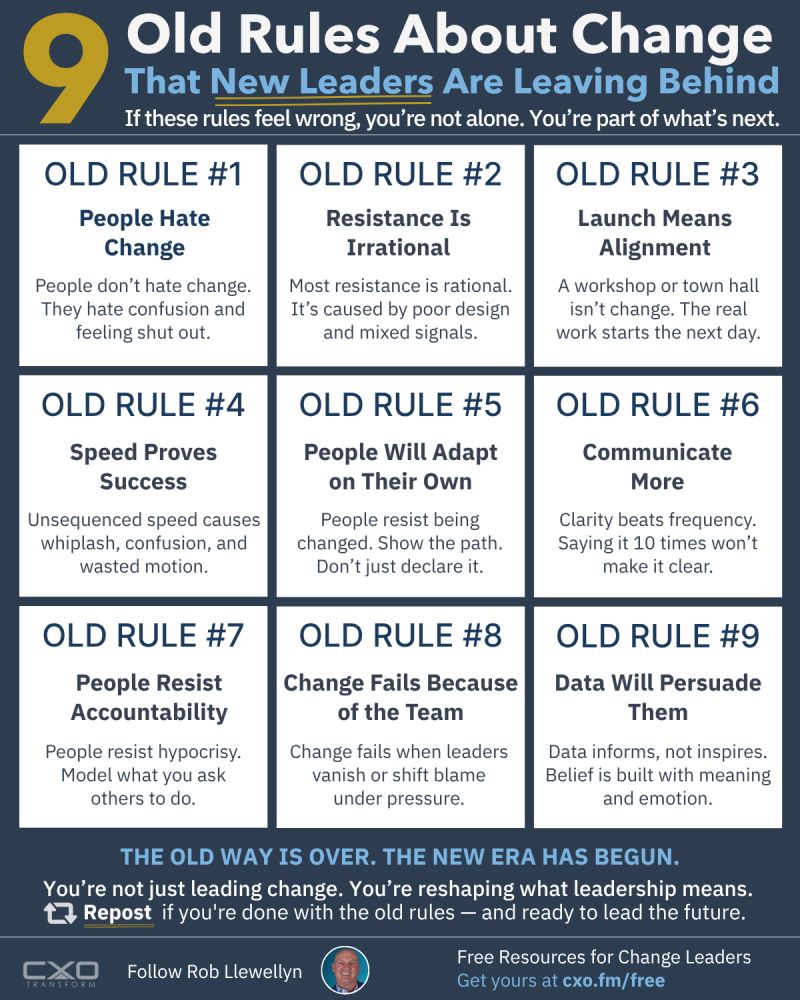
People hate change.
You’ve heard it. You’ve said it. It’s wrong.
The truth?
People hate confusion.
They hate feeling shut out.
They hate being told they’ve changed.
But change itself?
People want it.
They just want it to make sense.
The best transformation leaders already know this:
The old rules of change are broken.
The ones in training decks.
The ones recycled in offsites.
The ones that let leaders vanish when things get hard.
They don’t work anymore.
Because the world you’re leading in has changed.
Here’s what’s really happening:
• People don’t resist change.
They resist mixed signals.
• Launch isn’t alignment.
It’s day one of the real work.
• Speed doesn’t prove success.
It creates whiplash when mis-timed.
• Repeating it doesn’t make it clear.
Clarity beats noise.
• People don’t resist accountability.
They resist hypocrisy.
One vague email can undo six weeks of trust.
One skipped stand-up, and the story collapses.
Change doesn’t fail because of the team.
It fails when leaders disappear.
I’ve sat in rooms where the plan looked perfect.
But the leader had already checked out.
Leadership isn’t strategy.
It’s presence.
Seventy percent of change fails after launch.
Not from bad plans. From vanishing leadership.
If you want people to believe in the change:
Don’t bury them in data.
Tell them what it means.
Show them why it matters.
Real leaders get this.
They don’t treat change as an event.
They treat it as a craft.
Old question:
“How do I make them change?”
Better question:
“How do I lead them through it?”
If you’ve ever looked at a change plan and thought:
“This doesn’t feel right.” You’re not wrong.
You’re not the problem.
You’re part of what’s next.
You see the gap. And you’re willing to lead through it.
Are you ready to be the one who stays visible?
Most leaders talk change.
Few stay visible when it gets messy.
Prioritizing Your Tasks
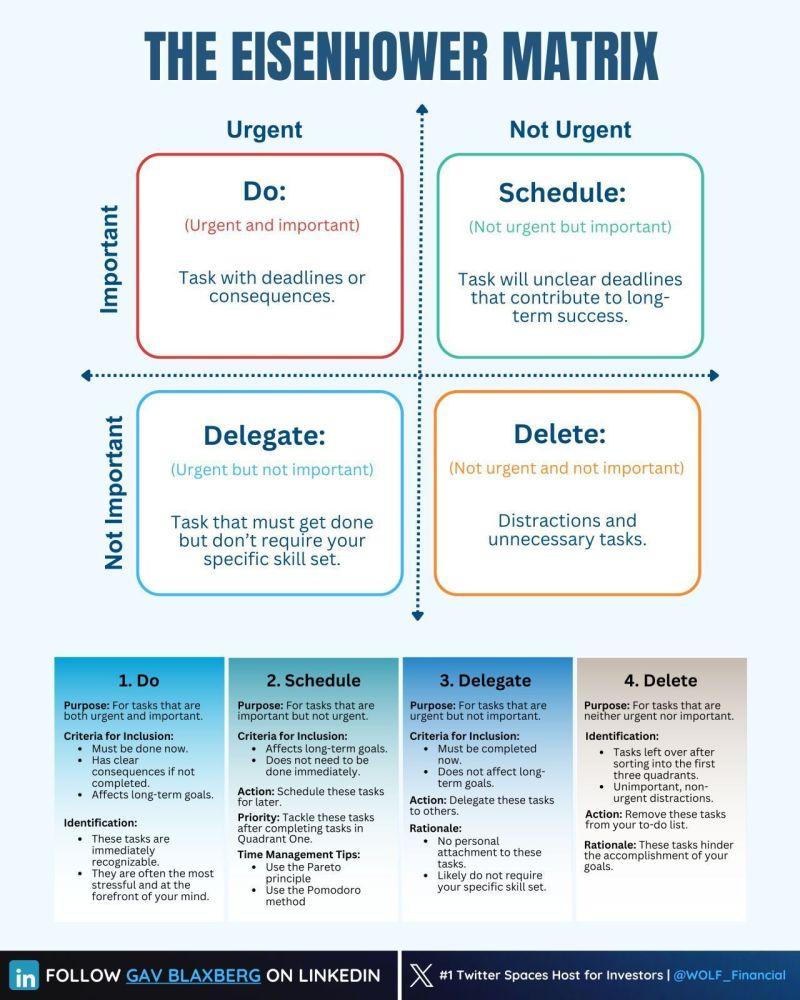
Effective prioritization boosts productivity and ensures urgent tasks get immediate attention.
Boost your productivity by organizing tasks with the Eisenhower Matrix.
The four quadrants of the Eisenhower Matrix:
1. Do:
➟ Purpose: For tasks that are both urgent and important.
➟ Criteria for Inclusion:
– Must be done now.
– Has clear consequences if not completed.
– Affects long-term goals.
➟ Identification:
– These tasks are immediately recognizable.
– They are often the most stressful and at the forefront of your mind.
2. Schedule:
➟ Purpose: For tasks that are important but not urgent.
➟ Criteria for Inclusion:
– Affects long-term goals.
– Does not need to be done immediately.
➟ Action: Schedule these tasks for later.
➟ Priority: Tackle these tasks after completing tasks in Quadrant One.
➟ Time Management Tips:
– Use the Pareto principle (focus on the 20% of tasks that yield 80% of the results).
– Use the Pomodoro method (work in focused intervals with breaks).
3. Delegate
➟ Purpose: For tasks that are urgent but not important.
➟ Criteria for Inclusion:
– Must be completed now.
– Does not affect long-term goals.
➟ Action: Delegate these tasks to others.
➟ Rationale:
– No personal attachment to these tasks.
– Likely do not require your specific skill set.
➟ Benefits of Delegation:
– Efficient workload management.
– Opportunity for team members to expand their skill set.
4. Delete
➟ Purpose: For tasks that are neither urgent nor important.
➟ Identification:
– Tasks left over after sorting into the first three quadrants.
– Unimportant, non-urgent distractions.
➟ Action: Remove these tasks from your to-do list.
➟ Rationale: These tasks hinder the accomplishment of your goals.
4 tips for prioritizing your tasks
1. Color-code your tasks
2. Limit tasks to 10 per quadrant
3. Make personal and professional to-do lists
4. Eliminate, then prioritize
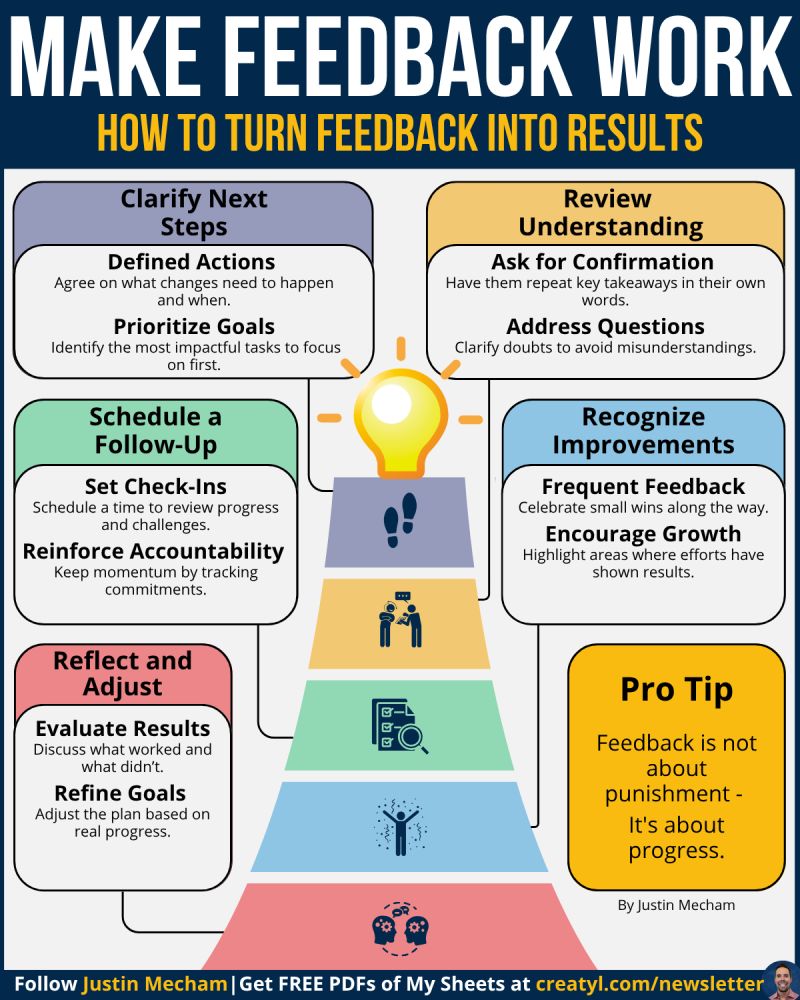
Make Feedback Work
Every word you say—
Is either building or breaking:
Most feedback doesn’t help.
It hurts.
It’s vague.
It’s rushed.
It’s forgotten.
And teams are left with:
🔴 Confusion
🔴 Stagnation
🔴 Resentment
We think we gave them clarity—
But they walk away unsure.
We think we sparked progress—
But we just shut them down.
The truth?
Feedback only works when it’s built right.
That means:
⭕ Naming the wins
⭕ Noticing the effort
⭕ Adjusting what didn’t
⭕ Tracking what worked
⭕ Clarifying what matters
⭕ Following up with purpose
⭕ Agreeing on what comes next
⭕ Asking what they heard—not what you meant
This isn’t soft.
This is structure.
Use this to reset how your team
gives and gets feedback.
Make it stick.
Make it clear.
Make it count.
Because every conversation—
Is a chance to move someone forward.
When You Stop Wrestling the Weather
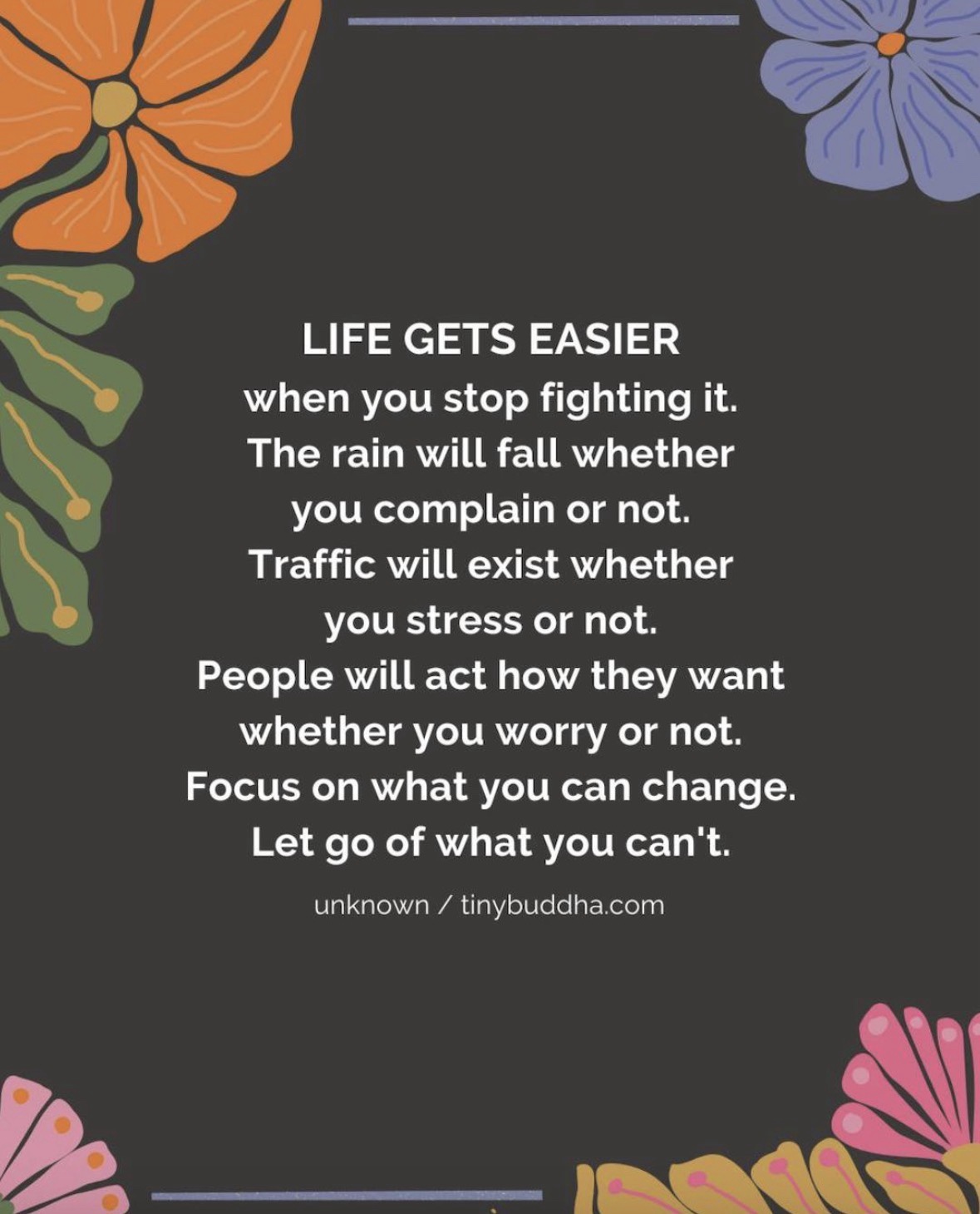
Life has a funny way of reminding us that we’re not in charge of as much as we think. We like to believe we can out-muscle circumstances, out-plan uncertainty, or out-worry the things that bother us. But the truth is simpler and far less dramatic: some things won’t move no matter how hard we push. And ironically, the moment we stop fighting what won’t change is the moment everything starts to feel lighter.
It’s like the rain. You can yell at the sky, bargain with the clouds, or lecture the thunder about your schedule, but the weather doesn’t negotiate. It just is. And standing there soaked and frustrated doesn’t stop the storm—it only drains you. The same goes for traffic. You can clench the steering wheel, roll your eyes at the brake lights stacked in front of you, and convince yourself you’re the only one who deserves to get somewhere on time. But every car around you is filled with someone who thinks the same, and stressing about it won’t magically clear the road.
And then there are people—unpredictable, beautiful, maddening humans who will behave exactly how they choose. You can tie yourself in knots trying to decode their intentions, predict their moods, or control their responses. But their choices will still be theirs. Worrying doesn’t grant you superpowers; it only steals your peace.
What you can do is shift your attention from the storms you can’t stop to the umbrella you can choose to carry. You can decide how you show up in moments that aren’t ideal. You can choose patience in traffic, curiosity instead of judgment, resilience instead of spiraling. You can save your energy for the things that are actually moveable—your habits, your reactions, your voice, your attitude, your boundaries.
Letting go isn’t surrender. It isn’t giving up. It’s choosing not to waste strength on battles that don’t have a win condition. It’s understanding that acceptance is not passivity—it’s wisdom. It’s learning to walk with the weather instead of pretending you command the sky.
And something beautiful happens when you do: life softens. The noise quiets. The weight shifts. You start noticing the small joys you used to miss because you were too busy wrestling the things you couldn’t fix. You realize how much easier it all feels when you release what was never yours to control in the first place.
Focus on what you can change. Let go of what you can’t. The rain will come and go, but your peace doesn’t have to.
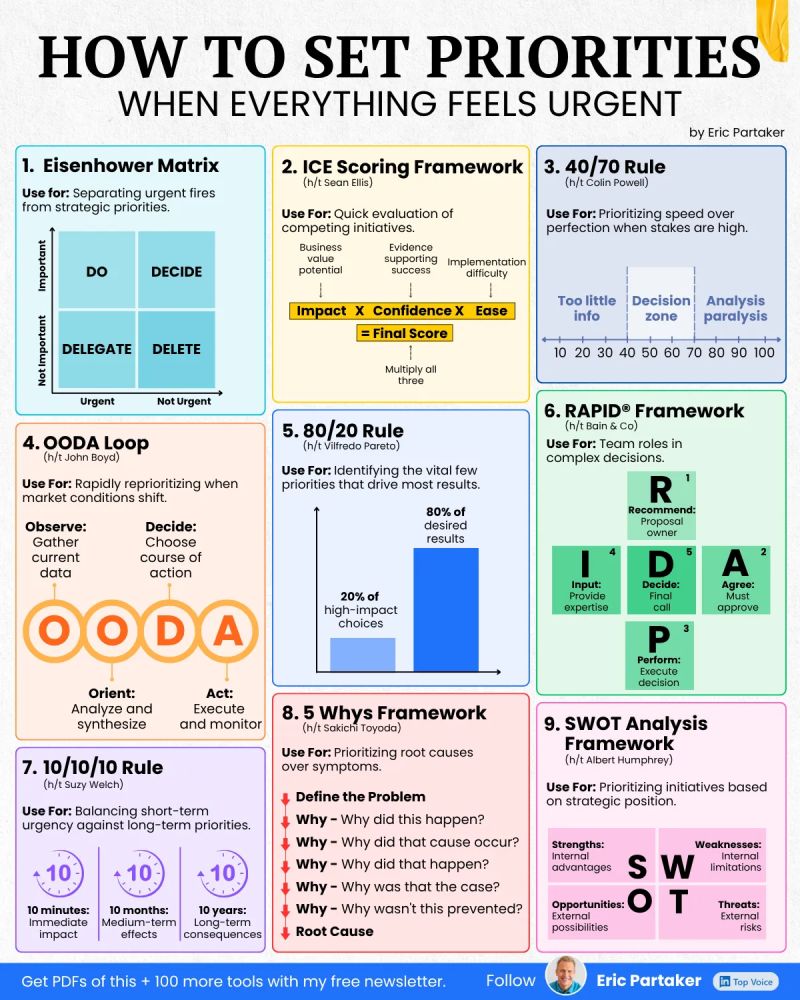
How To Set Priorities
Every CEO I know struggles with the same paradox.
The more successful you become, the more everything feels urgent.
Hiring and training.
Board meetings.
Customer fires.
Team crises.
Investor updates.
Product launches.
Strategic initiatives.
All screaming for attention. All “top priority.”
The best don’t rely on gut instinct when the pressure hits.
They use frameworks.
Not because frameworks are magic.
But because under stress, your brain defaults to whatever is loudest.
Not what’s most important.
A framework forces you to think, not just react.
Take the Eisenhower Matrix. Simple 2×2 grid.
But it exposes a painful truth:
Most “urgent” tasks aren’t actually important.
They’re just noise dressed up as necessity.
Or the 80/20 rule. Brutal in its clarity.
Most of what fills your calendar contributes almost nothing to your goals.
The 40/70 rule?
It gives you permission to move when you have enough information, not perfect information.
Because waiting for certainty is a luxury leaders can’t afford.
Each framework serves a different moment:
– When choosing between good opportunities
– When speed matters more than perfection
– When the team can’t agree who decides
– When you’re drowning in daily tasks
The frameworks themselves aren’t the insight.
The insight is this:
In the heat of battle, you need pre-made decisions about how you’ll decide.
Because when everything feels urgent, nothing is.
And the leaders who understand that don’t just survive the chaos.
They cut through it.
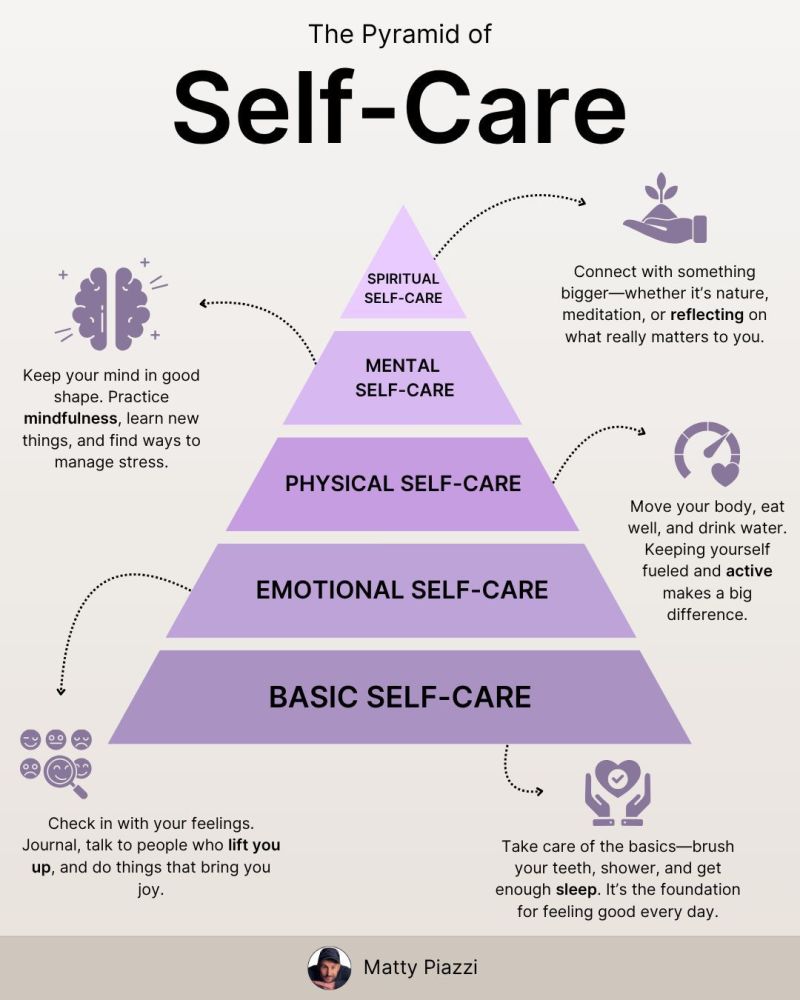
The Pyramid of Self-Care
How to make self-care a part of your life
Here’s how to use the Pyramid of Self-Care:
1. Basic Self-Care
This is about taking care of your essential needs.
It’s the foundation for feeling good and staying healthy.
For example:
→ Brushing your teeth
→ Getting enough sleep
→ Taking a shower (or a hot-cold shower, like me)
Basically, it’s just the basic stuff that keeps you going every day.
2. Emotional Self-Care
This layer is all about taking care of your feelings.
It helps you stay emotionally balanced and happy.
For example:
→ Keeping a journal
→ Talking with friends or family about your feelings
→ Doing activities you enjoy, like painting or playing music
I’m not a huge fan of painting or music.
But I know they’re therapeutic for many.
So, this layer is about making sure your emotional needs are met.
3. Physical Self-Care
This is about taking care of your real home—your body.
It’s about making sure you feel strong, energized, and healthy.
For example:
→ Eating well
→ Going for a walk in nature
→ Hitting the gym (my second home!)
→ Drinking enough water (underrated!)
4. Mental Self-Care
This layer is all about keeping your mind sharp.
It’s about doing things that help you think clearly and handle stress.
For example:
→ Doing puzzles
→ Learning new skills
→ Practicing meditation (try Zen Meditation! Love it!)
It’s like exercise for your brain.
5. Spiritual Self-Care
This is about finding meaning and purpose.
It’s about practices that help you connect with your inner self.
It helps you feel fulfilled at the end of the day.
For example:
→ Reflecting on your values
→ Spending time in nature (it’s therapeutic!)
→ Engaging in activities that give you a sense of purpose
It’s the stuff that keeps you grounded.
It helps you stay connected to something bigger.
That’s it.
Now, we just gotta fit each layer into our crazy schedules.
How?
By scheduling them. Period.
And let’s remember: self-care isn’t selfish.
We can’t truly care for others if we don’t take care of ourselves.
So, what’s your favorite layer?
10 Feedback Techniques From Harvard
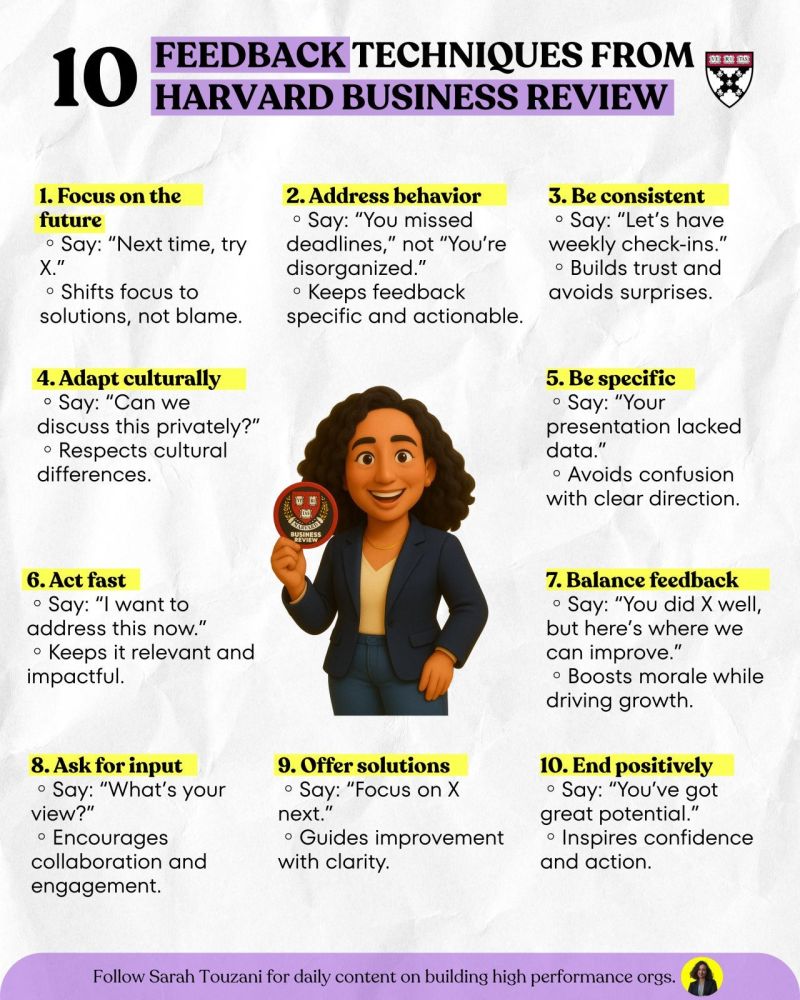
69% of employees want more feedback.
But only 23% of leaders provide it consistently.
Here’s what Harvard discovered:
Your “feedback sandwich” is hurting growth.
Why?
• It dilutes positive recognition.
• It weakens constructive feedback.
• It creates anxiety (everyone knows it’s coming).
The research is clear:
Employees receiving direct feedback are 3x more engaged.
So, how do you give feedback effectively?
Here are 10 science-backed techniques to drive performance:
1. Focus on the future
◦ Say: “Next time, try X.”
◦ Shifts focus to solutions, not blame.
2. Address behavior
◦ Say: “You missed deadlines,” not “You’re disorganized.”
◦ Keeps feedback specific and actionable.
3. Be consistent
◦ Say: “Let’s have weekly check-ins.”
◦ Builds trust and avoids surprises.
4. Adapt culturally
◦ Say: “Can we discuss this privately?”
◦ Respects cultural differences.
5. Be specific
◦ Say: “Your presentation lacked data.”
◦ Avoids confusion with clear direction.
6. Act fast
◦ Say: “I want to address this now.”
◦ Keeps it relevant and impactful.
7. Balance feedback
◦ Say: “You did X well, but here’s where we can improve.”
◦ Boosts morale while driving growth.
8. Ask for input
◦ Say: “What’s your view?”
◦ Encourages collaboration and engagement.
9. Offer solutions
◦ Say: “Focus on X next.”
◦ Guides improvement with clarity.
10. End positively
◦ Say: “You’ve got great potential.”
◦ Inspires confidence and action.
Microsoft proved it under Satya Nadella.
A feedback-rich culture drives exceptional results.
Under Nadella’s leadership,
Microsoft prioritized continuous feedback, open communication, and a growth mindset, transforming their culture.
This feedback-rich environment helped them:
• Increase employee engagement and retention
• Drive innovation and adaptability
• Achieve superior financial and market results
The simple framework I use:
What? → So What? → Now What?
Which of these techniques will you try first?
 Kenrick Vaz