Finding Our True Direction

I am sure you have tried walking around your home in the dark. With arms stretched out, we feel our way around, stumbling into walls, cupboards, feeling for what is familiar to find our way. It is surely had to see where we are going without light. It’s painful to run into things we didn’t know were there, it can be uncomfortable to not know where our next step may lead. It’s easy to lose our way when our eyes can’t see.

The same is true about the dark seasons of our life. Those times when we feel like we are aimlessly wandering around in the dark, and the divine presence of light feels far out of reach. As we wander, we wonder, where is He? Why isn’t He showing up for me here? Why did He allow this to happen? What now?

The reality of our humanity is that none of us are exempt from the pain and brokenness of this place. We all walk through tragedies and trials, seasons of life where God seems more like a distant elusive entity, rather than a close loving Friend.

Maybe like me, you planned out your life, but it didn’t pan out the way you wanted it to. 

Maybe the dream you had in mind has not yet become a reality. 

Maybe there was a relapse instead of remission. 

Maybe there was divorce instead of reconciliation. 

 Maybe you were healthy but then illness came out of nowhere are you are waiting for healing. 

Maybe you want to start a family, and though you’ve been trying for years, your arms are still empty.

Maybe you deeply desire to be married, and though you’ve gone on date after date, you are still single. 

Maybe you were enjoying a stable, smooth life, but now you’re sitting in a season of depression that is dark, ugly, terrifying, and debilitating. 

I wish I could show you, when you are lonely or in darkness, the astonishing light of your own being.

Hafiz of Shiraz

Truth is, sometimes the lights go out in life and we feel left alone in the dark with our pain. So how do we find our way back to the light? How do we take the next step forward when we our eyes can’t see? How do we live with the pain?

When something unthinkable happens, the question isn’t Why? The question is Who?

Who are you? That’s the only thing you can really know. Let what is inexplicable be inexplicable. You can’t change what has happened and you can’t control other people. But you can choose to let adversity teach you something about yourself.

If you lose everything, you are still you.

Nothing that happens, no matter how bad, can erase who you are. You are always you, no matter what happens. Experiences may change you, but deep inside there is always that shining seed of self, the blueprint of who you truly are, guaranteeing the possibility of renewal.

Loss allows space for something else to take root in you. You can let it be wisdom, not bitterness.

When everything else has been taken away, you have a choice to mend the pieces that are left or to stay in the shadowlands. When you move in the direction of wholeness, the power of your intention can ignite your own personal revolution.

An open mind and an open heart can turn the key.

It is hard work to generate gratitude and serenity when you are suffering. Luckily, just wanting to be that kind of person can be enoughWith your intentions set in the right direction, peace and contentment will find you.

In persevering through my own darkness, I found a self—call it my authentic self, my immortal soul, core being, my heart center and sanctuary—who can survive whatever life throws at me.

My experience has taught me that the human capacity to endure—and to do it with grace, courage, and joy—does not really depend on anything outside of ourselves. Even when life seems impossible, the brilliant light inside yourself is enough to see your way through your own darkest nights.

Baby Bird Syndrome

Have you spent a lot of time trying to help people who very clearly aren’t ready to accept help? This is called the “baby bird syndrome” where you pick the wounded animal off the ground and try to slowly nurse it back to health. But what if all that baby bird does is resist your help? For someone who loves a good “fix-it” job, it’s important to know that trying to help someone who doesn’t want or isn’t ready to be helped is a noble effort, but ultimately it’s like asking to be punched in the face.

How can you stand by, though, when someone you love is self-destructing? How can you not at least try to make them see that they’re hurting themselves?

The missing piece is that the other person has to want help. You can’t force them to believe anything is wrong — wrong enough to warrant some major changes in their life. 1) Change is scary and 2) Admitting you have huge innate flaws is scary. People like to think they have a handle on themselves until they really, really don’t. And even then sometimes, they will fight you, kicking and screaming, and still not realize they are in trouble. They’re so used to being on a boat with a hole in the bottom, retaining water, that they don’t even believe in boats without that.

The person you are trying to help wants to believe they can live a normal life, just like they assume everyone else is. They want to believe they don’t have to sacrifice, that they don’t have special circumstances, and they don’t have tendencies other people don’t. If their problem is drinking or drugs or relationships, they wonder: why when everyone else does these things does it not end up in disaster? Why is it when I do them, there are always major consequences or problems?

You want to help them. You want to be there for them and see what you can do to make their problems go away. Maybe at first you do help them, gently making suggestions, then more adamantly pushing them to admit they have a problem. But then they harden. They turn stubborn and think you’re trying to sabotage them or that you’re overreacting or that you don’t care about them, when all you’re doing is caring.

You can not help someone who doesn’t want help. I know it’s frustrating. It’s like a terrifying Ferris wheel, where they keep going ’round and ’round, making the same mistakes over and over while you stand on the ground and watch, sucking in breath through your teeth and holding your tongue.

If your offers of advice and support are being rejected, you may feel like you’re powerless to do anything. But you can still be there for your friend; you might just need to take a different approach to the way you’re supporting them.

Be available
Continue to be supportive. Listen to your friend when they need to talk.

Offer help
Give suggestions, if and when your friend reaches out to you and asks for your advice.

Become informed
Do a bit of research into what help is available in your area that could be useful for your friend. That way, if they decide they’re ready to seek help, you’ll be able to give them some direction about who to go and see.

Talk to someone yourself
You need to look after yourself, too. It can be really frustrating, and make you feel helpless, if a friend won’t let you help them. Talk through how you’re feeling with someone you trust.

Set boundaries
You’re not going to be able to be there for someone at every moment of every day. Set some limits on things you’re willing and not willing to do – and stick to them!

Don’t force the issue or put pressure on them
If you try to pressure or force a friend to get help, it may come from a good place, but it can actually have the opposite effect to what you intend and could turn your friend off seeking help altogether.

Don’t avoid them
If you avoid your friend, it’s likely to make them feel isolated. It may also mean that if and when they’re ready to seek help, they might not feel comfortable about coming to you for support.


Let people grow on their own level. Don’t try to pull them up just because you can. Your intention may be helping but in reality you may land up doing more harm than good.

It’s their experience, their journey and their challenges to overcome. Leave them be unless they come to you for help.

After all, maybe the ones who don’t get it, aren’t supposed to.

Make Time for Things You Love

Two of the all-time biggest reasons or excuses people use when it comes to not living a life of passion and fulfilment are:

Time and money.

We’ve heard this over and over again. Make time for the things that make you happy and for people you love. Time flies and you don’t want to look back one day with a regret. I sometimes wonder why we get voluntarily overwhelmed by the things that don’t even matter.

Urgent is not important

People often think that everything urgent must be important. But it’s not. You don’t need to be everywhere. You don’t need to solve every problem someone involved you in or fight the battle you don’t even care about.

Have you ever said or thought phrases like these

If I just had more time in the day then I’d make it work, but my life is so jam-packed!

I just ran out of time to get it done.

I don’t have time right now.

What “I Don’t Have Time” Really Means

We all have the same amount of time in a day. It is one of the few things that actually puts us all on an equal playing field!  So why is it that there are some people who seem to be able to achieve more?  

Well the answer is actually quite simple: whenever any of us say “I don’t have time,” what we really mean is:

“It’s just not a priority for me right now.”

Becoming aware of this statement will become a massive wake-up call—just like it was for me. Because all of a sudden you will interrupt your normal way of being, thinking and doing—which for many of us means being caught up in constant excuses.  

Changing your language is one of the fastest ways to change your life. So try out some of these replacement phrases and see how it feels to get real:

I don’t have time to work on my passion = My passion isn’t a priority right now

I don’t have time to exercise = My health isn’t a priority right now

I don’t have time to meditate = My mind balance isn’t a priority right now

Now, of course, it might actually be that these things (for example, passion, health, meditation, etc.) are important to you, but you just actually aren’t making them a priority, because you’ve been entertaining an old and familiar conversation in your head. You have been giving the “I don’t have time” thoughts all the attention and power. 

When you start to change the conversation in your head, you’ll be taking the first step towards living in alignment with your highest priorities.

For example:

I don’t have time to work on my passion—becomesMy passion is a priority and I will do 5 minutes tonight toward it.

I don’t have time to exercise—becomes—My health is a priority and I will do 5 squats right now.

I don’t have time to meditate—becomes—My mind balance is a priority and I will take 3 deep, mindful breaths to prove it

How to Magically Make More Time for Yourself

1. Start (Super) Small

With any habit change, it’s really important to start as small as you can. Getting into that first phase of momentum can be challenging as you’re used to doing things the “old” way. It can be somewhat comfortable. Because although our tendency is to shoot high and go all out from the outset, it’s often not sustainable, and can be seriously deflating when you don’t meet your goal.

2. Get Clear on What You Actually Want 

Before you can move from where you don’t want to be (and work out how to create more time to get there), you have to know where you actually want to go (or at the minimum identify some place different than where you are now). Take some time to figure this out. What is your passion?

And although we are almost 4 months into the year, you can still create some 2022 goals and action items before the year’s out.

3. Ask Yourself “What Am I Actually Scared of?”

Time is an excuse. Usually people use it because they are scared of something else. 

Is it failure, success, being unsure of yourself, not believing you are worthy?

Get super curious about what the time excuse is a cover for—and you will not only magically make more time for yourself, but you’ll also create more power for yourself.

4. Use the “In Between” Time

We have so much “in between” time in our days. Waiting in line, waiting on hold on the phone, waiting for the kids to come out of school, or for your boss to show up at the meeting. Start using these micro times to work on your passion projects. You’d be surprised how much five minutes of consistent daily action gets you.

5. Stocktake the “Wasted” Hours of Your Day

So many of us fill our days with unnecessary tasks that actually progress us nowhere. Is it TV, gossiping, scrolling the social networks, lunch breaks at work, etc.?  

Whatever it is for you, take stock of it, and either cut it out or make better use of it. Remember, is this really a priority for you?

6. Start Saying NO

You need to have boundaries in your life. If you cannot say NO, other people’s priorities will sneak into your day and become your priorities. 

Do you offer to help others out because you feel obligated instead of honoring your own priorities? Do you find yourself doing “busy” work that can wait (cleaning the house endlessly, doing chores) because they give you a feeling of getting somewhere?

I think a good question to ask is: What is this at a cost to? Because by saying yes to something, you are by default saying no to something else you might rather (and perhaps should rather) do. And saying no to something means you are able to say yes to something really important.

7. Delegate

Release your need for control. Most people have this insane need to control everything in their lives. Don’t worry, most of us have suffered from this once upon a time, too! But you can find people around you that actually love the things that you despise. What a great match that is!

Just make sure that when you are delegating to that person, they actually want or enjoy the thing you are asking. If it is in a home setting, perhaps you need to have an open and frank conversation with the other people you live with.

For many of us who claim to have no time, it’s simply poor management of that time. It can be easy to fall into the trap of thinking “If I don’t do x-y-z, then nobody will do it!” Let go of some tasks that are mundane or drain you and ask for help!

Time Is Your Most Precious Resource

You can always get more stuff—more money—but no matter how much you accumulate, you cannot write a check at the end of your life and purchase more time! Time is constantly ticking. There is no reverse switch, and the decisions you make about how to spend your time will largely determine the quality of your life.

So are you ready to stop fooling yourself that you don’t have time to do what matters to you? Are you ready to live a life that you love and to take the small steps towards making it happen? Are you ready to start treating time as the precious and finite resource it is?

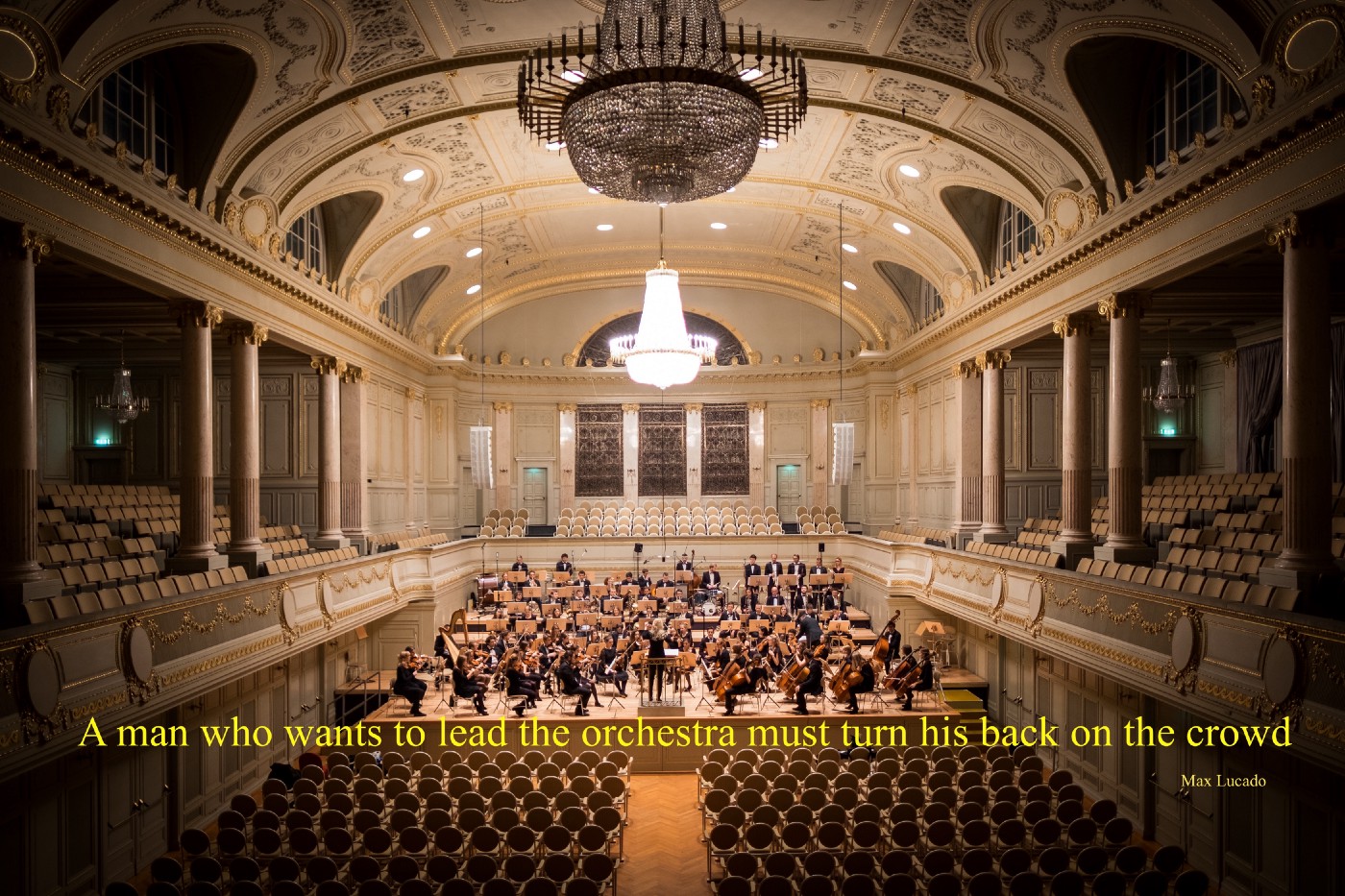
Turning your back on the crowd…to Lead

When I first saw this quote on one of my friend’s Whatsapp story, I was filled with awe. I see so many people in leadership who spend a lot of time wanting to be “in the crowd” instead of leading the crowd. No doubt it is hard to turn our backs to the cheering crowd — it seems so fun to be in the middle of it all, but a woman or man who wants to lead the orchestra must turn her/his back on the crowd.

Why? Because leadership is strengthened when a few willing and wise members who are under the guidance of a great leader will learn, watch and grow and then produce other great leaders.

When you become a leader, success is all about growing others

Jack Welch

If you check on Wikipedia you will see that a “smaller-sized orchestra of about fifty musicians or fewer is called a chamber orchestra. A full-size orchestra has between 70–100 musicians and they are sometimes called a symphony orchestra or philharmonic orchestra. Orchestras are usually led by a conductor who directs the performance by way of visible gestures. The conductor unifies the orchestra, sets the tempo and shapes the sound.”

Of course we all want to be liked, but liking someone is a feeling that can just as easily disappear when the next shiny object takes its place, and, if that is the case, that’s not leadership but following the crowd, and when the crowd goes in the wrong direction, by sheer force, the one who wanted to lead will be swept away into the middle of the crowd and lose their standing. Unfortunately we see it all the time.

When you believe you have the heart, ability and strength of leadership, then put a stake in the ground and move in the right direction for the good of your team instead of waiting to test the winds of change for your next step. Leadership moves forward; even a slow step in the right direction is still a step in the right direction.

All of us have our own spheres of influence. Do others trust you enough to follow your leadership, do they trust you enough to turn from the crowd and leave what they have known to follow you? Have you, as the orchestra conductor, spent time in developing leaders who will, after you’re gone, be able to command the respect and loyalty of others that they are currently showing to you? Or are you like most others, wasting valuable time by chasing the crowd and spending your time running to the front of the parade?

The conductor must remain focused on the musicians, he/she cannot pay attention to the crowd or anything else for that matter. The applause of the crowd is a by-product and not the main goal!

What I find interesting about the relatively small number of musicians in an orchestra is how a few people on a stage under the direction of a great conductor can bring thousands to their feet in applause and appreciation.

Just think what you could do if you focused on the orchestra of your team or your friends. By your life, your personal leadership standards, and I’ll add, your principles, you can unify, set and shape the outcome for a positive ending. But that will only happen when you turn your back on the crowd and lead.

7 Ways to Avoid Gossiping and Be Happy

Gossiping comes naturally to ALL of us. We see a lot of it in the media around famous personalities. But we gossip even in our day-to-day lives, very regularly. You may be a victim of it or you may participate in it. You may tell a friend or a co-worker something in confidence (you think). Before the day is over, almost everyone knows about it. It can be extremely painful to find out your friends and colleagues are talking about you behind your back. But worse, it can severely damage your reputation and even your career. 

Gossip doesn’t always have to be a bad thing. Perhaps you gossip to entertain yourself or to lighten the atmosphere. Maybe you’re surrounded by people who see it as a way to bond with you. But gossip turns into a toxic activity when it is done to harm another person intentionally. It affects you in many ways, may even make you anxious and miserable.

If you’re looking for ways to manage this, here are a few points for you to follow:

Ask yourself if there’s any point in the gossip.

Human beings are social creatures, and communication is a vital part of society. So whenever someone starts gossiping about a person with you, ask yourself:

“Does it need to be said?” “Am I gaining something from it?” “Is it true? Do I know the other person’s side of the story?”

If you find yourself saying “no” or “nothing” in your head, you need to stop yourself from becoming an accessory to such toxicity. Imparting information is one thing, but if someone gossips to stroke their ego, it isn’t worth it for you in the long run.

Either listen passively to the gossip, switch the topic or make an excuse and walk away from that situation — virtually and literally. Save yourself from the negativity.


Defend the person (or subject) if possible.

You must understand that the person who’s gossiping with you might not come from a place of truth. You could, therefore, defend the gossip with a detail you know about the person being talked about. Remind the gossipmonger that they’re not aware of the complete picture.

There are two ways in which the conversation will flow: First, they will stop the discussion immediately. Or, they will tell you another gossip on top of it, mostly a personal attack on the person. If this happens, use phrases like: “I don’t know.” “Seriously?” “Is it?”

People who gossip love to be correct all the time. Engage them with words but not emotionally. You’ll be off the hook when they feel they have won despite your defense about the person.


Pick your words wisely during gossip.

When you’re talking ill about a person (and enjoying it), you could use incredibly vicious words. Don’t pass remarks unnecessarily on someone’s character, hygiene, or how they dress and talk simply because you’re gossiping about the person.

Before you start such a conversation, rethink the words you plan to use. Is it possible for you to use a softer substitute for the word? Using lighter words during the conversation can reduce the intensity of the gossip or even cut it short.


Pause for a moment and think about the person.

Whenever there’s an opportunity to gossip, I always think about the person. Why am I talking about them? What do I not like about them?

If you find yourself talking about how, for instance, someone is heavily reliant on his/her family, emotionally stunted, and cowardly, stop and try to identify the problem here. Is this how you feel about the cousin? Do you feel jealous of the attention given to her? Does her family want to be helpful wholeheartedly? Whatever the answers, accept the truth, and move on. If someone’s causing you to worry, it’s best not to fuel your thoughts about them at all!

Cut off negative people from your life.

If you find the gossipmonger constantly challenging your world negatively, remove the person from your life. Break the chain of toxicity. Block them from social media, delete their phone number, and cut all ties — no matter how brutal that seems.

Suppose it’s a family member or an office colleague who gossips incessantly and you can’t break ties with them permanently. In that case, you might have to set a time limit or always have an excuse to leave the conversation.

The best way to stop gossiping is by removing gossipmongers from your life, then there would be no one to tempt or instigate you to spread negativity about a person.

Observe your tendency to gossip.

If you were to spend a day with people who love talking about others, you might begin to notice a slightly compulsive quality in your desire to gossip. When that happens, pretend the person you want to gossip about is standing next to you. Would you say anything offensive if they’re in front of you? In most cases, you wouldn’t. So why gossip behind their backs?

Create your own Happiness

How would you define a happy person? Most of the research in the field of psychology defines a happy person as someone who experiences frequent positive emotions, such as joy, interest, pride, and sometimes infrequent (though not absent) negative emotions, such as sadness, anxiety, and anger. Happiness has also been said to relate to life satisfaction, appreciation of life, moments of pleasure, but overall it has to do with the positive experience of emotions.  The ancient Greeks defined happiness as: “Happiness is the joy that we feel when we’re striving after our potential.”

Happiness is not something you postpone for the future; it is something you design for the present.

Jim Rohn

Happiness has traditionally been considered difficult to find or a fading thing. To some, even trying to achieve it is an exercise in futility.

It has been said that: “Happiness is, as a butterfly which, when pursued, is always beyond our grasp, but which if you will sit down quietly, may alight upon you.”

Happiness is not something ready-made. It comes from your own actions.

Dalai Lama

The power is within us.

The foundations for Happiness are good Relationships, good Health, and Abundance (fulfillment, contentment, sense of accomplishment, sense of purpose).

Happiness comes from choosing to be happy with whatever you do, strengthening your closest relationships and taking care of yourself physically, financially and emotionally.

Many might say that money is a big part of the equation. But intrigued with discovering the secrets to a meaningful and happy life, a group of Harvard researchers launched a study in 1938. Then, they followed 268 male Harvard undergraduates – for 75 years.
The unique Harvard Grant Study collected data on the men’s lives through surveys and interviews. They looked at all aspects, including relationships, politics, and religion, coping strategies and alcohol use. What they found may surprise you.
Perhaps one of the biggest revelations was that love really does matter when it comes to living a fulfilled life.

Relationships are the only things that matter in life. You could have a successful career, money and good physical health, but without supportive, loving relationships, you’d be unhappy. The ability to take in love is a great human skill. Even our earliest relationships are important to long-term happiness, especially the mother-child relationship. At the end of the day we are social creatures, from our cradle to our grave.

The 3-pillars mentioned above i.e. Relationships, Abundance & Health are closely interconnected or intertwined. At different times in our lives, we can be in a vicious-cycle or virtuous-cycle depending on where we are in our Happiness Journey!. 

Unhealthy or toxic Relationships can adversely impact you Health and impede your success and be a roadblock to Abundance (i.e. contentment, sense of achievement & purpose). The opposite is also true, poor physical or emotional health such as chronic illness or being stressed, anxious & depressed can definitely impact your Relationships and Abundance. Also, feeling of discontent, feeling defeated, self-doubt, being “lost” and lacking a sense of purpose can have a negative impact on your Relationships and Health. This leads to a vicious-cycle or unhappiness spiral.

On the other hand, if you strengthen your Relationships, with yourself and others, your Health and Abundance will increase tremendously. Also, managing your stress, anxiety & depression reduces your risk for chronic illness and/or may help you recover faster. This, in turn, will enhance you Relationships and boost your Abundance & success. This leads to a virtuous-cycle of joy & Happiness.

What keeps us healthy and happy as we go through life?

If you were going to invest now in your future best self, where would you put your time and your energy?

Here are some great ways to create your own happiness:

  1. Don’t obsess over things you cannot control
  2. Choose your battles wisely
  3. Get enough sleep
  4. Exercise (at least during the week!)
  5. Have a growth mindset
  6. Clear the clutter
  7. Lend a hand
  8. Believe the best is yet to come

Let nothing stand in your way in creating your own happiness!

How to Improve Work-Life Balance

Work often takes precedence over everything else in our lives. Our desire to succeed professionally can push us to set aside our own well-being. Creating a harmonious work-life balance or work-life integration is critical, though, to improve not only our physical, emotional and mental well-being, but it’s also important for our career.

In short, work-life balance is the state of equilibrium where a person equally prioritizes the demands of one’s career and the demands of one’s personal life. Some of the common reasons that lead to a poor work-life balance include:

  • Increased responsibilities at work
  • Working longer hours
  • Increased responsibilities at home
  • Having children

A good work-life balance has numerous positive effects, including less stress, a lower risk of burnout and a greater sense of well-being. This not only benefits employees but employers, too.

Chris Chancey, Career Expert

When creating a schedule that works for you, think about the best way to achieve balance at work and in your personal life. It is less about dividing the hours in your day evenly between work and personal life and, instead, is more about having the flexibility to get things done in your professional life while still having time and energy to enjoy your personal life. There may be some days where you work longer hours so you have time later in the week to enjoy other activities. 

Here are eight ways to create a better work-life balance:

1. Accept that there is no ‘perfect’ work-life balance.

When you hear “work-life balance,” you probably imagine having an extremely productive day at work, and leaving early to spend the other half of the day with friends and family. While this may seem ideal, it is not always possible. 

Don’t strive for the perfect schedule; strive for a realistic one. Some days, you might focus more on work, while other days you might have more time and energy to pursue your hobbies or spend time with your loved ones. Balance is achieved over time, not each day. 

2. Find a job that you love.

Although work is an expected societal norm, your career shouldn’t be restraining. If you hate what you do, you aren’t going to be happy, plain and simple. You don’t need to love every aspect of your job, but it needs to be exciting enough that you don’t dread getting out of bed every morning. 

Finding a job that you are so passionate about you would do it for free. If your job is draining you, and you are finding it difficult to do the things you love outside of work, something is wrong. You may be working in a toxic environment, for a toxic person, or doing a job that you truly don’t love. If this is the case, it is time to find a new job.

3. Prioritize your health.

Your overall physical, emotional and mental health should be your main concern. If you struggle with anxiety or depression and think therapy would benefit you, fit those sessions into your schedule, even if you have to leave work early or ditch your evening spin class. If you are battling a chronic illness, don’t be afraid to call in sick on rough days. Overworking yourself prevents you from getting better, possibly causing you to take more days off in the future. 

Prioritizing your health first and foremost will make you a better employee and person. You will miss less work, and when you are there, you will be happier and more productive. Prioritizing your health doesn’t have to consist of radical or extreme activities. It can be as simple as daily meditation or exercise. 

4. Don’t be afraid to unplug.

Cutting ties with the outside world from time to time allows us to recover from weekly stress and gives us space for other thoughts and ideas to emerge. Unplugging can mean something simple like practicing transit meditation on your daily commute, instead of checking work emails. 

Here is something I had shared earlier this year: Give Yourself a Break

5. Take a vacation.

Sometimes, truly unplugging means taking vacation time and shutting work completely off for a while. Whether your vacation consists of a one-day staycation or a two-week trip to Bali, it’s important to take time off to physically and mentally recharge. 

According to the State of American Vacation 2018 study conducted by the U.S. Travel Association, 52% of employees reported having unused vacation days left over at the end of the year. Employees are often worried that taking time off will disrupt the workflow, and they will be met with a backlog of work when they return. This fear should not restrict you from taking a much-needed break. 

The truth is, there is no nobility in not taking well-deserved time away from work; the benefits of taking a day off far outweigh the downsides. With proper planning, you can take time away without worrying about burdening your colleagues or contending with a huge workload when you return.

6. Make time for yourself and your loved ones.

While your job is important, it shouldn’t be your entire life. You were an individual before taking this position, and you should prioritize the activities or hobbies that make you happy. Achieving work-life balance requires deliberate action. 

If you do not firmly plan for personal time, you will never have time to do other things outside of work. No matter how hectic your schedule might be, you ultimately have control of your time and life.

When planning time with your loved ones, create a calendar for romantic and family dates. It may seem weird to plan one-on-one time with someone you live with, but it will ensure that you spend quality time with them without work-life conflict. Just because work keeps you busy doesn’t mean you should neglect personal relationships. 

Realize that no one at your company is going to love you or appreciate you the way your loved ones do. Also that everyone is replaceable at work, and no matter how important you think your job is, the company will not miss a beat tomorrow if you are gone.

7. Set boundaries and work hours.

Set boundaries for yourself and your colleagues, to avoid burnout. When you leave the office, avoid thinking about upcoming projects or answering company emails. Consider having a separate computer or phone for work, so you can shut it off when you clock out. If that isn’t possible, use separate browsers, emails or filters for your work and personal platforms.

Whether you work away from home or at home, it is important to determine when you will work and when you will stop working; otherwise, you might find yourself answering work-related emails late at night, during vacations or on weekends off.

Also it may help to notify team members and your manager about boundaries beyond which you cannot be accessible because you are engaged in personal activities. This will help to ensure that they understand and respect your workplace limits and expectations.

8. Set goals and priorities (and stick to them).

Set achievable goals by implementing time-management strategies, analyzing your to-do list, and cutting out tasks that have little to no value. 

Pay attention to when you are most productive at work and block that time off for your most important work-related activities. Avoid checking your emails and phone every few minutes, as those are major time-wasting tasks that derail your attention and productivity. Structuring your day can increase productivity at work, which can result in more free time to relax outside of work.

Why should you let life surprise you?

The struggle with life results from trying to control conditions beyond your capacity. We feel we are in control because it gives us command over our lives. Yet, unseen forces are at work in the background which include: conscious and unconscious thoughts and free will. Struggling is pointless because it doesn’t change outside circumstances, it makes matters worse. You get caught up in negative emotions instead of cooperating with life.

When we look deeply into our fears, we see that, at base, every fear is a fear of not having control

David Richo, Author of The Five Things We Cannot Change: And the Happiness We Find by Embracing Them

Plans are easy—and kind of fun—to make. It’s so tempting to try and control the trajectory of our lives by making as many of them as possible. Where we’ll go to college. When we’ll start looking for a forever love. When to have a kid or two or whichever precise number fits into the equation. Work. House. Travel. Hobbies. Retirement. Exacting detail after exacting detail.

It feels safer this way, creating a plan to ensure we live a happy, structured life. While hanging your expectations on a framework of hope is a comfortable way to keep moving forward, life doesn’t always agree to our terms. It prefers to keep us on our toes. Sure, things might not go exactly how we planned, but the end result can be a beautiful thing.

Life is full of challenges and surprises

Jil Sanders

It’s no secret, life is full of surprises when you least expect it. Some thrive in these conditions, yet others need to maintain control since they cannot cope with what life throws up.

Think back to a time when something unexpected left an indelible mark on your life. Perhaps it was a chance meeting with someone who later became a romantic interest or landing your dream job through a series of unforeseen circumstances.

Whatever the case, as the late John Lennon sang in Beautiful Boy: “Life is what happens to you while you’re busy making other plans.”

Life will surprise you if are open to possibilities, without knowing how things will unfold. Whilst expectations are good to have, don’t be bound by them since something better could unfold in the background.

Struggle ensues when you expect life to develop in a particular way. Suffering results from your resistance to what “IS” happening. That doesn’t mean you are ambivalent or do not care. Rather you are less attached to outcomes, given your passive state of anticipation.

Here’s something illuminating. No one knows what they’re doing.

We’re all making it up as we go along. There’s no roadmap revealing the future. All we can do is make informed choices based on our level of awareness and hope it lays the foundations for what will unfold.

As long as you are making informed choices, you are guided by universal intelligence and your greater self.

So, you needn’t run from your life and day-to-day living. There are surprises in every moment that will transform your life if you dare to peak behind them.

Wanting life to be other than it is seems to be the most basic form of resistance

Ezra Bayda, Author of The Authentic Life: Zen Wisdom for Living Free from Complacency and Fear

So stop bemoaning your present conditions. The obstacles you fear is leading you to your greatest triumph if you drop your resistance to how life should be.

Untangle yourself from expectations, since this delays what is likely to evolve. Stop judging conditions as good or bad, and simply allow the pieces of the puzzle to emerge.

Be patient above all else.

It is only then you will realise life has been supporting you, though you’ve been pushing her away like a jealous lover.

Be open to what comes your way and use it to lay the foundations for each chapter of your life.

Soon enough, you will appreciate life is one big surprise and you’ve been covering your eyes the entire time, unable to appreciate what has been given to you.

Saying yes to reality — to the things we cannot change — is like choosing to turn around and sit in the saddle in the direction the horse is going

David Richo, Author of The Five Things We Cannot Change: And the Happiness We Find by Embracing Them

The Battle Between Mind and Heart

It is a tough situation when your heart says go for it and your mind says “No” it is wrong. You do accept the things happening in your life and you want to create a new life which is better than what you are living today. 

Sometimes your heart tells you to help someone find their way, but your mind tells you that someone needs to find their path on their own to grow.

Sometimes your heart tells you to love someone who is not on the same page as you, but your mind tells you your differences will end up pulling you both a part.

Sometimes your heart tells you to endure the cheating and abuse with the hope of change, but your mind says you know you deserve better.

Your heart and mind sometimes disagree; your fate will depend on whose advice you follow.

Head vs. Heart: Which is Smarter?

Our head

Is where the analysis, logic, thoughts.

It’s where we think through things, review those “pros and cons” lists.

It’s also where fear, It comes up with all the reasons to stay in our safe comfort zone.

When those fears present themselves, it’s time for your True Self to face them and determine how real they are.  Until we do that, our fears will control us and greatly limit us.


Our heart

Is where our intuition lies.  It’s the source of that little voice that guides us, if we let it.  Our heart is where our True Self resides, our Higher Self – the one that truly knows what is best for us.

Without practice, it’s harder to hear our heart; the chattering mind speaks so loudly, sending us in different directions without an overall purpose and makes it hard to hear the heart.

When we’re busy being busy, the mind rules.

When we can get quiet, we can finally hear the music in our heart.


The Process of Choice

We make hundreds of choices every day, whether we realize it or not.

Many of these choices are made subconsciously – we don’t even realize we’re doing it.

Then there are bigger choices like whether to get married or divorced, leave or stay at our jobs, have kids, make a big move and pursue our passions.

And other are the ones where we take time to consider all of our options,

Those are the choices where we let our mind take over many times.


Pausing for Values

Do you know what your highest values are?  Most people don’t ever stop to consider this.

What are the three to five most important things to you in life?

Sometimes going with the flow is the easier choice but, if it doesn’t support these values, I need to make a harder choice.

What is the choice you’re about to make?  Have you uncovered all the available options?


Consider your highest values.

Consider how each option supports your highest values.

Don’t be wishy-washy about it.  If you’ve taken the above steps seriously, the choice should make itself evident.  Choose that and move forward.

No second guessing.   No regrets.  Start taking action on your choice.

If, after you start taking action on the choice you made, you do not like the results, simply make a different choice.


Slow down enough each day to hear your inner voice.  Listen to it.  Follow it.  It may lead you to unexpected places but those places will always be the best for you.

The heart and mind always quarrel with each other like your everyday couple. Without their quarrels, life becomes nothing but a vast empty space.

Kick Out The Auto Pilot

As one ages it becomes easier to just allow life to lead you rather than you leading your life. It’s as if ‘auto pilot’ has kicked in. We just wake up and respond to life. We do what we do and ultimately allow the status quo to become our life style.

Or….we can determine as we get older, never to allow age to deter us from setting new goals or dreams which we may have or want.

It is time to – Kick Out The Auto Pilot!

Life is not quantifiable in terms of age, but I suppose in my fifties I am more grounded and more at ease in my own skin than when I was younger. I have a confidence that I didn’t have before from the experiences I’ve had.

Annie Lennox

Ask a small child and he’ll tell you that an old man is his uncle, teacher or neighbor. These people might well be in their 20s or 30s, yet in a child’s mind, they are old. That’s because to a young kid, everyone seems much bigger, plus they don’t really grasp the concept behind this until they grow up.

Ask someone in his 20s or 30s, and they’ll say that having 50 or 60 years means “being old”. That’s most likely because they are afraid of this age.

But then again, ask someone over their 60s, and they’ll tell you that they just started living life and that age does not count. That’s because they went through all the phases, they experienced life, and are in a place where they know what matters.

They know that time is precious and that you should live every day to the fullest, no matter if you are 7 or 70 years old.

Society defines the guidelines on who is considered young when you become “old” when you should start a career, start a family, buy your first house…

Only those who have the experience and truly lived life, know that age is nothing more than a number.

Age is an issue of mind over matter. If you don’t mind, it doesn’t matter.

Mark Twain

You go to school up until a certain age, but you never stop learning.

You get your first job early in life, but you never stop upgrading.

You achieve success at some point, but you never stop growing.

That’s the case with everything in life. It just keeps going, and it never stands still. And neither do you.

It’s silly to let your age define you. After all, there is no “age” that defines when you stop caring about others, when you stop helping others, or when you stop feeling love and appreciation for the people in your life.

So why should there be an “age” that stops you from feeling good about yourself? Or an age that says that you can no longer have fun in your life, and experience new things.

The decision is up to you.

Here are some examples that are proof that dreams can be realised at any age!

Find Your Heart and Soul in Food and Self Love

Julia Child was over 50 years old when she wrote her first cookbook. In the 1950s she began to teach the art of French cuisine to housewives, which branched into a passionate career spanning television programmes, winning awards, and writing cookbooks about her chosen speciality and great love: food.


Hear The World Speak To You in Color

World famous fashion designer Vera Wang was over 40 years old when she began a career in fashion and design. Previously she had been a figure skater and journalist, which just goes to show that you can try many things before really landing on the thing that you shine at.


Write The Book That Has Forever Lived In You

If you have ever felt like you wanted to do something – now is the time. On The Origin of Species was published when Charles Darwin was 50 years old and the book went on to change the natural course of science forever more. Imagine if he had never bothered to pick up the pen? It’s important to make the move toward your passion and worry about how it will be received later – or not at all. Do it simply because you must.


Let The Passion Guide You

Anna Mary Robertson Moses, otherwise known as ‘Grandma Moses’, was a twentieth-century artist who began her painting career at the age of 78. Until Moses turned to painting she had worked as a seamstress for her whole life. A piece of her work sold posthumously in 2006 for $1.2 million, and her work has been displayed in galleries around the world. Moses was also mother to ten children and her work was lovingly distributed on the well-known Hallmark cards.


Be A Winner As The Underdog – Literally

Carol Gardner was freshly divorced, feeling depressed, with little prospects and a lot of debt at the age of 52. Her lawyer told her to ‘get a therapist, or get a dog’. She chose the dog – an English bulldog she called Zelda. She entered Zelda into a Christmas card competition – and won. After sending the image of her and her pooch to family on Christmas cards, Gardner decided to start her own unique company designing greeting cards, clothing, jewellery, books and gifts. Her original spin is the hilarious wit she adds. She encourages one to laugh with life – and Hallmark seemed to like it! Her company, Zelda Wisdom, is now valued at approximately $50 million.


There is no such thing as ‘too late’ to reach a goal or to achieve a dream. If you believe in yourself and you work hard, if you define your own personal idea of success, there is no reason you shouldn’t have the things you want for your life.