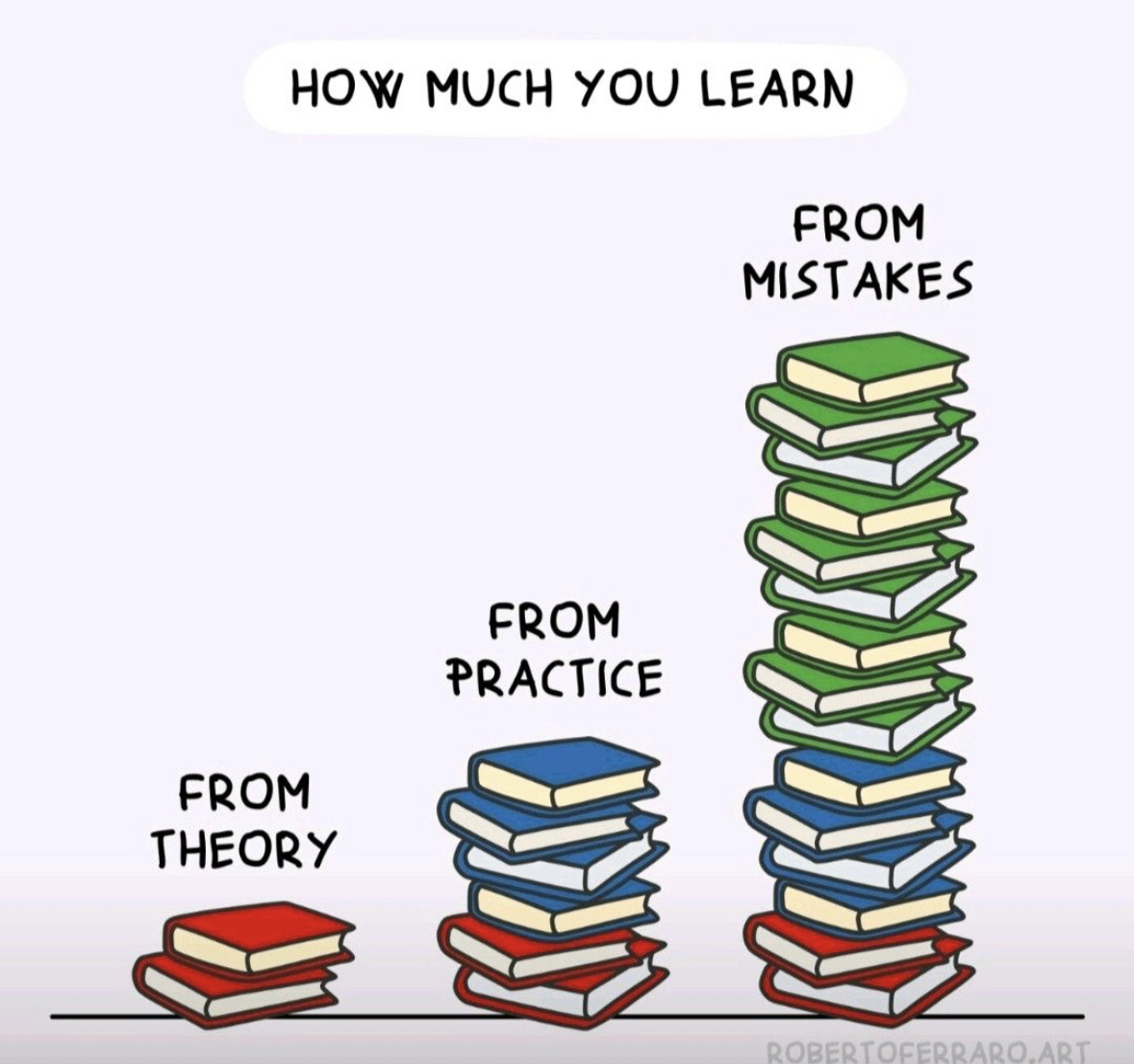
In life, mistakes are often seen as stumbling blocks, but they can also serve as stepping stones towards growth and self-improvement. One such lesson came to me through a story I read of a personal experience involving a cherished family heirloom, a delicate porcelain vase that had been passed down through generations.
One sunny afternoon, as a curious and carefree child, the author found himself left unattended in the living room. Drawn to the captivating vase displayed on a high shelf, he couldn’t resist the temptation to examine it more closely. Ignoring the cautionary whispers in his mind, he reached for it, only to accidentally knock it off the shelf.
The world seemed to slow down as the vase descended, shattering into a thousand pieces upon impact with the floor. Panic set in, and guilt washed over him like a tidal wave. How could he have been so careless? Tears streamed down his face as he realized the magnitude of my mistake.
When his parents discovered the broken vase, they were understandably upset. However, rather than scolding or punishing him, they approached the situation with wisdom and compassion. They sat him down and gently explained that mistakes are a natural part of life. It was how we respond to them and learn from them that truly mattered.
Together, they gathered the fragments of the shattered vase, symbolizing the opportunity for redemption. As they painstakingly reconstructed the pieces, his parents encouraged him to reflect on what had happened and think about the consequences of his actions. They emphasized the importance of being more mindful and responsible in the future.
That incident became a turning point in his life. It taught him humility, accountability, and the value of learning from mistakes. He understood that avoiding mistakes altogether was impossible, but taking responsibility for them and seeking growth was within my control.
After reading this story, I approached life with a newfound sense of resilience and determination. I embraced challenges as opportunities for growth, learning from each misstep along the way. Through perseverance and self-reflection, I developed a greater understanding of my strengths and weaknesses.
Today, as I reflect upon that story of the broken vase, I am grateful for the lessons it taught me. It reminds me that mistakes do not define us but rather shape us into better versions of ourselves. By accepting responsibility for our actions and learning from our missteps, we unlock the potential for personal growth and become more resilient individuals.
In conclusion, the story of the broken vase serves as a poignant reminder that mistakes are not to be feared but rather embraced as valuable teachers. They provide us with the opportunity to learn, adapt, and become wiser. By acknowledging our errors, making amends, and striving to improve, we transform our mistakes into stepping stones towards a brighter future.
Here’s a lovely rendition of Shakira’s “Try Everything”
Do you remember older generations drinking from their saucer? Then today I came across this poem that made me feel there was symbolism to the coffee ritual.
Drinking from My Saucer by John Paul Moore
I’ve never made a fortune and it’s probably too late now. But I don’t worry about that much, I’m happy anyhow.
And as I go along life’s way, I’m reaping better than I sowed. I’m drinking from my saucer, ‘Cause my cup has overflowed.
I don’t have a lot of riches, and sometimes the going’s tough. But I’ve got loved ones around me, and that makes me rich enough.
I thank God for his blessings, and the mercies He’s bestowed. I’m drinking from my saucer, ’Cause my cup has overflowed.
I remember times when the went wrong, my faith wore somewhat thin. But all at once the dark clouds broke, and the sun peeped through again.
So God, help me not to gripe about the tough rows that I’ve hoed. I’m drinking from my saucer, ‘Cause my cup has overflowed.
If God gives me strength and courage, when the way grows steep and rough. I’ll not ask for other blessings, I’m already blessed enough.
And may I never be too busy, to help others bear their loads. Then I’ll keep drinking from my saucer, ‘Cause my cup has overflowed.
Conversations are much more than a simple exchange of words. Consciously or not, every time we interact with someone, we’re meeting some of their social needs and perhaps depriving them of others. That is, we’re using language and engaging in behavior that either uplifts and motivates people or causes them to withdraw and shut down.
Have you ever struggled with building teamwork? Do you remember times when you thought everything was working well, only to find that your colleagues were unhappy or frustrated? A little while back I came across the SCARF model to improve communication and understand your influence when working in a team.
The SCARF model, from David Rock out the Neuroscience Leadership Institute (2008), provides a framework to understand the five domains of human social experiences. David Rock and his team found that there are 5 areas of our brains that light up (via brain scan technology) during our social experiences.
Status – Sense of respect and importance in relation to others. “I am respected by my family, friends, and colleagues.”
Certainty – Sense of clarity to predict future outcomes. “I am confident I know what is coming next in my life.”
Autonomy – Sense of control over events that impact the future. “I am the master of my own destiny.”
Relatedness – Sense of connection with others in your groups. “I am connected to those around me.”
Fairness – Sense of non-biased and just treatment between people. “I am treated justly.”
These five areas can either be interpreted by us as a reward or threat based on the type of social experience we are having. Conflict is, by its very nature, a social experience. When we experience conflict we are experiencing the threat response side of the SCARF model. The different ways our brain interprets social experiences in the SCARF model is summarized in the graphic below.
😱Respond To Threats 👉🏻Blood is redirected from the brain to the muscles Which means: Less creativity, fewer ideas, short term thinking, conflict
🤩Responding To Rewards 👉🏻Increased blood flow to the brain Which means: More creativity, more problem solving and insights, fresh ideas
Once you know how and why you react, with better understanding you can manage your own responses, have increased empathy for others and increase engagement amongst your team and colleagues.
Many of us will have one or two areas in this SCARF model that will be regular conflict triggers for us. For me, they are Fairness and Certainty. A lot of my conflicts surround these topics.
There you have it. That’s the SCARF model.
Remember that not everyone works the same way and that everyone can react differently to any given situation. To use the SCARF model most effectively, it’s key to understand each of your team members. Consider who that individual is before taking any action, and adjust your strategy accordingly. If you can master applying the SCARF model to your daily interactions, you’ll be one step closer to building a functional and fulfilling working environment for everyone around you.
Everything we know about St. Joseph comes from scripture. We know he was a carpenter, a working man, for the skeptical Nazarenes ask about Jesus, “Is this not the carpenter’s son?” (Matthew 13:55). He wasn’t rich for when he took Jesus to the Temple to be circumcised and Mary to be purified he offered the sacrifice of two turtledoves or a pair of pigeons, allowed only for those who could not afford a lamb (Luke 2:24).
We know he was a compassionate, caring man. When he discovered Mary was pregnant after they had been betrothed, he knew the child was not his but was as yet unaware that she was carrying the Son of God. He knew women accused of adultery could be stoned to death, so he resolved to send her away quietly to not expose her to shame or cruelty.
We know Joseph loved Jesus. His one concern was for the safety of this child entrusted to him. Not only did he leave his home to protect Jesus, but upon his return settled in the obscure town of Nazareth out of fear for his life. When Jesus stayed in the Temple we are told Joseph, along with Mary, searched with great anxiety for three days for him (Luke 2:48). We also know that Joseph treated Jesus as his own son for over and over the people of Nazareth say of Jesus, “Is this not the son of Joseph?” (Luke 4:22)
We know Joseph respected God. He followed God’s commands in handling the situation with Mary and going to Jerusalem to have Jesus circumcised and Mary purified after Jesus’ birth. We are told that he took his family to Jerusalem every year for Passover, something that could not have been easy for a working man.
Since Joseph does not appear in Jesus’ public life, at his death, or resurrection, many historians believe Joseph probably had died before Jesus entered public ministry.
We celebrate two feast days for Joseph: March 19 for Joseph the Husband of Mary and May 1 for Joseph the Worker. March 19 has been the most commonly celebrated feast day for Joseph, and it wasn’t until 1955 that Pope Pius XII established the Feast of “St. Joseph the Worker” to be celebrated on May 1. This is also May Day (International Workers’ Day) and believed to reflect Joseph’s status as the patron of workers.
Joseph is also patron saint of the Universal Church, families, fathers, expectant mothers (pregnant women), travelers, immigrants, house sellers and buyers, craftsmen, engineers, and working people in general.
Joseph is the patron saint of the dying because, assuming he died before Jesus’ public life, he died with Jesus and Mary close to him, the way we all would like to leave this earth.
The prayer below to St. Joseph is among the first few prayers we learned at home and said daily at the end of our rosary.
O St. Joseph, whose protection is so great, so strong, so prompt before the throne of God, I place in thee all my interests and desires. O St. Joseph, assist me by thy powerful intercession and obtain for me all spiritual blessings through thy foster Son, Jesus Christ Our Lord, so that, having engaged here below thy heavenly power, I may offer thee my thanksgiving and homage. O St. Joseph, I never weary contemplating thee and Jesus asleep in thine arms. I dare not approach while He reposes near thy heart. Press Him in my name and kiss His fine head for me, and ask Him to return the kiss when I draw my dying breath. St. Joseph, patron of departing souls, pray for me.
Early in Pope Francis’s pontificate, the sense of expectation was enormous.
He spoke simply and powerfully. He stayed away from the typical trappings of papal luxury. He was seen as an outsider and a natural reformer. He stirred some trepidation among conservatives, but not enough to override the global adulation. “The People’s Pope,” Time magazine called him, naming him person of the year in 2013.
Today is 10 years since Francis was elected pope. In that time, he has retained many of his personal hallmarks, and he has altered the Catholic Church in important and potentially enduring ways, including by making pillars out of issues such as migration and the environment.
Pope Francis asked for prayers as he spoke about the future of the Church and his pontificate so far in an interview published yesterday.
“Being the pope is not an easy job. Nobody has studied before doing this,” the pope said, recalling how St. Peter also “fell” when he denied Christ.
“But, after the resurrection, Jesus chose [Peter] again,” Pope Francis explained. “That is the mercy of the Lord towards us. Also towards the pope.
Asked about his wish for the world, Pope Francis responded: “peace.” He also criticized what he called a “globalization of indifference” in the face of tragedies like war: “The turning a blind eye and saying, ‘Why should I care? It doesn’t interest me! It’s not my problem!’”
Francis said one of his dreams for the future of the Church is a Church which ventures out into the world and is among the people.
Addressing readers of the newspaper, he asked for prayers from those who pray and “good vibes” from those who do not. “The pope loves you and is praying for you.”
“Even if bad things happen, even if you have had a bad experience with someone from the Church, don’t let it condition you. The Lord is always waiting for you with open arms. I hope you succeed in experiencing it within your lives like I have within mine many times. The Lord has always been beside me, above all in the darkest moments.”
As Pope Francis celebrates the 10th anniversary of his papacy, may we lead by his example of caring for the poor, reaching out to people often overlooked and sharing the joy of the Gospel.
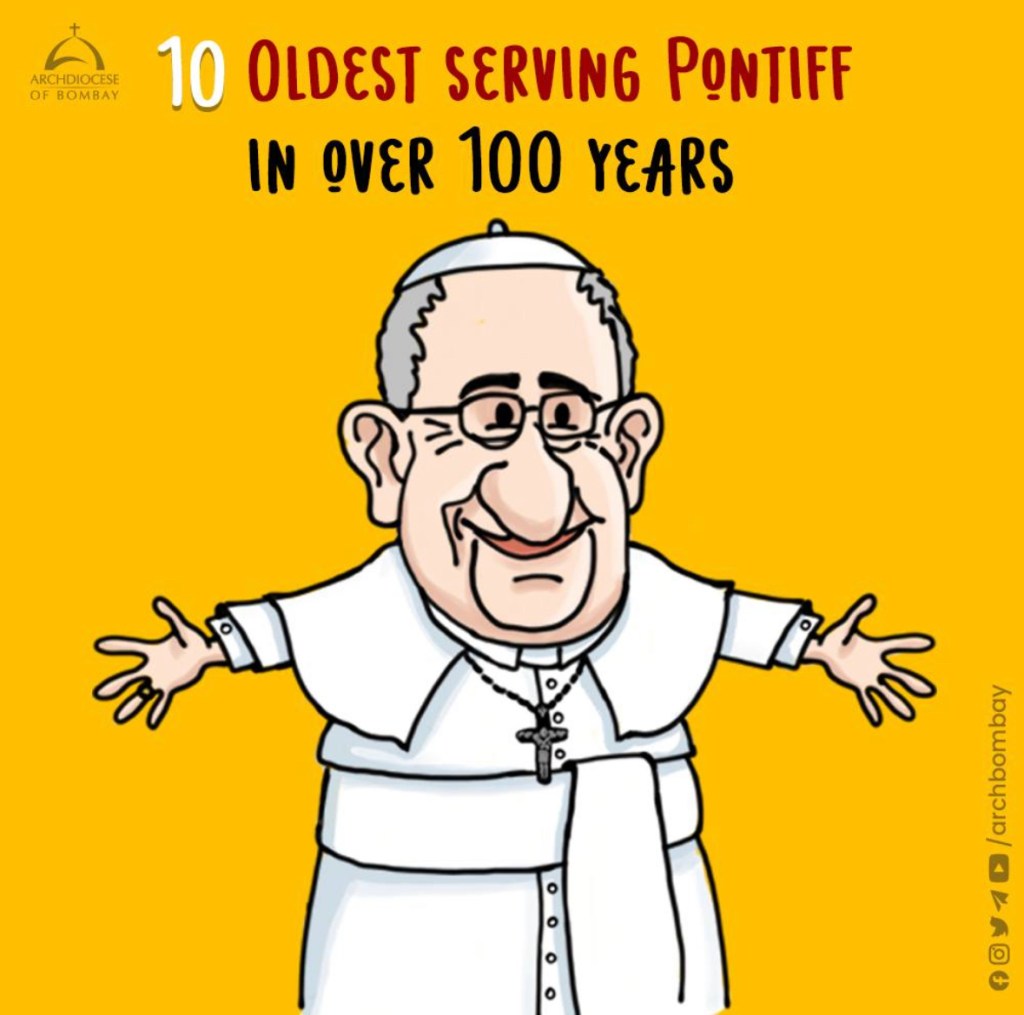
Here are 10 facts about Pope Francis, shared by the Archdiocese of Bombay.
We put wheels on bags after we put a man on the moon, made the internet and started flying the Boeing 747. What took so long?
In 1970 Bernard Sadow had no luck selling his new invention into Department stores.
“I showed it to every department store in New York City and everybody said I was crazy. ‘Nobody’s going to pull a piece of luggage with wheels on it.’ People just didn’t think in those terms,”
He was a Vice President of a Luggage company, and simply put 4 wheels on the bottom of a normal case. Macy’s finally started selling them, with a campaign called ” “the Luggage That Glides.” A patent for 2 years followed, before other makers jumped into the market.
We learn from this than innovation is inextricably linked with culture and society.
Until the 1970’s travel was for the wealthy only.
People who travelled didn’t carry their own bags, they had staff too. The idea they’d lift things themselves was outrageous. And thus the buyers were not the users and there was a huge disconnect in the market.
(For similar reasons domestic use of electricity was slow, why would a house owner care how hard their staff found it to light lights, or cook food)
The idea of dragging luggage on wheels was seen as less sophisticated or too utilitarian.
But Sadow didn’t change the world. The bag was still slightly awkward to use, as as more people entered the travel market, traveling more and more often, it was a bad bag for people who wanted to travel alone or for quick trips.
It was even later, in 1987, US pilot Robert Plath created the modern cabin bag. As a pilot for Northwest Airlines, Robert Plath had to travel very frequently so he knew what people really needed.
He made a far smaller version of Sadow’s suitcase and reoriented it to be more upright and with a longer telescopic handle. Now the bag would be easier than ever to move, with no bending over.
It’s then the bag took off.
But in an even more useful twist to the tale, we learn than neither really invented wheeled luggage. It was 1954, when the Polish/Croatian painter Alfred Joseph Krupa first attached wheels to a bag.
Krupa was an amateur boxer and martial arts practitioner, and he also taught target shooting and fencing, and a chronic inventor.
But the timing wasn’t right, he didn’t have the right connections, he was born into a country that didn’t have a clear path to global markets at the time, and he had so many ideas, he could never just focus on one.
There is a lot that can be learned from all of this. Take from it what you wish.
My biggest takeaway here is that the idea itself, however crucial, is only about 1% of the process needed to make it work. And that there’s a bit of luck with timing and opportunities involved, perhaps outside of our control. Then I get to thinking…how many potentially great inventions/prototypes are out there, but are victims of bad timing or placement, or the inventor being discouraged from an initial rejection?
Christmas is over and it’s Lent all over again, Should I eat a meat sandwich or should it be plain? Should I fast for 5 hours or skip breakfast and lunch, Or just have tea and a little something to munch?
Should I stop smoking or should I shun drink, Should I stop thinking those wrong thoughts I always think? Should I be patient with the one driving in front of me, Should I give a mouthful to my colleague or just let him be?
This, my friends, is what we’ve made Lent out to be, A set of bargaining chips, to be paid as salvation fee! It is just a reminder for you and for me, The price has been paid, by the One on the tree!
Let’s make use of this time given to us for no fee, To reconcile with the world and the One who set us free. Because no chicken or chocolate can ever pay the price That has already been paid by our Lord Jesus Christ.
Mobile phones have evolved a lot over the last few years. However storage is still a big concern. In addition to all the apps we have installed, we still would love to have a lot more storage for our photos and music. This makes the mobile app developer’s job a little more challenging as they need to keep their application size in control to make downloads fast and improve the user experience.
Source: CleverTap
When forced to uninstall a few apps to make room in their phone’s memory, a person is most likely to choose from a list of apps that take up more space and are used the least. If your app is on that list, it’s likely getting deleted.
A bigger app size also results in longer installation time and slow launch times. When choosing between apps with similar features and similar ratings, a user is more likely to go for one that takes up less space in their phone.
Here are a few techniques used to reduce app size and improve performance so your app gets downloaded and stays on your ideal user’s device.
Compress image files
Many apps, if not all, make use of images to improve user experience. Reducing the size of these images is an easy way to decrease your app size.
There are two ways to reduce image size:
Remove metadata from image files (lossless compression)
Reduce file size by reducing image quality (lossy compression)
Remove metadata from image files
Your image files have a lot of metadata stored in them that has nothing to do with image quality. For example, an image taken with a digital camera may store information about the date, time, shutter speed, flash mode, and camera manufacturer and model. Removing this information will reduce the file size without having any impact on image quality.
To remove metadata in Windows 11, right-click the image, go to Properties, and click Details. The window will give you the option to ‘Remove Properties and Personal Information.’
Source: Bitrise.io
Click on that, and you’ll get another window to select the metadata you want to remove.
Source: Bitrise.io
Select all and click OK. That will remove all metadata. This method will not result in a significant decrease in file size. However, doing it for every file in your app will result in a cumulative reduction in size that can make a noticeable difference.
To remove the metadata from images on MacOS, you need to use a third party application like Exif Metadata to remove metadata from your photos.
Use vector graphics where possible
Vector graphics are images generated based on mathematical commands that tell the system to connect a series of points. Vector graphics are smaller in size and more scalable compared to raster images — images that are saved as pixels. Vector graphics are usually saved in SVG (scalable vector graphics) format.
The use of vector images for icons, symbols, logos, and characters is very common, and you can create a vector version of any raster image using Adobe Illustrator or a similar tool. Doing so will result in the loss of some colors and sharpness — so this method is not applicable in all cases. If your app is image heavy and you think that converting all raster images into vector images will be too resource intensive — or there will be an unacceptable loss of quality — you can always go for image compression.
Use image compression tools for raster images
Image compression tools such as TinyPNG can compress images by reducing their quality by 50% or more. This is also called lossy compression and is achieved by removing less critical information from the image. This is an irreversible process, and the compressed image cannot be restored by any means.
With high-resolution images, the human eye cannot spot the difference between the original image and the compressed image. That is why lossy compression using an image compression tool is a good idea to reduce the size of all images used in your app.
Using this method, you can reduce the file size for each image by a few hundred kilobytes or just a few kilobytes depending on how much you choose to compress the images. If there are dozens or hundreds of images in your app, the saved space will become significant.
Reduce or remove unused resources
As you keep updating your app, some features may become obsolete, and some layouts, colors, strings, etc., may slowly go out of use. Removing unused resources of all types when you update will help you keep your app size small.
Remove unused resources in iOS
You can open up the app in Xcode and see all the resources in the resource list or use a tool like FengNiao to detect all unused resources. The tool helps you find all unused resources, which you can then remove from the IPA file. Your IPA (iOS App Store package) file is a compressed file that contains all the resources, code, and metadata that iOS uses to distribute and install apps.
Remove unused resources in Android
Use the lint tool to detect unused resources in your APKfile. The APK file is the Android equivalent of the IPA file — it is a compressed file that contains all the resources, code, and metadata that Android uses to distribute and install apps. The lint tool shows warnings about all unused resources, and you can then proceed to remove them.
Use Android App Bundle for Android
The Android App Bundle is a pre-APK publishing format that contains all of your app’s resources and code. Google Play uses it to create multiple APKs, each optimized to support a different device.
Using the Android App Bundle helps you reduce download size. That’s because once you sign up for it, Google Play only delivers the resources necessary to run the app on each device. For example, Super Mario Run on Google Play has a download size of 60 MBs for devices with smaller screens and 80+ MBs for those with bigger screens.
You can use the Gradle command to build your App Bundle by using the following command:
./gradlew :app:bundleDebug
Use App thinning for iOS
App thinning removes unnecessary resources and code from your IPA file. Using this technology, you can decrease the size of your app on your users’ phones. When you export your app to the App Store, you get the option to enable App thinning.
Additionally, you can enable on-demand resources. The App Store hosts all resources for released apps — resources being images, video, and sound files. Enabling on-demand resources means resources are downloaded in the background as needed, only called when needed, and removed when not needed automatically. You have to mark on-demand resources by tagging them.
The App Store also creates multiple variations of your app for different versions of iOS and devices. These variations only contain the necessary resources needed to run the app; all else is removed. This is very similar to how Android App Bundles work. The App Store does it for every new app now, i.e., you don’t have to enable this option from anywhere.
Aim for a lower-than-average app size — and keep it that way
The top apps on the App Store are 153 to 206 MB in size, and those on Google Play are 55 to 73 MB. This also depends on the type of app. A gaming app will definitely be bigger than a To Do app. But aiming for a lower-than-average app size can lead to quicker installation and better performance — giving you a chance to increase your conversion rate and user retention.
Having a small app size on release is good, but as you release new updates and features, your app size will grow. To keep the app size lower than the average for your category, you need continuous testing and monitoring capabilities.
Any other tips/ideas/suggestions on reducing app size? Let me know in the comments below!