Is the Risk Worth Taking?

We all keep taking risks every day, some big, some small. Most, if not all of us only hesitate when you feel something important is at stake. Whether you love adventure or you always focus on what could go wrong, guidelines can help you objectively assess the value of taking risks.

One question I keep asking myself when in a dilemma is “one year from now will I regret not doing this?” Some risks aren’t worth the consequences. And If you are considering a decision that will change your life, you need to flesh out a vision of the job, relationship, or lifestyle you want to create and a plan for getting there before you leap. 

Some risks are based on how much pleasure you will gain, such as choosing an exotic vacation, buying a new car, or getting a new phone. You can look at what value you will get from taking the risk and then weigh that against the value of not doing it. There’s no guarantee you will feel happier but you will be clearer about what you might gain.

There’s no way to predict how you will feel in the future.

Stumbling on Happiness, Dan Gilbert

Other risks are based on relieving present discomfort. Although you feel frustrated, resentful, or bored, you shouldn’t take a risk just because you don’t like what you have now. You need to be clear on what you want instead so you know the risk will move you forward.

Here are some pointers that help to determine if a risk is worth taking

  • Use a sounding board. Your brain wants to keep you within your personal safety zone, which differs for each situation depending on past experiences and your taste for challenge. It is better to talk through options with someone who will not be affected by your choice, someone who will be objective. Also, don’t choose someone who likes to tell others what they should do. As you explain the pros and cons of risking, notice how you feel. How badly do you want what the risk will give you? Do your reasons make you feel proud or satisfied? Your emotions may indicate how important taking the risk is to you.
    You could also try the Coin Trick. Assign your options to heads or tails. Flip the coin. The moment you see the result, are you disappointed or relieved? The trick might help you uncover what you really want to do.
  • Catch your “shoulds.” It’s hard to make a decision when you are attached to other people’s opinions. What do you think they will say if you take the risk? Try writing these statements down to identify your fears of their judgments and your guilt about disappointing others. Recognition of your should-based actions can also free you from black-and-white, stay or go, decisions. You might find other options available to you when you clearly understand what you want for yourself in the future.
  • Know your why. Be mindful of being driven by needs for recognition or acceptance. When you assess the value of your risk, what type of satisfaction do you gain? What outcome will you be most proud of over time? What would you do if you had no people to take care of or please? Twenty years from now, what would you love to tell people about the risk you took? What story do you want to be living?

    For life-changing risks, consider the strengths you love to exercise. Can you envision using these strengths in a deeply satisfying way?

When I dare to be powerful, to use my strengths in the service of my vision, then it becomes less and less important whether I am afraid.

Audre Lorde, Activist
  • Be honest about what could go wrong. Don’t ignore hazards. When you look at possible problems, how would you handle them? Fear can blind you to your options once you take a risk. Consider bad outcomes, determine the likelihood they will happen, and what you would do next.

    If you decide the risk is worth taking, commit to taking a few steps, even if the steps are small. You might read a book, have a conversation with someone about the direction you want to take or sign up for a class on starting a business. Do something to keep moving. Then, if things don’t go as you hoped for, allow for self-correction. Learn along the way.

No matter what you decide, you will encounter difficulties. You will question your choices. You may even find your choice was just a step to the next as you create many chapters in your life.

Which risks will you regret not making a year from now? Decide what risks are worth taking and take the first step today.

Not Everyone Is Genuinely Happy For You

When something beautiful comes our way we run to share the good news with friends, family or colleagues, and their wide smiles, giggles, hi-fives, and awkward jumps, fool us into thinking they are genuinely happy for us. Think again. Not many are genuinely happy for us. To be fair, a few are genuinely happy for you. Yes, it’s a weird world we live in but there are still a few genuine friends, family and colleagues.

A lot of people view life as a competition or a race. Some people have this mindset that they have to do better than someone else. In their minds that can mean a handful of things: getting married first, having the flashiest car, having a bigger house than their so called “friends,” or making more money than them. People like these are either not happy with themselves or trying to prove to others that they look happy and are “winning” at something.

Competition is healthy but unfortunately, competition doesn’t always make the best of friends. It is possible for everyone of us to succeed, but not everyone does. People who do succeed don’t succeed at the same exact time as you. There will certainly be a gap of years between your success and that of your friends. It is easy to say that we will be happy to see our friends do well for themselves and acquire great achievement, but the fact of the matter is that we all get a little jealous.

Funnily enough, when you see someone succeed, you are reminded of your lack of success. It’s silly, but human beings usually prefer seeing people worse off than they are because it makes them feel that they aren’t doing so bad for themselves. I guess we are all competitive by nature and knowing that we are not in last place is more comforting than being reminded of how far behind we are. Of course, there will be some people in your life who will truly be happy for you when you hit the jackpot, among them will be your parents.

There may even be some friends who aren’t competitive or driven, who will be supportive. Everyone else will vary in how much they loathe you for beating them to the finish line. Some closer to you, will do their best to hide their unhappiness and jealousy, while others will try to put you down and point out flaws or reasons the success won’t last. We are all not cut from the same fabric, where some are undoubtedly, brewing with high hopes and arriving with a head full of dreams.

Yes, success takes a lot of hard work, focus and sacrifice and a bit of luck. It’s a waiting game. It’s those who are patient and diligent enough to stay in the game that end up on top. So picture this; you put in so much hard work, sacrifice and focus and then with a bit of luck, you succeed and you feel like sharing this with friends, genuinely. Some frown on this behind your back and wish your success won’t last. I guess we were all given plain level playing field but I aimed higher right from day one and it has yielded me fair results, but you frown on mine?

Sadly, pursuing your dreams involves a lot of downs before ups. So seeing other people make it, even if they are your friends, feels like a slight kick to the gut that intensifies, depending on how down you are. I also firmly and staunchly believe that, when you are genuinely happy for people and pray for their success, help promote their business, you are definitely unlocking doors for yourself too and you can never tell what could be waiting for you at the corner. Praying for other people’s success and elevation, can bring you a whole lot, genuinely.

Not many people would want to talk about such stuff especially when they consider themselves to be good friends with whoever is basking in glory, they feel guilty for feeling the way they do. They know that they should be happy for their friends, but sort of hate them for being able to do what they still haven’t managed. It’s these people that find it the hardest to hide their disappointments in your happiness because they don’t really care whether or not you remain “friends.” That is, unless they know they can use your newfound success to their own advantage. They are not happy for you; they are happy to know you so they can exploit you.

Sure, when you succeed in something grand, all you want to do is talk about it, share it with your friends and bathe in the glow for as long as you can. However, if you know your friend is having a difficult time, that he/she is likely to be jealous or bummed out of your success, you may want to take one for the team and find a way to boost his/her confidence instead of rubbing it in or boasting about your achievements.

It’s funny how our generation has information about others at the touch of a button, just to compare and contrast. Others fake it all by posting fake successes and life events on social media, so they won’t be left out. Why go through a whole lot of fake stuff just to prove a point?

Keep doing you, embrace the ups and downs, and share what you want just knowing that most people are there for the information. Know who to share with. Tell the people closest to you about your life’s ups and downs, they are the ones who truly care and support you.

Some of God’s Greatest Gifts Are Unanswered Prayers

All of us who have put something in God’s care always tend to steal it right back. It is not that we intentionally do it, but it is very natural for us to go back to something that we are concerned about. How do you leave a problem in God’s hands and not steal it right back? 

Usually when we neglect to leave a problem in God’s hands the “stealing it back” comes in the form of mental musing over the problem. You know, those anxiety conversations that we have with ourselves in our mind, act out in our imagination, and eventually spill over onto someone’s peaceful day.

Therefore we have to catch those little though starters of doubt or anxiety before they become long conversations in our self-talk. 

Trying to control every aspect of our lives rarely brings the control that we are seeking. Instead there is the adverse effect that causes us to become more weary and anxious than ever. We all want good things to happen in our lives, but too often we want it now…not later. When it doesn’t happen that way, we are tempted to ask, “When, God, when?” Most of us need to grow in the area of trusting God instead of focusing on the “when” question. If you’re missing joy and peace, you’re not trusting God. If your mind feels worn out all the time, you’re not trusting God.

The tendency to want to know about everything that’s going on can be detrimental. Sometimes knowing everything can be uncomfortable and can even hurt you. I spent a large part of my life being impatient, frustrated and disappointed because there were things I didn’t know. God had to teach me to leave things alone and quit feeling that I needed to know everything. I finally learned to trust the One who knows all things and accept that some questions may never be answered. We prove that we trust God when we refuse to worry.

God gives us hopes and dreams for certain things to happen in our lives, but He doesn’t always allow us to see the exact timing of His plan. Although frustrating, not knowing the exact timing is often what keeps us in the program. There are times when we might give up if we knew how long it was going to take, but when we accept God’s timing, we can learn to live in hope and enjoy our lives while God is working on our problems. We know that God’s plan for our lives is good, and when we entrust ourselves to Him, we can experience total peace and happiness.

God causes things to happen at exactly the right time! Your job is not to figure out when, but to make up your mind that you won’t give up until you cross the finish line and are living in the radical, outrageous blessings of God! The more you trust God and keep your eyes focused on the divine, the more life you’ll have. Trusting God brings life. Believing brings rest. So stop trying to figure everything out, and let God be God in your life.

Here is a lovely song by Garth Brooks which I am reminded of when writing this post

The Most Important Part Of The Body

When I read this quote I am reminded of this lovely story shared by a dear friend.

My mother used to ask me what the most important part of the body is.
Through the years I would take a guess at what I thought was the correct Answer.

When I was younger, I thought sound was very important to us as humans,
so I said, “My ears, Mommy.”

She said, “No. Many people are deaf. But you keep thinking about it
and I will ask you again soon.”

Several years passed before she asked me again.
Since making my first attempt, I had contemplated the correct answer.

So this time I told her,
“Mommy, sight is very important to everybody,
so it must be our eyes.”

She looked at me and told me,
“You are learning fast, but the answer is not correct because
there are many people who are blind.”

Stumped again, I continued my quest for knowledge and over the years,
Mother asked me a couple more times and always her answer was,
“No. But you are getting smarter every year, my child.”

Then one year, my father died. Everybody was hurt.
Everybody was crying.

My Mom looked at me when it was our turn to say our final good-bye to my father.
She asked me, “Do you know the most important body part yet, my dear?”

I was shocked when she asked me this now.
I always thought this was a game between her and me.
She saw the confusion on my face and told me,
“This question is very important. It shows that you have really lived in your life.
For every body part you gave me in the past, I have told you were wrong and
I have given you an example why.

But today is the day you need to learn this important lesson.”

She looked down at me and threw her head to my shoulder and hugged me.
I saw her eyes well up with tears. She said,
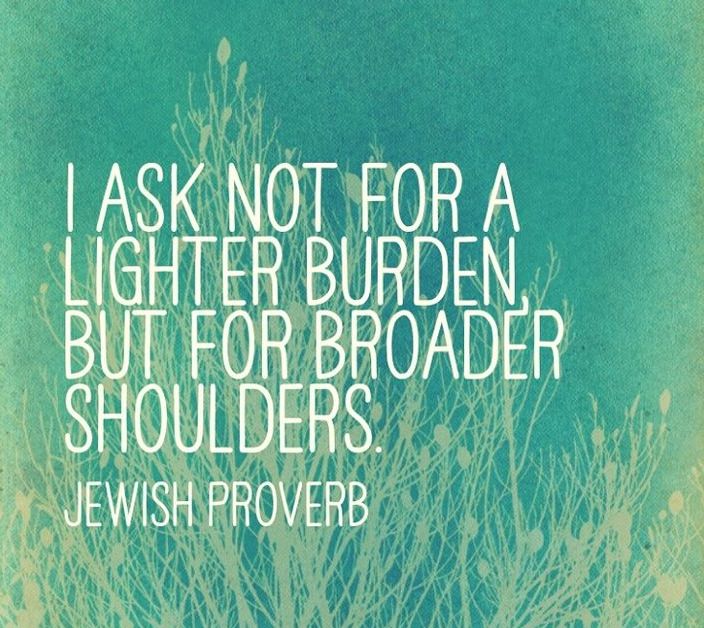
“My dear, the most important body part is your shoulder.”

I asked, “Is it because it holds up my head?”

She replied, “No, it is because it can hold the head of a friend or a loved one
when they cry. Everybody needs a shoulder to cry on sometime
in life, my dear. I only hope that you have enough love and friends that
you will always have a shoulder to cry on when you need it.”

Then and there I knew the most important body part is not a selfish one.
It is made for others and not for yourself. It is sympathetic to the pain of others.

if/else in CSS

As we know, there are no conditional statements in CSS, but this may soon change with new @when and @else operator

Currently, the only way to perform a conditional statement was to use media queries like this:

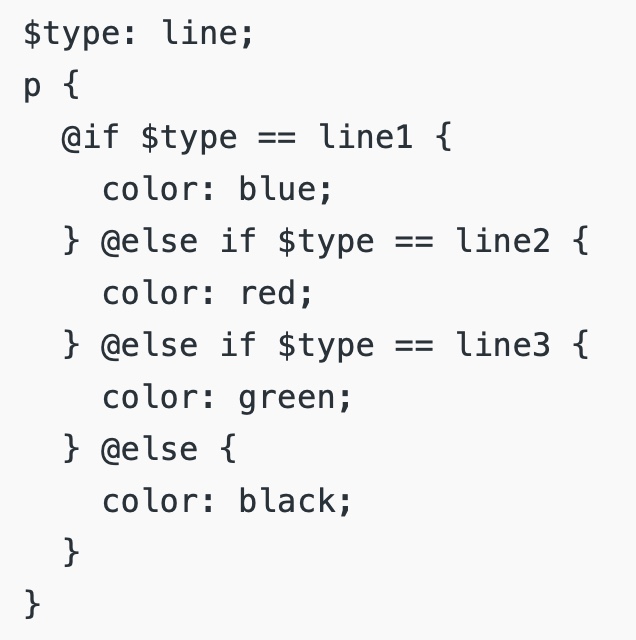
We can use CSS preprocessors like SASS which allows us to write condition statements in it. Even if you use SASS you have to pre-process your stylesheets which means that the condition are evaluated at compile time, not at run time.

SASS Syntax:

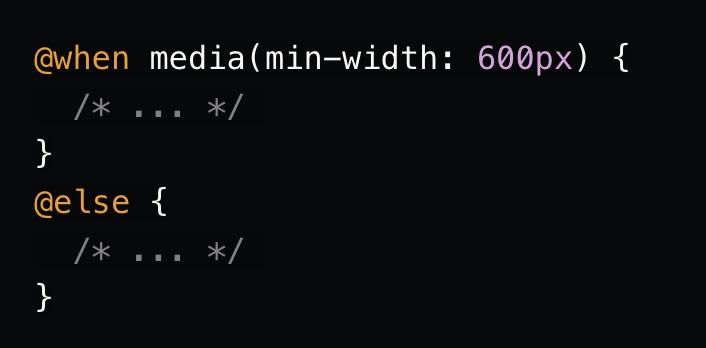
The above work well, but in the new proposal it looks much cleaner and very similar to many programming languages.

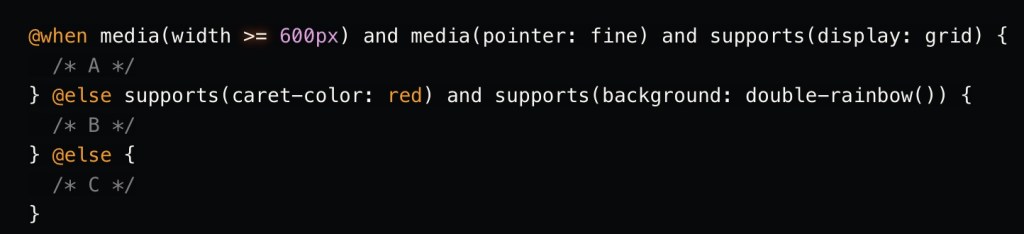
Here is the new proposed syntax

We can do multiple conditions as well by using multiple @else statements, and not just use @media, but @supports too.

Naming this new feature is still not clear. I think that @if would be a better name than @when. However the reason behind this naming is probably that Sass already uses @if, and it would be very annoying to many developers if they had to refactor their Sass code.

The bad news is that it’s not supported by any browser at this moment, it’s not even listed on caniuse.com

What do you think about this new proposal?

Collect Memories, Not Things

Do you remember your first phone, or that awesome Starbucks caramel latte you bought last week? How do those items make you feel? Now, think of a Christmas with your family. It probably isn’t the gifts you think of first; you probably think of the conversations, the laughter, and the board games. Lasting joy doesn’t come from objects, it comes from experiences. Our brains are like living scrapbooks; they collect moments in time, frame them, and revisit them constantly. We can derive happiness from these memories years after they are made, and we can enjoy them in a way we can never enjoy material things.

Most of us can distinguish quite clearly the difference between the pleasure we get when our new phone arrives vs. the happiness we feel during a dream vacation to a place we’ve been dying to visit. Whereas we may feel excited during the days leading to a vacation, we tend to feel impatient when waiting for an object. Where most of us lose interest in a new gadget or toy relatively quickly, we tend to cherish a memory.

The more important things in life aren’t things

Anthony J. D’Angelo

So, in this society of materialism, how do we change our focus from consumerism, to the pursuit of experiences? Most of us aren’t going to jump off the couch right after reading this and go skydiving, and that’s OK! Some of the happiest moments in our life aren’t the most exciting ones. Here are several ideas to help you start collecting.

Make A Bucket List

We all have things that we secretly want to do. Making a list and sticking it up on your bulletin board will bring those experiences that much closer. Most of us give up on our more ambitious plans, believing them to be impossible or too expensive.

Keep An Adventure Jar

Keep a jar on your kitchen table. Every time you decide not to buy something you don’t really need, or decide not to eat out, put the money you would have spent on those things in the jar. Most of us don’t realize how much money we could save if we didn’t spend it on little, pointless things.

Have Some Small-Time Goals

Not all experiences need to be world-changing. Try doing something differently every week or even every day. Choose a different way to get to work, or have some new people over every once in a while. Take a little time out of the day to experience life instead of becoming stuck in a mindless routine. You may be surprised how these little things can change your life.

Take Time For Family And Friends

Some of the best memories we have are with other people. Just a conversation with a dear friend may be enough to bring you happiness one day when you’re feeling down. 

Be Open To New Things

Many of us are afraid to stray outside our comfort zones, which will often keep us from experiencing many things in life and result in regret. Life is meant to be lived. Do new things, they’re how memories are made!


When we shift our perspective from yearning for things to collecting memories, we maximize our potential to have amazing experiences, regardless of our material possessions!

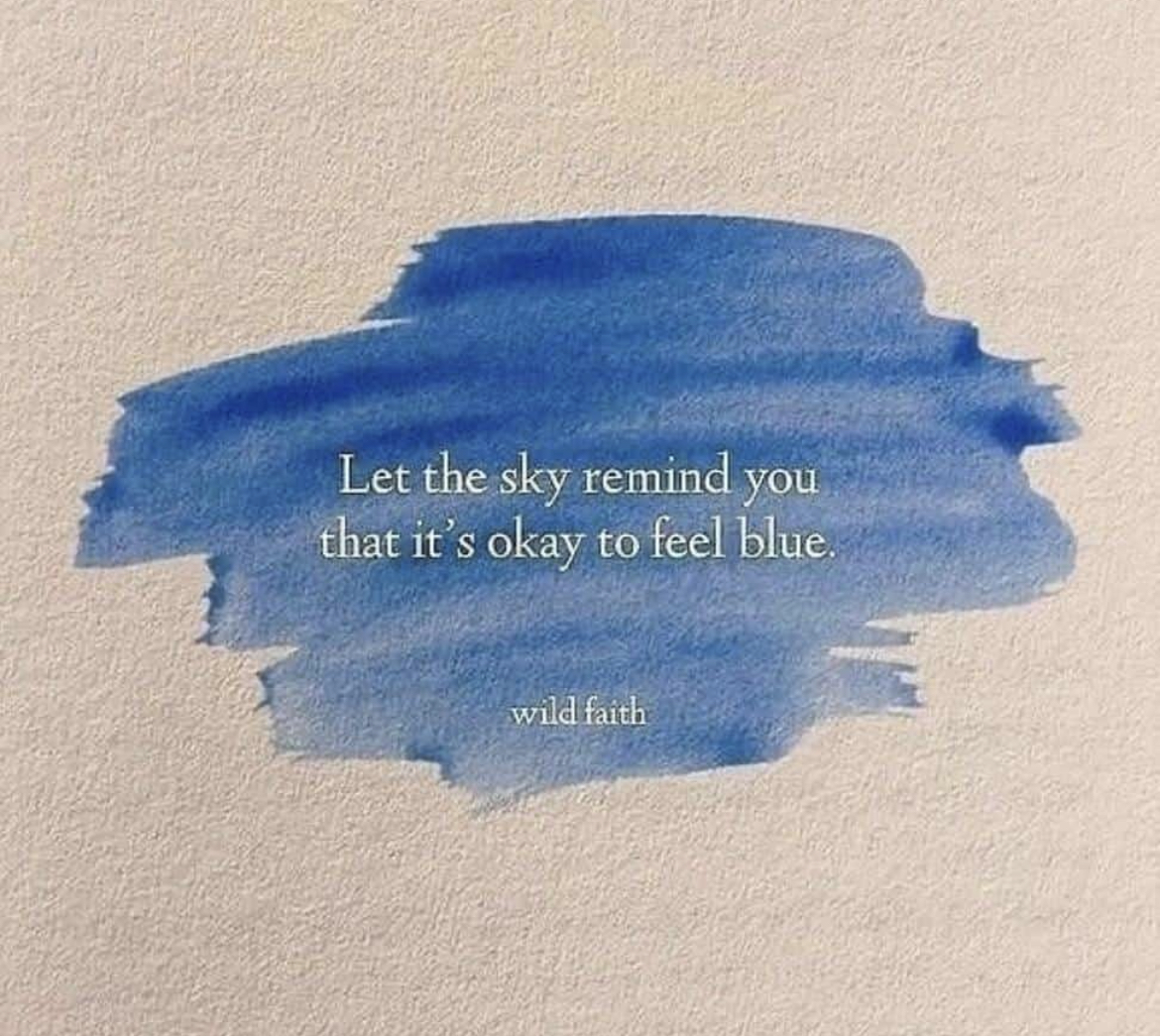
Feeling Blue?

Perhaps today you woke up feeling blue. We’ve all been there because, well, we are all human. It is normal to feel down sometimes. Negative emotions can be a result of anything from suffering from a tragedy to just feeling sad for an unknown reason. When you feel stressed or sad, it is important to slow down and take time out for yourself.

If you are reading this, chances are you want to do something to lift your spirits. It is helpful to have a list of things that make you feel good to keep in the back of your journal or hidden in a drawer for moments when you might need them. It may be hard to think of things when you’re in a tough spot. Below are a few ideas of things to do when you feel blue to help give you a lift:

1. Get Some Exercise — Exercise is a natural, healthy coping strategy for stress and feeling down. Getting your heart rate up releases endorphins, feel-good chemicals, which help with viewing your circumstance from a more balanced, positive perspective. Exercise has also been associated with increased creativity which helps with problem-solving. Even 10–15 minutes can help make a difference.

2. Listen To Music — It turns out that listening to your favorite tunes and singing along does more than just entertain your neighbors. Listening to music has been used for centuries to reduce stress. It has been used to treat both physical and mental symptoms. According to Dr. David Lewis, a cognitive neuropsychologist, listening to music reduced stress in study participants by 61 percent.

3. Have Coffee or Lunch With a Friend — Sometimes talking about what is making you feel the way you do, helps you see it from an outside perspective, even if there isn’t one thing making you feel down. There is nothing like having a great friend to talk to about your emotions. Even if you don’t talk about them, just having someone there to take your mind off of your current state is priceless.

4. Take a Nap — Not getting enough shut-eye is a recipe for emotional disaster. If you haven’t spent enough time sinking into dreamy bliss, taking a nap may help restore balance. On the flip side, if sleeping is your “go-to” when life gets rough, you might want to avoid this one and push yourself to get out instead. For short term stress, it can help. However, if you notice you have been going to bed more frequently, it may develop into an unhealthy coping mechanism. It can also be a sign of depression and you should discuss it with your doctor.

5. Have a Solo Dance Party at Home — It is hard to dance at home by yourself without a smile on your face. Dancing helps you get in touch with your authentic self. Doing it at home allows you to express who you are in a safe environment. Plus, you may end up finding some new dance moves you can use in public.

6. Draw or Paint — Like dancing, doing art, even if you don’t consider yourself an artist, helps reduce stress, fosters creativity and helps you get in touch with your true self. Psychologist Carl Jung recommended patients color mandalas as a way of improving their psychological health. For decades, therapists have used art therapy and have reported positive results in patients.

7. Avoid Drinking Alcohol — Although there are thousands of memes that make jokes about drinking to relieve stress, it only leads to worsening symptoms. Your body has a natural defense mechanism to deal with anxiety and stress, using the nervous and endocrine systems to help achieve homeostasis. Alcohol interrupts this process and takes a toll on your body both physically and emotionally, which can compound feelings of stress and anxiety.

8. Get Outside — Spending even five minutes outside can improve your mood, especially in natural, green spaces. We live in a world where our attention is constantly being pulled in different directions, adding to unwanted stress. Getting outside and appreciating the beauty of nature, can help slow our minds down and has a calming effect.

9. Have a Cup of Tea — It may sound far-reaching, but there is something calming about the ritual of making a cup of tea and sipping it. It reminds us to slow down. Herbal teas used to induce sleep, like chamomile and lavender, also help with stress. Having tea outside, perhaps at an outdoor table, is a bonus since getting outside for fresh air is also helpful for making us feel better as discussed above.

10. Read a Book — Reading a book is a great distraction. A good book will take you to new places and get your mind thinking about the story rather than your unwanted thought patterns. Dr. David Lewis discovered that reading was one of the most effective ways to reduce stress. His study found that reading reduced stress levels by 68 percent.

11. Text Your Friends a Kind Message — It is great to focus on what you like about a friend and tell them. Making someone else feel good helps spread kindness and it usually comes back full circle, even if not immediately. It helps to put your mind in a positive place about others and can remind you of what you like about yourself.

12. Prepare a Healthy Meal — Cooking is a form of creativity and preparing healthy food in a tasty way can be fun and rewarding. When you choose a difficult recipe, one that challenges you, it forces you out of cooking autopilot. It also means you may have to get out of the house to buy ingredients. Besides the cooking side of it, eating a good, healthy meal will help prevent poor eating that can come along with stress and sadness.

13. Listen to Comedy — Laughter has always been touted as “the best medicine.” There is truth to that adage. Listening to something that makes you laugh is the best way to shift your mind into a more positive state. Many of the popular music streaming apps have a comedy station, and you can choose if you want explicit humor or not.

14. Do Something Outside of Your Normal Routine — Vacations are great for switching your mindset by taking you out of your normal routine and getting you to look at yourself and the world from a different viewpoint. The good news is that you don’t have to travel far to gain this benefit. Being a tourist in your own town is valuable as well. Visit a local museum or botanical garden.

15. Turn off Screens — If watching T.V., playing video games, or constantly checking our phones made us happy, we would be the happiest culture that ever existed. Unfortunately, many studies have shown the contrary. If you feel blue, I highly recommend taking a “screen fast.” We should all do that regularly.


It is normal to feel down sometimes. When you do, it is important to develop healthy coping strategies so that we can help our body’s natural process of recovery. Do you have a healthy strategy for when you feel down? I would love to hear about it. Leave a comment below!

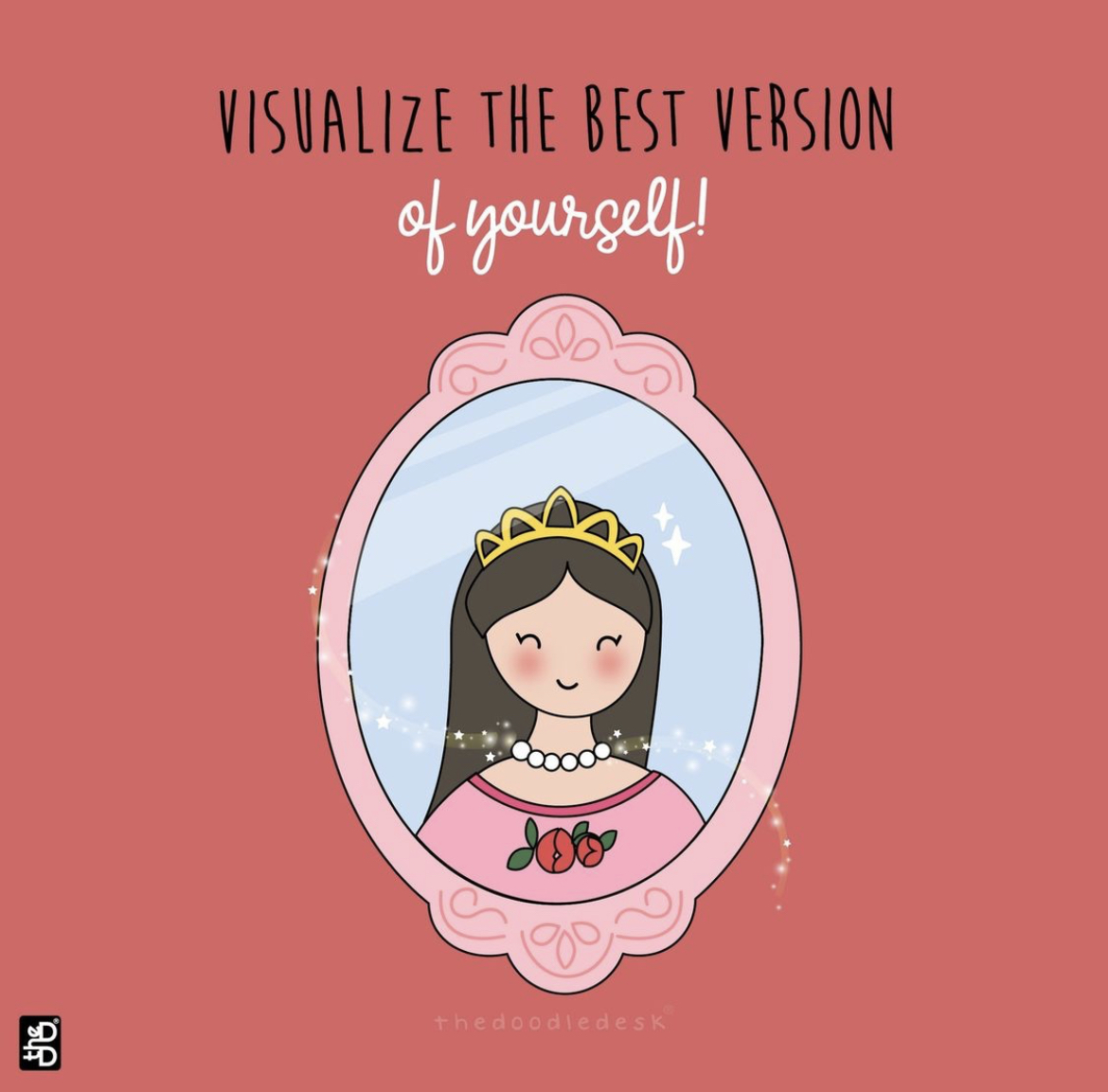
The Power Of Visualization 

Where do you see yourself in five years? How do you imagine your future partner like? How much money will you make? Can you confidently reply to all these questions? How would you react if someone asked you these questions? In other words, have you figured everything out yet? Congratulations! Then there’s no need for you to read further. 

If you’re still unsure about how to answer all the questions, rest assured, you’re not alone, and the good news is that there’s a tool out there that can help you with it: visualization.

According to the Cambridge Dictionary, visualization is “the act of visualizing something or someone” or “forming a picture of it in your mind”. It’s almost like looking through a particular lens, your unconsciousness, your imagination, your deepest desires, and seeing your life unfold within your inner eye.

If my mind can conceive it and my heart can believe it – then I can achieve it

Muhammad Ali

Visualization has been used for a very long time in sports. The quote above my Muhammed Ali shows that he truly believed in the power of visualization. But he’s not the only one who used visualization in his successful sports career. Arnold Schwarzenegger  was also a big believer in visualizing how he wanted to look like and kept on imagining it. Later on, he used the same technique in politics and acting. A study found that imagining to move certain parts of your bodies almost trains the muscles as much as the actual movement. Our mind is literally very powerful!

Anything you can imagine, you can create.

Oprah Winfrey

You can’t really argue with Oprah, can you? And it’s not only her who believes in the power of affirmations and visualizations. Jim Carrey apparently wrote a check of over $ 10 million to himself every night during the time when he wasn’t famous yet. It so happened that three years later, he received exactly this amount for starring in Dumb and Dumber.

Visualization, also called imagery helps you reduce stress as well. It is used among healthcare professionals as an effective stress management tool. Studies have shown that novice surgeons who received imagery training demonstrated reduced self-reported stress and decreased objective stress. The same goes for police officers. You clearly see that visualization works for all groups of people and in all kinds of situations: it helps you to achieve your goals, to imagine your future, to deal with stress and much more.

But, how do you do it in real life? How can you tap into the power of visualization and enjoy all its benefits? Generally speaking, you need to imagine the specific situation in as many details as possible using all your senses – you can see it, smell it, hear it, feel it and taste it. For many people, it helps when they close their eyes, and then there are others who prefer to write it all down instead of doing it purely in their mind.

Writing affirmations helps your mind as well to get into the future mode. When you write affirmations, write in present tense, and be careful not to write too many. Start with “I” followed by something that you wish you had accomplished already or how you want to be in the future, e.g. “I am strong and face all adversities with grace.”, “I have a publishing empire with 100 employees and 5 offices worldwide.” Try to be as specific as possible. The trick behind it is that our brain cannot differentiate between what is already true and what is fiction. Hence, your brain will think that you already own that publishing empire and you’ll start acting accordingly, unconsciously. If you add a little bit of embodiment to it and think of a posture that incorporates a specific affirmation very well, your body will also “save” it and the more often you do it, the quicker you’ll be able to get into the mindset of your future self.

Another way of visualizing your future is to create a vision board. In short, you take a blank poster and fill it with snippets and pictures from magazines that represent what you want your life to look like in a certain amount of time; it could be 6 months, 3 years, or more. It’s important to put the finished vision board in a prominent place in your office or apartment so that you are regularly reminded of it. 

As you can see, it’s about visualizing in your mind, on paper, or a blank canvas. Approach it with a curious and open mind, and try out different options so that you find what works best for you. One of its biggest advantages is that you can literally do it everywhere – on the train, at home, at work. Your mind is truly powerful, so keep exploring and create the life you want with the help of visualization.

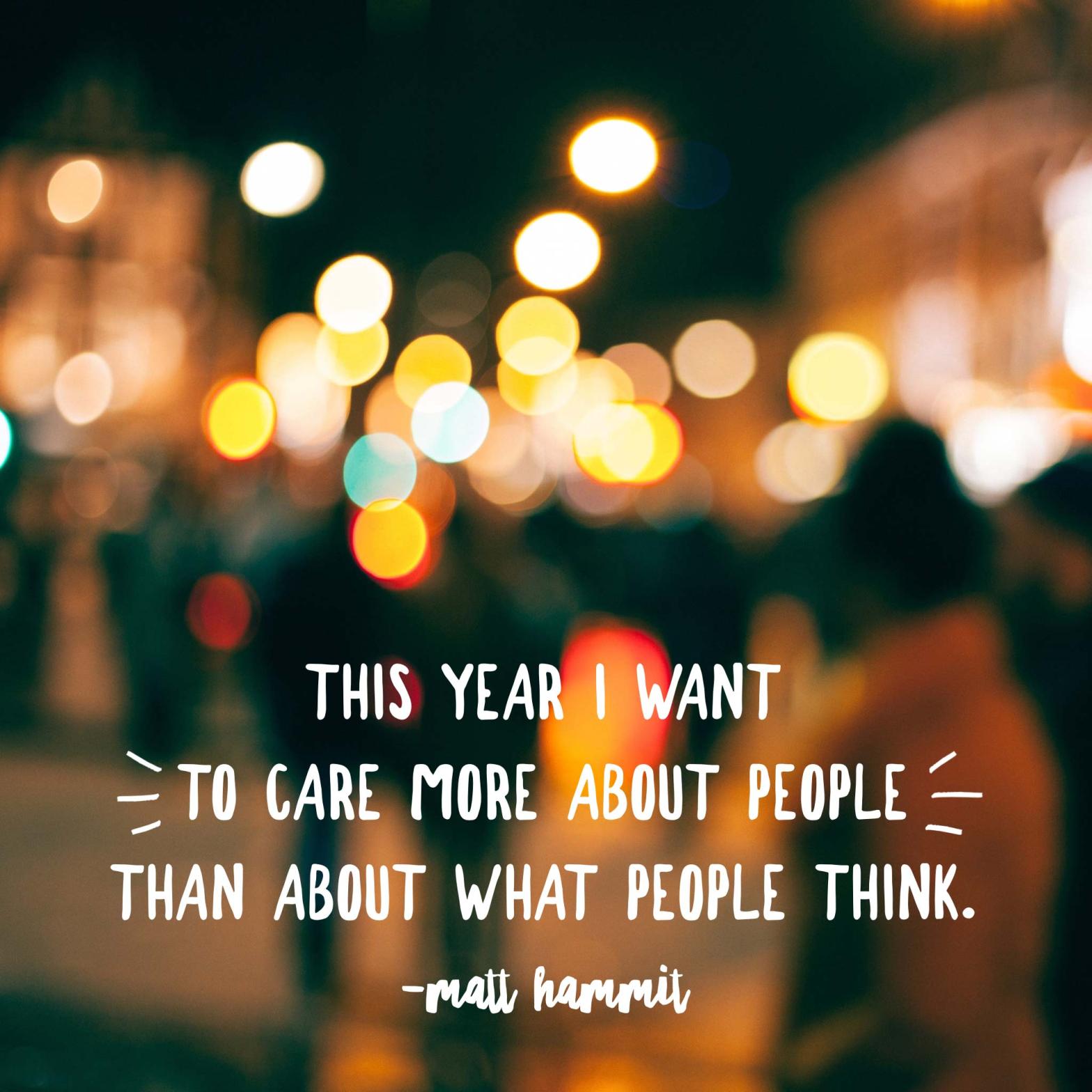
Why You Should Not Care What Others Think

We all want to be liked and appreciated for our many talents, our intelligence, our good nature, our sparkling personality. But when we start to rely on what other people think of us, and we make their opinion pivotal to our success, we get into trouble. We start tailoring our lives to fit the expectations of others, and from there it’s a vicious cycle.

When we give over our power to others and allow that their impressions to become how we perceived, we lose out on who we really are. The only reality we can see is  how we believe others see us.

Care about what other people think and you will always be their prisoner.

Lao Tzu

Here are ten reasons why you should not care about what others think:

1. It’s Not Their Life, So It’s None Of Their Business

People are entitled to think whatever they want, just as you are entitled to think what you want. What people think of you cannot change who you are or what you are worth, unless you allow them to.

This is your life to live. At the end of the day you are the only person who needs to approve of your own choices.

2. They Don’t Know What’s Best For You

Nobody will ever be as invested in your life as you. Only you know what is best for you, and that entails learning from your own choices. The only way you will ever truly learn is through making your own decisions, taking full responsibility for them, and that way if you do fail, at least you can learn from it wholeheartedly, as opposed to blaming somebody else.

3. What’s Right For Someone Else May Be Completely Wrong For You

It’s important to recognize that someone’s opinion is often based on what they would do. This alone is the problem. What is best for somebody else, can be the worst thing for you. One person’s food is another ones poison! We are all so unique. Only you know what is right for you. 

4. It Will Keep You From Your Dreams

If you are constantly worried about what other people think, you will never get to where you need to go in life. You are going to have to do things that don’t always meet people’s standards. You will come into situations where you have to put your pride, and your reputation on the line to get what you want. If you are constantly worried about what people are thinking, you will never have the will to do what’s right.

5. You’re The One Stuck With The End Result

In life, you are the one stuck with the consequences of your decisions. For example, if someone suggests you buy some stocks, but you just don’t feel like it’s the right choice, you are the only one who will live the consequences. If the stock falls and you lose a lot of money, you are the one that will have to live with the fact that you didn’t follow your inner call. When people give you their suggestions or even orders, there is no risk for them. They don’t have to live with your choices—but you do.

6. People’s Thoughts Change On A Regular Basis

We are constantly changing. Some philosophers and theorists suggest that we are in a constant state of flux, so much that we cannot even say we have one, specific ‘self’ (or a fixed personality). People’s thoughts, ideas and views change on a regular basis.

That means even if somebody does think badly of you at the moment, there is a good chance they will think differently in the near future.

7. Life Is Simply Too Short

You only have one life to live, so why would you spend it worrying about other people’s opinions? Do whatever you want, be whoever you want. You’re not going to see these people after you’re dead. You probably won’t even see them in a year from now. Live your life without worrying about other people’s thoughts and opinion, and you will live your life to the maximum.

8. You Reap What You Sow

Worrying too much about what other people think of you can become a self-fulfilling prophecy. Frequently, people indulge their need to be liked so much so that it actually dictates to the way they behave. Some become people-pleasers or so submissive that many people are turned off. The behavior you use as an attempt to ensure you are liked may actually cause you to be disliked.

9. Others Don’t Care As Much As You Think

People generally don’t think outside themselves a great deal of time. It is a sad but simple truth that the average person filters their world through their ego, meaning that they think about most things in terms of “me” or “my”.

This means that, unless who you are or what you have done directly affects another person or their life, they are unlikely to spend much time thinking about you at all.

10. The Hard Truth: It’s Impossible To Please Everybody

You can’t please all of the people all of the time. It is impossible to live up to everyone’s expectations so there is no point in burning yourself out trying to do so. Just make sure that one of the people you please is yourself!


The weight of other’s thought can become a burden for you. It can inhibit you from living your life, because your entire being (your personality, your thoughts, your actions) are controlled by an idealized standard of what people want to see. When you become so obsessed with other people’s opinion of you, you forget your own.

You can make a conscious effort to stop giving a damn; to let yourself free. It’s a skill that needs to be practiced. But once you truly understand how to let go, you will see the world as entirely different.

Once you give up catering to other people’s opinion and thoughts, you will find out who you truly are, and that freedom will be like taking a breath for the first time.

Give Yourself A Break

When people experience a setback at work—whether it’s a bad quarter, being overlooked for a promotion, or an interpersonal conflict with a colleague—it’s common to respond in one of two ways. Either we become defensive and blame others, or we berate ourselves. Unfortunately, neither response is especially helpful. Shirking responsibility by getting defensive may alleviate the sting of failure, but it comes at the expense of learning. Self-flagellation, on the other hand, may feel warranted in the moment, but it can lead to an inaccurately gloomy assessment of one’s potential, which undermines personal development.

What if instead we were to treat ourselves as we would a friend in a similar situation? More likely than not, we’d be kind, understanding, and encouraging. Directing that type of response internally, toward ourselves, is known as self-compassion, and it’s been the focus of a good deal of research in recent years. Psychologists are discovering that self-compassion is a useful tool for enhancing performance in a variety of settings, from healthy aging to athletics, including enhancing professional growth.

Self-compassion is a less familiar concept than self-esteem or self-confidence. Although it’s true that people who engage in self-compassion tend to have higher self-esteem, the two concepts are distinct. Self-esteem tends to involve evaluating oneself in comparison with others. Self-compassion, on the other hand, doesn’t involve judging the self or others. Instead, it creates a sense of self-worth because it leads people to genuinely care about their own well-being and recovery after a setback.

People with high levels of self-compassion demonstrate three behaviors: First, they are kind rather than judgmental about their own failures and mistakes; second, they recognize that failures are a shared human experience; and third, they take a balanced approach to negative emotions when they stumble or fall short—they allow themselves to feel bad, but they don’t let negative emotions take over.

Most people want to improve—and self-compassion is crucial for that. We tend to associate personal growth with determination, persistence, and hard work, but the process often starts with reflection. One of the key requirements for self-improvement is having a realistic assessment of where we stand—of our strengths and our limitations. Convincing ourselves that we are better than we are leads to complacency, and thinking we’re worse than we are leads to defeatism.

Apart from self-compassion, it is also important to know your limits. It’s common among overachiever types: We like to push ourselves.

All that pushing can feel so smart and productive—until you’re exhausted, overextended, overwhelmed, or otherwise ready to snap. I’ve felt all these things before. If you feel physically, mentally, emotionally, or even digitally exhausted, here are some tips that may help:

How to Give Yourself a Break Physically

1. Allow yourself a little extra sleep, whether it’s by going to bed a half-hour earlier or by sleeping in an extra fifteen minutes and then skipping your usual morning coffee stop.

2. Take a day off from exercising if you usually run, go to the gym, or participate in some type of aerobic class.

3. Skip the stairs and take the elevator or escalator. Sometimes it’s perfectly okay to choose the easy path!

4. Replace strenuous exercise with something less intense, like restorative yoga.

5. Utilize a detoxifying cleanse to clear out toxins and give your digestive organs a break.

6. Take a long, hot bath to take weight off your weary muscles and joints.


How to Give Yourself a Break Mentally

1. Use a deep breathing technique to calm your nervous system and clear your thoughts.

2. Give yourself a complete day without any financial worries; put your statements and bills in a drawer and save all eBills for tomorrow. (Trust me, they won’t go anywhere. Just don’t make this one a consistent practice!)

3. Set aside some time to play and be childlike.

4. Sing, paint, dance, or otherwise express yourself creatively. It’s awfully hard to stress and over-think when you’re engaged in something fun and expressive.

5. Go outside and immerse yourself in nature. Feel the ground or grass underneath your feet and focus on being present on enjoying your environment and the scenery.

6. Close down the multiple tabs on your computer screen and instead single-task. If you’re writing, write. If you’re editing a video, edit. Give yourself permission to get into a state of flow and let all distractions slip away.

7. Take a day off from negative, draining people, even the ones you love. You can be an ear tomorrow.


How to Give Yourself a Break from Technology

1. Commute without technology. Instead of listening to voicemails or tweeting on your phone, read a physical book or write in your journal. Use this small window of time to connect with yourself.

2. Take a completely tech-free hour. Turn your cell phone off, shut down your computer, and put your all your gadgets in a drawer.

3. Plan unproductive downtime, by taking a walk, for example. Research shows this type of disconnected time is crucial to learning and forming memories.

4. Decide to check email only once today (outside of work) so that you spend less time checking messages and more time engaging in activities that feel fulfilling.

5. Identify what you’re really seeking from technology—whether it’s acceptance, acknowledgment, or stimulation—and then look for ways to get that without logging on.

6. Technology fast on a weekend day. This probably isn’t an option during the week—and I’ll admit this is challenging for me even on the weekend—but it’s worth trying: a day without any gadgets.

7. Give your technology a bed time. I know from experience how pre-bed web surfing can negatively impact sleep. Decide in advance at what point you’ll put all your gadgets away, and then choose other relaxing activities before you head to sleep.

8. Decide for a day that nothing is urgent. Emails, phone calls, text messages—unless it’s an actual life-or-death situation, it isn’t a catastrophe and it can wait until tomorrow.


Any more tips that help you? Let me know in the comments :)