Once upon a time, there was an island where all the feelings lived: Happiness, Sadness, Knowledge, and all of the others, including Love.
One day it was announced to the feelings that the island was going to sink, so they all need to vacate it as soon as possible. All the feelings prepared their boats and left. Love was the only one who stayed.
Love wanted to stay until it started sinking. When Love was almost sinking, he decided to ask for help.
Wealth was passing by Love in a beautiful boat. Love said, “Wealth, can you take me with you?”
Wealth answered, “No, I can’t.. There are a lot of gold and silver in my boat. There is no place here for you.”
Love decided to ask Vanity who was also passing by, “Vanity, please help me!”
“I can’t help you Love. You are all wet and can probably damage my boat,” Vanity answered.
Sadness was close by so Love asked for help, “Sadness, let me go with you.”
“Oh..Love, I am so sad that I prefer to go alone!”
Happiness passed by Love too, but she was so happy that she did not hear when Love called her!
Suddenly, there was a voice, “Come Love, I will take you.” It was an elder. Love became so happy that he even forgot to ask the elder her name. When they arrived at dry land, the elder went on her own way.
Love asked Knowledge, another elder, the name of the elder who had helped him. “It was Time,” answered Knowledge.
“Time? But why did Time help me?” asked Love.
“Because only Time is capable of understanding how valuable Love is,” answered Knowledge.
Each and every day, we’re inundated with stories about how the world is going to hell. War, poverty, pollution… all manner of atrocities are flung at us from all directions, and it’s enough to draw even the most lighthearted person into a pit of despair.
Fortunately, a great way to counteract all that ugly is to be the change we want to see. None of us can change the entire world all by ourselves, but by making small amendments in our own lives and encouraging others to do the same, a snowball effect occurs that can affect the entire planet in time.
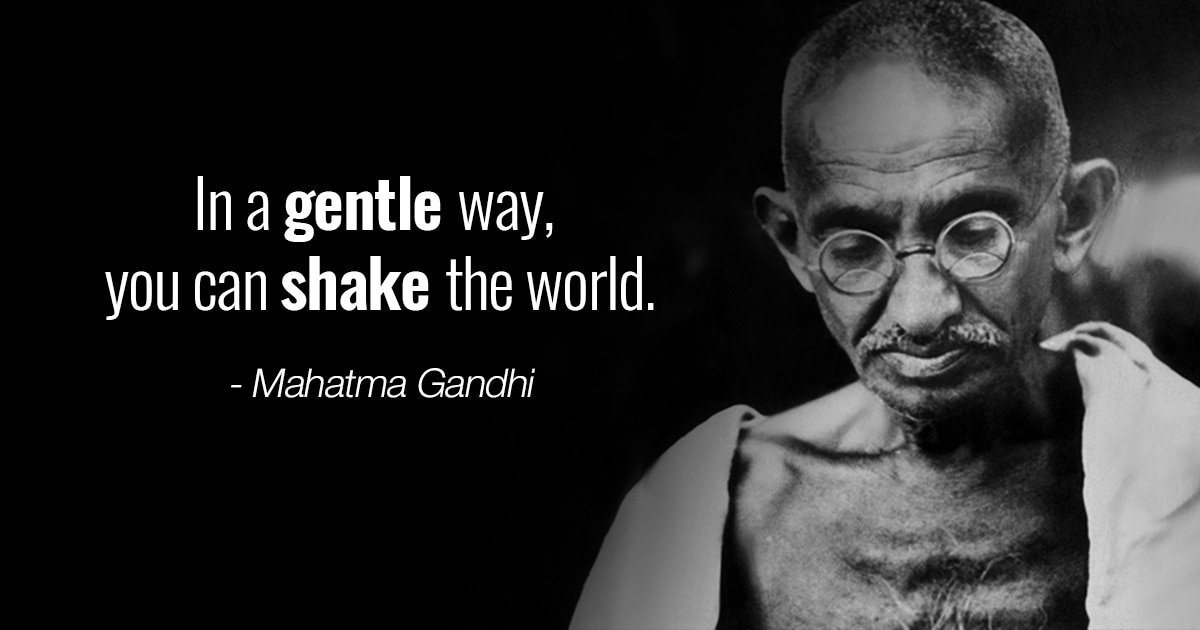
Mahatma Gandhi once said, ‘In a gentle way, you can shake the world’. Meaning, don’t underestimate the little things that can make a big difference. A small act of kindness may not seem a lot from your perspective, but it can make someone’s day. Remember the last time somebody held the door open for you, simply smiled or gave you an honest compliment? Or the last time you gave someone a compliment and they appreciated it? How did that make you feel?
In today’s digital age it could be argued that it is becoming increasingly challenging to listen to somebody without being interrupted by a social media nudge, to hold the door open instead of holding onto a phone, to smile at a person instead of smiling at a screen or to simply observe other people’s kindness around us. Stopping and reflecting on what each of us can do to be kinder in our own lives is more important today than ever before, and is part of what makes us all human.
Kindness is the language that the deaf can hear and the blind can see
Mark Twain
Illustration from Happiness is… by Lisa Swerling and Ralph Lazar
When I saw this quote, the first thing that came to my mind is the inspiring story of 11 year old James who had a big, impractical idea. He was going to graduate from high school. Before you dismiss what would seem an alarmingly average accomplishment, consider his story.
James lived in rural, war-torn Uganda. He lost his entire family to disease by the time he was six and was raised by his grandmother who didn’t even earn enough for the $500/year school tuition.
A high school diploma was not the default path for James. And you could hardly blame him if he decided that goal was impossible—that he should give up and work in the fields.
But he didn’t. Instead, he and his grandmother devised a long-shot of a plan to secure the financing his tuition.
It all started with a goat.
His grandmother sold one of hers and, with the proceeds, James bought shoes, clothes, and a bus ticket to the capital city where he’d stay with his aunt.
That’s where the plan gets more interesting.
To get the money necessary for school, he’d sneak into the president’s compound and ask for a scholarship. It would require scaling a barbed-wire fence and getting past armed guards.
Once inside, though, he’d learned that he’d be greeted warmly and given money for tuition.
So that’s what he did. And—to everyone’s amazement—it worked. Today, now in his 30s, James has two masters degrees and is a leader with a great job.
Making excuses and giving up would have been easy and certainly forgiven. Regardless of where you are in life, there’s a link between the excuses you make and the success you achieve.
We’ve all experienced disappointment. You don’t get the promotion you wanted. You fail a test. An important relationship crumbles.
When it happens, you have two choices for how to respond. You can ask yourself, “What could I have done differently?” Or, you can tell yourself, “It wasn’t my fault. There was nothing I could have done.”
If you choose the second option, you’re doomed.
source: Riskology
The more excuses you make, the worse you peform.
Making excuses now has a cascading effect on how you behave in the future.
An excuse is a way to externalize failure—blame it on something else. We’ve all done it. And we all know whywe do it. It makes you feel better!
But when you externalize failure, it also makes you feel like the outcomes in your life are out of your control. When you lack control, it’s difficult to find motivation work harder. Why bother if you’re not in charge?
When you lack motivation, your performance suffers. The chain reaction that follows an excuse ensures failure not just now, but spiraling into the future as well.
We all want to be the best we can be at whatever we do. But excuses are easy to make, and genuine commitments to improve are hard.
If you want to be the person who takes responsibility and gets what you want, it could all come down to the stories you tell yourself when you feel overwhelmed or fail.
There are two stories you can tell yourself: what can I do about it or it is not my fault. One you can control, and one you can’t. If you focus on the story you can’t control, you’ll spiral towards failure. But if you focus on the story you can, you’ll spiral towards success.
Today, take a second to ask which of those stories you tell yourself. What excuses are you making in your own life? And how could you change the story you tell yourself to make success more likely?
Being financially responsible is important for your health and your financial life. To “live within your means” means that what you spend each month is less than or at least equal to the amount of money you bring in each month. For many people, it’s a lot easier said than done.
When your lifestyle exceeds your income, you’ll be dealing with financial problems that could have been easily avoided if you had started off with living within your means. Credit cards, loans, savings, and even emergency funds allow you to buy more things than your income would ordinarily allow. Unfortunately, that kind of lifestyle isn’t sustainable and, at some point, reckless spending will catch up to you.
Here are three simple ways that may help you:
1 KNOW HOW MUCH YOU MAKE If you want to live within your means, you have to know what your means are. But simply knowing your annual salary or hourly rate isn’t enough to help you live below your means. You need to know the net income that appears on your paychecks—the amount you actually have to spend.
2 SPEND LESS MONEY THAN YOU BRING IN Once you know how much you make, you can focus on reducing your spending to fit your income. If you don’t have one already, create a budget to plan your expenses and use it to keep your spending on track. If you’ve already tried budgeting and it didn’t work, try it again. Often you just need to make some minor changes to your budget to get it to be effective.
3 DON’T TRY TO KEEP UP WITH THE JONESES OR HILTONS Resist the pressure to have the same material things as the people around you or, worse, the people on television. You may be able to use credit cards and loans to fake wealth for a short period of time, but you’ll pay for it later—and you’ll end up paying more since interest is added to your balance each month.
Worry and stress is an issue for me, for you, for everyone. Although I believe in God, more often than not, I’ve trusted more in my own abilities than I have in his faithfulness. We think, I know God’s a good God and all that, but I’ve got this situation handled. And when it turns out we don’t have it handled, then it falls to us — not to God — to fix it.
There is story of a young boy, about five years old, playing on the front porch of his house. His family were all doing different things around the yard when suddenly they heard the toddler squealing with delight. He was jumping up and down, calling out, “My fwend! My fwend! Daddy, look! He’s my fwend!”
His dad strolled over and asked, “Where’s your fwend? Is it an imaginary fwend?”
The boy chirped, “No, Daddy!” and pointed excitedly.
“Look! My fwend!” And there, directly at his feet, was a small rattlesnake. The dad got a shock of his life, jerked the child away from the snake, then stomped on the snake’s head and crushed it — immediately after I first cut off its head with a shovel.
Many of us treat worry like our fwend. We don’t consciously think or talk about it that way, of course, but how we live tells a different story. We clutch worry to our chests like our favorite stuffed animals from childhood. We have many different euphemisms to mask this. But at the end of day, no matter how you refer to it, worry is the complete opposite of faith!
Worry indicates we’re not willing to let God handle certain things — at least not in his way, and certainly not in His time. And hence reeks of arrogance!
Here is a lovely poem that touched me:
Life’s Daily Doses Lenora McWhorter
Life is measured in daily doses Of trials and pleasures each. Day by day grace is dispensed To meet our immediate needs.
Comfort comes to the weary We find that which we seek. A bridge is built at the river And power is given to the weak.
One day’s load we have to bear As we travel on life’s way. Wisdom is given for the occasion And strength to equal each day.
We are never required to stagger Under tomorrow’s heavy load. We journey one day at a time As we travel life’s rugged road.
God’s mercy is new every morning And His faithfulness is sure. God perfects all that concerns us And by our faith, we will endure.
When I was in school, my uncle Joe shared this old saying with me: to “assume” makes an “ass out of you and me”. This play on the word assume definitely makes a lot of sense. When there is a problem, if we dig down under the layers of misunderstandings, there usually lies a big mess of assumptions and erroneous beliefs. Lack of clarity and understanding can mean we barge straight into situations and conversations that are driven by sketchy information at best.
Basing our assumptions about a situation on little bites of information can lead to firmly held and potentially damaging beliefs. Assuming we’ve got it right, that we know what people mean and that their perspective must be the same as our’s are all recipe for disaster.
Ladder of Reference
Professor Chris Argyris (1923 – 2013) former Professor at Harvard Business School and Yale University identifies how humans come to their beliefs via assumptions in his model The Ladder of Inference.
The Ladder journey travels like this: – I OBSERVE data (see hear feel) – I SELECT data from what I observe – I add MEANING (cultural, personal, cognitive) – I make ASSUMPTIONS based on my meanings – I draw CONCLUSIONS – I adopt BELIEFS about the world – I BEHAVE accordingly
This ladder often occurs in the blink of an eye. It is also something that drives our behaviour throughout the day. Imagine heading out to work in the morning. You step outside and observe the grey clouds, that it is June and so draw a very quick conclusion that grabbing your umbrella would be a wise decision – and behave accordingly.
This ladder can also lead us to fixed beliefs that mean we can get caught in what Argyris calls ‘The Reflexive Loop’, which we means we can ONLY seek the data that confirms our belief.
TIPS FOR TESTING ASSUMPTIONS
1. STOP! Identify where assumptions and fixed beliefs might be having a negative impact on your work. Knowing when a lack of information or data might be driving either a confirmation bias or simply a critical gap in understanding is the first step to being able to address the issue. Heightening awareness of beliefs that may be fixed before you have explored what lies beneath, or you’ve simply held that believe for a long time without question allows us to open up thinking.
2. THINK WELL! Assume positive intent first ( ie. mistake rather than malice; positive intent rather than harm; lack of clarity rather than withholding information) Most assumptions arise simply by not having the right conversations, rather than being driven by any machiavellian agenda. It primes our conversations for trust if we test our assumptions rather than believing them to be truth.
3. ASK! Simply asking clarifying questions that can lead to a deeper understanding. Authentic dialogue is always the best antidote for major assumptions or beliefs that are railroading progress or certainty. Be curious about finding out more about what people are thinking and feeling.
The one thing we all do when we’re so caught up in our heads is that we create a reality that hasn’t or will never come into being! You talk to yourself in your brain and convince yourself of the certainty that the thing you’re anticipating will be a particular way.
Oh, he’s going to be so hard to deal with. It’s going to be a pain to get there. Traffic will be terrible. What if they hate what I’m wearing. My hair isn’t going to be the same length by then. I’ve put on weight since I saw them last — they’re going to say something.
You create an infinite amount of imagined futures, only one of which can ever actually eventuate.
When you live in your head like this, two things happen:
You build up stress hormones in your body, like cortisol, compounding until the event itself takes place. More cortisol leads to more stress, more bad health, more tension, bad digestion, inflammation, and a litany of other ailments.
You rob yourself of living in the moment, being present and enjoying what you have now. You can’t control the future. Worrying about it does nothing to change it.
It isn’t unusual. We all do it. We catastrophize a future that we fear for one reason or another. We blow it out of proportion… and guess what? 9 times out of 10, you’re wrong. The future you anticipated doesn’t happen. All of your worrying was for nothing. But you’ll never get that time back.
So worry less, live more!
Do not anticipate trouble or worry about what may never happen. Keep in the sunlight.
One of the key reasons I was trapped into aimless wandering for sometime was because I kept listening to what everyone around me was saying. That was when I came across this quote by Winston Churchill
“You will never reach your destination if you stop and throw stones at every dog that barks.”
During our journey brings us many ‘barking dogs’ to deal with. If we allow them to scare us, distract us, or bite us, they may easily prevent us from reaching our destination.
Here are some points adapted from Inner Leadership which contains several tools that can help to keep us focused and on track:
Staying calm in a crisis and connecting with what matters most, because keeping a clear head is important
Making clear sense of our situation, because clear understanding leads to good choices
Knowing which dogs matter (and which do not) and deciding how we will behave when we meet them, because some issues need to be engaged with, actively, and in a way that works for you
Realising that there are five basic strategies you can employ for dealing with the dogs you choose to engage with (and five other strategies that can also be useful)
Being clear about your destination, because then you can get back on track quicker
Choosing the best way forward for you now, because you have to start from where you are now
Creating a vision that will inspire you when barking dogs are all around, because inspiration is what will get us through this time of change
We will never reach our destinations if we stop and throw stones at every dog that barks. So it is useful to plan out our strategies and tactics in advance.
Do you know which dogs to ignore, which ones to pay attention to, and how best to handle them?
Life is not predictable. There are ups and downs along the way. Many of us want to trust God. When times are good, it can feel easier. But when times feel difficult, it is even more important to trust God. God’s unchanging character can give us a firm foundation when things feel unsteady and uncertain.
Life can be going along smoothly for a season. Your job is satisfying. Your friends and family are enjoyable. Your goals, finances, health and outlook seem bright. Then, all of a sudden, life throws a curveball. Someone you know gets sick. You lose your job. A friend or family member betrays you. The things you felt secure in all of a sudden feel shaky and uncertain.
How do you trust that God is good in these circumstances? How do you trust Him when you do not understand what is happening? When you cannot see a resolution? These are valid questions, and God wants to help you navigate them.
This wonderful story helped me and I am sure it will help you too
A MAN JUST GOT MARRIED AND WAS RETURNING HOME WITH HIS WIFE. THEY WERE CROSSING A LAKE IN A BOAT, WHEN SUDDENLY A GREAT STORM AROSE. THE MAN WAS A WARRIOR, BUT THE WOMAN BECAME VERY MUCH AFRAID BECAUSE IT SEEMED ALMOST HOPELESS:
THE BOAT WAS SMALL AND THE STORM WAS REALLY HUGE, AND ANY MOMENT THEY WERE GOING TO BE DROWNED. BUT THE MAN SAT SILENTLY, CALM AND QUIET, AS IF NOTHING WAS HAPPENING.
THE WOMAN WAS TREMBLING AND SHE SAID, “ARE YOU NOT AFRAID ?”. THIS MAY BE OUR LAST MOMENT OF LIFE! IT DOESN’T SEEM THAT WE WILL BE ABLE TO REACH THE OTHER SHORE. ONLY SOME MIRACLE CAN SAVE US; OTHERWISE DEATH IS CERTAIN. ARE YOU NOT AFRAID? ARE YOU MAD OR SOMETHING? ARE YOU A STONE OR SOMETHING?
THE MAN LAUGHED AND TOOK THE SWORD OUT OF ITS SHEATH. THE WOMAN WAS EVEN MORE PUZZLED: WHAT HE WAS DOING? THEN HE BROUGHT THE NAKED SWORD CLOSE TO THE WOMAN’S NECK, SO CLOSE THAT JUST A SMALL GAP WAS THERE, IT WAS ALMOST TOUCHING HER NECK.
HE SAID,” ARE YOU AFRAID ?”
SHE STARTED TO LAUGH AND SAID,” WHY SHOULD I BE AFRAID ?,IF THE SWORD IS IN YOUR HANDS, WHY I SHOULD BE AFRAID? I KNOW YOU LOVE ME.
” HE PUT THE SWORD BACK AND SAID, THIS IS MY ANSWER”. I KNOW GOD LOVES ME, AND THE STORM IS IN HIS HANDS
A professor entered his classroom with a glass of water. He raised the glass of water. everyone in the room expected the: “half empty or half full” question. Instead, to everyone’s surprise, the professor smiled and inquired: “How heavy is this glass of water?”.
The answers called out for the range from 8 Oz to 15 Oz.
“I need to weigh it to know how much exactly it weighs. But the question, I really want you to answer is – what if I held the glass up for a minute?”, asked the professor.
“Nothing” the students answered unanimously.
“But what if I hold it for an hour?” asked the professor.
“Your arms will start aching “ , answered one of the students.
“You are right!, But what if I held it up for a whole day?”, queried the professor.
“Your arms will feel numb, your muscles get stressed and it may even get paralyzed” ventured an another student .
“You are right!”, exclaimed the professor. “ So what should I do to avoid the pain “ asked the professor.
“Keep the glass down”, answered a student.
“Exactly!” said the professor. He continued “In all the case the weight of the glass remains the same. But, longer I held it up, heavier it becomes. The stress and worries in life are like the glass of water. If you think about them for a while, nothing happens. Think about them for longer, they will start hurting. Think about them for even longer, you will feel stress and be paralyzed ”
It is important to think about the problems in the life. But, you should not carry the stress long enough that it begins to ache and paralyze your life. It is important to let go of your stresses. Don’t carry your stress all day and always remember to put the glass down before you go to bed!







 Kenrick Vaz