The Joy of Giving Lasts More Than The Joy of Getting

Joy or happiness is a state of mind. It is a feeling that keeps people healthy and fit.  There is a famous quote ‘The more you give of yourself, the more you find yourself.’ There are many reasons why giving is important. It is a way to show appreciation, to say thank you, or to show someone you care. Sometimes it is hard to express true feelings in words, but offering a token of appreciation will not only represent your feelings, but will allow the recipient to know how much you appreciate them. 

There are many people that we come across in our everyday life that perhaps make our days easier, such as neighbours, co-workers, even mail carriers or the local cashier at the grocery store. While giving does not always have to be a gift, offering a kind word or a friendly smile goes a long way in saying thank you for all you do, and will encourage the chances of a friendly and successful relationship. 

In two studies, psychology researchers Ed O’Brien (University of Chicago Booth School of Business) and Samantha Kassirer (Northwestern University Kellogg School of Management) found that participants’ happiness did not decline, or declined much slower, if they repeatedly bestowed gifts on others versus repeatedly receiving those same gifts themselves.

“If you want to sustain happiness over time, past research tells us that we need to take a break from what we’re currently consuming and experience something new. Our research reveals that the kind of thing may matter more than assumed: Repeated giving, even in identical ways to identical others, may continue to feel relatively fresh and relatively pleasurable the more that we do it,” O’Brien explains.

Giving food to the needy, items of use to a family whose house may have burnt, even monetary donations to a children’s charity can make a huge difference. Giving is an important trait to teach children. For example, if a child helps pick out a gift for a family member who is having a birthday and presents them with this gift, it teaches them to be unselfish, how to share and to appreciate the pleasure of giving to others. Teaching by example is the best way to show a child how to give, not only gifts but in other ways as well. Visiting someone in the hospital, sending a thank you, get-well card or congratulations card, even Christmas cards are excellent ways to teach a child the importance of giving. Time, gifts, cards or words of kindness all are a part of giving. A manager who gives time off, bonuses, or other incentives to his employees for a job well done will definitely reap the joy of giving.  Giving is all about getting or in other words, the more you give, the more you receive.

I slept and I dreamed that life is all joy. I woke and I saw that life is all service. I served and I saw that service is joy.

Kahlil Gibran

Yes, it is a secret barter where we give something that we have and receive happiness without asking for it. However, when we give something, we should not expect anything in return. One should give with all of one’s heart, and forget about it. The funny thing is that we’re most happy when our act of giving has no selfish motives. The dictionary defines giving as “disposing of property by voluntary transfer without receiving value in return.”

Giving and helping people is what everyone should do. Generosity is nothing but the habit of giving. Blessed are those people who are generous and believe in the joy of giving. It’s definitely an act of philanthropy that spreads happiness and peace, and lets goodness prevail in the world!

There is a certain joy in getting something. That’s the joy children experience when they get things like toffees and toys. Parents and grandparents feel happy when they give. The joy in giving is much more fulfilling than the joy of receiving.

Life is a journey, moving from the joy of taking, to the joy of giving. Giving to charity is one aspect of caring and sharing. Nevertheless, we can do that individually too in various ways while we celebrate the joy of giving. When we share something we somehow connect to others in many ways. It’s a God-like trait. ‘Giving’ can make a difference to others and in turn we achieve a sense of empowerment, pride and accomplishment. To conclude, in  the words of Mother Teresa, “It’s not how much we give but how much love we put into giving.”
Know Thyself

Your “self” lies before you like an open book. Just peer inside and read: who you are, your likes and dislikes, your hopes and fears; they are all there, ready to be understood. This notion is popular but is probably completely false! Psychological research shows that we do not have privileged access to who we are. When we try to assess ourselves accurately, we are really poking around in a fog.

“To know thyself is the beginning of wisdom.” This famous quote is often attributed to Socrates. But what exactly do you know when you “know yourself?”

Below there are six elements of self-knowledge that can help you understand your own identity. As you live your daily life, you can look for clues to these important building blocks of the self. 

But first, why is it important to know yourself?

Maybe it’s obvious, but here, in a nutshell, are a few reasons why you might want to know your own nature:

  • Happiness. You will be happier when you can express who you are. Expressing your desires will make it more likely that you get what you want.
  • Less inner conflict. When your outside actions are in accordance with your inside feelings and values, you will experience less inner conflict.
  • Better decision-making. When you know yourself, you are able to make better choices about everything, from small decisions like which sweater you’ll buy to big decisions like which partner you’ll spend your life with. You’ll have guidelines you can apply to solve life’s varied problems.
  • Self-control. When you know yourself, you understand what motivates you to resist bad habits and develop good ones. You’ll have the insight to know which values and goals activate your willpower.
  • Resistance to social pressure. When you are grounded in your values and preferences, you are less likely to say “yes” when you want to say “no.”
  • Tolerance and understanding of others. Your awareness of your own foibles and struggles can help you empathize with others.
  • Vitality and pleasure. Being who you truly are helps you feel more alive and makes your experience of life richer, larger, and more exciting.

Hopefully you are now convinced that self-knowledge is worth having (for those of you that needed convincing!). We’ll now move on to those “VITAL Signs” of self-knowledge.

The Building Blocks of Self: Your VITALS

The capital letters in “VITAL Signs” form an acronym for the six building blocks of the self, or VITALS, for short. The letters stand for Values, Interests, Temperament, Around-the-Clock, Life Mission and Goals, and Strengths/Skills.

V = Values
“Values”—such as “helping others,” “being creative,” “health,” “financial security,” and so on—are guides to decision-making and motivators for goals. Research shows that just thinking or writing about your values can make it more likely that you take healthy actions. The motivation provided by worthwhile values can also keep you going even when you are tired, as shown in many psychology experiments. If you want to self-motivate, know your values!

I = Interests
“Interests” include your passions, hobbies, and anything that draws your attention over a sustained period of time. To figure out your interests, ask yourself these questions: What do you pay attention to? What are you curious about? What concerns you? The focused mental state of being interested in something makes life vivid and may give you clues to your deepest passions. 

Many people have built a career around a deep interest in something. For example, when I was in the 6th standard, my aunty and uncle gifted us their computer as they were migrating to Indonesia. I was so fascinated by all that I could do then and was curious about how it works. That’s what got me all interested in programming.

T = Temperament 
“Temperament” describes your inborn preferences. Do you restore your energy from being alone (introvert) or from being with people (extrovert)? Are you a planner or go-with-the-flow type of person? Do you make decisions more on the basis of feelings or thoughts and facts? Do you prefer details or big ideas? Knowing the answers to temperament questions like these could help you gravitate toward situations in which you could flourish and avoid situations in which you could wilt. 

A = Around-the-Clock Activities
The “around-the-clock” category refers to when you like to do things—your biorhythms. Are you a morning person or a night person, for example? At what time of day does your energy peak? If you schedule activities when you are at your best, you are respecting your innate biology. While the idea of biorhythm preferences may sound trivial compared to lofty qualities of the self like “values,” your daily life is more pleasant when you are in sync with your biology. In every area, it’s easier to enjoy life when you don’t waste energy pretending to be someone you aren’t.

L = Life Mission and Meaningful Goals 
“What have been the most meaningful events of your life?” I remember a story I had read of a 40 year old woman. She got teary-eyed as she tried to answer this question. “Recently,” she writes, “I found it incredibly meaningful to care for my aging father as he declined and went into hospice. I was able to be there and hold his hand when he died.” As she talked about the difficulties and rewards of her father’s last days, she had an “aha” moment and realized she wanted to become a hospice nurse.

Ask yourself the same question: “What have been the most meaningful events of your life?” You may discover clues to your hidden identity, to your career, and to life satisfaction.

S = Strengths
“Strengths” can include not only abilities, skills, and talents, but also character strengths such as loyalty, respect for others, love of learning, emotional intelligence, fairness, and more. Knowing your strengths is one of the foundations of self-confidence; not being able to acknowledge your own superpowers could put you on the path to low self-esteem. Become a person who “takes in the good,” listening for compliments and noticing skills that could be clues to your strengths. Likewise, knowing your weaknesses can help you be honest with yourself and others about what you are not good at. You might decide either to work on those weaknesses or try to make them a smaller part of your personal or professional life.


Even if you know your “VITAL Signs,” it’s hard to remain true to yourself because you are constantly changing and because society’s values often conflict with your own. I love this quote from fellow habits author Gretchen Rubin:

“My first commandment is to “Be Gretchen”—yet it’s very hard to know myself. I get so distracted by the way I wish I were, or the way I assume I am, that I lose sight of what’s actually true.”

For all of us, being yourself sounds easier than it actually is. But there are a few signposts. When you’ve made a discovery about one of your “VITAL Signs,” you’ll feel a sense of excitement. Acting on self-knowledge will give you energy and save you energy. You’ll feel freer and stronger because you no longer conform to how you “should” feel, think, or act.

What Happens When You Bottle-Up Your Emotions

To “bottle up” means to suppress your feelings. It is when you refrain from venting out that you end up bottling your emotions. Be it due to the the fear of seeming weak or the unwillingness to feel the negativity, but avoiding challenging emotions doesn’t make them go away. In fact, they have an adverse effect on our minds and bodies.

We need to understand just how intrinsically our bodies and minds are connected, and why that makes mental health such a vital part of overall health and well-being. You see, when we home negative emotions like anger and anxiety, we tend to disrupt the normal balance of cortisol—the stress hormone. Not only that, this also leads to a lowered immune system functionality, risk of depression and chronic illnesses like heart disease, stroke, cancer, and diabetes.

So, while it is important to acknowledge and express your emotions, the first step is to understand what kind of harm are you causing yourself by bottling up emotions.

1. You end up feeling lonely
When you bottle up your emotions you tend to cut yourself off from others, thus disconnecting from your friends. So, if you have been a good listener to your friends when they are venting out, perhaps it’s time to swap places talk openly about what happening with you.

2. You feel anxious all the time
Bottled up emotions find a way to come out in one way or the other. So, when you choose not to deal with what you are feeling, your mind tends to latch on to the fact that you are trying to deceive it. This sense induces feelings of anxiety, thus making you feel perpetually anxious.

3. You latch onto unhealthy coping mechanisms
Anything in extreme is harmful. So, when you find yourself drinking, smoking, eating, or even working out excessively, know that your mind is trying to avoid the inflow of certain thoughts and emotions.

4. You experience unexplained weight fluctuations
Your body experiences a great deal of stress when you bottle up your emotions. As a reaction it produces the stress hormone, cortisol. This happens as a counteraction to the release of adrenalin. However, it comes with a downside. It suppresses appetite in most people. While you might lose weight initially, once the cortisol takes over and your appetite returns, it leads to weight gain.

5. You’ll experience digestive issues
When your brain experiences stress, it tends to affect the gut as well. It could manifest in the form of stomach cramps, bloating, diarrhoea or constipation. This further slows down your metabolism and subjects you to many more issues.

6. You’ll have regular headaches
Headaches on a regular basis without any underlying physical ailments could imply that you are struggling to keep your emotions under control. When this happens you also find it hard to focus and find yourself mostly distracted.


All of these effects confirm one thing, that is, your emotions find a way to surface. And it is up to you if you let them out in a healthy manner or wait till they affect you adversely.

Here are some ways to help you “unbottle” your feelings, straight from the experts.

1. Name them.

Naming emotions is one of the first ways to deal with them and make them “go away” peacefully. In a study led by Dr. Michelle Craske at UCLA about spider phobia, the researchers found that subjects (a.k.a. people) who verbalized more words about their fear and/or anxiety had a reduced response to seeing a spider. 

Saying you feel “good” or “bad” probably falls short of describing the strength of your emotion. Are you feeling frustrated? Tired? Annoyed? Thankful? Concreteness really helps here. Usually concreteness only comes through writing or talking with someone, as I have found through personal experience. I can describe my feelings or emotions in my head, but it just goes in circles: nothing resolves. However, if I write them down or verbalize them, I can get over them quicker.

2.Write a journal entry.

Research has shown that journaling can:

  • reduce stress levels
  • help you problem solve more effectively
  • improve your mental and physical health (sounds great to me!)

Don’t just write everything factually. Give some color to your writing with words that describe how you felt in reaction to an event, and why you felt that way. 

3. Talk to someone.

This one may not come naturally to introverts. However, talking through your emotions with someone helps you: 

  • sort through the problem 
  • see the situation from a different perspective

If you are not/do not want to go to a psychologist, you can talk to:

  • a good friend 
  • someone who would keep your secrets
  • someone you can trust

Open up and talk to them. Describing and talking about an emotion out loud tends to decrease the effect of it and helps you come to a resolution. 

4. Take a solitary brisk walk or exercise.

According to the American Physiological Association, even five minutes of moderate intensity exercise will improve your mood. Just five minutes! You definitely have time to do that! 

Personally, I always feel happier, calmer and more energetic after a walk. Even if I walk along a busy street with hundreds of people passing me, I have space to think and reflect (and name my emotions). It is also one way of having introvert alone time, and taking a break from the extroverted world.

The Toxicity of Gossip

All humans partake in some form of gossip, despite the age-old saying, “If you have nothing nice to say, don’t say anything at all.” Whether it’s workplace chatter, the sharing of family news or group texts between friends, it’s inevitable that everyone who talks, well, talks about other people. In fact, a 1993 observational study found that male participants spent 55% of conversation time and female participants spent 67% conversation time on “the discussion of socially relevant topics.”

People tend to think of gossip as synonymous with malicious rumors, put-downs or the breathless propagation of a tabloid scoop. But researchers often define it more broadly: as “talking about people who aren’t present,” says Megan Robbins, an assistant professor of psychology at The University of California, Riverside. “It’s something that comes very naturally to us” — an integral part of conversation, information sharing and even community building.

Sometime back I had read the book, The Four Agreements by Don Miguel Ruiz.

The first agreement is, “Be impeccable with your word.” Ruiz goes into detail about the root of the word “impeccable,” stemming from “without sin.” He continues to explain and emphasize the importance of using our words wisely, restating over and over that our word has a ripple effect on the people around us.

When we gossip, we are fertilizing our minds with toxicity and judgment. We are much more likely to scrutinize ourselves when we are busy scrutinizing others. We are significantly more susceptible to self-centered fear and the obsession that others are going to gossip about us.

When I feel the internal pang of adrenaline that rushes through me right before I start character assassinating another person, I try to combat by asking myself these three questions (which I saw on a Facebook video some time ago):

Is it true?
Is it good?
Is it useful?

The reality is that I don’t always practice this mindful technique. The reality is that I am just as human as anyone else and I can fall directly into the pit of gossip that almost feels like quicksand; the more I try to justify my actions or reword my gossip, the more I fall more deeply into the pit.

So let’s take a look inwardly at why we gossip. For me, I can inadvertently feel better about myself when I am putting another person down. I can put myself up on a pedestal, even when I’m judging another person for being judgmental, which is super hypocritical.

But rather than shame myself for my basic human nature, I can practice moments of self-forgiveness while simultaneously keeping myself accountable. Instead of telling myself, “I literally wrote an article about this… how am I so hypocritical?” I can gently say, “I really don’t like that I just gossiped. I don’t want to do that anymore. I forgive myself for being human but I am going to keep myself accountable by telling on myself promptly and making the concerted effort to change my actions.”

I am a firm believer that we cannot shame our way into growth.

The last of The Four Agreements is, “Always do your best.”

That means that some days, my best is only going to be 60%. Maybe I am grieving, I’m physically sick from a cold or the flu. Rather than using that as justification for my actions, I can practice self-compassion and understand that I am doing the best I can at this moment if I am being as honest as I can. Other days, my best is 100% and I can live up to my ideals.

The most significant thing to help me avoid the gossip trap is surrounding myself with people who are also trying to better themselves and hold themselves accountable.

If I surround myself with negativity, toxicity, and gossip, I am going to adapt to my surroundings and that will become my new normal. If I surround myself with women and men who don’t allow themselves to fall into that trap or get honest about falling short and can practice that internal self-compassion, I am able to grow to those ideals that have been set as the norm.

Just for today, try to check your intentions when it comes to gossip. I can almost guarantee that it will not only change your relationships with others in your life, but most importantly, it will change your relationship with yourself.

How Much is Your Time Really Worth?

Not all uses of time are equal, and this simple truth can make a big difference in life. People who spend their time doing more profitable work make more money. People who spend their time investing in others build better relationships. People who spend their time creating a flexible career enjoy more freedom. People who spend their time working on high-impact projects contribute more to society. Whether you want more wealth, more friendship, more freedom, or more impact, it all comes down to how you spend and value your time.

If you’re like me, you probably want the things listed above, friendship, freedom, impact and others too such as health. But you can’t have everything at once, so you need to understand how to effectively manage the tradeoffs that you face on a day-to-day basis.

The Time vs. Money Dilemma
At some level, we all have an internal gauge for how much our time is worth. On extreme ends of the spectrum, it is easy to know if a task is worth your time. As you move toward the middle of the time-value spectrum, however, it becomes less clear if a particular task is worth your time or not. And this is the problem: most of life is lived in the gray zone of the time-value spectrum.

For example:

  • Should you buy the nonstop flight and save two hours or get the flight with a stopover and save a few bucks?
  • Should you pay your neighborhood teenager to mow your lawn so you have an extra hour free on the weekend?
  • Should you spend this week working with a client that will pay you $2,000 right away or working on a business idea that could generate $20,000 over the next year?

We make choices like these everyday, but most people base their decisions on gut feelings or guesswork and never calculate what their time is actually worth. Everyone has an hourly value, but very few people can actually tell you what that number is.

Regardless of how you calculate the value of your time, here are some additional factors I keep in mind when considering the value of time.

Misguided Success – Don’t waste your time becoming successful at the wrong thing. Simply understanding the value of your time is helpful, but you need to know what you want out of life to get the most accurate idea of the value of your time. Too many people chase money or power or approval because everyone around them does the same. What if that’s not what you really want? Sure, you can find ways to increase the value of your time, but what if you’d rather have more free time than more cash? This is where knowing your core values and getting clear about what is most important to you is useful.

Tradeoffs and Opportunistic Addition – Bill Gates has been named the richest person in the world more than a dozen times. In 2015, he ranked number one yet again with an estimated net worth of $72.7 billion. According to one analyst, “With a worth of $72 billion, a 6% rate of return would earn Gates roughly $114.16 per second he is alive, making it a poor investment for Bill Gates to bother picking up a $100 bill if he dropped it.”

Although interesting and quotable, the idea that it isn’t worth it for Gates to bend down and pick up a $100 bill off the ground is incorrect. Why? Because picking up the $100 bill does not prevent Gates from earning $114.16 at the same time. He will be paid whether he picks up the $100 bill or not. In fact, by picking up $100 Gates will earn $214.16 during that particular second instead of his normal $114.16.

Picking up a $100 bill is not a tradeoff that prevents Bill Gates from earning money. It is an opportunistic addition on top of the money he is already earning. Opportunistic Addition refers to choices that would decrease the value of your time if you spent all of your time on them, but increase the value of your time if you do them at opportunistic moments. For example, consider an author who also does speaking engagements. If they spent all of their time speaking, then they would decrease the value of their time because they wouldn’t write any new books, they would gradually become irrelevant and their speaking rate would decrease. However, by doing speaking engagements every now and then—say, once or twice per month—many authors can add thousands of dollars to their bottom line while still having plenty of time to write new books.

Non-Negotiable Free Time – One of the dangers of calculating the value of time is that you end up convincing yourself to work another “productive” hour so that you’ll increase the overall value of your time. Having free hours where I can relax and decompress makes it possible for me to be effective during the working hours that remained. You need to value your free time, downtime, and leisurely activities that provide whole health and wellness to your life.

Should you work another hour? – Wondering if you should work another hour? Here’s a good rule-of-thumb I learned: Consider each hour of your day. 9AM to 10AM, 10AM to 11AM, and so on. On average, do you make net positive or net negative decisions during that hour? For example, if you work late, does the hour between 9PM and 10PM lead to positive outcomes on average? Or does that hour include more mistakes than accomplishments? Does that hour include more procrastination than productivity? If it’s a net negative hour on average, then you should stop working. Working hard on a project is good until the next hour of work burns you out more than it produces something valuable.

Happiness and Meaning – At the end of the day finding happiness and meaning in everything you do is key. Without this, no matter how much you make in that hour, it will eventually leave you feeling empty and unsatisfied.

Love Yourself

One of the most important relationships in your life is the relationship you have with yourself. Many of us invest so much time and energy in our relationships with others while completely disregarding our own relationship with ourselves, even though it’s actually the most important one.

At some point you will realize how much you keep seeking acceptance and validation from others when you should’ve been seeking your own acceptance and validation all along, because it all starts with you.

Often people actually spend most of their time trying to be very supportive towards their friends’ dreams and goals, but when it comes to their own dreams and goals, they just don’t show half of this support for themselves.

Many of us aspire to always be nice, kind, and helpful towards others, but I don’t know why we forget to be that way towards ourselves as well. We even tend to make excuses to forgive others for so many things while being so hard on ourselves and not showing ourselves the same forgiveness we practice on others.

We tend to encourage our loved ones to pursue their dreams no matter what and give them pep talks and make sure that we are right beside them all the way, but what about ourselves? We deserve pep talks from ourselves. We deserve to believe in ourselves as much as we keep on believing in everyone else around us.

And it hits you how sometimes we are just too consumed with others that we neglect ourselves. We are so keen to be there for everyone else that we forget to be there for ourselves.

Love yourself first. If you don’t believe that you are worthy, neither will anybody else.

Bobby J. Mattingly

You deserve the love of your own that you keep trying to give everyone else. You deserve to be loved by you. That deep care, compassion, and concern that you constantly give to others is what you deserve to be receiving from you. You deserve to be loved by you with the same passion, more passion even, than that which you have in your love of any other person.

By saying that you deserve to give yourself the love that you keep trying to give everyone else, I am not saying to stop caring for others. But you will never ever, no matter how much you love others, be able to receive more love from them than you have for yourself because it is not possible.


Here is a lovely poem by Nikita Gill

You are not small. 
You are not unworthy. 
You are not insignificant. 

The universe wove you from a constellation, 
just so atom, every fibre in you comes from
a different star. 

Together, you are bound by stardust , altogether
spectacularly created by the energy of the
universe itself. 

And that, my darling, 
is the poetry of physics, 
the poetry of YOU

The Grass Is Greener Where You Water It!

We’ve all heard the “grass is greener on the other side of the fence” cliche. It’s a great saying that keeps us aware that we tend to compare ourselves and think that other people have it better. It’s perception. Because the people on the other side of the fence are thinking your grass is greener!

In life, we find ourselves constantly looking around for something better — better job, nicer house, bigger clients, faster car. It starts to seem like we’re standing in weeds, and all around us, there is lush green grass.

In fact, the more attention we pay to the green grass all around us, the uglier the weeds under our feet become, and why wouldn’t they? We’re watering everywhere but where we are standing. We wish we could work on something more exciting. We spend hours lamenting “what if,” and all the while ignoring what is. As this vicious circle continues, we assign all manner of causes to our plight, and the most common is blaming other people, circumstances, or just bad luck. While there may be external factors, the primary cause is us.

Relationships, whether business or personal, are like gardens. They are fragile things and require attention and nurturing. The moment we stop tending to them or take them for granted, they begin to wither. The decline happens slowly at first and often goes unnoticed in the early stages. Oh, sure, there will be subtle signs, but in the hectic pace of the day, we overlook them.

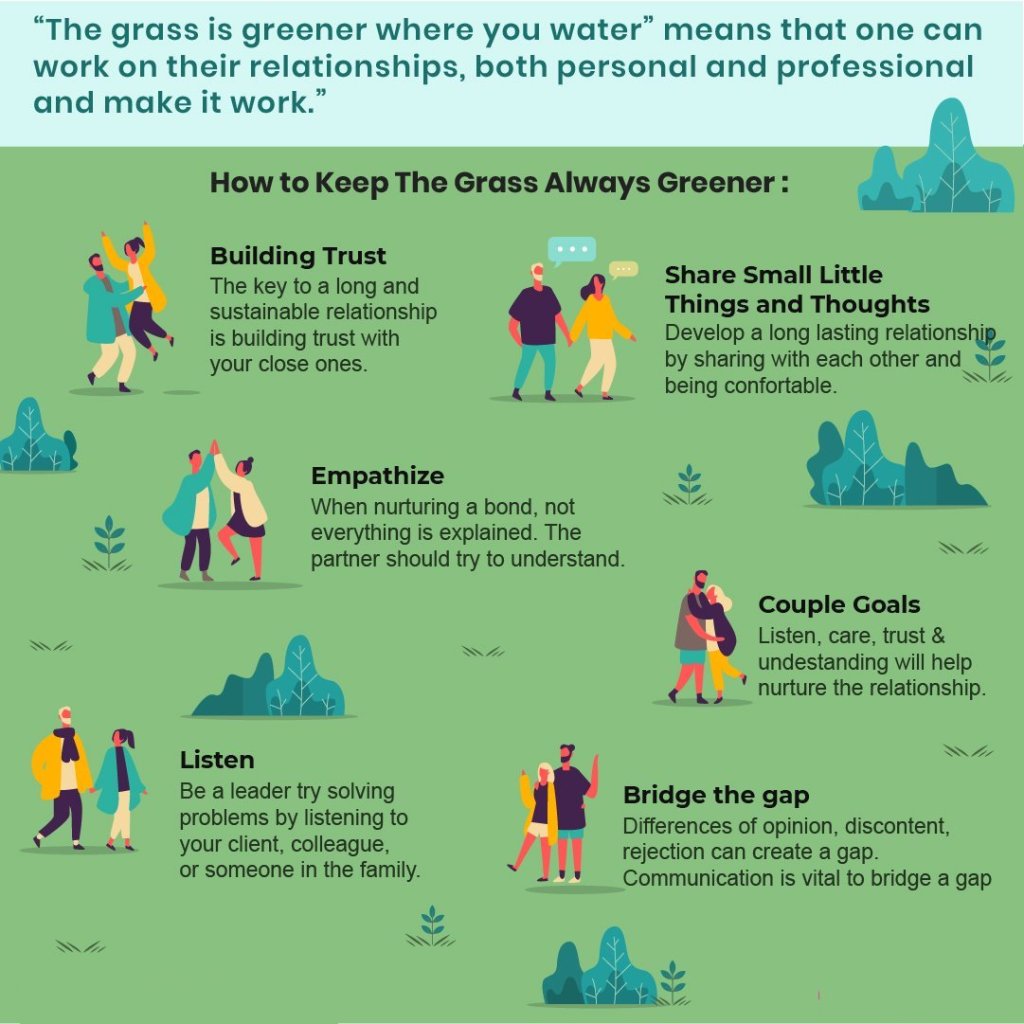
I came across this lovely graphic to illustrates how to keep the grass always greener

Source: themindfool.com

The weeds we see in our own backyard are green fields to others, and vice versa. There is nothing wrong with seeking new pastures and bigger, better opportunities. The mistake is not recognizing that the greatest opportunities are often right under our feet. Don’t let your relationships perish from neglect. The grass is always greener where you water it.

Lighten your Load

Have you seen the 2009 movie “Up in the Air”? It’s a movie starring George Clooney as Ryan Bingham travelling around America firing people whilst living out of a suitcase, only to find his beloved lifestyle threatened by the presence of a new hire and a potential love interest.

The film also featured a fantastic monologue which contained enough snappy sound-bites such “Moving Is Living” and “The Slower We Move, the Faster We Die”.

We all carry around unnecessary ‘baggage’ with us which makes each day harder than it needs to be and holds us back from really doing what we want which is what makes the “What’s In Your Backpack” so relevant to each and every one of us.

Here is What’s In Your Backpack? Speech:

How much does your life weigh? Imagine for a second that you’re carrying a backpack. I want you to feel the straps on your shoulders. Feel ’em? Now I want you to pack it with all the stuff that you have in your life. You start with the little things. The things on shelves and in drawers, the knick-knacks, the collectibles. Feel the weight as that adds up. Then you start adding larger stuff, clothes, table-top appliances, lamps, linens, your TV.

The backpack should be getting pretty heavy now. And you go bigger. Your couch, bed, your kitchen table. Stuff it all in there. Your car, get it in there. Your home, whether it’s a studio apartment or a two bedroom house. I want you to stuff it all into that backpack. Now try to walk. It’s kind of hard, isn’t it? This is what we do to ourselves on a daily basis. We weigh ourselves down until we can’t even move. And make no mistake, moving is living.

Now, I’m gonna set that backpack on fire. What do you want to take out of it? What do you want to take out of it? Photos? Photos are for people who can’t remember. Drink some ginkgo and let the photos burn. In fact, let everything burn and imagine waking up tomorrow with nothing. It’s kind of exhilarating, isn’t it?

So what is this proverbial backpack? And how can we prevent it from filling up to the point where we feel like we can’t carry all of our “stuff?”

The movie has a one very interesting, crucial, absolutely essential point: your relationships are the heaviest components in your life. His message is to get rid of those relationships as much as possible, because they slow you down. In reality, you don’t need to get rid of people. You just need to say no a lot more.

The difference between successful people and really successful people is that really successful people say no to almost everything.

Warren Buffet

You can’t actually be friends with everybody. Your life revolves around 3 main circles of people:

  • Family
  • Friends
  • Acquaintances

A lot of us spend way more time than necessary in the 3rd circle, and that’s what slows us down. If you want to make any sort of progress in a given direction, you have to say no to people, and mostly the people in the 3rd circle.

  • Say no to events.
  • Say no to distractions.
  • Say no to late nights.
  • Say no to one more drink.
  • Say no to people.

Then sometimes, say yes. Say yes to things that matter, and most importantly to the people who matter. Saying yes doesn’t necessarily mean taking ownership of a task that would clutter your calendar. You can yes and direct people to other sources of help. You can say yes, but later. You can say yes, but only when you’re done with your current task.


Letting go is a process that takes time. But the sooner you move through the process of letting go of what is hurting you or not letting you soar, the sooner better days are to come for you!

The Power of Words

Words have power. They can destroy and create. Sometimes a single word can change everything. Do you remember the words and kind acts that encouraged you when you were young? Perhaps a teacher, a coach, or a relative changed the trajectory of your life, all with the way they spoke to you. Hopefully, he or she spoke positive words of love and acceptance that encouraged you. I still fondly remember the encouraging words from my teachers in school :)

A 21st century Jewish Rabbi shared this striking statement about the power of words: “Words are singularly the most powerful force available to humanity. We can choose to use this force constructively with words of encouragement, or destructively use words of despair. Words have energy and power with the ability to help, to heal, to hinder, to hurt, to harm, to humiliate and to humble.”

Our thoughts also impact what we manifest in our lives. But it can be argued that the real power lies in our words. It is our words that provide a bold affirmation of our innermost thoughts. They are a confirmation to the world of how we see others, our lives and ourselves. It is this powerful affirmation that our words provide which enables our thoughts to manifest into a reality.

The words you speak with your spouse is so powerful that it can literally make or break your relationship. Your words literally decide the happiness quotient of your marriage.

Here are a few examples to portray the different moods of words you speak!

1. Depressive words make your spouse gloomy.

  • Are you a person lacking in confidence?
  • Do you feel that you are destined to fail?
  • Do you always utter negative words of depression?

Your attitude makes your spouse feel downcast and gloomy. When there is depressing atmosphere at home, there is no real happiness worth the name in your relationship. Your miserable and negative comments makes your spouse terribly bored to interact with you.

2. Angry words make your relationship crash to failure.

You are always stressed and tensed by your work related problems. You are constantly pressurized by family issues. You do not share your feelings with your spouse. Instead, you thrust your frustration and disappointment on him/her.

Angry words always hurt your relationship. It makes both drift far away from each other. Both feel unloved and uncared by the persistent use of angry words.

3. Humorous words can enliven your marriage

  • Do you joke with your spouse?
  • Do you make your spouse laugh by your humorous words?

Then your marriage is indeed lively and total fun.

Humor is the best way to relieve the tension and stress of your day-to-day interaction. It makes your relationship thrive with fulfillment. You enjoy your time together. When you are amusing and witty, your spouse wants to keep on communicating with you.

Your home echoes with laughter and fun. When you make light weather of family problems, your spouse loves you for this.

4. Caring words binds your relationship

  • Is your spouse feeling downcast and pulled down?
  • Do you overlook it as none of your business?

Your indifferent behavior makes your spouse feel that you do not care enough for him/her.

‘Is something wrong?
‘Don’t worry, everything will be fine.’
‘I am there for you.’

These words depict how much you care for your spouse.

5. Encouraging words build confidence.

Everyone wants success. Your spouse is no different. But success never comes easily. He/she feels let down when he/she faces persistent failures.

He/she feels terribly upset that you do not support him/her. Never shatter the morale of your spouse by browbeating or nagging him/her with discouraging words.

When you utter encouraging words, your spouse literally feels energized about his\her ability to be successful. ‘You will do it’, I know you will succeed’, such encouraging words make your spouse feel worthwhile and valuable.

6. Words of love make your relationship strong

Your spouse never outgrows the need to be loved by you. He/she literally craves for visible show of love from you. Your spouse feels uncared when you live through your married life with routine and mundane interaction.

Your spouse adores it when you have many loving words to say to him/her.

‘I love you’.
‘I do not know what I would do without you’.
‘You are the best thing that has happened in my life’.

Such beautiful words make your spouse melt in happiness.


So choose your words bravely, consciously and lovingly. Always speak from a place of love; for yourself, for your life, for your spouse and for others. Your words equal your world, so use them wisely.

Is it better to give than to receive?

Money will not buy you love but it might buy you happiness if you spend it in the right way. We may have heard the old adage “it’s better to give than to receive”: spending money on others or giving to charity puts a bigger smile on your face than buying things for yourself.

Usually, a phenomenon known as hedonic adaptation is responsible for us feeling less happiness every time we experience some event or activity again. We get used even to the best things and want more. But when we give to others, something different happens. Psychology researchers Ed O’Brien from the University of Chicago Booth School of Business and Samantha Kassirer of Northwestern University’s Kellogg School of Management carried out two studies. They discovered that the happiness of the subjects declined much less or not at all if they repeatedly gave gifts to others as opposed to getting the same gifts themselves.

If you want to sustain happiness over time, past research tells us that we need to take a break from what we’re currently consuming and experience something new. Our research reveals that the kind of thing may matter more than assumed: Repeated giving, even in identical ways to identical others, may continue to feel relatively fresh and relatively pleasurable the more that we do it.

Ed O’Brien

One of the experiments consisted of having 96 university students getting $5 every day over the course of 5 days. The catch – they had to spend it on the same exact thing either for themselves or someone else (like donating to charity or putting money in a tip jar). At the end of each day, the study participants had to reflect on their spending and level of happiness. 

This study showed that over the 5 days, the levels of self-reported happiness decreased for those who spent money on themselves. Those who gave money to someone else did not show such a fade in happiness, however. The joy and satisfaction of giving is just as powerful every time you give it.

The best way to find yourself is to lose yourself in the service of others.

Mahatma Gandhi

For the second experiment, the researchers had 502 online participants play 10 rounds of a word puzzle game. The 5 cents they won each round could be either donated or kept for themselves. After each round, the subjects reported how joyful the winning made them feel. Those who gave the won money away reported their happiness decrease much slower than those who hung on to the gains.

The fuller explanation for why people react this way to giving may lie in the fact, say the researchers, that when we focus on an outcome like a paycheck, we are setting ourselves up for being less happy. Paychecks can be compared to one another, which reduces our sensitivity to each such experience. When we focus on actions, like donating to a charity for example, comparison becomes less important. What happens instead is that we treat each instance of giving as a unique event that can bring us inner satisfaction and elation.

The value of giving to others was one of the themes reiterated by Dr. Martin Luther King, Jr. In arguably his finest sermon, The Drum Major Instinct, King notes that personal greatness and service to others are intertwined. In a world filled with people’s selfish endeavors and nations’ destructive engagement in war and violence, King emphasized that a desire to be the best (the drum major) can be transformed from a selfish impulse to an instrument for justice if people adopt service to others as their goal. In King’s poignant words, “Everybody can be great, because everyone can serve.”

It does not matter whether you give a lot or a little, give gifts or intangible things. What matters most for meaningful happiness is appreciating the importance of those around you — family, friends, and community — and do so each and every day of the year.