In a world of plenty where most of us are pre-programmed to strive for more, desire what we don’t have, and lust after what’s faster, better, and stronger, we forget to appreciate what we have.
It made me think: what would happen if we could all learn to live with less? What if we could accept the gifts life has to bestow upon us and let what we have be enough? What if we took measures to simply count our blessings everyday? Would we (could we) be happier or more content?
When we count our blessings, we note all the wonderful things in our lives. This helps us to appreciate how good life is. Gratitude is a feeling of appreciation or thanks. When people count their blessings, they can say it like this: “I am thankful for my family. I am thankful for my friends. I am thankful for my health.”
It is better to be grateful for our blessings than to take them for granted. When we take something for granted, we do not appreciateit. Sometimes we are not appreciative of our good fortune and blessings until they are gone.
But now, let’s take a step back. What exactly is a blessing?
In English, the word “blessing” has at least two meanings. As we said, a blessing is something that brings you happiness or helps you. To religious people, a blessing is approval and help from a higher source — God.
So, what kinds of things can we be thankful for? Here is my list which I frequently look at as a source of encouragement and positivity
The love of my family and friends
The privilege of having a job
The opportunity to spend time with the less fortunate both at work and my church
Being able to help people
Clean water and good food
All the beautiful things that God has created
Make a habit of being thankful. As I mentioned, I think it’s a great idea to keep a list handy to remind you of everything you have to be grateful for. You can even write yourself notes and put them around the house or at your office.
So much of our happiness has to do with our focus…what we’re dwelling on in our mind. That’s why when we put our focus on God and all of the great things He does for us, it breathes hope into our thoughts, moods, and our entire day.
When we give thank, we make God bigger in our eyes…and suddenly our problems seem smaller!
Do you want to make this day and every day better? then begin to count your blessings! As you do, your perspective will change, and you’ll suddenly feel so much better about life.
Last night (India time!) we had Google I/O, which at its core is a developer focused event. Here are the some of the biggest announcements made at the keynote.
Android
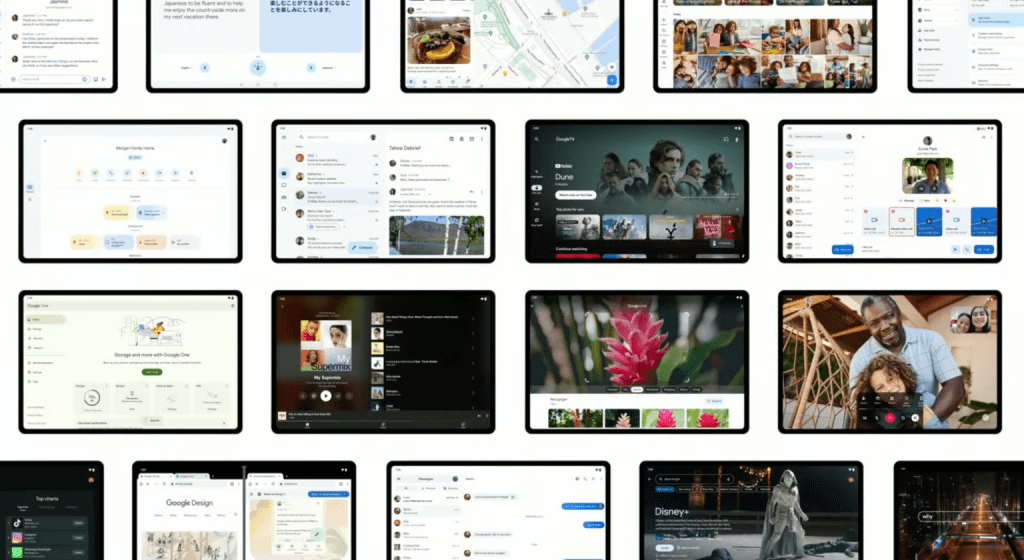
With Android 12L last year and Android 13 this fall, Google has been focusing on enhancing the experience on “large screen” devices like tablets and foldables. And Google is leading by example with Android’s large screen ambitions by updating over 20 of their own apps to look and act better on tablets and foldables, this includes YouTube Music, the Play Store, and Google TV.
Google is also integrating TensorFlow Lite into Play Services. Because of this, developers can now depend on the bundled version of the library to reduce the size of their application.
On the privacy front, there’s a new ML-based “Google Code Scanner” API for scanning things like QR codes and barcodes. The work is delegated to Google Play Services, which saves your app from needing the camera permission, and the scanning is done on-device, keeping the data securely offline.
Android Studio
During the I/O developer keynote, Google showed the next steps for Android Studio, with a look at the upcoming “Dolphin” release, which is moving into Beta testing phase.
View Compose animations and coordinate them with Animation Preview.
Define annotation classes to easily include and apply multiple Compose preview definitions at once.
Track recomposition counts for your composables in the Layout Inspector.
Easily pair and control Wear OS emulators and launch tiles, watch faces, and complications directly from Android Studio.
Diagnose app issues faster with Logcat V2.
Looking further ahead, the latest Canary release, dubbed Electric Eel, is testing out a variety of new features.
For starters, Google has launched a new “Google Play SDK Index” that offers public information about the versions of Android dependencies and SDKs. This SDK Index is being integrated into Android Studio to offer lint warnings about outdated and deprecated packages early on, allowing you to easily fix them before publishing your app.
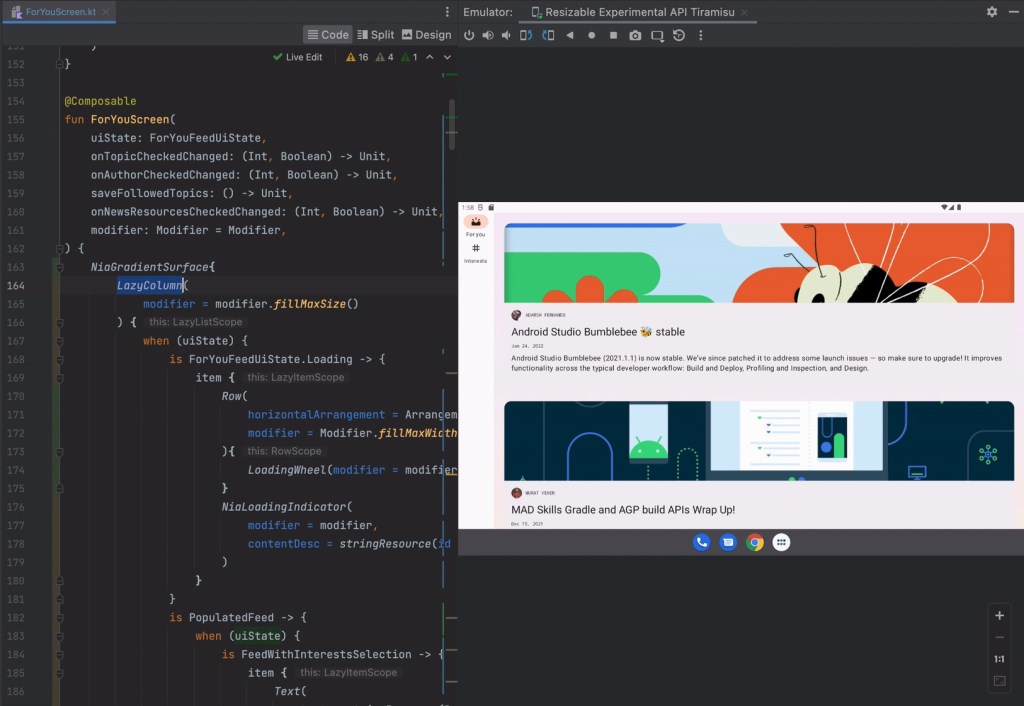
Android Studio’s resizable emulator is staying in Canary testing for a while longer rather than graduating to Beta. Just like before, there are four layout presets for rapidly checking your app in various common display shapes — phone, unfolded foldable, tablet, and desktop.
Android Studio Electric Eel includes a new, experimental “Device Mirroring” tool that can show your phone’s display on your computer.
Additionally, for Jetpack Compose developers, Android Studio Electric Eel includes an optional “Live Edit” feature that allows changes to your code to be reflected in emulators and previews of your app in real time. This should go a long way toward making design iteration faster. The previous version of live editing for Jetpack Compose was limited to changing literals such as in-app text and dimensions.
Jetpack Compose
For a few years now, Google has been steadily crafting Jetpack Compose, a new UI framework for Android, built to use the advantages of Kotlin while also taking inspiration from Flutter’s (another Google project) declarative UI creation. Since its stable launch nearly a year ago, Jetpack Compose has seen significant adoption from the Android community, with over 100 of the top 1000 Play Store apps using the framework, including Twitter.
The biggest announcement for Compose is that Jetpack Compose for Wear OS has now reached beta testing phase, with Google often considering beta to be ready for production applications.
IO 2022 marks the launch of Jetpack Compose 1.2 Beta. The first highlight of this release is that font padding for text is now optional, one of the most hotly requested features from Compose developers. In a future release, padding will default to being disabled, so it’s definitely worth playing with it in your own app.
On a related note, Compose 1.2 now allows your app to download the fonts it needs, rather than needing to ship it in your APK. This feature is powered by Google Fonts, allowing your Jetpack Compose app to have easy access to over 1000 free fonts. Another textual improvement in Compose 1.2 makes more of your app’s text compatible with Android’s built-in magnifier tool.
Other improvements with Jetpack Compose 1.2 include a new customizable “LazyLayout,” stable lazy grid layouts, WindowInsets to better add Compose to an existing app, and recommended “window size” layouts for testing.
Google is also making it easier to get from one particular part of a Jetpack Compose app to another, with a new Compose-specific adder for the Navigation library, allowing for your compose functions to be set as navigation destinations.
Jetpack
Google’s goals for Jetpack have always focused on making the lives of Android developers easier, be it through APIs to bridge new features to the many versions of Android or unique new libraries to improve apps.
On the latter front, Google has unveiled the concept of “Baseline Profiles” for Jetpack, which take usage data from your app to optimize the most commonly used parts. Those parts are then compiled by the system first, allowing for them to be ready to run faster. To create a Baseline Profile for your own app, you can use the Jetpack Macrobenchmark library.
Google themselves have begun using Baseline Profiles in their apps, with the Play Store’s search results page loading as much as 40% faster. In other instances, Google has seen some apps receive a 30% initial speed boost just by using Baseline Profiles.
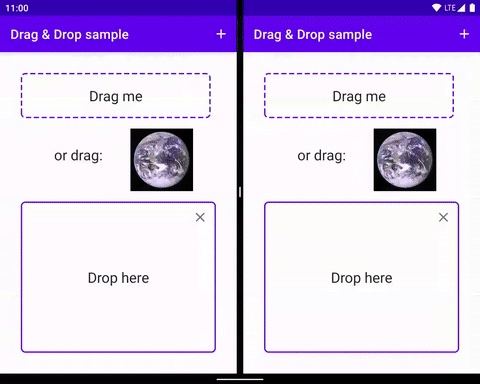
To better run your app across multiple windows and on foldables, Jetpack offers the WindowManager library to solve common problems like physical display size changes. WindowManager pairs well with another library, DragAndDrop, which makes it all too easy to accept dragged contents, either from your own app or another.
Jetpack’s new JankStats library does just what it says on the tin, tracking down and offering statistics about instances of “jank” or dropped frames. These moments are recorded along with helpful context of what the user was doing that could help explain inconsistent instances of jank.
For Room, a data persistence library and one of the foundational pieces of the Jetpack suite, Google is readying an update to version 2.5, which begins the effort of rewriting Room in Kotlin. Room 2.5 will also bring support for the newer “Paging 3.0” way of reading and saving data that’s enhanced for Kotlin use. Other Room improvements include easier JOIN queries and AutoMigration changes.
If your project hasn’t yet made the jump to Kotlin, the Jetpack team is preparing a Paging 3.1 update that integrates Guava and Rx for Java alternatives to Kotlin coroutines.
Flutter 3
Flutter, Google’s massive cross-platform app development framework, has reached version 3, bringing Material You, Linux, & macOS support, and more. Linux and macOS Flutter apps.
Meanwhile, part of supporting macOS is that both Flutter and the underlying Dart programming language now have native support for Apple Silicon. Better yet, you can ship Flutter apps in the Universal Binary format, allowing them to run effectively on both Apple Silicon and Intel based Macs. This Apple Silicon support also extends to developers, with the Flutter and Dart SDKs both now ready to run on the latest generations of Mac.
At last year’s Google I/O, shortly after the company announced its then-upcoming Material You design language, the Flutter team confirmed that developers would be able to bring this third generation of Material Design to their own apps. Less than a year later, we now see the fruits of that effort, with Flutter 3 bringing a variety of new Material You widgets.
Beyond that, significant effort has gone into custom theme generation within Flutter 3. Similar to Android 12, it’s possible to automatically craft an app’s entire color scheme from a single starting color. Importantly, though, this capability is in no way limited to Android 12 and its wallpaper-based themes. Should you wish, your app can use just about any color as its baseline for a custom theme.
DART
The hallmark feature of Dart 2.17 is the ability for developers to extend enums as well as override its default functions. This allows enums to act quite a bit more like custom written classes, should you see fit.
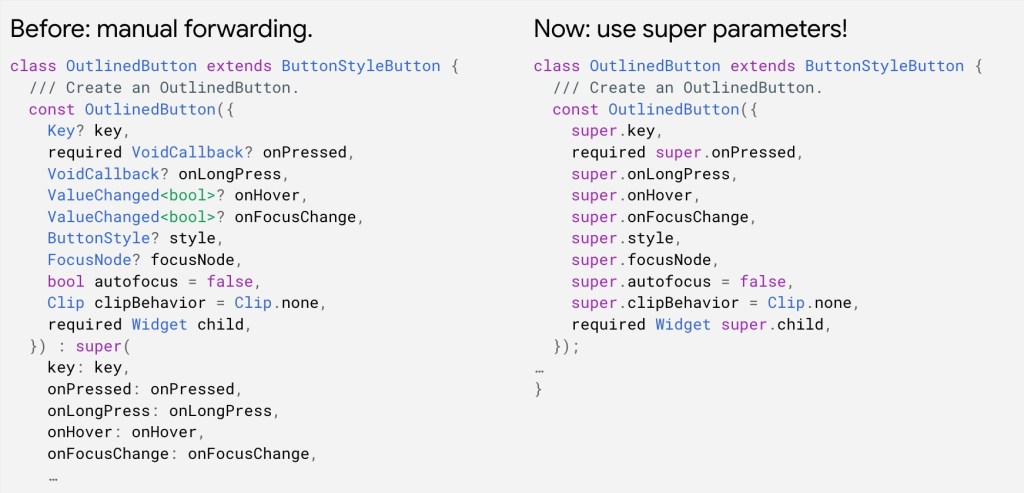
In an effort to reduce boilerplate code, Dart 2.17 also introduces the idea of “super parameters” when creating a class that inherits from another class. In the common example of Flutter widgets which always pass on the “key” parameter to the “Widget” class, this should save quite a few lines of code and make your code much easier to read.
Firebase
During Google I/O 2022, the Firebase team shared a suite of new features for Android and Web developers, as well as improvements to security and third-party services.
For many, the most crucial tool that Firebase offers is Crashlytics, a purpose-built tool for identifying issues that users of your app are experiencing and precisely where in your code that issue is occurring. However, until now, that data has been primarily accessed through the Firebase Console in your browser.
With the upcoming release of Android Studio Electric Eel, currently in Canary, your data from Crashlytics is now available in a new “App Quality Insights” window. This makes it even easier to dive into each crash and the parts of your code likely to be responsible. For now, Android Studio’s Crashlytics integration only works with Android applications written in Kotlin or Java, but Firebase Product Lead Francis Ma confirmed that additional support for Flutter applications is coming soon.
Elsewhere in Crashlytics for Flutter developers, the Firebase team has vastly improved adding the plugin to your Flutter app, now making it a simple two-step process. Other improvements to Crashlytics for Flutter include better automatic grouping and logging & alerts for critical errors. More broadly, the various Flutter plugins for Firebase are now moving to “general availability” and are being developed more directly by the Firebase team.
For web developers who use Firebase to host their applications, the “firebase deploy” command is being massively upgraded to deeply support two popular frameworks, Next.js and Angular Universal. These improvements will help bring the power of Firebase’s security and CDN to your app with little effort on your part.
On the security front, Firebase App Check is a recently launched service — moving today from beta to general availability — that works to protect your app’s backend from being accessed by illegitimate apps and devices. It does so through, among other things, the Play Integrity API, which checks against common forms of abuse and rooted devices.
For those who want to integrate their apps with third-party services, Firebase is expanding their system of “Extensions.” In addition to new supported partners like Snapchat, some Extensions can now be deeply customized through the use of “events” that let you run your own code in response to workflows from third-party services.
Google Play
The biggest highlight of Google Play’s announcements at I/O is the release of the SDK Index, a web tool that offers insights into the most popular packages in use on Android today. In particular, you’ll find what permissions they need, what apps use them, and code that may potentially violate Google Play policies.
A new beta program called “LiveOps” will allow developers to submit their applications and special events/discounts/etc. to be featured prominently by the Play Store. Google has said that apps using LiveOps on average see 5% more active users and 4% higher revenue. For now, the LiveOps beta is limited, but developers can register for the chance to join.
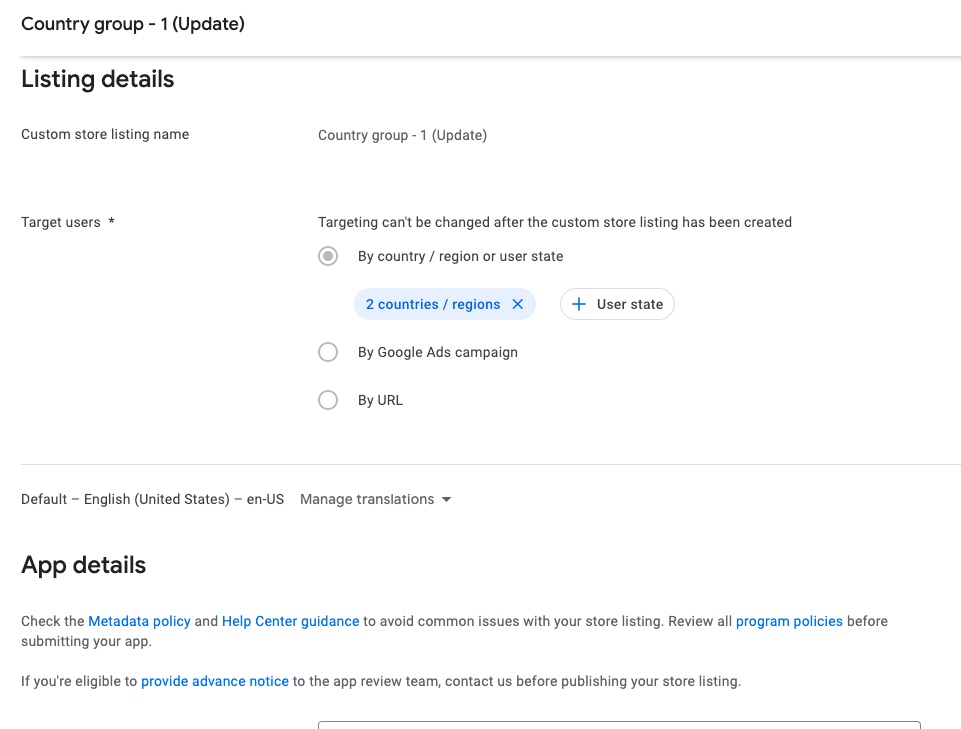
Another new feature coming soon to the Play Store is the ability to manage up to 50 store listings for an app, allowing for slight variances between them, perhaps based on an ad campaign or based on the user’s region or interests.
Similarly, developers of apps that have subscription plans can now create a diverse set of slightly different offers and even flexible pricing. There’s even a way to change the price of a subscription for new customers while leaving existing customers at the older cost.
On the security front, the Play Console is also working to make it easier to keep your app’s signing keys safe. As a best practice, Google Play App Signing can be configured to automatically rotate to a new signing key on an annual basis. Additionally, Play App Signing is in the process of switching to exclusively using Google Cloud Key Management, both for newly generated keys and migrating existing keys to the service.
Any of the updates I may have missed? Any of the above need more details on? Please let me know! :)
Did you know that the first Thursday of May is apparently “World Password Day”? I didn’t! And this year to celebrate this day Apple, Google, and Microsoft are launching a “joint effort” to kill the password. The major OS vendors want to “expand support for a common passwordless sign-in standard created by the FIDO Alliance and the World Wide Web Consortium.”
The new capability will allow websites and apps to offer consistent, secure, and easy passwordless sign-ins to consumers across devices and platforms.
Password-only authentication is one of the biggest security problems on the web, and managing so many passwords is cumbersome for consumers, which often leads consumers to reuse the same ones across services. This practice can lead to costly account takeovers, data breaches, and even stolen identities. While password managers and legacy forms of two-factor authentication offer incremental improvements, there has been industry-wide collaboration to create sign-in technology that is more convenient and more secure.
The expanded standards-based capabilities will give websites and apps the ability to offer an end-to-end passwordless option. Users will sign in through the same action that they take multiple times each day to unlock their devices, such as a simple verification of their fingerprint or face, or a device PIN. This new approach protects against phishing and sign-in will be radically more secure when compared to passwords and legacy multi-factor technologies such as one-time passcodes sent over SMS.
The announcement last week extends these platform implementations to give users two new capabilities for more seamless and secure passwordless sign-ins:
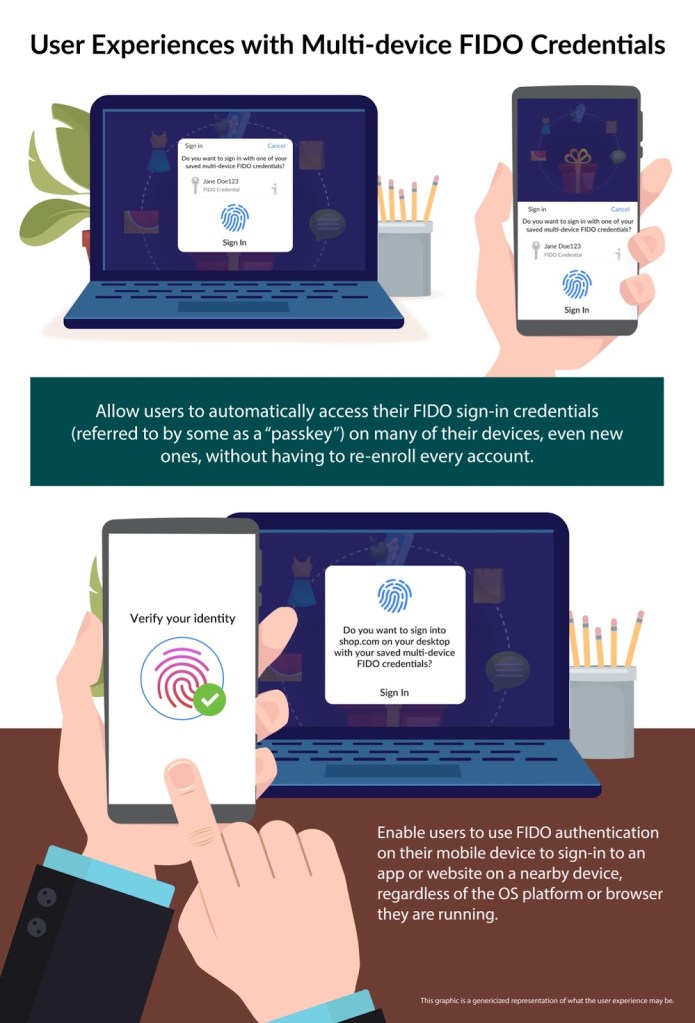
Allow users to automatically access their FIDO sign-in credentials (referred to by some as a “passkey”) on many of their devices, even new ones, without having to re-enroll every account.
Enable users to use FIDO authentication on their mobile device to sign in to an app or website on a nearby device, regardless of the OS platform or browser they are running.
In addition to facilitating a better user experience, the broad support of this standards-based approach will enable service providers to offer FIDO credentials without needing passwords as an alternative sign-in or account recovery method.
These new capabilities are expected to become available across Apple, Google, and Microsoft platforms over the course of the coming year.
Here is an illustration of the envisaged experience
This looks like a familiar system for anyone with phone-based two-factor authentication set up, but this is a replacement for the password rather than an additional factor.
Companies have been trying to go “passwordless” for years, but getting there has been tough. Will FIDO get it done? Only time will tell :)
We all want to be accepted and loved by others. It is a nearly universal human desire. After all, we evolved to survive better in groups, where fitting in and having the trust and respect of our peers are the measures of success. The need to belong is in our DNA.
But sometimes that need takes center stage, and what others think about us takes on more importance than what we think about ourselves. We may analyze each look and word that comes our way for clues that we’ve been judged and found acceptable or lacking. Someone passing in the hall without a hello may leave us red-faced and convinced we don’t deserve notice. We may people-please, always putting others first, which leaves us open to being taken advantage of while we chase praise. We may exhaust ourselves trying to be cool enough, hard-working enough, attractive enough, or successful enough to feel valued.
What’s behind this anxiety about being liked, and why are some of us so much more vulnerable to it than others?
Healthy striving is self-focused: ‘How can I improve?’ Perfectionism is other-focused: ‘What will they think?’
Brené Brown, “The Gifts of Imperfection”
If you recognize that you are someone who’s anxious about being liked, there are steps you can take to get back to a healthier relationship with others and with yourself.
1. Keep things in perspective. It’s said that people would care a lot less about what others think about them if they knew how little others think about them. And it’s true: Everyone has enough to occupy their mind. They also have their own insecurities. If you’re worried about how you come across to someone you’ve just met, keep in mind that they’re probably doing the same.
2. Question your thinking. We tend toward patterns of negative thinking that can hurt our mood or behavior. For example, we may assume the worst, or filter out the good in a situation and pay attention only to the bad. Or we may overgeneralize or jump to conclusions. Pay attention to your thoughts, and question them rather than allowing impressions to run away with you. You may discover that what you’re fretting over exists only in your mind.
3. Let go of perfection. It can be hard to shake the feeling that if you just get things right, you will be loved and admired. But this is a fruitless pursuit, not only because perfection is an illusion, but because what people think about you has more to do with them than with you.
4. Get to know yourself. What do you really like? What do you really want? Are you making choices about your career, relationships, and pastimes because you want them or because they’ll please or impress someone else? Allow yourself to try new things and wonder, “What would I pursue or enjoy if I wasn’t so worried about being judged?”
5. Find your tribe. Somewhere out there are people who can identify with you and appreciate you for who you are. Don’t waste time trying to hang on to those who expect you to conform to their wishes and wants. Cultivate authenticity, and you’ll find those you are meant to be with.
Because true belonging only happens when we present our authentic, imperfect selves to the world, our sense of belonging can never be greater than our level of self-acceptance.
Brené Brown, “Daring Greatly“
6. Allow yourself to be vulnerable. It can be terrifying to go against the grain, speak out, take a risk, or face disapproval. But decide what matters to you, trust yourself, and go for it. We don’t grow by always playing it safe; we grow by allowing ourselves a chance to fail.
7. Accept a helping hand. The anxiety you feel about what others think can sometimes be overcome with a little self-awareness. But in some cases, especially for those with underlying trauma or mental health issues, professional help can help you get to the root of your feelings. Allow yourself to reach out for the care you need rather than prolonging your suffering.
8. Be your own friend. It’s a tough reality, but you will never be able to make everyone like you, no matter what you do. But look on the bright side: No one else can do it, either. So accept the twinges that will inevitably come when you realize you haven’t made a connection with someone, and focus instead on a goal that will take you further toward being the kind of person you want to be—learning to like yourself, flaws and all.
In conclusion, this quote sums things up perfectly
What other people think of me is none of my business.
As managers, we are expected to provide an exceptional level of support to our teams. And this support could cover both technical and non-technical, even emotional support. This is extremely hard work and requires plenty of patience, trust and understanding on both sides.
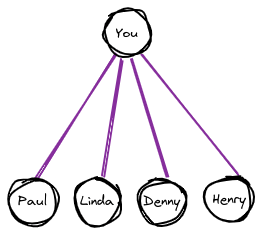
The Triangle
“1 to 1” relationship between manager and reports
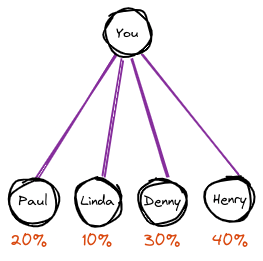
There are many ways to build this A-grade level of support. 1-on-1s are great and widely used as the personal connection definitely helps to make a difference. Most managers have more than one direct report and their attention is spread across all their direct reports. Some need more attention than the others, while some demand more attention. This subsequently leads to leaving others with less support.
Your model looks like a triangle where everyone depends on you with every person needing a different amount of attention at any given point of time.
Your attention must be distributed wisely.
Every person reporting to you is unique in their own way and more importantly all of your direct reports may not have the same level of skills. Add the different complexities of the projects they are on, some have crazy weeks while others are pretty relaxed.
What could go wrong?
Neglecting Talent: You may miss out on focusing on talent that may need more attention than you are giving.
Blind Spots: In the middle of your busy schedule, you may miss catching on a few non-verbal cues from your team that will help throw light on why they may not be performing well enough.
Out of your League: You may have to deal with an issue that you may feel less competent to deal with, for example a new technology that you haven’t had the time to explore.
So what can you do? How can you provide such comprehensive support without spreading so thin that it will impact your other responsibilities?
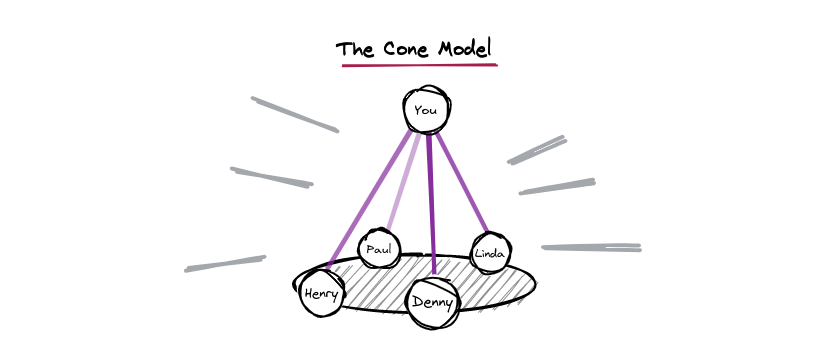
The Cone Model
Create a many-to-many support network
The essence of the Cone Model is to minimize your dependencies while maximising the network between your team members. Instead of letting all your team depend on you for their growth, you should create a connection between people, leveraging the different strengths and weaknesses.
Continue with your 1-on-1s and while you do that identify a need that someone else on your team can assist with. At the same time ensuring expectations are set so that your team and network is fully aligned to what you have in mind.
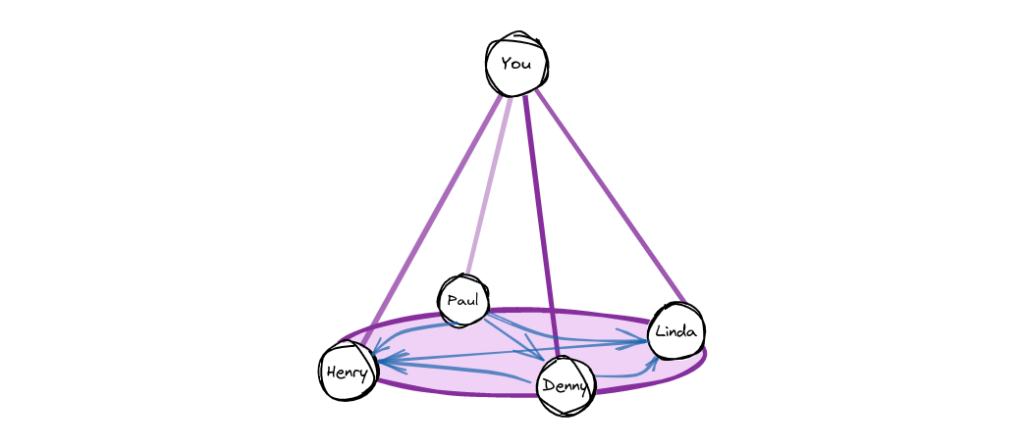
How can a good network look?
Linda supports Henry: Coding in our tech stack
Paul supports Linda: On software architecture and system design
Paul also supports Denny: Coding in our tech stack
Denny supports Henry: Team collaboration and communication
And you support everyone :)
An internal network of support
How do you know if your cone model is working? Here is the answer:
Managers should build strong networks and create an environment where they are not critical components. They should be able to stay away for a few weeks without impacting the team.
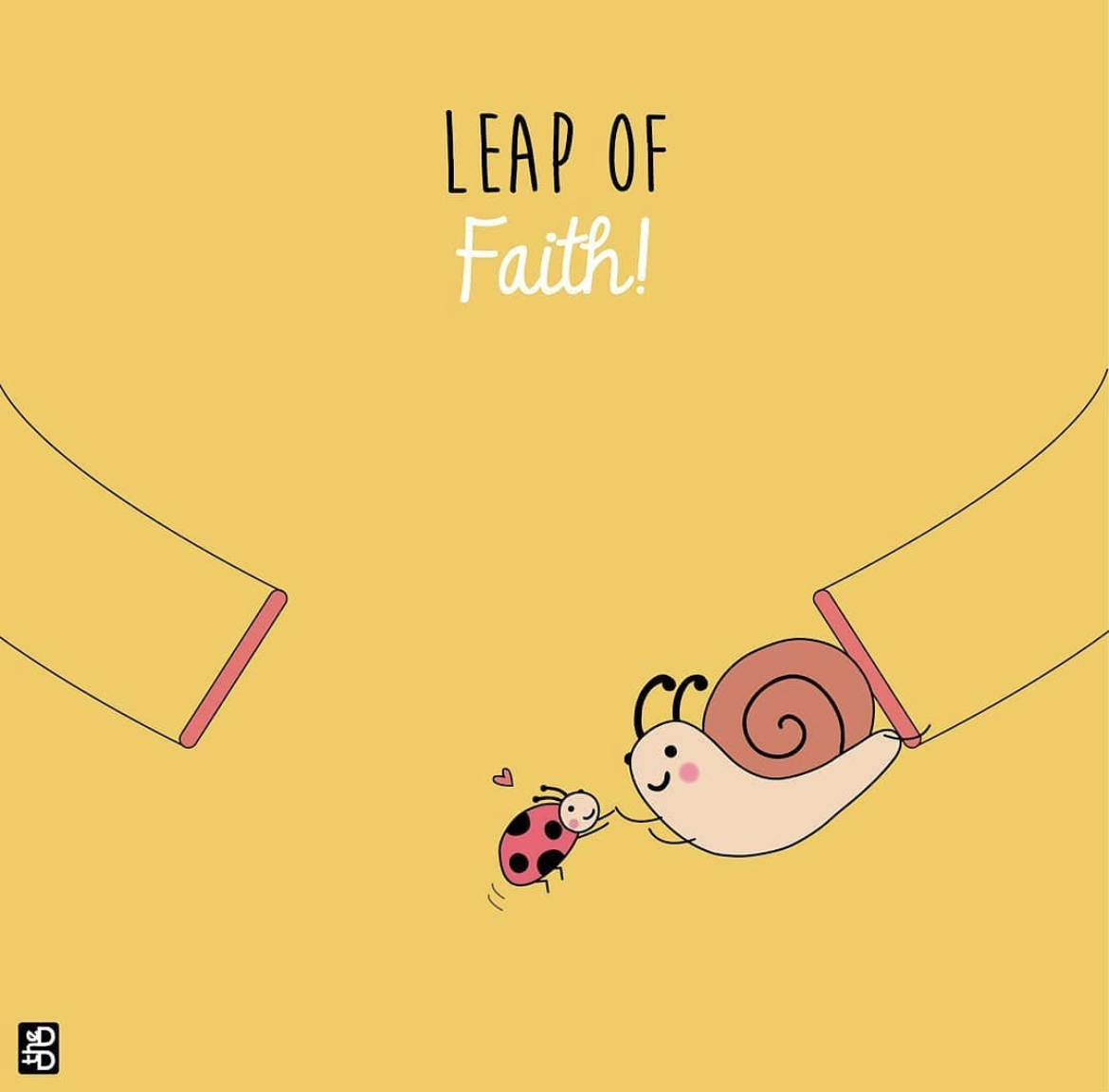
Leaping without knowing where you’ll land on the other side can be extremely scary. But taking risks is necessary for growth. All of the greatest things in life require a leap of faith. You cannot fall in love if you don’t let down your walls and leap. You most likely won’t advance in your career if you don’t allow yourself to put in the hard work to make it happen. And you cannot connect with the Universe unless you lay down your sword and learn to lead with and embrace love.
It’s called a leap of faith for a reason. But what is faith exactly?
Faith is the belief in something larger, grander and more powerful than you. Faith is the belief that you cannot fail, you can only learn. Faith is the belief that you’re always being guided by love.
I like to think of my faith as an interconnected network of tree roots: No matter what storms may come my way, I will remain unshakeable and stand tall; I may bend, but I shall never break; I am grounded yet boundless. And yet, despite all of the strength I garner from my faith, it can still be difficult to accept this truth.
Fear is powerful, but faith persists. Fear says, “why try?” but faith says, “why not?” Fear whispers that you need to ration your love, but faith whispers that love is the only thing that lasts. Fear builds walls, but faith builds bridges.
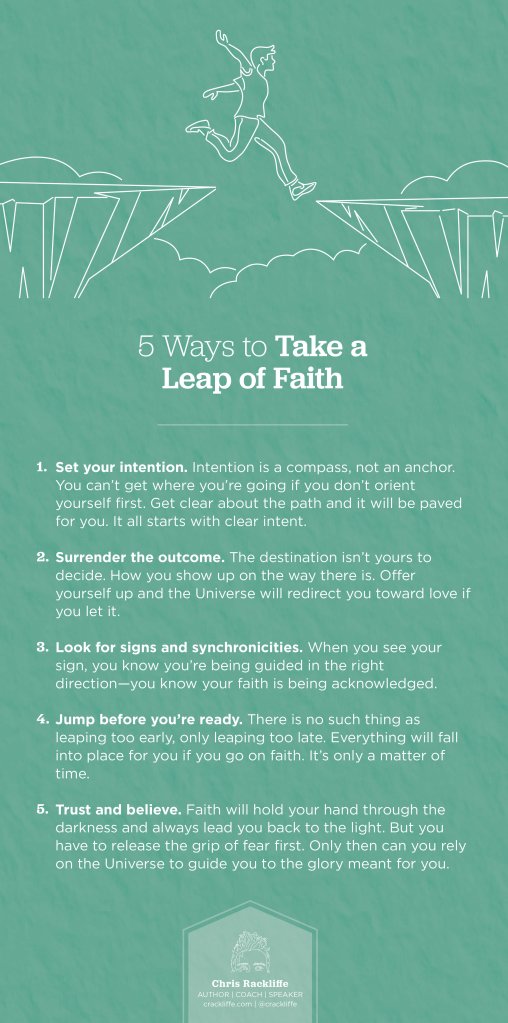
So how do you take a leap of faith? I came across this lovely infographic by Chris Rackliffe
Here are the 7 things that will likely happen when you take a leap of faith in yourself and throw yourself into the unknown. Because, hey, the sky is the limit and the world is your oyster!
1. You will discover who you truly are 2. You will learn to make yourself feel “whole”. 3. You will always feel excited and anew. 4. You will have no fear. 5. You will be more intuitive. 6. You will feel a complete sense of freedom. 7. You will achieve great things.
If you look at the world’s greatest leaders, they have always followed their passion and used their innate talents to become successful. Listen to your heart and follow that. It may take a few years to figure it out. It may take a decade to get to where you want to go as the straight way through might be too risky. However, you just have to start now. Don’t feel scared or feel that you’re inadequate. You can achieve what you believe you can. Most important of all, you need to have faith in yourself.
Upma used to be served everyday in a hostel of 100 inmates. Out of the 100 students, 80 complained and asked to be given different tiffin items every day. But 20 students were happy to eat upma every day.
In order to come to a decision, the warden arranged for voting. Whichever tiffin gets the majority will be served. The 20 students who wanted upma voted promptly. The remaining 80 students voted as per their choice:
Absolutely love this story on doing all you can while you are alive.
A rich Goan landlord once asked his parish priest : ‘Why does everybody call me stingy when everyone knows that when I die I will leave everything I have to this church?’
The priest answered: ‘There once was a pig and a cow in this village. The pig was unpopular and the cow was loved by all in the village. This puzzled the pig.
The pig said to the cow: ‘People speak warmly of your good nature and your helpful attitude. They think you are very generous because each day you give them milk, butter and cheese. But what about me ? I give them everything I have. I give them the famous Goa sausages, bacon and ham. I also provide ingredients for mouth-watering sorpotel. Yet no one likes me. Why is that?’
The priest continued: ‘Do you know what the cow answered ? The Cow said: Perhaps it’s because I give while I am still living’!!!
Once upon a time, what happened did happen…..or you wouldn’t be hearing this story!! A merchant on a casual jaunt through a market, came across a fine specimen of a camel for sale. The merchant and the camel seller, both skilled negotiators, struck a hard bargain. The camel seller pleased with his skill of worming out what he felt was a very good price, parted with his camel and the merchant chuffed that he had struck a fantastic bargain, proudly walked home with the latest addition to his large livestock.
On arriving home, the merchant called to his servant to come and help him take out the camel’s saddle. The unwieldy heavily padded saddle being too difficult for the servant to manage on his own. Hidden under the saddle, the servant found a small velvet pouch which on opening he discovered to be filled with precious jewels!!
The servant was overexcited!!! “Master you bought a camel…..but see what came FREE along with it!!!”
The merchant was astonished as he looked at the jewels in his servants’ palm. They were of extraordinary quality sparkling and twinkling in the sunlight. “I bought the camel” he said, “not the jewels. I must return them to the camel seller immediately.”
The servant was aghast…..his master was really foolish. “Master…..no one will know.”
But the merchant headed right back to the market and handed over the velvet pouch back to the camel seller. The camel seller was very happy, ” I had forgotten that I hid these jewels in the saddle for safe keeping.” “Here, choose one of the jewels for yourself, as a reward.” The merchant said “I paid a fair price for the camel and the camel only, so NO thank you, I do not need any reward.”
But as much as the merchant refused, the camel seller insisted.
Finally the merchant said, sheepishly smiling, ” Actually when I decided to bring the pouch back to you, I already took two of the most precious jewels and kept them for myself.”
At this confession the camel seller was a bit flabbergasted and quickly emptied the pouch to count the jewels. However he was very confused. “All my jewels are here. What jewels did you keep?
“The two most precious” said the merchant.
” My INTEGRITY and my SELF-RESPECT “
Integrity is the ability to do the right thing or choosing to do the right thing when you could get away with doing the wrong thing.
When I saw this quote, the following story immediately came to mind. On March 10, 1748, John Newton, a 22-year-old English seaman who had worked in the slave trade, was traveling home on a merchant ship after a series of misadventures, including being captured and enslaved in Sierra Leone. On that day, a violent storm struck just off the coast of Donegal, Ireland. Rocks ripped a hole in the side of the ship, and it seemed unlikely that the vessel would make it safely to shore. Newton prayed and committed to devote his life to Christianity if the ship was spared. At that moment—the story goes—the ship’s cargo shifted, covering the hole and allowing the ship to limp to port.
Newton kept his promise, eventually becoming an Anglican priest. Most famous perhaps for composing the hymn “Amazing Grace,” the former slave trader dedicated himself to ending the slave trade. In 1787, he joined efforts with others to found the Society for Effecting the Abolition of the Slave Trade. Their members included Olaudah Equiano, a former slave whose storytelling abilities and autobiography made the horrors of slavery real. Josiah Wedgwood, an industrialist, created a logo for the campaign that inspired empathy and connected with the horrifying inhumanity of slavery. The emblem pictured an enslaved man on his knees, in chains, encircled by the words “Am I not a man and a brother?” It appeared on snuffboxes, cufflinks, and jewelry throughout Europe. Newton himself wrote a pamphlet titled Thoughts Upon the African Slave Trade, which detailed conditions on slave ships, and which he sent to every member of parliament.
Together they created what is often regarded as the world’s first infographic: a cutaway map of the Brookes slave ship, showing how slaves were stacked and chained. They posted these images in taverns and pubs throughout Europe. (See image below.)
Copies of this cutaway map of a slave ship, created in 1787, were posted in taverns across Europe. Regarded by some as the world’s first infographic, it made a powerful case against slavery. (Image courtesy of the British Library)
As part of their campaign, they launched a boycott of sugar, a product purchased mostly by women, who made most decisions about the foods and products their families consumed. The campaign reduced the demand for sugar by 30 percent, showing that the tie between economic dependence on slave labor and products in demand across Europe could be severed.
Their work eventually succeeded. In 1807, Parliament passed the Abolition of the Slave Trade Act, which banned British ships from engaging in the slave trade. Their efforts are widely regarded as one of the first social justice campaigns. What these men accomplished contains the hallmarks of any effective campaign and conveys lessons we can apply today.
So what does make people care?
The questions which come to mind: Why should I care about you? Why should I care about your problems, your challenges, whether or not your day is going well, your child is sick, or your job is stressful? I don’t even know you and may never even meet you. Why do you, a stranger, matter to someone who will never know your name?
In simple words: Because it’s the right thing to do.
Each of us expresses this care in different ways, some in anger, some in tears, some in debates and discussions. But the way I love best is by actions. Deeds not words, Facta non Verba (my school motto!), walking the talk. There are soooo many needs and there are many ways to show you care. There are children going hungry all around the world. There are seniors unable to pay their bills. There are animals being abused, retired military men and women left alone after their service to the country, people in every neighborhood struggling with mental illness, drug abuse, and worse.
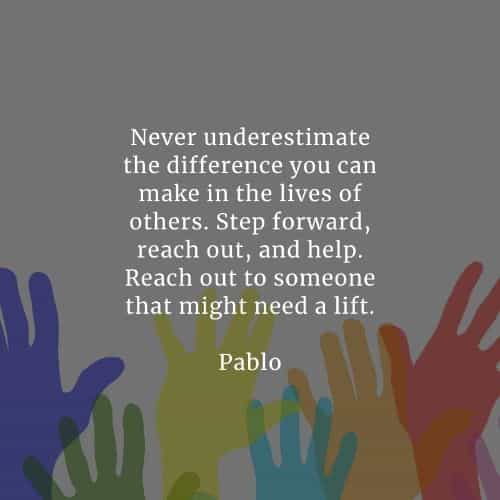
We need each other. We have to come together, to give of ourselves and to offer an outstretched hand. It isn’t easy work and sometimes we can get overwhelmed by all the need. But, in those moments, maybe we can retreat for a day or so and nurse ourselves a bit until we feel strong enough, and then get back out there.
Why should I care about you? Because we’re all in this together.
On 6th May 2021, as I was recovering from covid, I had decided to get back to writing and sharing with the world a little of what goes on in my head every day. Today I complete a year of sharing an article a day (sometimes even 2 articles a day!). The journey hasn’t been easy, but I absolutely loved putting this all together and more importantly for the lovely feedback I kept getting right through the year!
I shall still keep writing, not as frequently as I have been doing, but yes, will keep it going for sure! :)