Surviving the Dark

We’ve all had tough times of profound darkness. It could be when a relationship that you cared about ended or nothing going right with your job. It is a turbulent time with days filled with uncertainty, pain and loneliness. There have been 2 such dark phases in my life and today, I can honestly say that I’m grateful for having experienced this period of darkness.

I realized that my grueling and painful journey brought me to a place of clarity and happiness. In my darkest hour, I found myself and my purpose.

And most importantly, this place of confusion and darkness helped me understand and appreciate the light.

Hope is being able to see that there is light despite all of the darkness.

Desmond Tutu

How do we navigate these dark phases? Here are some ways that helped me.

1. Get to know yourself better and be open to internal work.
Until we confront a real life-crushing event, we tend to preoccupy ourselves with external circumstances and changes. Difficult life circumstances give us opportunities to explore our inner lives and do the internal work necessary for us to rise above our challenges. Now is the time for self-understanding and self-awareness.

2. Become aware of what doesn’t work.
When you hit a dark place, you receive a gift: you realize what doesn’t work. You have more insight into yourself than you did before.

What went wrong in your relationship? What was your part in its breakup? What kind of partner is wrong for you? How do you break the cycle of seeking the wrong person as your partner?

What did you hate about the career you left? Which parts of the job were toxic? Which skills did you master and which skills did you want to continue working on? What kind of work do you find fulfilling?

Understanding what doesn’t work is as insightful as knowing what does work. Knowing the dark is critical to appreciating the light

When you see the futility and hopelessness of a particular path or situation, your mind can create a new path and life.

3. One step at a time.
Every day of a personal crisis, breakup or serious life change will be a tough one. If you think about the enormity of the situation, you’ll feel paralyzed and want to stay in bed.

What is one small step you can take today?

How can you move your life in a positive direction in the smallest of ways?

4. Never give up on yourself.
You’re in a tough spot but you’ve been in similar places before. You’ve gotten through rough patches and you can do it again.

Sure, your current circumstance may be more challenging than those you faced in the past, but you’ve built up your adversity muscle to deal with changes and setbacks. And you’ve done it again and again. You’re a known and proven problem-solver, solution-finder and fighter.

You made it this far, even with the scars and bruises that past troubles inflicted on you. You yourself are the best proof that you’ve done it before and can do it again.

5. Appreciate the dark.
During your most difficult hour, it’s hard to sit back and exercise any amount of gratefulness. Your heart’s throbbing, your head’s crammed with worries and you don’t know yourself anymore. Why would you ever be grateful for this?

You can learn to appreciate the situation because you are discovering the tools you’ll need to navigate in the dark. If you can keep walking toward the light, you’ll develop qualities that will help you resist life’s challenges.

When you walk in the dark, you develop the qualities of persistence, patience, discovery and navigation. Sure, you won’t know where you are, but you’ll start getting a better sense of the darkness and will eventually navigate your way around.

Your greatest gift in the dark is your newfound abilities to embrace change, persist and keep going. These skills you’ll have with you for the rest of your life.

6. The dawn is near
Yes, the current situation is icky but it can’t stay this way for long. I’ve found that when a person is at rock bottom, things can’t get worse. They can only improve. If you’re having the worst week or month of your life, be prepared for a positive change.

Life is like the seasons, after all. You can’t remain stuck in winter forever. Your situation will change, just like the seasons change.

You’ll find a way to move on, discover the solution or get the break you’ve been waiting for.

Don’t bask in life’s lows and dark places when light is just around the corner.

Stay hopeful for a brighter tomorrow. Stay patient if things take a little longer than expected.

Control your Temper

There once was a little boy who had a very bad temper. His father decided to hand him a bag of nails and said that every time the boy lost his temper, he had to hammer a nail into the fence.

On the first day, the boy hammered 37 nails into that fence.

The boy gradually began to control his temper over the next few weeks, and the number of nails he was hammering into the fence slowly decreased.

He discovered it was easier to control his temper than to hammer those nails into the fence.

Finally, the day came when the boy didn’t lose his temper at all. He told his father the news and the father suggested that the boy should now pull out a nail every day he kept his temper under control.

The days passed and the young boy was finally able to tell his father that all the nails were gone. The father took his son by the hand and led him to the fence.

“You have done well, my son, but look at the holes in the fence. The fence will never be the same. When you say things in anger, they leave a scar just like this one. You can put a knife in a man and draw it out. It won’t matter how many times you say I’m sorry, the wound is still there.”

Moral of the story:

Control your anger, and don’t say things to people in the heat of the moment, that you may later regret. Some things in life, you are unable to take back.

There is no ‘I’ in Team

A frog asked two geese to take him south with them. At first they resisted; they didn’t see how it could be done. Finally, the frog suggested that the two geese hold a stick in their beaks and that he would hold on to it with his mouth.

So off the unlikely threesome went, flying south over the countryside. It was quite a sight. People looked up and expressed great admiration at this demonstration of creative teamwork.

Someone said, “It’s wonderful! Who was so clever to discover such a fine way to travel?” Whereupon the frog opened his mouth and said, “It was I,” as he plummeted to the earth.

Moral: There is no “I” in team.

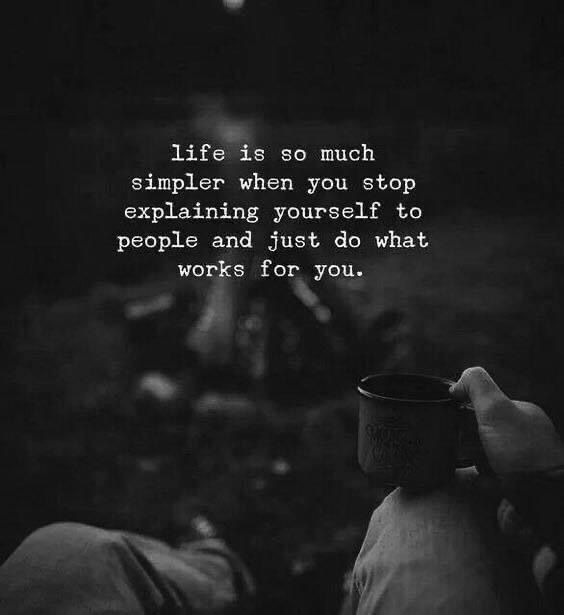
Do What Works For You

Have you ever been asked a question, found yourself gushing out an awkward explanation for an answer, and then felt pretty silly afterwards? Yeah, me too. It’s called over-explaining. We all do it sometimes, and we’ve got to stop.

This habit of over-explaining ourselves can be a major problem. I’m not talking about meaningful back and forth dialogue where you’re sharing ideas and learning from each other. 

No, I’m talking about those moments when you feel uncomfortable and put on the spot, and you start spewing a load of unprovoked justification.

What other people think of me is none of my business

Wayne Dyer

Unless you’ve committed a crime, or have a set of duties you are paid to do, there is no reason you need to be explaining yourself to anyone. And yet, many of us do this all the time. We do it almost unconsciously. We want others to like our ideas, validate our accomplishments, and assure us that we are on the right path. Sadly, many of us also base our self-worth on measurements as futile as how many friends like our posts on Facebook. And what does it lead to? Probably not a lot of happiness, and even worse, we probably like ourselves a little less too.

You are basing your self-worth on others’ evaluations. Trying to convince others that what you are doing is worthy is like trying to recruit a cheering squad. Your actions don’t need a pep rally. What they need is YOU. Your conviction that what you are doing has merit to you. You have to be your own cheering squad, advocate, coach, and even slave driver. And yes, when you think you are not good enough, or that you didn’t do a good job, you have to look within to find reasons as to why you should keep going, why what you do matters, and why you matter. Because you may never convince others that what you are doing or even who you are is good enough. But you don’t need to. You only need to convince yourself.

You are losing trust in yourself. When you explain to someone why you are doing something and you don’t get the reaction you are hoping for, you are going to start questioning it yourself. You are going to wonder if perhaps their objections and criticism have merit. And just like the air being let out of a balloon, you are going to feel deflated. Why? Because you forgot that undertaking anything worthwhile requires confidence in yourself. Ultimately you — and only you — have to believe it’s possible. What is doesn’t require is others’ confidence in you.

You are losing focus. Every time you spend energy trying to convince someone that what you are doing is a good idea, you are focusing one on thing only: convincing them. Who you are not convincing is yourself. Because instead of searching within yourself for the reasons for what you are doing, you are searching others’ faces for a hoped for reaction. What matters is why you are doing what you do. The real purpose behind your actions, and just what you are hoping to accomplish by doing the things you do. What doesn’t matter, is whether or not others think what you do is right or good. After all, you are the one doing the things you do, and you are the one living your life.

Sometimes it makes sense to explain yourself—when someone misunderstands, or when you hurt someone accidentally. But most often the only person who needs an explanation is you so you can ascertain, accept, and work through whatever is on your mind.

Today if you’re tempted to justify your emotions, remember: You can’t control what other people think. But if you can accept yourself in this moment, you may discover what you need to do to feel better–instead of just trying to look better.

Are you a potato, egg or coffee beans?

Once upon a time a daughter complained to her father that her life was miserable and that she didn’t know how she was going to make it.

She was tired of fighting and struggling all the time. It seemed just as one problem was solved, another one soon followed.

Her father, a chef, took her to the kitchen. He filled three pots with water and placed each on a high fire.

Once the three pots began to boil, he placed potatoes in one pot, eggs in the second pot and ground coffee beans in the third pot. He then let them sit and boil, without saying a word to his daughter.

The daughter, moaned and impatiently waited, wondering what he was doing. After twenty minutes he turned off the burners.

He took the potatoes out of the pot and placed them in a bowl. He pulled the eggs out and placed them in a bowl. He then ladled the coffee out and placed it in a cup.

Turning to her, he asked. “Daughter, what do you see?”

“Potatoes, eggs and coffee,” she hastily replied.

“Look closer” he said, “and touch the potatoes.” She did and noted that they were soft.

He then asked her to take an egg and break it. After pulling off the shell, she observed the hard-boiled egg.

Finally, he asked her to sip the coffee. Its rich aroma brought a smile to her face.

“Father, what does this mean?” she asked.

He then explained that the potatoes, the eggs and coffee beans had each faced the same adversity-the boiling water. However, each one reacted differently. The potato went in strong, hard and unrelenting, but in boiling water, it became soft and weak.

The egg was fragile, with the thin outer shell protecting its liquid interior until it was put in the boiling water. Then the inside of the egg became hard.

However, the ground coffee beans were unique. After they were exposed to the boiling water, they changed the water and created something new.

“Which one are you?” he asked his daughter.

“When adversity knocks on your door, how do you respond? Are you a potato, an egg, or a coffee bean?”

Are You Open-Minded or Close-Minded?

What if I told you someone took a hundred bucks from the cash register at the supermarket. How would you feel/think? Would you look down on them? Would you be mad that they just took the money while you go to work and earn your money? Would you feel sorry for them? Now what if I told you that person owns the store and was going to give the money to a family who was homeless? Would your opinion change about that person? Obviously yes!

When people are closed minded, they jump to conclusions. They only believe that there is only one answer or solutions. I used to be pretty close-minded when I was younger. I thought I was right when I wasn’t. Things changed as I grew older especially during my days at Xaviers college and with the Jesuits.

So the question we ask ourselves today is am I open-minded or close-minded?

According to the billionaire Ray Dalio’s book, Principles, a close minded person:

  • blocks others from speaking.
  • lacks a deep sense of humility.
  • doesn’t like their ideas challenged.
  • rarely asks questions, prefers statements.
  • has a focus on being understood rather than to understand.
  • holds closely to what he believes and isn’t willing to change.
  • has more interest in being proven right than hearing other perspectives.
  • has trouble having two conflicting thoughts in their head at the same time.
  • starts off by saying, “I could be wrong, but…” to convince himself and others he’s open-minded when he isn’t.

Whereas, an open -minded person:

  • genuinely believes he could be wrong.
  • is compelled to see through others’ eyes.
  • is more interested in listening than speaking.
  • approaches everything with the belief he may be wrong.
  • is curious and isn’t angry when there’s disagreement.
  • knows when to make statements and when to ask questions.
  • is capable of holding two conflicting thoughts in his head and assessing relative merits.

The key difference between open minded and close minded people is in their willingness to adopt new ideas and beliefs, ways of life, or practices. It can be as small as trying a new cuisine to as big as living in a new country.

One of Ray Dalio’s main principles is radical open mindedness and transparency. He explains that in order to achieve your goals, you need to set aside your ego and find the truth of how to get there. To do this, you have to get the perspective of different people with knowledge and ways of seeing the world that are different from you. That way, you can account for factors you didn’t even consider.

Being more open-minded is tough. When you’re in the moment, and swept up with emotion, you don’t want to even consider someone else’s perspective.

When the storms appear…
raining down on your parade
Be Open-minded

When hate fills the air
Snatching love’s sweet melody
Be Open-minded

When called a manqué
By life’s hurt and feckless souls
Be Open-minded

As you gain mastery
Untainted by flawed precepts
Stay Open-minded

How Giving Back Helps

Most philosophies and religions include a strong belief in giving back to the world. Not only does it have the obvious benefit of helping others, but it’s apparently one of the most therapeutic things we can do for ourselves. In the midst of striving to improve our own lives and earn as much as we can with our industry and talents, balance our work and family, and find time for our leisure and health, giving back may be an important but overlooked key to feeling better.

The best way to find yourself is to lose yourself in the service of others.

Mahatma Gandhi

Apart from making you happy, one of the biggest ways it helps me is by putting things in perspective. By interacting with others and hearing all that they are dealing with makes my problems and challenges seem so insignificant. We often get lost and down thinking the world is against us, but interacting with the less fortunate drastically changes our outlook on life and what matters.

We spend so much time trying to make more money and buy more things to feel more satisfied. Choosing to give back can actually have the effect of making you feel more satisfied. Rather than scrambling to get more, helping others through giving back can help you appreciate what you have. Seeing others struggling with less, and giving back, so they can have enough, can make you grateful for what you, and your family have.

At my workplace, we have this absolutely fantastic initiative “Bringing Smiles”. It provide hands-on STEM education to underserved communities. In 2015, Bringing Smiles began with just one school, and 50 students. Now, it has reached over 375 schools, and 50,000 students, with goals to impact over 100,000 young minds by 2022. Things are so much better every single time I am part of the various sessions that are held as part of this programme. I am filled with joy interacting with the kids who have such high aspirations and dreams, who work so hard to help their families see better days. Here is a short glimpse of Bringing Smiles

Being part of something larger might be one of the best things we can do, both for others and ourselves.

The Tortoise Mindset

I’m sure you’ve heard Aesop’s fable about the tortoise and the hare. These days, most people try to live like the hare. I don’t mean that they’re bragging and boasting and challenging random turtles to sprint races, but rather that they want things to go FAST. We are obsessed with instant gratification and immediate results. Everywhere we look there are promises of getting rich quick, lotteries that’ll make you an overnight millionaire, fad diets and training programs that’ll transform your appearance in weeks or days.

You can get fast food, one-hour glasses, thirty-minute photo processing, overnight mail, microwaved food, instant hot water, and emails and text messages delivered anywhere in the world on a seconds notice.

These things have made us expect instant results to the point that when we don’t get them, we get discouraged and immediately quit. But the truth is lasting change doesn’t happen overnight.

For the most part, the results we’re looking for will rarely come quickly. But they won’t take that long, either. In my experience, they tend to take just a little bit longer than we’re comfortable going for. Let’s look at a few examples

  • Exercising for one hour three times a week for a month will show very little, if any, results.
  • Reading one book in January won’t make much of an impact on your personal growth.
  • Meditating 10 minutes a day for a couple of weeks won’t show much of an affect on your mind.

But what if you decided right now to drop the quick-fix mentality of the Hare and instead adopt the mindset of the Tortoise?

What if, instead of obsessing over (and very likely getting discouraged by) the short-term results, you focused on just taking the next tiny step in the right direction?

Failure is a few errors in judgment, repeated every day
Success is nothing more than a few simple disciplines, practiced every day.

Jim Rohn

If you took these principles to heart you could have the following results within a year:

  • By exercising for one hour three times a week, you would have 150+ hours of exercise under your belt. More than enough to have a huge impact on your health and appearance.
  • By reading one book a month, you would have read 12 books. This means tons of new insights, ideas, and concepts to enrich your life.
  • By meditating 10 minutes a day, you would have 60+ hours of meditation experience. This translates (among many other benefits) into improved focus, creativity, compassion, memory, less stress and anxiety.

It’s not your speed, but your consistency that makes all the difference

It does not matter how slowly you go as long as you do not stop.

Confucius

When you’re consistent, that creates momentum. That momentum creates progress. The progress creates self-confidence. The self-confidence starts shaping a new, more resourceful and empowering identity. And with this new identity comes the ability to create lasting change in your life.


In case you haven’t heard of the fable, it goes something like this

There once was a speedy hare who bragged about how fast he could run. Tired of hearing him boast, Slow and Steady, the tortoise, challenged him to a race. All the animals in the forest gathered to watch.

Hare ran down the road for a while and then and paused to rest. He looked back at Slow and Steady and cried out, “How do you expect to win this race when you are walking along at your slow, slow pace?”

Hare stretched himself out alongside the road and fell asleep, thinking, “There is plenty of time to relax.”

Slow and Steady walked and walked. He never, ever stopped until he came to the finish line.

The animals who were watching cheered so loudly for Tortoise, they woke up Hare.

Hare stretched and yawned and began to run again, but it was too late. Tortoise was over the line.

After that, Hare always reminded himself, “Don’t brag about your lightning pace, for Slow and Steady won the race!”

The Benefits of Laughing at Yourself

We all know that humor is a good thing. There is nothing better than a clever joke, a witty one liner, some slapstick comedy, or a moment in time sealed with a giggle, chuckle, or side-splitting-laughter. It is easy to laugh at others, which is why romantic comedies, stand-up comedians, and improv shows are where people run when times get hard. What can be hard in life is seeing your own comedic moments and laughing through embarrassment or self-consciousness.

The human race has only one really effective weapon and that is laughter.

Mark Twain

Laughter is one of life’s greatest gifts. It makes our complex and often confusing existence decidedly more tolerable. There’s nothing more satisfying than laughing until your stomach hurts, and there’s an inexplicable power in sharing laughter with others — even complete strangers.

Being able to laugh at yourself is a sign of resiliency and mental toughness. It’s one thing to find humor in particular situations, it’s another to be reflective and self-aware enough to laugh at oneself.

We all make mistakes in life, doing and saying things we wish we could take back. Many of us likely have certain personality traits we’d like to overcome.

But nobody is perfect. There’s no point in beating yourself up for being human. A big part of what makes life so beautiful and interesting is the fact we are all deeply flawed in our own ways.

Laughter and tears are both responses to frustration and exhaustion. I myself prefer to laugh, since there is less cleaning up to do afterward.

Kurt Vonnegut

We shouldn’t take life or ourselves too seriously. We should laugh at the absurdity of it all and revel in both our positive and negative characteristics — they’re what make us unique.

Life is a series of ups and downs. We can’t allow negativity to take over; we have to fight against it, and laughter is one of our most powerful tools in this endeavor.

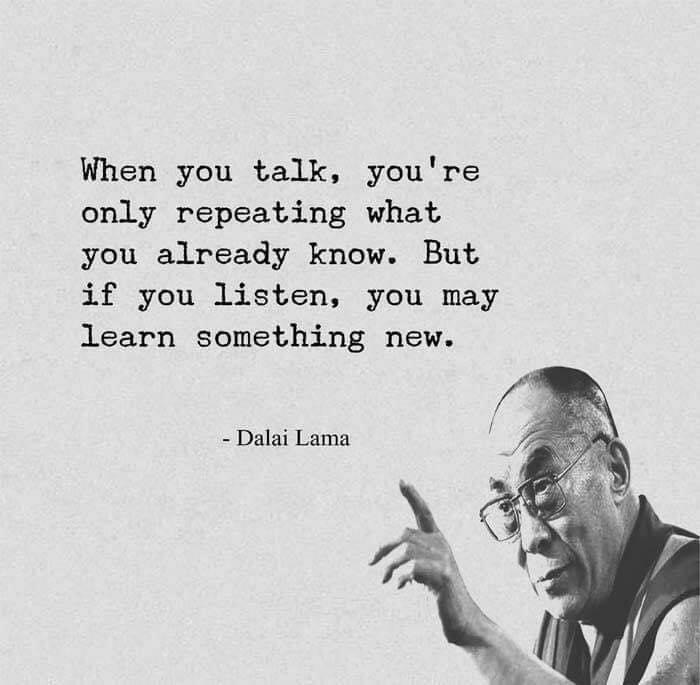
Listen to Learn

Ever been in a conversation where you felt like the person you were talking to wasn’t listening to a word you said because they were too busy trying to convince you of their opinion? We’ve all been in such situations. It’s a common phenomenon. So much so that there’s likely been times that you’ve left others feeling that way. I’m sure I have.

The reality is that we’re wired to think our view of the world (along with the problems and people in it) is the right one. If only everyone would see (think and act) as you do all would be well, right?! But consider this:

While your perspective may seem completely logical to you, other people think the same about theirs!

There is a lot of information online of successful people being great listeners. People who asked lots of questions and don’t assume they have all the answers. People like Richard Branson who carries a notebook with him everywhere he goes and Bill Marriott who shares why lousy listeners make even lousier leaders.

Here are 4 tips that have helped me:

  1. Maintain eye contact
  2. Let others complete their sentences/views, don’t interrupt!
  3. Offer minimal encouraging prompts
  4. Ask probing questions

Courage is what it takes to stand up and speak. Courage is also what it takes to sit down and listen

Winston Churchill

Given all the turmoil going on in our world right now, there’s never been a better time to start being more deliberate in trying to understand those who see the world differently to you.

Your ears will never get you into trouble and, who knows, you may just learn something that changes everything.