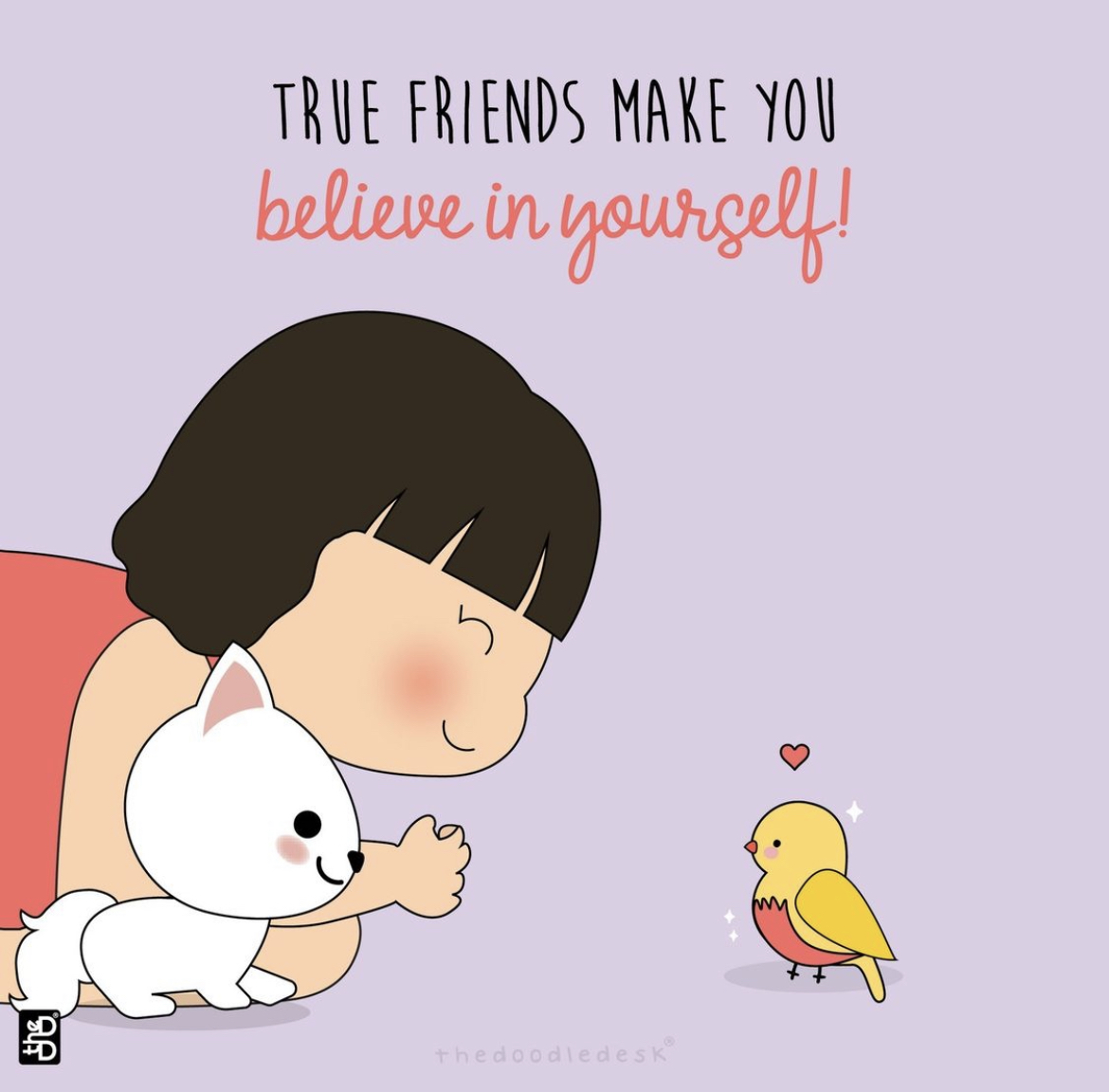
Find Friends who Believe in You When…

It’s important to make friendships that have depth and meaning.

Friendships that contain more than going out on a Friday night to drink yourself stupid, friendships that have more complexity than going out to lunch and gossiping about other people’s lives, friendships that are more than shallow conversations you could have with just about anyone.

You need more than that.

You need friends that you can go to breakfast with when you’ve had a really rough night and feel like the world is crumbling beneath your feet. You need friends you can cry with when it’s 2 AM and you’re crying your eyes out because the you got dumped.

You need friends that bring out the best in you, who truly want the best for you and not for the sole reason they hope to get something out of your success.

You need friends who will be there for you when you’re on the bottom of the floor shaking your fists because nothing is going the way you planned and the same friends to be there when you’ve finally overcome every obstacle in your way. You need friends who are not only going to send you words of encouragement to overcome the barriers, but actually help you push them out of the way if you’re struggling on your own. You need friends who believe in you when you don’t even believe in yourself.

You need friends who will push you out of your comfort zone, encourage you to do more because they know what you’re capable of – even if you hate them for it at the time.

You need friends who will make you angry from time to time because they won’t stand by your side and watch you fail or watch you quit, they’ll keep pushing you because they know you can do better. You need friends who won’t give up on you when you give up on yourself.

You need friends who inspire you to try new things, to learn new skills and to test yourself. You need friends who are willing to push you when you need a little push. You need friends who will say enough is enough when you’re sulking over your ex on the couch. You need friends who will rip the phone from your hand and drag you out the door to enjoy life.

You need friends who become your family, through everything you’ve been through. Friends you love like sisters, friends you miss when you’re apart for too long, friends you’d hop on a plane and fly across the country just to spend a day with.

You need friends who bring out the best in you, even when you can’t stand them every now and then because you’ll always love them more than you can ever hate them.

Cherish and treasure these friendships; they’re the ones that are going to be by your side forever. 


Some friends will touch your life along the way 
but only a true friend will touch your heart 
no matter if they’re by your side or far apart 

True friendship can’t be measured by distance or time 
but rather by the laughs, tears and secrets you share 
a friendship that no other friend can compare 

John Gabriel

Living in the Present

Most of us have a tendency to live in the past or the future. How often do you find yourself thinking about what happened yesterday, or what might happen tomorrow? How does this affect your life and well-being?

The easiest way to explain living in the present is to start by explaining what it means to not be present, since this is the state we have become habitually used to.

When you aren’t being present you become a victim of time. Your mind is pulled into the past or the future, or both.

Your thoughts are of the past: what has been, what could have been, what you thought happened vs. what actually did happen. Or, your thoughts are of the future: what will be, what could be, what might be, if…

Of course, it’s natural to spend moments of thought in the past or in daydreams of the future. Identifying impending dangers through associations with things that have happened in the past is important for self-preservation.

But when our lives become dictated by thoughts and emotions attached to past events and potential future outcomes, standing peacefully rooted in the present becomes increasingly rare.

The idea of “living in the moment” has inspired a lot of motivational posters and T-shirts, but it’s really an important concept. You’ve probably heard several variations: Live like there’s no tomorrow. Live as if you’ll die today. Living in the moment takes practice, but when you learn how to live this way, you will lead a fuller life and appreciate the beauty in every activity every second of the day. Learn how to live in the moment with these six ideas.

1. FOCUS ON THE NOW

In order to live in the moment, you need to focus on the now. Focus on what you’re doing. Shut off the TV, turn off the computer, slow down, and savor the present.

2. PAY ATTENTION TO THE SMALL THINGS

Notice the world around you: the small things. Be thankful for them. Living for the moment and taking notice of the small things will help you cultivate more positive experiences.

3. SMILE

If you want to know how to live in the moment, you just have to take a look in the mirror and smile. Smile — it can influence how you feel.

4. PERFORM RANDOM ACTS OF KINDNESS

Random acts of kindness, those selfless acts that help others, help you live for the moment of making others smile, and making you smile as well. Random acts of kindness are just that — random. They are spontaneous, in the moment, and a great addition to your daily life.

5. GIVE THANKS

Be thankful. Sounds easy, doesn’t it? But it isn’t always. It doesn’t have to be Thanksgiving for you to feel grateful and express that gratitude.

6. DON’T WORRY

It’s much harder than it sounds, but try to remember that worrying today won’t change what happens tomorrow. Every second you spend in worry about the future is a second of the present wasted. Because worrying takes you out of this moment and transports you into the realm of future possibilities, it’s impossible to live in the moment and worry at the same time.

Instead, if circumstances are troubling, focus on ways you can solve an existing problem now or otherwise improve the current moment. Spending time focused on what may happen down the line robs you of fully experiencing what is happening now. Life in the moment moves quickly — don’t miss it.

Living a Purposeful Life

Repetition. Boredom. Déjà vu? We’ve all been there. Wake up, go to work or work from home, have lunch, dinner, watch television… go to bed.

Repeat.

Sure, you are functioning… but do you have purpose in your life? Are you incorporating things into your days that bring you excitement and joy?

The truth is, without purpose things feel meaningless. 

Life isn’t just about staying alive. It’s about living for something bigger. To connect with your desires, excitement and things that actually matter. To touch, smell, and feel the awakening of every cell in your body. Moving towards a purposeful life might sound complicated. But it doesn’t have to be.

One of the most common misconceptions of having a purposeful life is that the purpose of life is based on the amount of wealth, status, and/or power an individual has achieved. Yet, even though these “goals” have been achieved, there is still an empty feeling… like something is missing in their life.

A purposeful life should not be based on what society has dictated, and although everyone is different, living a purposeful life should be based on what their soul is actually searching for to fill the void.

One of the most wonderful gifts of being human is that you have the ability and option to choose to live your life the way you want. There isn’t a set rule that forces humans or a guidebook that teaches humans how to live a purposeful life… it’s more of an individual rule on how to be happy with yourself and your life.

In other words, nothing else really matters if you aren’t following your soul’s purpose and aren’t doing what makes you feel complete or loved by yourself.

Moving towards a more purposeful life and reaching inside of yourself may sound like a complicated process… but that is hardly the truth. Here are a few tips that have helped me

When seeking the answers on how to live a more purposeful life, the first and most important step is to have a clear understanding of not only what you want your life to look like… but how you really want to live it.

Your personal fulfillment, joy, and meaning are your responsibility. Finding purpose is like anything else that is “new” in life… people tend to get excited and attempt to jump in with both feet.

But finding purpose is more about taking baby steps. The slower you go, the more time you will have to truly reflect on what you want and what you can do to feel a sense of purpose. Take each step with the knowledge that you trust yourself to live your life to its fullest.

Finding gratitude is an essential factor for how to have a more purposeful life… but finding gratitude in things around can sometimes be difficult. That is why it’s so important that you take baby steps on your journey to living life with purpose.

It’s your Attitude that Matters

A study attributed to Harvard University found that when a person gets a job, 85% of the time it’s because of their attitude, only 15% is because of how smart they are or how many facts and figures they know.

What matters most comes from having well-developed soft skills and only a few percentages come from hard technical skills. But almost all we learn in schools and colleges is “facts and figures”, rather than “attitude”.

They taught us to “remember” rather than to “learn”. They taught us to focus on what machines and instruments we can create, rather than what can we do better as human beings. This system somehow pulled us to the “superficial”, we are more focused on our goals; we forget that it’s actually our attitude that will affect our goals.

I absolutely love this story and it is the first thing that comes to mind when I hear this quote.

Once, there was a man who made a living by selling balloons at a fair. He had all the colors, there were red, yellow, blue, green, white, and purple.

Whenever he thinks that his business was slow, he would release a helium-filled balloon into the air. And when the children saw it go up, their eyes sparkled with excitement. The children would then come up to him and buy a balloon. This made his sales would go up again.

He continued this process every day.

One day, he felt someone tugging at his jacket. He turned around and saw a little boy. Innocently, the boy asked, “If you release a black balloon, would that also fly?”

Moved by the boy’s concern, the man replied with empathy, “Son, it’s not the color of the balloon, it’s what inside that makes it go up.”

This story told a lesson that we all seem to undervalue: it’s what inside that counts. The thing inside us that makes us “go up” is our attitude. 

Look inside you, and be the best version of you

To look inside means listening to your internal dialogue. It means to be honest with yourself, to discover and acknowledge the gap between what you say, what you want, and what you actually get.

It may be uneasy, and uncomfortable to look inside. It’s real, raw, and unprepared. But it’s your innermost heart.

Seeing deep inside you will reframe how you feel and think, and it will shape you to be the person you really want to be.

Your attitude belongs to you, and only you.

By changing the way you see and appreciate things in a positive way, you create your own happiness. And from that, you can improve on all dimensions of what you might be capable of, and be the best version of you.

When Things Don’t Go As Planned…

It is one of the hard things in life: accepting that life sometimes doesn’t go as planned. We manage to come up with the most beautiful things in our mind. We go along with timeless new encounters which seem to be developing into lifelong friendships, or hope that this new encounter might lead to the eternal fairytale marriage.

From a young age we dream of a carefree and stable future, of a road which we map according to a specific plan. But when the most beautiful things and plans suddenly come to an end, when the beauty disappears in seconds and life takes you in a different direction than planned, there is simply nothing you can do but accept the disappointment.

I believe a valid reason hides behind everything that happens. Every disappointment is a snapshot which prevents you from making a wrong choice, or even a worse choice. And it is something which will occasionally challenge you to become a better version of yourself. Sometimes the time simply hasn’t come for certain things to happen, how amazing they might be. This can only be agreed upon when you give the event some time, by giving yourself some time to deal with a disappointment. Later on you will see that life always goes the way it should.

At some point in our lives we all experienced that we weren’t selected for a job or an internship, but subsequently were rewarded with something better. Or perhaps we got rejected in love, but after an endless amount of waiting, suddenly our dream partner was standing right in front of our noses.

For every event the same holds true: you just have to see the good in it. And, above all: have faith. Turn your fears into power, action and patience. In time everything will be all right, because life is filled with unprecedented surprises. Even for you.

Learning when to let something go can be a challenge for those of us who feel pressured to “get it right the first time,” no matter what the setting. Here are some things that help me to let go and move on:

  1. Learn to concede a loss, Accept it
  2. Turn Anger/Resentment/Jealousy Into a Motivating Force
  3. Forgive Yourself If It’s Too Late for You to Be Forgiven
  4. Let Past Mistakes Be Bridges to Better Choices Now
  5. Turn the Chance That Slipped Through Your Fingers Into a Grasp on the Future

Some people have no trouble letting go of things that keep others up at night or obsessing about what “could have been.” Truly, there is no one alive who will not make some mistake or let something slip through their fingers that they will wish they had held onto. Life is full of opportunities and regrets. However, when regret becomes an obsession and you lose sight of what is in your present due to what you did in your past, this becomes the biggest obstacle to a fulfilling future.

Give yourself a pass, forgive yourself and others for being human, and learn from the lessons of earlier experiences. You will become much more likely to create a present that leaves less opportunity for future rounds of the “what ifs” and “why didn’t I’s” that keep us from being satisfied in the moment.

Powerful Traits of People who Inspire Others

In a culture obsessed with measuring talent and ability, we often overlook the important role of inspiration. Inspiration awakens us to new possibilities by allowing us to transcend our ordinary experiences and limitations. Inspiration propels a person from apathy to possibility, and transforms the way we perceive our own capabilities. Inspiration may sometimes be overlooked because of its elusive nature. As recent research shows, inspiration can be activated, captured, and manipulated, and it has a major effect on important life outcomes.

People who inspire us demonstrate six critical traits and behaviors that enliven us, light a spark inside of us, and make us want to be better, stronger, bigger, and more of who we are.

They Have Immense Courage
People who inspire us to be better are not weak, scared or stuck.  They’re bold and have the fortitude and courage to push through their fears, and take a stand on what they believe. These inspirers have faced great odds and challenges, and they’ve turned “their mess into a message” to help others overcome their challenges too. They’re warriors, and courageous fighters for what they believe in and how they see themselves and the world. They’ve figured out that if you want to make a difference in the world, you have to address your own demons first.

They Have Deep Empathy For Others
A lot of people have suffered at the hands of narcissists, or from mentally disordered or morally-corrupt individuals — either in their families, upbringing, or in their professional lives. In my view, the most crushing aspect of narcissistic behavior is the total lack of empathy. It’s very scary (and damaging) to be in relationship with someone who is totally incapable of empathy, because they’ll do anything to you and against you without remorse. They simply cannot put themselves in your shoes or understand or accept what you feel.

On the flip side, those who inspire us to be better are fully capable of experiencing empathy, and they openly express their ability to understand our personal “stories” and who we really are and what we feel, deep down.  They don’t coddle or overprotect us, but they validate and appreciate who we are inside, which makes us feel safe to be more authentic, and expand on our own identity even more fully, without worrying that we’ll be crushed or humiliated in the process.

They Express Love And Appreciation Openly, And Foster Equality
The people who inspire us the most are not full of hate, bigotry, or racism and they don’t harbor or encourage thoughts of who is “better” than someone else, or who deserves more.  They model equality. They are full of love and appreciation, and aren’t afraid to share it openly at work, at home and in their communities.  They use loving, accepting language, and are inclusive not divisive, and share their thoughts and beliefs around love, acceptance and equality in their narratives. Love and acceptance is at the basis of what they do. Look at those who’ve made the biggest positive difference throughout history. Invariably, there is love, understanding, compassion, and appreciation at that heart of who they are and what they stand for.

Many who have made a real positive difference have been compelled to fight hard for radical change and for a cause bigger than themselves. But even in their fighting, they never stop openly sharing love, compassion, and care for humanity.

They Are Emotionally Healthy And Healed
There’s a powerful expression, “Hurt people hurt people.” Truer words have never been spoken. If you’re hurt, wounded, distraught, overly-reactive, or emotionally dysfunctional in any way, you’re just not in a position to make the positive impact you long to, or to inspire people at the highest level. Why? Because your open wounds get in the way — of how you see yourself and others, and how you relate, experience and interact with the world. The wounds you experience color everything.

People who inspire and uplift others have done the work to heal their wounds. They’re not necessarily pain-free. As we all know, life regularly doles out painful experiences, but they’re not inflicting or projecting their pain onto others. Every human on this planet has experienced deep trauma and pain at some point in their lives. But those who inspire and positively influence have done the work to clean up their wounds , recover, heal, move forward in healthier ways, and stop hurting others with their own hurt.

They Believe In Collective Power
Those who inspire others believe in collective power – in uplifting others so that positive change can happen more quickly. They’re not focused intensively and solely on amassing their own wealth, power and influence. They want to see others rise, grow, and expand. That’s what fuels them and motivates their actions, and their business and growth strategies. In doing so, they can become very wealthy, powerful and influential, but that’s only a by-product of their focusing on expanding collective strength, power and positive impact.

They’ve Used All Of Themselves To Make A Difference
These individuals have used all of themselves, including their past pain, their “quirks” and idiosyncracies, their raw experiences, their unique voices, their isolation and shame, and their past and current struggles to uplift the world.

Look at the most popular TED talks that have gone viral and touched millions of people and you’ll see people who struggled in their past, but decided to use what they personally experienced to learn more, dig deeper, and finally, to help facilitate positive change for others.

These inspirers have grown comfortable being totally authentic and open about who they really are deep down. They no longer worry that they’ll be rejected, scorned and put down. They’ve grown beyond feeling they have to hide or suppress parts of themselves to be accepted. They realize that it’s the universal plight to want to hide those parts of us that make us feel ashamed and vulnerable. And it’s that very readiness to use all of themselves – openly and courageously – that inspires and encourages us to do the same.

Which of these six traits inspires you most to be more of yourself?

Make a Positive Shift in your Life

Change in your life can be both scary and exciting, but more than anything it’s necessary to grow. Most people come to a point where they have to make a change in their life to either grow personally or professionally, but it’s hard to figure out when you’re ready to make that change.

So how do you know when it’s time that you’re ready to change your life?

The truth is there is at least one sign in front of you that you have been ignoring or not even noticing. Here are some of the signs:

  1. Your motivation is gone
  2. You’re unhappy most of the time
  3. The people around you are changing
  4. You’re often bored
  5. You’re often stressed
  6. You’re often scared

If you want to make a change in your life, you can to do so positively by following these seven tips.

1. Identify and understand what you want to change.

Whenever you decide to make a change, you must first understand why you’re making the change in the first place.

You need to be able to identify what it is about your goal that adds to you as a person, that makes you feel better and more expansive

Anthony Grant, Professor @ University of Sydney’s Coaching Psychology Unit

If your goal aligns with your core values, then “the thought of it will trigger a positive gut feeling.”

2. Rid your life of negativity.

This is not as simple as it may sound. If you’re surrounded by negativity, then how can you expect to have a positive and joyful life? In fact, those who are negative or surrounded by negativity are more stressed, get sick more often, and have less opportunities than those who are positive.

When we make a decision to become positive, and follow that decision up with action, we will begin to encounter situations and people that are also positive.

Chris Talambas

3. Exercise more often.

You may be getting tired of hearing everyone telling you that you need more exercise. Sure. Exercising is great for you physically. But, it’s also an excellent way to become more positive in life. Exercise can change the direction of most situations in your life. As Nike says, “Just Do It.” The benefits of exercise are immeasurable. You gain purpose, drive, but most of all it teaches you a discipline.

For starters, when you exercise, you feel better about yourself, which leads to having more confidence. Exercise also reduces anxiety and stress and releases euphoric chemicals in the brain like endorphins and dopamine.

4. Be kind to others.

There numerous ways that you can be kind to others that don’t take that much time and effort. For example, you could purchase coffee for a co-worker. Pay the toll for the person in line behind you. Visit a family member or friend. Smile at cashiers or servers. Or, you could volunteer whenever you have free time.

People who engage in kind acts become happier over time. When you’re kind to others, you feel good as a person–more moral, optimistic, and positive.

Sonja Lyubomirsky, professor @ the University of California

5. Build a support network.

A strong social support network can be critical to help you through the stress of tough times, whether you’ve had a bad day at work or a year filled with loss or chronic illness. This group of friends, family, and peers is also important because they provide additional benefits like providing a sense of belonging, an increase in self-worth, and a feeling of security whenever you need advice, information, or guidance.

6. Eliminate the nonessentials.

After identifying the things that are most important in your life, it’s time to start eliminating everything else. This is all about simplifying your life, so that you can focus on the things that matter most to you and prevents you from getting distracted.

We have so much stuff in our lives, from possessions to things we need to do to information coming in to visual and emotional clutter, that we are overloaded. The result? We end up doing a lot of things that aren’t really important to us, because we have so much other stuff to do that has crept into our lives and that we leave in our lives, unexamined.

Leo Babauta, Zen Habits

7. Take baby steps.

When we look at the big picture we can get overwhelmed with all of the steps involved in achieving a goal. Instead, break the “big picture goal down into systematic, manageable baby steps.” Then, document and celebrate your wins daily.

This will help you achieve that change that you’ve been seeking in a positive way and meaningful way.

The one primary motivator that leads us to persevere is baby steps

John Brubaker on Entrepreneur

Be the Best Version of Yourself

Do you expect nothing but the best from yourself?  Well, you are not alone.  Everyone wants to become the best version of themselves, but few actually do it. We’re our own worst enemies when it comes to achieving success, chasing our dreams, and living a life that’s filled with passion and purpose. Some of us are self-destructive without realizing it, and others are conscious of the fact, but lack the tools and/or knowledge in order to improve.

The definition of “best self” is subjective. Your version of your best self may not be the same as your family or close friends. Considering this, do not give in to the temptation of comparing yourself with others. Instead, remember your personal definition of your best self.

Additionally, your “best self” does not need to be the same thing forever. Over time, your definition of your best self will change in all areas of your life so do not be afraid to be flexible.

Generally, your best self means taking control of your life. When you call the shots, you become more empowered to make decisions towards your happiness.

More than that, remember that your best self does not always mean winning. All areas of your life can’t turn out the way you want to. That’s simply not how life works. Instead, it’s about acknowledging that being your best self means showing up to face each challenge.

Even if you ask your most successful close friends, they will tell you that unlocking your best self is not an overnight process. Sometimes, it can take a lifetime. Just brace yourself for the ride, and enjoy the journey.

As someone who’s highly committed to personal excellence and growth, my motto in life is to ‘be my best self and live my best life.’  I strive to uphold this motto every single day.  In doing so, I have adopted these simple principles which help me stay on track:

  1. Follow your heart
  2. Prioritize and focus
  3. Look on the positive side
  4. Place yourself in the face of uncertainty
  5. Think and reflect
  6. Detach yourself
  7. Concentrate on actionable steps
  8. Keep the momentum alive
  9. Learn from the best
  10. Help others

It’s a long journey to the top of the mountain, but it’s completely obtainable and totally worth the effort.  Start climbing today, and you’ll be well on your way before you even start feeling the pain.

Move Forward

We all make mistakes. Some of them are big while some are small. We can correct them and learn from them. One thing is for sure, when we have done what we can, we must move forward.

The problem with obstacles and challenges are being stuck in them. We sometimes would remain in that space. Often, we have to really pull ourselves out of a situation just so we can move forward. There are also times when we beat ourselves up because of our mistakes. But no matter what the situation is, we must always see that there is a future waiting for us; one that we can change through our choices. For these times, we must remember the quote above, “Don’t look back, you aren’t going that way.”

Some people forget to look at the bright side or the other opportunities waiting for them. They tend to just see their past and how much it has hurt them. But the best way to reach your goal is to leave the past behind and just move forward.

Cars and other vehicles move forward to reach their destination, so why should you go the opposite way? The only way you will be successful is if you stop looking back and start moving forward. Don’t stress yourself out with the past when there is a whole new future waiting to be unlocked. Go for your dreams by embracing the present and looking forward to the future.

Here is an amazing poem that keeps me moving forward!

As you travel through life there are always those times
When decisions just have to be made,
When the choices are hard, and solutions seem scarce,
And the rain seems to soak your parade.

There are some situations where all you can do
Is simply let go and move on,
Gather your courage and choose a direction
That carries you toward a new dawn.

So pack up your troubles and take a step forward
The process of change can be tough,
But think about all the excitement ahead
There might be adventures you never imagined
Just waiting around the next bend,
And wishes and dreams just about to come true
In ways you can’t yet comprehend!

Perhaps you’ll find friendships that spring from new things
As you challenge your status quo,
And learn there are so many options in life,
Perhaps you’ll go places you never expected
And see things that you’ve never seen,
Or travel to fabulous, faraway worlds
And wonderful spots in between!

Perhaps you’ll find warmth and affection and caring
And somebody special who’s there
To help you stay cantered and listen with interest
To stories and feelings you share.

Perhaps you’ll find comfort in knowing your friends
Are supportive of all that you do,
And believe that whatever decisions you make,
They’ll be the right choices for you.
So keep putting one foot in front of the other,
And taking your life day by day…
There’s a brighter tomorrow that’s just down the road –Don’t look back!
You’re not going that way!

From Pride to Humility

We’ve all heard the phrase, “Pride comes before a fall.” I’ve always taken that as a warning not to become too prideful lest you succumb to a similar temptation. Or perhaps get so puffed up only to be proven publically not to be the person you say you are.  However, the older I get the more I think it means that pride comes before a fall in the sense that humility comes with maturity and life experience.

Shedding of ego is thus only a theoretical concept. The closest which one can come is to observe, understand and thus regulate, for minimising undesirable manifestations, including pride. Benjamin Franklin writes jokingly about this pride, “….disguise it, stifle it, it is still alive and shows itself… even if I completely overcome it, I should, probably be proud of my humility”.  

Pride is a big problem for any leader. Here’s why:

Pride Leads to Blaming Others
Prideful people always look for someone to blame instead of taking responsibility. If things aren’t working out for them, they automatically assume it is someone else’s fault.

Pride Leads to Closed Mindedness
Prideful people are generally defensive and opposed to new ideas. They are more concerned about improving their position than improving the organization.

Pride Leads to Broken Relationships
Prideful people tend to deflate others because of their insecurity. They take too much credit for victories and give too much blame for losses. In result, they drive away their best people.

However, of all the problems pride causes, the greatest is it prohibits us from learning.

When we are prideful, we lose perspective on everything around us. We begin justifying our behavior and ignoring mistakes. Pride deceives us into thinking that our greatest problem is failure, when the truth is our greatest problem is failing to learn.

How are you doing in this area? Where do you stand on the humility/pride spectrum? 

I have listed some questions that I want you to ask yourself and answer honestly. Just a simple yes or no will help you figure out where you stand:

  1. Do you tend to believe you know it all?
  2. Do you tend to believe the rules don’t apply to you?
  3. Do you think you should be in charge in most situations?
  4. Do you tend to believe you can get everything done without anyone else’s help?
  5. Do you think you are as important/more important than the organization?

If you answer yes to most or all of these questions, you may have a pride problem. But don’t give up! As John Maxwell says, “It’s the finish, not the start, that counts the most in life.” Change is possible for you.

Mistakes can become the best teachers if you are willing to admit them and learn from them. 

Humanity is filled with mistakes. Humility allows us to learn from them.


Here is my favorite story on pride.

Gorelal was a famous sculptor. His sculptures looked real ones. One day he saw a dream that after fifteen days, the demon of Death would come to take him. Gorelal prepared nine statues of himself and when on the 15th day he heard the Demon of Death coming, he took his place between the statues. The Demon could not recognise him and was astonished to see ten Gorelals instead of one. He rushed back to the God of death and told the matter. The God of death got annoyed and set out to take Gorelal himself. Gorelal was alert and stood motionless. The God of Death initially got perplexed. But he thought for a moment. He said, “Gorelal, these sculptures would have been perfect but for one mistake.” Gorelal was unable to suffer the least blemish in his work. He came out and asked, “Where is the fault?” God of Death caught him and said, “HERE”. The statues were faultless but Gorelal was caught because of his pride.