What is Web3 – The Decentralized Internet of the Future?

Web3 is a somewhat ambiguous term, which makes it difficult to rigorously evaluate what the ambitions for web3 should be, but the general thesis seems to be that web1 was decentralized, web2 centralized everything into platforms, and that web3 will decentralize everything again. web3 should give us the richness of web2, but decentralized.

The web has evolved a lot over the years, and the applications of it today are almost unrecognizable from its most early days. The evolution of the web is often partitioned into three separate stages: Web 1.0, Web 2.0, and Web 3.0.

What is Web 1.0?

Web 1.0 was the first iteration of the web. Most participants were consumers of content, and the creators were typically developers who build websites that contained information served up mainly in text or image format. Web 1.0 lasted approximately from 1991 to 2004.

Web 1.0 consisted of sites serving static content instead of dynamic HTML. Data and content were served from a static file system rather than a database, and sites didn’t have much interactivity at all.

You can think of Web 1.0 as the read-only web.

What is Web 2.0?

Most of us have primarily experienced the web in its current form, commonly referred to as web2. You can think of web2 as the interactive and social web.

In the web2 world, you don’t have to be a developer to participate in the creation process. Many apps are built in a way that easily allows anyone to be a creator.

If you want to craft a thought and share it with the world, you can. If you want to upload a video and allow millions of people to see it, interact with it, and comment on it, you can do that too.

Web2 is simple, really, and because of its simplicity more and more people around the world are becoming creators.

The web in its current form is really great in many ways, but there are some areas where we can do a lot better.

What is Web 3.0?

There are a few fundamental differences between web2 and web3, but decentralization is at its core.

Web3 enhances the internet as we know it today with a few other added characteristics. web3 is:

  • Verifiable
  • Trustless
  • Self-governing
  • Permissionless
  • Distributed and robust
  • Stateful
  • Native built-in payments

In web3, developers don’t usually build and deploy applications that run on a single server or that store their data in a single database (usually hosted on and managed by a single cloud provider).

Here is a nice infographic I came across on the difference between Web 2.0 and Web 3.0


There are six major significant features of the new Web, Web 3.0. We think these will help you to grasp the whole concept better.

credits to 101blockchains.com

In sum, Web 3.0 will bring us a fairer internet by enabling the individual to be a sovereign. True sovereignty implies owning and being able to control who profits from one’s time and information. Web 3.0’s decentralized blockchain protocol will enable individuals to connect to an internet where they can own and be properly compensated for their time and data, eclipsing an exploitative and unjust web, where giant, centralized repositories are the only ones that own and profit from it.

In the world of blockchains, it’s only normal that we would get a newer version of the web system. The process is still on its way and has a lot of improvements we can still hope for a much better digital experience.

Let’s see what the future awaits for us.

In a World Full of Critics, Be an Encourager

It is but natural to get completely frustrated, frazzled and fraught by the numerous opinions and suggestions on all you do from everyone around you. So many of us give up when we hear negative feedback as we work hard towards our goal. Choosing a contagious group of friends and a solid support system is the key to help you accomplish your dreams, and to do things that might be scary at the moment but that will ultimately help you in the long run.

While choosing great encouragers to spend most of your time with is important, you also can become an encourager for others. There are three aspects of being an encourager.

First and foremost, you have to be able to listen, and with that, be a good listener. That means removing yourself from all distractions, whether it be your phone or Instagram or TikTok, thinking about what else you have to accomplish during the day/week, etc.; you must be fully present. Listening and thinking of how you will eventually respond to the person speaking is crucial, because that person is confiding in you and they deserve a well thought response. However, it is important to also give that person an adequate amount of time to share. If they are taking the time to confide in you, they must trust you, and that says a lot.

Second, you have to be an acknowledger. While you are listening to one’s concerns, hopes, or dreams I hope you are also taking mental note. It is important to be able to acknowledge one’s concerns, hopes, or dreams because it means you are truly listening. In return, give a thought out response that takes into concern the sharer’s needs. That alone shows a true act of acknowledgement of the person because you are taking that time out of your day to truly focus on them.

Take time to acknowledge strengths and weaknesses: how far that person has come, why they would be great at something, or why they should pursue whatever they are dreaming about.

Third, you have to be a cheerleader. And I mean the best cheerleader anyone has ever seen or heard. Positive comments, excitement, and enthusiasm for encouraging someone to pursue something or feel better is extremely important. That upbeat and excited vibe you will give that person is contagious, and necessary.

While I encourage you to find the ultimate support group, a group of people who will encourage you and love you through anything and everything, I also encourage you to take time out of your day and be an encourager for someone who is brave enough to share information with you. There is a reason people choose to share information with people; you should be grateful that they trust you enough to confide in you. This is your chance to be an encourager and help that sharer with the encouragement they need in whatever aspect of their life.

Here is a lovely poem that may help you when your inner critic decides to jump out


When you’re criticising others,
And are finding, here and there,
A fault or two to speak of
Or a weakness you can tear:
When you’re blaming some one’s weakness,
Or accusing some of pelf –
It’s time that you went out
To take a walk around yourself.

There’s lots of human failures
In the average of us all,
And lots of grave short comings
In the short ones and the tall;
But when we think of evils
Men should lay upon the shelves,
It’s time we all went out
To take a walk around ourselves.

We need so often in this life
This balancing of scales,
This seeing how much in us wins
And how much in us fails;
But before you judge another –
Just to lay him on the shelf –
It would be a splendid plan
To take a walk around yourself.

The Courage to Keep Going

Most of us have this notion that success is the ultimate.  It is not a final destination to reach, it just an achievement to be counted on in your life’s journey. Success or failure is never an end to anything, it’s just a start; similarly comparison with others is not going to help us in anyway.

The way life is interpreted is different from person to person that is why it is said- “Success is not final, failure is not fatal: it is the courage to continue that counts.”

Even if you do achieve our goal, you can keep striving for more. And though failure may seem like the flip side of success, it definitely helps you learn and improve from what went wrong.

Learning through mistakes is the key, it is important the one should be capable to learn from others mistakes too. Being able to look around and just taking the good things from others is nothing but a positive thing.

Whether it’s success or failure that is waiting for you at the end of each day or task or gaol, it should not be a show stopper; you should keep putting effort to get things to the next level.

Failure is never the worst thing; the worst thing is when you give up your desire and ambition due to failure. Nothing is impossible to overcome if you have the perseverance towards your goal.

Irrespective of what the goal is, make sure you have positivity around you, the people you mingle with, the books you read, the things you do matters a lot.

Every failure has a reason; similarly every problem has a solution. It is left up to you to think through and beyond the problem to find a solution. Most of the times solution for a problem will be in the question itself.

It is important to stay focused and not have lack of foresight, lack of execution, lack of preparation. Never see failure as an obstacle, it is just like a dirt in your eye, wash it away and keep moving forward.

It is essential to think failure as just an outcome or result of the experiment; it is not the end. Be capable to invest your time in understanding what went wrong instead of crying over the spilt milk.

If for success persistence is crucial, to overcome failure, courage is a need. It is good to go through multiple experiments to get the final result, this helps in understanding what the effect will be if something goes wrong.

To be an expert, failure is one of the best learning tools. The things you can learn through failure can never be thought by success.

Put all your efforts in doing what you love, so every time you feel like giving up, just think what made you to hold on all this while.

It is essential to think at all times: “Success is not final, failure is not fatal: it is the courage to continue that counts.”

I am across this lovely piece by Tameka Carter which I am reminded of whilst I write this post:


The storms of life will come.
The winds and the waves will take you and spin you out of control.
The rain will fall hard on you.
Every drop will feel like rocks being thrown at you and there is no relief.
But no matter what, keep going.

It’s dark and cold.
Every step you take is as scary as the next one because you can’t see.
Vision is blurry; there’s no light to make your path clear.
In fact, it gets darker and darker with each ounce of courage to take another step,
But please keep going.

You scream out but can anyone hear you?
Can anyone see the pain, the agony, the turmoil you are in?
The louder you cry out the fainter your voice becomes.
Why am I here? Why do I exist? Is there a plan for my life?
The questions continue to come, but there is no answer.
You must keep going.

You are playing tug of war with a giant, and you always lose.
With each muster of strength and each bead of sweat that falls from your brow the rope is slowly slipping from your hands.
You fall on the ground in defeat each and every time.

Nevertheless, don’t give up, keep going.

“I know the plans I have for you” say’s the Lord.
A still small voice settles you and says, “trust me, I am with you.”

The raging waves settle into a calm body of water.
The darkness that blinded you is now fading as you see a twinkle of light further down the road.
The rain that poured heavily on you is gone and the sun begins to shine again.
The giant that once bullied you runs in fear because it can’t stand in the face of your faith. 
Keep speaking, keep sharing, keep believing
and keep loving because your voice is heard.

The path to destiny is a dangerous one; if you give up.

Greatness is inside of you.
Joy lies ahead of you.
Love will surround you.
Success will chase you down!

Please KEEP GOING!

15 Things That Are Probably Weighing You Down

Just about everybody has things in their lives that weigh them down, preventing them from soaring, loving themselves and life the way it was meant to be loved.

The reason many birds can fly is that they are incredibly light.

You won’t be getting a set of hollow bones anytime soon, but taking a load off your mind can have a similar effect. Here are 17 things that may very well be weighing you down in life:

1. Your accustomed way of thinking.
When you’re stuck in a never-ending cycle, and you know that you’re stuck, the first things you should stop and examine are your thought processes. You may not even know that you’re capable of watching your thoughts from almost a third person’s perspective, but with practice, you’ll be able to. Understanding the way you think and why you think the way you think is the first step to changing your life.

2. Your reality and perspective on life.
The way we think brings about the things we think about, what we believe, and how we view the world and life itself. The way you see the world will differ (slightly or greatly) from your neighbor. We all have different memories. We all learned different life lessons in different manners and have created our own theories on why and how life works the way it does. Unfortunately, our perspectives aren’t always accurate or helpful. Yet, with enough focus, we can manipulate and mutate our realities to better serve our purpose.

3. All those minutes and hours that are wasted.
You waste time. I waste time. We all waste time. The trick is to minimize the time being wasted. Don’t get this confused with the concept of filling every waking minute of each day with an activity. Sometimes the most productive thing you can do is lie down and watch the clouds float by.

4. Your past failures.
There has never been a person in existence who has not failed at something. Even machines fail! Failing is a part of existing – there’s no need to be ashamed of it.

You make mistakes, you fail, and you hopefully learn from those failures.

However, while the lesson should never be forgotten, the failure itself cannot continue to weigh you down. Failures weigh heavy while lessons learned lift you up. It’s all a matter of putting things in perspective.

5. Your past life partners.
If your past relationships were failures and you officially decided to call it quits, then let go and move on with your life. Believe me when I tell you that I know very well how difficult this can be.

But if you don’t let them go then they will forever weigh down on your thoughts – a sort of self-induced torture that we simultaneously enjoy indulging in. Love is a beautiful sort of pain.

6. Those habits you hate, but have a difficult time getting rid of.
Many people have at least one habit we aren’t fond of, but have a difficult time letting go of. If you want to lighten your load and make changes in your life for the better, then you’re going to need to drop these sorts of habits first and foremost.

7. Those habits you love, but you know they do you no good.
These are even harder to get rid of as they bring you joy. It may actually be more beneficial not to remove these habits entirely, but to simply limit how much we indulge in them. Life is meant to be enjoyed… joy itself has many benefits. It may be a fair tradeoff – be honest with yourself and make the right decisions.

8. That job that makes you want to never wake up.
I’m not sure if having such a job is a necessary part of life – because it may be – but most of us find ourselves holding down such a job sooner or later. Hopefully, you accept how much you loathe it as soon as possible and give in your notice before moving on to something that brings a smile to your face.

9. All those people that bring negativity into your life.
Sometimes it seems like the world is out to get you, doing its best to bring you down. The truth is that some people probably are, while most are simply spewing negativity because they feel like it.

10. That friend(s) who’s holding you back.
Sometimes you outgrow friends. Sometimes you or your friends change and no longer have too much in common. Sometimes your friends weren’t very good friends to begin with. If you know they aren’t adding to your life, but only taking from it, then do yourself favor and stop carrying them.

11. Your unhealthy lifestyle.
If you have an unhealthy lifestyle and you know you have an unhealthy lifestyle, then why do you choose to continue to live in such a way? Answer this first and then making changes should be easier. Or… you may just decide that you don’t want to make any. At least you’ll accept your reality.

12. The need to constantly be moving, constantly be doing.
There are many ways to define life, but constantly being active and constantly filling your days with tasks isn’t one of them. Sometimes you need to take a breather and do nothing more than is minimally required to be considered alive.

13. Wave after wave of useless information you allow to be stuffed down your throat.
We have so many outlets of “entertainment” and information that we are constantly overwhelmed. Most of the things you hear, see, and read get stored in your head – if only for a somewhat short period of time.

The fact that you are constantly processing this information is reason enough to cut yourself off. You’re processing information that is essentially worthless – that takes time, energy and memory space. Avoid information overloads and you’ll literally feel lighter.

14. Believing that stress is a bad thing.
Stress is sort of like an alarm system. It stirs you to action, to do something, to make changes. Stress is – according to easily accessible studies – good for you.

It only becomes bad for you when you believe that it is bad for you. I know this may sound impossible, but our brain is so incredibly powerful that simply believing something is bad for us can make it bad for us. Use stress to your advantage and stop allowing it to weigh you down.

15. Your poor self-image.
You are you and will be you until there no longer is a you. You are great because you believe yourself to be great – and that’s enough. You don’t need to impress anyone else.

Whatever you don’t like about yourself, you can change – but that doesn’t mean that you have to change it or should want to change it. You can do and be anything you want. It may not be easy, but it is possible. A possibility is all you need.


Finding Joy in Little Things

In the midst of dreaming big, setting up a goal, planning, and implementing it, we often tend to overlook the happiness that we can seek from the little things around us. Finding happiness in little things can refresh your mind. It can also help you to release stress from your mind.

Little things seem nothing, but they give peace, like those meadow flowers which individually seem odourless but all together perfume the air.

Georges Bernanos

Danny Wallace, a British comedian transformed his life through the accumulation of small joys. He believes that it is by getting out of your comfort zone and saying yes more often that you can access these small joys that life has to offer.

He wrote a book about how this saying yes process improved his life — ‘Yes Man’ — the inspiration behind the 2008 film of the same name.

The film is more concerned with trying to make you laugh than providing you with life advice. We can turn to Wallace’s book when we want to gain insight into how the ‘saying yes’ philosophy can positively impact our lives:

  • ‘Sometimes the little opportunities that fly at us each day can have the biggest impact.’
  • ‘The closed mind is a disease. You need to have an open mind; otherwise, life will just pass you by…’
  • ‘Probably some of the best things that have ever happened to you in life, happened because you said yes to something. Otherwise things just sort of stay the same.’

In my experience, when life does not go according to plan there are ways to find happiness in the smallest details. Here are a few:

1. Expect Less
Studies show happy people value contentment as their primary motivation. If you are satisfied, you are likely to be happy. Working towards realistic goals is sure to cultivate happiness since you pursue that which brings you joy. 

2. Enjoy Your Work
Happy people enjoy their work. They don’t pursue it for the money or fame but for the satisfaction it brings. Those stuck in an unfulfilled job that pays well, soon find it is not the way to happiness. Whilst it is rewarding being remunerated for your skills, money is just one aspect of job satisfaction. Pursue a job or career you enjoy. If you are not respected at work, find a satisfying job you enjoy; I assure you they exist. Many people waste their best years making money for their families while putting their passion on hold. However, your happiness is a priority too.

3. Live for Today
Avoid being fixated on your earlier failures. What’s gone is gone and to ruminate on the future only invites added stress and worry. You don’t know what will happen next, let alone predict your next step. So what is the point of worrying? Live in the present moment and enjoy it while you can. There is much to be gained with your focus on the present moment, such as taking in the beauty of life and reduced stress.

In short, happiness doesn’t come from making happiness the goal — it comes from being able to appreciate the journey, particularly the present-moment experience of our life.

Ezra Bayda, The Authentic Life: Zen Wisdom for Living Free from Complacency and Fear

4. Be Social
Humans are social creatures. It is wired into our DNA to connect with others. A region of the brain called mirror neurons allows us to recognise and mirror the behaviour of other people. That is why yawning is contagious because scientist believe it is a sign of unconscious social bonding. Happiness and love flourish in the company of others and are important for your health and well-being. If you isolate yourself, negative emotions are likely to arise. In this time of technological connectedness, people are more isolated and lonely than ever, giving rise to mental health issues. Cherish those important to you via regular social contact.

5. Don’t Compare Yourself
Whilst it’s fine to be ambitious, envy will only make you unhappy. Comparison to others has its limitations. We can become too invested in the lives of others and lose track of our journey. Everyone’s circumstances differ. To compare yourself to others will lead you towards emptiness and misery. Whilst other people’s lives may look perfect from the outside, there is a hidden story we are unware of. Whilst it helps to learn from them, too much competition can ruin your peace of mind. Focus on your dreams and goals and enjoy your achievements and success. Savour them instead of being competitive.


I end with Adyashanti’s wisdom: “There’s no way to become happy. We simply need to stop doing the things that make us unhappy.”

Turning Suffering into Blessings

The process of personal growth is not easy. If engaged with consciously, it is possible to transform the pain of life into great strength. Illness, loss, divorce, death, financial ruin, career failure, family issues, depression — everyone has experienced suffering of some kind. Many people are mired in the story of their personal hardship, reliving it over and over. Yet while some stay stuck as victims in the depths of their despair, others emerge as radiant as the lotus flower from murky waters, victorious over adversity, reaching for the light.

The seed of our healing lies deep in the darkness of discomfort, waiting for us to allow pain and suffering to teach us, to refine us, not define us. The challenges we face and overcome determine the strength and resilience of our character. The secret alchemy that turns life’s difficulties into blessings lies in the following five steps.

1. Practice Acceptance 
Where we are is where we are. What is happening is what is happening. If we resist this basic truth, denying or pushing away the reality of a situation we find ourselves in, we actually perpetuate suffering. But acceptance does not mean resignation. We gain no blessing by giving up in defeat. We must accept the challenge of our predicament and ask a new question. Start now with these.
Where do I need to meet myself today?
What do I need to face?
What could life be trying to teach me through this challenge?

2. Change the Focus 
Although we may not be able to change an external circumstance immediately, we can change our focus. Rather than blaming that which is around us, we can shift our attention inside – taking personal responsibility for whatever we now must face. In this way we claim our power as the creative beings we are meant to be. Change begins as soon as we commit to it. In the instant that we decide to live more consciously, we start on the road to recovery. We can reprogram our minds with new beliefs and new behaviors that draw us closer to joy. In this way, we change our life from one lived in reaction — to one lived in creation. We are the designers, programmers and writers of our lives. Take a moment and pull your focus inward.
If you stopped making someone else wrong, what could you be responsible for doing today?
What negative belief is it time to reprogram?

3. Become Humble 
As soon as we accept responsibility for our experiences, thoughts and actions, we begin to emerge like the lotus flower from the muddy pond bottom into the light. Through self-reflection and accountability, we learn that we are not determined by what life delivers from the outside. As we introspect, we can acknowledge our flaws, and see challenge as an opportunity for personal growth and transformation. Humility waters the seed of potential transformation. Our capacity to change is unlimited, if we allow it. By gently and compassionately opening the areas within ourselves that have become shut down due to loss, failure, fear, and unfulfilled need, we free ourselves from dis-ease. We can let go of self-destructive ways of acting and relating and we can encourage our disabled spirits into full spectrum living.
What is a situation in your life you know you should change but haven’t?
Can you invite the humility to change even if you haven’t the faintest idea of what to do first?

4. Learn to Forgive 
When we are hurt, it not only takes acceptance, focus and humility to move forward, it takes the massive leap of faith called forgiveness. Crying “tragic and unfair” just keeps us stuck in what hurts. Although someone’s action against us may have been wrong and terribly hurtful, there is not a human alive that is not doing the best they know how to do, given the awareness they have in this moment. Depending on their own inner wounds, current stressors or general ignorance, many people are not living lives of love. If they knew more love in their hearts, they would make more loving choices. Instead they are trapped by the darkness of fear, defensiveness, and hatred. We cannot change others but we can free ourselves through forgiveness. We do not forgive wrong actions. We forgive the soul of the person who has hurt us. If we choose to come into each day with an attitude of open heartedness and belief in the healing power of forgiveness, no matter what has come before, we send the Universe a message that says, “I will not surrender to fear, hatred or sorrow.”
What or whom do you need to forgive today?
Where are you holding energy in the past?
How does this prevent you from experiencing joy today?

5. Be Willing 
Healing comes on many different levels of our being. We cannot reach the state of being ‘healed’ until we are willing to move out of the old story and into a new one. However what lies between the old and the new is a space of un-knowing, which can often feel like a very deep, dark void. Preventing us from entering this unknown, uncharted territory is fear. We feel unsure, alone, and doubtful that we can succeed at change and actually reach the light of new life. Now we must be willing to move courageously forward through fear. We must be willing to consider a new possibility, to show up to life in this moment, to not know what is coming next. We must be willing to look straight at what prevents us from being fully alive. We must be willing to trust the process of self-discovery, willing to feel the full spectrum of feeling, and willing to eradicate beliefs and behaviors that keep us stuck. We must be willing to completely accept what is, and at the same time be willing to move out of our comfort zone and onto the edge of personal growth. We must be willing to stop avoiding pain and start opening the heart to whatever it has to deal with.
What edge of fear or un-knowing are you willing to explore today?
Are you ready to transform vulnerability into power?
By calling a part of your darkness into the light, how might you become free?


Like the blacksmith’s fire that melts iron to create steel, pain can melt our rigid hearts to create healing, if we let it. Through the alchemy of acceptance, focus, humility, forgiveness and willingness, we can all turn suffering into blessing and experience life anew.

15 Habits of the Tough

Saying things like, “I’m not scared of anything,” or, “I didn’t want that promotion anyway,” doesn’t necessarily mean you’re mentally strong. In fact, there’s a good chance you might just be acting tough. While acting tough may meet your needs in the short term by artificially boosting your ego or by getting other people to back off, it’s not a good long-term strategy.

It’s hard to be mentally tough, especially when you feel stuck. The ability to break the mold and take a bold new direction requires that extra grit, daring, and spunk that only the mentally toughest people have. It’s fascinating how mentally tough people set themselves apart from the crowd. Where others see impenetrable barriers, they see challenges to overcome.

When Thomas Edison’s factory burned to the ground in 1914, destroying one-of-a-kind prototypes and causing $23 million in damage, Edison’s response was simple:

“Thank goodness all our mistakes were burned up. Now we can start fresh again.”

Edison’s reaction is the epitome of mental toughness—seeing opportunity and taking action when things look bleak.

There are habits you can develop to improve your mental toughness. In fact, the hallmarks of mentally tough people are actually strategies that you can begin using today.

1. They’re Emotionally Intelligent
2. They’re Confident
3. They Neutralize Toxic People
4. They Embrace Change
5. They Say No
6. They Know That Fear Is the No. 1 Source of Regret
7. They Embrace Failure…
8. …Yet, They Don’t Dwell on Mistakes
9. They Won’t Let Anyone Limit Their Joy…
10. …And They Don’t Limit the Joy of Others
11. They Exercise
12. They Get Enough Sleep
13. They Don’t Wait for an Apology to Forgive
14. They’re Relentlessly Positive
15. They’re Grateful

Mental toughness is not an innate quality bestowed upon a select few. It can be achieved and enjoyed. Invest in building mental strength, so the way you feel on the inside matches how others see you on the outside. As your mental strength increases, your desire to act tough decreases.

Be You

We spend a lot of our time comparing ourselves to others, how they dress, what gadgets they have, how good looking they are etc. We can’t help but notice how well they are all doing. These thoughts frequently flood our minds: “She has so many followers.” “Why does his work get so much attention?” “Why can’t I be like them?”

Comparing yourself to others will not help you get further in life or with your skills. It only creates envy and jealousy.

When you constantly compare yourself to others, you will try imitating your way to success. “It worked for them, why wouldn’t it work for me?” I hate to break it to you but you can’t replicate your way to success, nor should you try to. Stop trying to be another version of someone else. Become a better version of yourself instead.

Always be a first rate version of yourself and not a second rate version of someone else.

Judy Garland

And the only way you can do this is by CHOOSING YOURSELF!

What does it mean to choose yourself? It means following what James Altucher calls the “daily practice”, which is being physically, emotionally, mentally, and spiritually healthy.

When most people think of being healthy, they only think of physical health. But physical health is not enough. Every part of you must work in conjuction to be truly healthy.

When you follow the daily practice, your best self will shine through. Things will start coming together in mysterious ways. Your body will feel great, you will have strong relationships, your mind will work better than ever, and you will be at peace with your life.

When you choose yourself and stop trying to be like everyone else, you become a first rate version of yourself instead of a second rate version of someone else.

The ancient Greek storyteller Aesop is credited with crafting scores of tales with valuable moral lessons. Many of them still resonate today, including the following tales about being yourself.

  • The Jackdaw and the Doves. A jackdaw paints his feathers white because he likes the looks of the doves’ food. But they catch on to him and chase him away. When he goes back to eat with the other jackdaws, they don’t recognize his white feathers, so they, too, chase him away. Guess who ends up hungry!
  • The Eagle and the Jackdaw. A jackdaw, envious of the eagle, tries to behave like one. But without the eagle’s skills, he gets himself into a sticky situation and ends up as a pet for children, his wings clipped.
  • The Raven and the Swan. A raven who wants to be as beautiful as a swan becomes so obsessed with cleansing his feathers that he moves away from his food source and starves to death. Oh, and his feathers stay black.
  • The Ass and the Grasshopper. This story is similar to “The Raven and the Swan.” A donkey, hearing some grasshoppers chirping, jumps to the conclusion that their voices must be a result of their diet. He resolves to eat nothing but dew, and consequently starves.

Leave your Comfort Zone, Enter your Growth Zone

Life is full of opportunities to step outside the comfort zone, but grabbing hold of them can be difficult. Sometimes the problem is not being aware of reasons to do so. After all, if the feeling of comfort signifies our most basic needs are being met, why should we seek to abandon it? What holds people back most of the time is their frame of mind rather than any distinct lack of knowledge.

From the ancient sailors who weathered storms to explore new lands to the modern digital entrepreneurs who’ve built remote online businesses, life continues to reward those who venture into the unknown. Why? Because they’re the ones who were willing to get uncomfortable. They’re the ones who’ve embraced discomfort and the true nature of the human experience: An always-changing, ever-evolving, growing process.

Getting out of your comfort zone can lead to so much satisfaction and increased self-confidence.  It can also teach you new skills and improve your resilience as you prove to yourself that you CAN take on challenges.

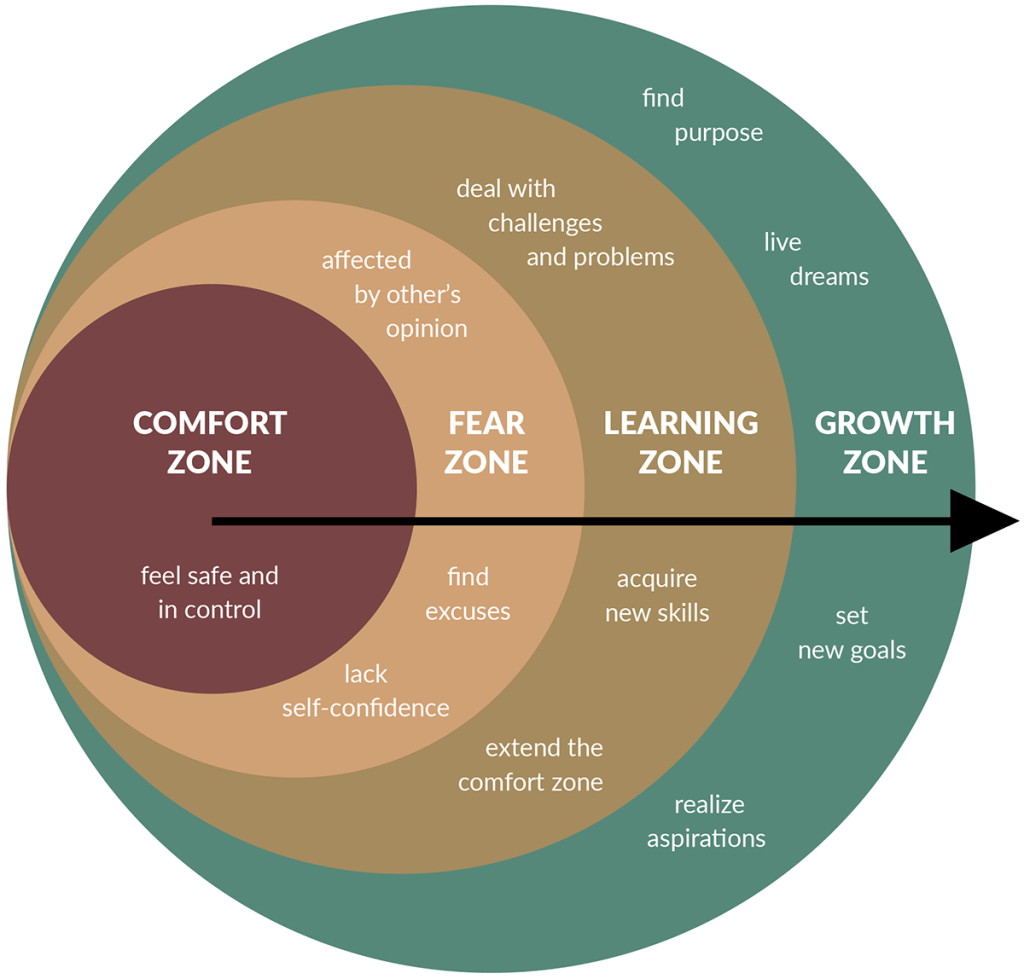
I came across this illustration that beautifully represents the journey from the comfort zone to the growth zone

Source: PositivePsychology.com ‘Leaving The Comfort Zone’ Toolkit

It takes courage to step from the comfort zone into the fear zone. Without a clear roadmap, there’s no way to build on previous experiences. This can be anxiety provoking. Yet persevere long enough, and you enter the learning zone, where you gain new skills and deal with challenges resourcefully.

After a learning period, a new comfort zone is created, expanding one’s ability to reach even greater heights. This is what it means to be in the growth zone.

The Comfort Pull

Your comfort zone is tempting. It’s that comfy couch that calls you over, wraps you with warmth, and then sucks you deeper into its core. It’s seductive. But linger in it a little too long and it becomes harder to stand up again—the gravitational pull is too strong.

And that’s the reason you stay stagnant where you are.

You’re not in motion or action. When you’re not moving, you’re not exploring. And when you’re not engaging in new experiences, you’re not learning or building new skills—you’re just there, existing in time, but not evolving through it.

The irony of the comfort zone is this:

You will most likely not be willing to step out of your comfort zone and into discomfort until you are extremely uncomfortable with the comfort zone itself.

When your comfort zone becomes so uncomfortable, that’s when the spark is lit. And that’s when you need to step up to the stage and ignite the fire. That’s when the new version of you needs to show up.

Discomfort in the status quo is a sign that it’s time to make a change, and discomfort demands a new version of you to show up.

We tend to think that discomfort is our enemy. But what if we changed the lens we’re looking through? What if we began to see discomfort for what it is: Our ally. The voice. A whisper so loud, it trembles our body. Our inner guidance telling us that we are meant for more because we are capable of more.

And what if we allow it to move us into action?

Discomfort in our comfort zone is the sign that it’s time for us to step out of that zone and get really uncomfortable as we fully step forward into our growth zone.

Between where you are today and where you want to be—who you are today and who you want to become—there’s discomfort. It’s the passage that carries you forward. Embrace it, and you will bloom. Shun it away, and you will shrink.

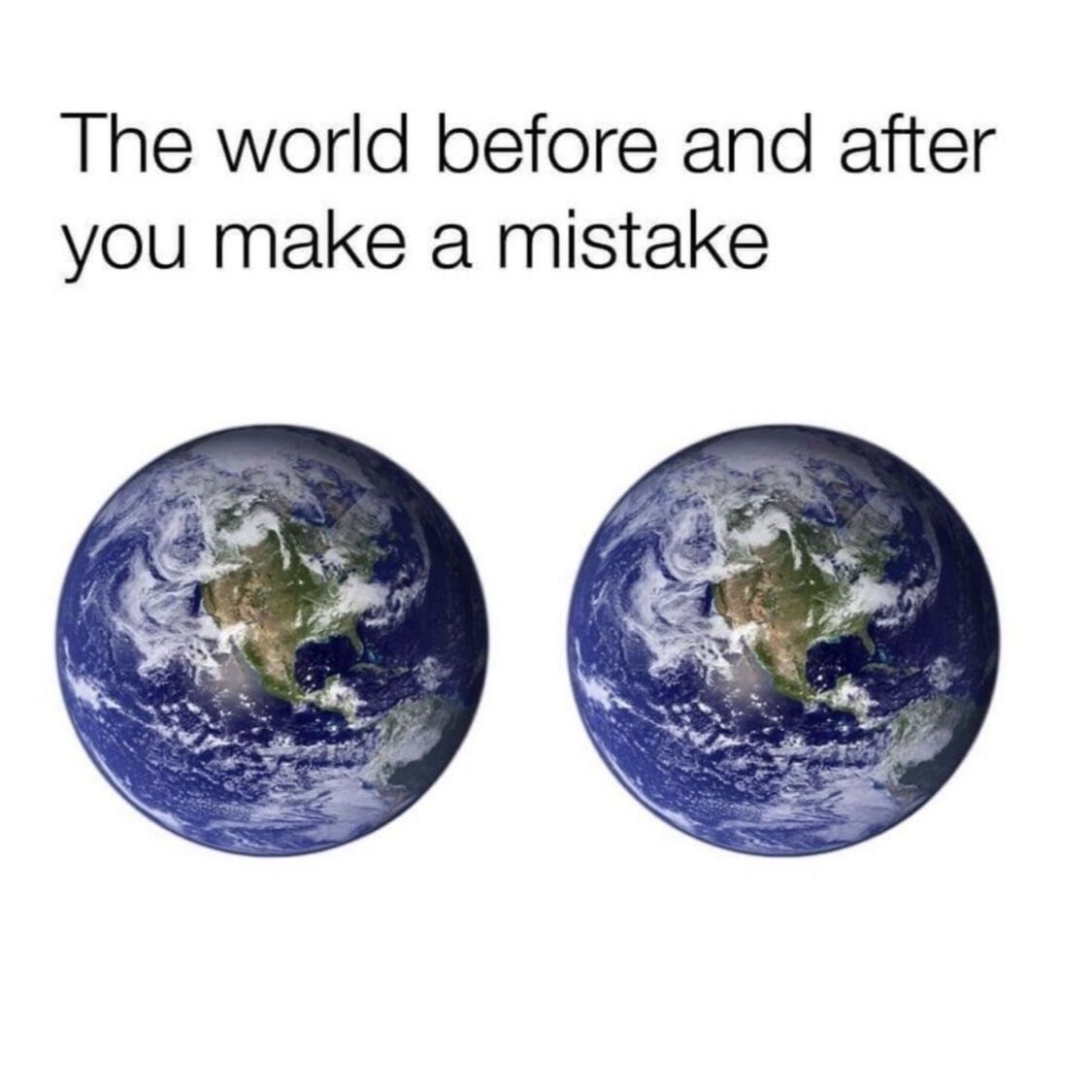
Mistakes are Essential for Growth

“I made a mistake.” Those are four words nobody ever wants to have to admit. Mistakes are a part of the learning process of life. Mistakes don’t always have to be bad, but the human reaction to making a mistake is usually a bad one. If you are like me, you beat yourself up over making careless mistakes. I like to strive for perfection and hate to disappoint people, but in reality, I make mistakes too. You replay everything in your head and try to figure out where you went wrong. In the end, you have to live with what you did. If you are lucky enough, the mistake can be fixed. Realizing that it is OK to make mistakes is the key to helping you live a happier life.

You aren’t the first

It’s funny we don’t usually think of others who screw up as inept, but when we falter, it’s a different matter. We imagine we are useless and don’t forgive ourselves.

Everyone makes mistakes. What’s more, trillions of people experienced the same gaffes before you. It’s easy to imagine you’re the first to be unsuccessful, but you’re not alone.

When you make an error, let yourself off the hook. Be kind with soothing self-talk. Offer yourself the advice and generosity you would give to a beloved friend. Remember, everyone fails to achieve the results they want at times, and doing so is part of forming the life you want.

Nothing stays the same

Life flows, life moves on. Sometimes, it looks as though nothing’s happening, but change is forever afoot. Beneath the dirt, a network of roots grow and plants take their first tiny reaches for the surface so they may feel the sun. The wheel of life never stops turning.

All things, your mood, the weather, and circumstances alter with time. One day soon your mistakes won’t mean anything anymore and the negativity you experience will fade from your memory.

Vulnerability is endearing

Did you ever notice how successful, seemingly perfect people, have a huge entourage, but not many close friends? People admire them, but they are in awe. Additionally, who wants to be best buddies with someone who shows you up all the time simply by being perfect?

We gravitate to people who aren’t afraid to show they are real and have problems the same as the rest of us. When they make mistakes, we warm toward them and recognize ourselves in their blunders and embarrassment.

It’s useful to be super-efficient, but perfectionism doesn’t help you connect with people. You need to be vulnerable and mess up occasionally.

When you are at your lowest, people can rise to the occasion, help, and feel closer to you.

Successful people screw up

Some of the most successful people I know made huge mistakes on their journey to achievement. Several earned, and then lost, massive amounts of money before regaining their losses, or made other blunders.

You will meet setbacks and make errors just because you are on a voyage of discovery. Recognize accomplished people screw up too. Your mistakes are not proof you won’t make it.

Blunders are stepping stones

Each mistake takes you one step closer to your goal. It increases your wisdom and experience, so you know more the next time you face a similar challenge.

Focus, not on failure, but on progress, and see mistakes as helpful. Remember, every blunder is useful. It shows you what not to do next time and urges you to try a new angle that might work. Carry on, and you’ll find a way forward.

You’re growing emotionally

You can’t change into a wiser version of yourself unless you transform. Like a caterpillar, you must undergo experiences that change you to become a greater version of yourself.

You grow as a person when you make blunders too. Your insights expand, you gain self-awareness, and you’re better able to understand others because, when you see them screw up, you’ve been there before and can empathize.

Mistakes show you what to improve

Have you ever met someone who thinks they know everything? Well, you realize they are wrong. Until they mess up, they don’t recognize where they must focus to increase knowledge though.

You can’t see your blind spots, areas under the radar needing attention until your mistakes highlight them.


Blunders might fill you with shame and anxiety, but they are integral to growth. You must fail occasionally to rise back up like a wave with renewed strength and wisdom.