Keep Trying

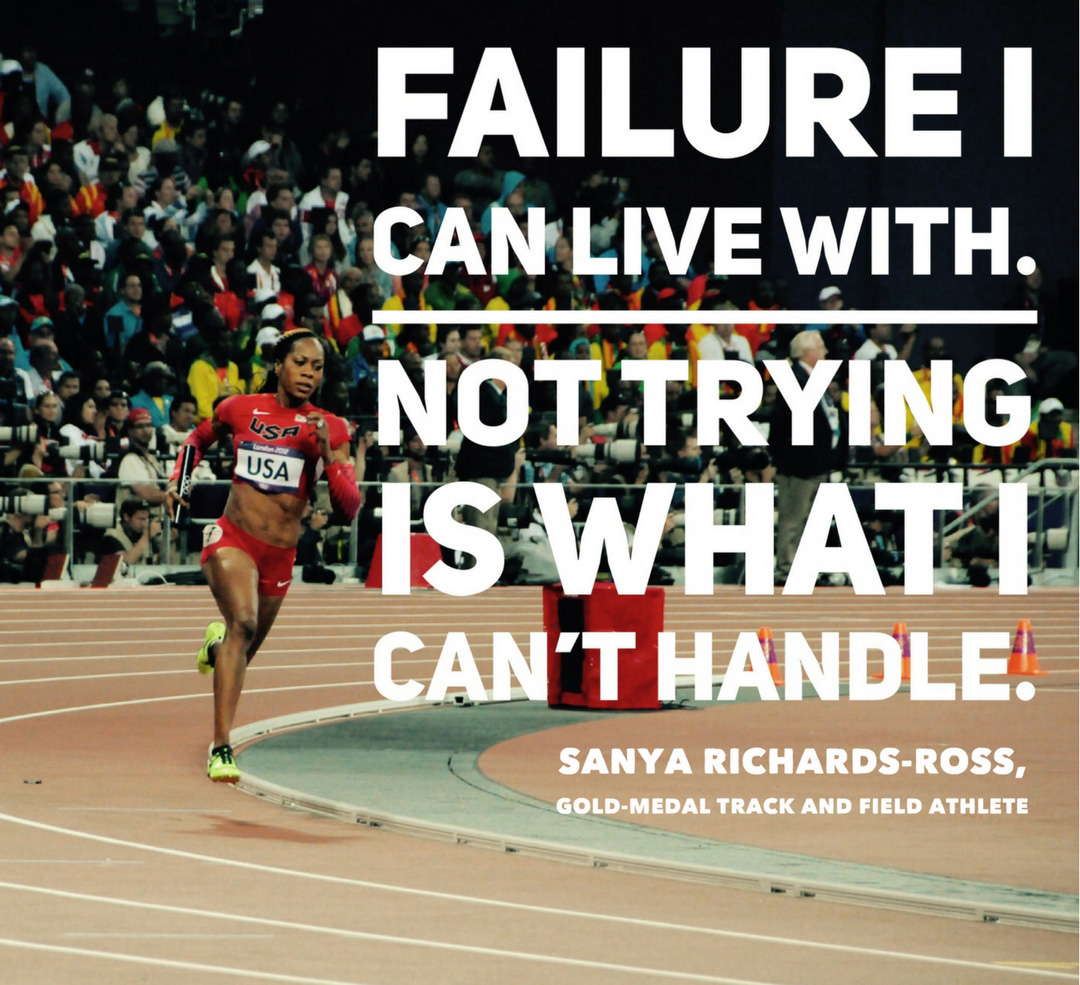
When four-time Olympic gold medal winner Sanya Richards-Ross said, “Failure I can live with; not trying is what I can’t handle”, she really meant it. Despite her extraordinary sporting accomplishments, the athletics star knows exactly what she is talking about, having gone through enough failure and heartache to sink all but the very strongest.

“There are no successful people on the planet who have not experienced failure,” Richards-Ross explained. “I always tell young people that failure is a necessary ingredient in the recipe for success. I say, ‘Hey, I failed on the biggest stage, but I came back and then victory was that much sweeter’.”

That failure came for Sanya at the Beijing Olympics. Unbeaten all year, the then 23-year-old was a nailed-on certainty for individual gold. But, having run the fastest time in qualification, Richards-Ross got chased down the home straight in the final and overtaken by both Great Britain’s Christine Ohuruogu and Jamaica’s Shericka Williams.

Richards-Ross was carrying a heart-breaking, secret burden, having had an abortion just days before travelling to China. 

“It was really, really, really hard,” Richards-Ross recalled. “For me it was more of a spiritual thing than physical because I never wanted to be in a position to have an abortion. It was more the emotional wear on me than the physical. I was still physically prepared to run fast.”

The fact that she told no one – even her coach was in the dark – added to the incredible weight on her shoulders. But in the months after Beijing, Richards-Ross returned to the mantra her father had first taught her in high school, and the athlete in her resolved to “keep trying”.

“I say, ‘fail forwards’. Yes, you are going to fail, but what can you learn from it that is going to push you one step closer to your goal?” Richards-Ross said. “It is about not letting failure stop you in your tracks and stop you achieving your goals. When you are doing well you never adjust or revaluate, most of the time you don’t get better. It is when you fail it’s like, ‘OK, what can I be doing differently to get to the next level?’.”

Olympic redemption came in 2012 at the London Games when Richards-Ross, trying again, faced down her demons. 

“People watch the video and it wasn’t one of my best races,” she laughed. I was just like, ‘I am going to win, I am not going to try and do anything special’. She won, and she finally got to celebrate the ultimate title in her sport.

Getty images

Despite dealing with an ongoing, serious foot injury throughout the final few years of her career, Sanya was never going to leave the sport without a fight and was focused on defending her Olympic title. You will not be surprised to hear that she did everything possible to be on the start line in Rio de Janeiro in 2016, despite her increasing physical limitations.

“I had a third surgery, I trained alongside my physio so I could be getting treatment every day while I was working out, I did it all,” Richards-Ross said with a smile. “I ran around the track at the Olympic trials but I wasn’t able to finish the race and I hung my head low for a minute, and then this woman shouted out, ‘We love you, Sanya’ and it brought me back to the moment and I was, ‘Oh my God, this might be the last race of my career’ and so I gave everything I had to finish.”

She received a standing ovation from everyone at the track that day as she smiled through the pain of a career-ending tear to her right hamstring. And that, despite all the medals, is the moment that sticks with her. 

“Even though I had so many experiences throughout my career, that race, even though I didn’t win, that depicts that saying for me,” she said. “I could live with the fact I didn’t make it because I tried, I gave everything I had.”

Citius – Altius – Fortius

The original Olympic motto  “Citius, Altius, Fortius” which means “Faster, Higher, Stronger” was adopted with the launch of the Olympic Movement in 1894 at the urging of founder Pierre de Coubertin, who wanted a slogan that expressed excellence in sport. These three words were meant to encourage athletes to give their best during competition. Pierre de Coubertin proposed the motto, having borrowed it from his friend Henri Didon, a Dominican priest who taught sport close to Paris. 

The motto can be compared to the Olympic creed which says: “The important thing in life is not the triumph, but the fight; the essential thing is not to have won, but to have fought well.” The inspiration for the creed would come later, following a sermon given by the Bishop of Pennsylvania, Ethelbert Talbot, during the Games of London in 1908.

The most important thing in the Olympic Games is not winning but taking part.

Pierre de Coubertin, (founder of the modern Olympic Games)

As Bronte Barratt says, the motto isn’t fastest, highest, strongest. All progress has emanated from the desire to improve, to be BETTER. Records will be broken, human potential will be stretched to the limits and athletes will do BETTER than ever before despite social, political and human setbacks. The same applies to any field in life. Whatever we achieve today, whatever records be set in the Tokyo Olympics, at some point, someone will surpass them.

While each of the athletes, competing at this Olympics are there to win, they also know that only a few of them will. Likewise for us, not all of us can achieve the great heights of glory and professional success that we look to with envy in others. We won’t all be CEO’s or have our business listed on the Fortune 500.  We won’t all be hailed as heroes, geniuses or trail-blazers and accorded the status that goes with it.  But what gets in the way of most people ever having a chance of achieving the success they are capable of, is not a lack of luck or talent, but simply a lack of courage and determination to pursue it.

It’s not the triumph that ultimately defines who we are, but our willingness to work hard toward a goal that is bigger than we are, knowing that as we do, we will discover just how capable we truly are and attain our own personal best.  After all, isn’t that ultimately what the true Olympic spirit is about?

If a legally blind archer can set a new world record, then what excuse do any of us have for not achieving more?

Silver Linings

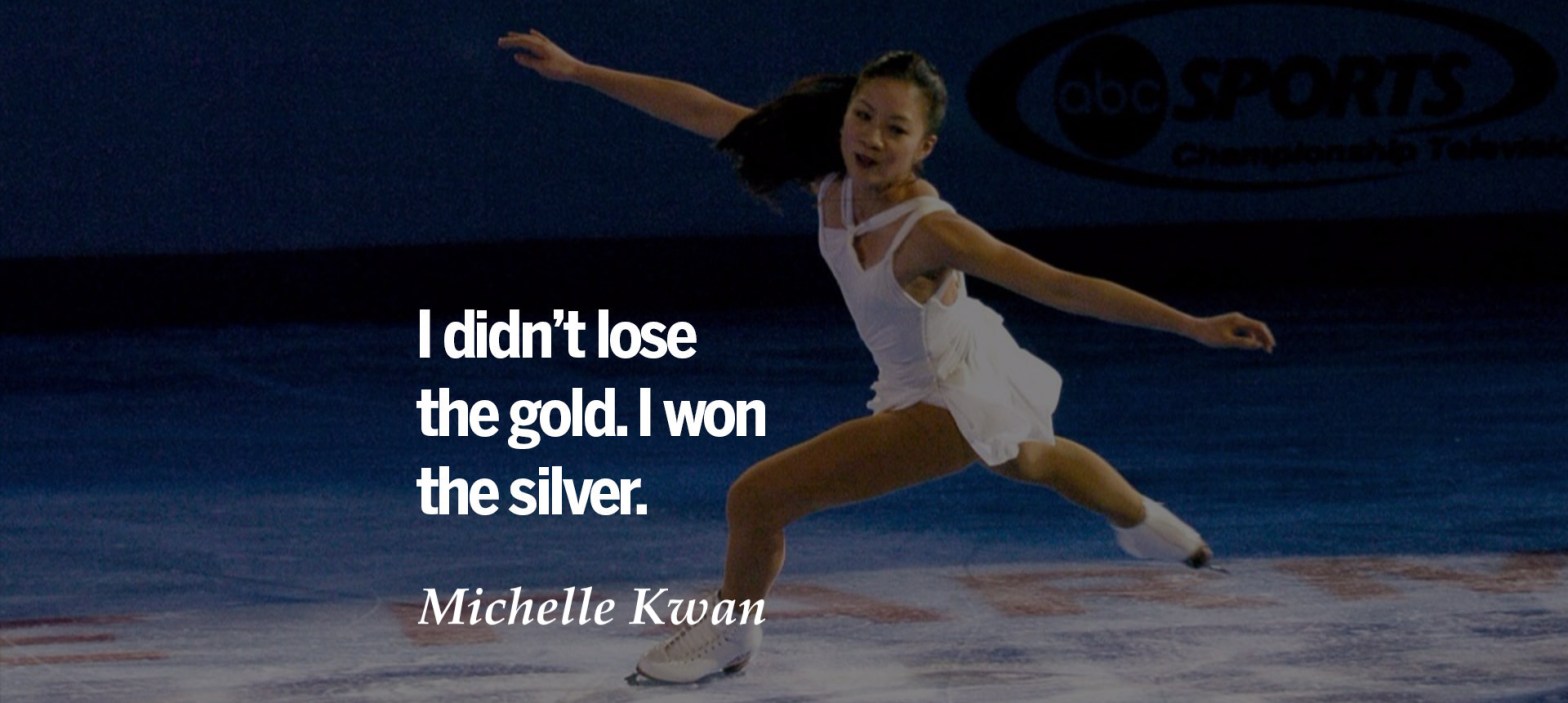
As we near the end of the Tokyo Olympics, this quote by Michelle Kwan got me thinking on the whole idea of winning and losing. Nobody participating at the highest level, strives to win the silver or bronze. Every single athlete prepares and yearns to win the gold. But at the end of the day, there is only one winner. Nothing else matters as long as you’ve done your best, you know you’ve done all you could possibly do!

A few years back, PV Sindhu kept getting a lot of flack for losing at the finals. With the label of being a failure in the final stages being stamped on her, Sindhu hit back at her critics saying it isn’t the gold medal that she lost in the World Championships but a second consecutive silver that she won. Here’s Sindhu’s hard-hitting Instagram post:

“Never give up, never give in, and when the upper hand is ours, may we have the ability to handle the win with the dignity that we absorbed the loss” – dough Williams It brings me immense amount of pleasure to bring back the silver consecutively 2nd year in the BWF world championships. I didn’t lose the gold , I won the silver and I can proudly say my silver sparkles. It was indeed a wonderfull week in Nanjing, inspite of losing in the finals I had some great matches. I have been really happy about my consistent performance over the rankings. I believe that patience and persistence make unbeatable combination for success, hence have complete faith that my gold shall come soon!! It’s amazing how I have received so much love and support from people all around the world, and that keeps me going! And finally I want to thank my amazing team, who have stood by me like a pillar throughout the tournament and also thanks to all my sponsors @olympicgoldquest @baselineventures whose been supporting me and a special thanks to my Physio @physio.shetty whos always been waiting to treat meand take care of me when ever i want to n always being there for me n finally thanks to all my coaches who helped me in and out and also been so kind always….”

While the world would always perceive the No.2 as more of not being No 1, it is important to celebrate being on that podium and the journey made to get there. An episode titled, ‘The Silver Lining’ of the fantastic podcast ‘The Happiness Lab with Laurie Santos’, discusses the human biases of focusing on positive references, harsh comparison with others and focusing on the destination rather than the journey. The discussion is with Michelle Kwan – the Olympic silver medalist ice skater. The episode discusses the possibility that like the silver medalists in sports, we make the same mistakes in life too, which eventually sets us up for sadness rather than celebration.

How did Michelle Kwan break out of the gloom of missing the Gold medal?  

It was by setting up a negative reference – she compared her winning the silver medal with that of winning the bronze medal, next she stopped comparing her performance with others and rather compared it with her own older self and lastly, she focused on enjoying the journey to that medal more than the colour of it. 

As we strive to be the best in our own respective fields, let us strive to do our best, enjoy the journey and find the silver lining at every moment!

The Masks We Wear

Often in life we don’t get to see what lies beneath a person’s “good self” presentation, also called a mask. We don’t get to find out if that person really is kind, caring, or not. The discrepancy is often hidden. And that is true for ourselves as well. We all put on masks to some extent for various reasons with different people to help get us through a variety of situations.

Eventually, though, what we’ve hidden beneath our mask does manage to find its way into the open. It may slip through the mask in words we mean, but didn’t mean to say; in actions we’d like to take, but didn’t mean to act out; in actions we don’t take, but want to.

The Japanese say that you have three faces:

1.      The first face, you show to the world.

2.      The second face, you show to your close friends and your family.

3.      The third face, you never show anyone. It is the truest reflection of who you are.

Why do we do this? Could it be that we have an absolute fear that if others saw us for who we believe we truly are, that they wouldn’t like or accept us? How many of us go through life thinking that we are not good enough, bright enough, interesting enough…. fearful of the opinions of others if they were to actually see the “Real” you? The ‘you’ who tries to hide all of this behind a mask. And, there is not just one mask, we have many of them – interchangeable ones, depending on the situation. The ‘you’ who bows to societal / family pressures and expectations for fear of being judged. But then, whose life are you living? Faking it is tiring. Living a life that is at odds with your authentic self will eventually wear you down.

Once you are Real, you can’t become unReal again. It lasts for always

Margery Williams – The Velveteen Rabbit

There is a beautiful children’s book called The Velveteen Rabbit by Margery Williams. It tells the story of a rabbit who becomes Real through the love of a little boy. It is a beautiful metaphor for the value of authenticity and vulnerability. It tells that we become Real through our openness. Maybe it’s time that we become Real through the love and acceptance of ourselves.

How wonderful would it be to be able to allow our authentic selves to be seen by others – to feel secure, loving and accepting enough of ourselves to allow ourselves be seen without our masks?

Friendship Requires EFFORT

As we grow older, some friendships may slowly start to diminish. It could be because you’ve started to grow apart, maybe you’ve become too different from each other. Sometimes we become extremely busy, and we don’t have as much time as we used to, to hang out with said friends. Maybe you’ve made new friends, and spend more time with them. Maybe you got into a relationship, and hang out with your significant other the most. Work often gets in the way, and then you have to struggle with handling friendships, relationships, your job, and spending time with your family all at once. It becomes too much sometimes, and maybe it’s a little overwhelming for you.

Nowadays it sometimes feels that behavior within friendships is trending more towards convenience. What is easy, readily available, and requires the least amount of effort.

We are busy today, yes? Most of us work way more than 40 hours a week, especially with email, texting, social media, and the new cultural development of being ever connected to work, even while at home. The boundary lines between work and home life, blurring and collapsing. We are pre-occupied with things like social media, networking, going to the gym, meal planning, commuting, and the schedules of one’s kids.

All this busyness though comes at a cost. That can be the neglect of and lesser engagement in relationships that are meaningful to us and which bring us joy. And this resulting, ultimately, in our losing those.

Without doubt quality friendships make our lives better by leaps and bounds. They lower our levels of stress, help us to feel supported and loved in both challenging times and otherwise, they offer life insight and learning potential to our lives, a sense of inspiration, as well as joy and laughter.

The keyword is quality, because shallow friendships, those that serve as fillers and mere placeholders against loneliness, the ones which still leave you a bit wanting, these do not provide the same emotional benefits.

However, emotionally close, high-quality friendships take effort. You cannot go to the gym, spend hours working hard to get fit, and then stop going while assuming to maintain the same level of strength and fitness. Your muscles will atrophy and diminish. You cannot grow a garden and then cease watering it. The flowers will wither and die. Friendship fits nicely with these metaphors.

Keeping great friends takes effort, though it’s of the most worthwhile kind. Without it, your friendship, even the best ones, they will not last.

Do not make the mistake of letting this happen, one that is sure to elicit later regret.

Go out of your way today, even if just a little bit, in order to hold onto and maintain those treasured connections that you hold dear. The ones that you know are worthwhile and that you wish to keep in your life over the long-run.

You will be thankful for having done so over the big picture of your life.


I’ve been blest with lovely friends. At my previous company, I had fantastic friends in my team. Sang this for them on my last day :)

MAGIS

Today is the feast of St. Ignatius of Loyola, the founder of the Jesuits. All my education was at Jesuit institutions – St. Britto’s High School (Goa), St. Xavier’s College (Bombay) and Xavier Institute of Engineering (Bombay). Every year, 31 July was celebrated with a lot of festivities and we kept hearing about the life of St. Ignatius of Loyola.

St. Ignatius of Loyola was born in 1491 in the Basque country of northern Spain. He was devoted to chivalry and suffered a severe leg wound in battle. During an extended recovery period, he experienced a profound conversion, and devoted the rest of his life to serving God. Ignatius died in 1556 and was canonized a saint in 1622.

All of us who have studied in Jesuit institutions will find some, if not all, of the following characteristics very familiar

source: Creighton University website

The one that inspired me the most is Magis which translates to “more.” By rising above expectations and striving for “more,” for others and for God, we can serve as a lasting part of something greater than ourselves. The key part is that Magis is not for self but for others. So it is not doing more or all you can to get the highest paying job in your batch or to get that promotion that you and your team are aspiring for. It doesn’t mean simply quantity, but quality, how effective or transformative our actions and words are. It isn’t striving to be the best and greatest. These kinds of superlatives can paralyze us, because who can tell or judge what the “best and greatest”?

Chris Lowney in his book Heroic Leadership: Best Practices from a 450-Year-Old Company That Changed the World, exposes the key to successful leadership based in the Jesuit magis

Magis-driven leadership inevitably leads to heroism. Heroism begins with each person considering, internalizing, and shaping his or her mission. Whether one works within a large organization or alone, no mission is motivating until it is personal. And it is sustainable only when one makes the search for magis a reflexive, daily habit. A magis-driven leader is not content to go through the motions or settle for the status quo but is restlessly inclined to look for something more, something greater. Instead of wishing circumstances were different, magis-driven leaders either make them different or make the most of them. Instead of waiting for golden opportunities, they find the gold in the opportunities at hand.


Here’s Fr. Roy singing “Noble Knight” also known as the “March of St. Ignatius” which is always sung on 31st July, the Feast Day of St. Ignatius either as the Final hymn at Mass or as part of the Cultural Program held at various Jesuit Schools and Universities across the world.

Wishing you all a Happy Feast! :)

Are you in the Balcony or the Basement?

Most people have plans to accomplish good things in life. Of course there are some exceptions who focus on violence, hatred and other related stuff. Our kids and colleagues may at times disappoint us or even make us boiling mad. It’s at time like this that we tend to start thinking the worst of them and say words which we later regret. Instead of getting worked up, it may help to take a step back and pay attention to why they have behaved in that way. Talking to them to understand why will help us in a big way.

If we take man as he is, we make him worse. If we take man as he should be, we make him capable of what he can be.

Viktor Frankl

Joyce Landorf Heatherley talks about two kinds of people in her book Balcony People. Some people are in the “balcony” of your life, cheering you on, energizing you with their affirmation. Others are in your “basement” doing exactly the opposite. Basement people evaluate others. With their critical judgments of people’s words and actions, they tear away at others’ souls. They make people feel like they are being compared to some unspoken ideal or standard.


In 1975, a young man who was struggling with what to do with his life returned home from college.

One afternoon, he was hanging out at his mother’s beauty salon when a respected elderly woman visited the shop.

She took her seat, saw the young man and couldn’t take her eyes off him. Every time he looked in the mirror, he saw her behind him looking right at him.

The woman saw something in the teenager… something he could not yet see in himself.

Eventually, she spoke what was on her mind.

The woman said, “You know young man, you are going to travel the world and speak or preach to millions of people.”

Then, she wrote those words on a blue envelope and handed it to him.
Her words spoke to his troubled heart, so he graciously accepted the envelope and signed it. Then, he put it in his wallet so he could carry it with him.

Today, Denzel Washington is one of the biggest movie stars in Hollywood.

In an article published in February 2017, Denzel said the woman’s words really encouraged him when he was starting out as an actor.

Believing in someone is indeed priceless!

Here’s a lovely song by Jason Mraz – Look for the good

Choices ~ Beach or Mountain?

When it comes right down to it, almost everything is a choice. Every single minute, we have choices in life. This is both a great truth and a hard lesson because it reminds us of our own power. Not power over others, but the hidden, untapped power to be our best and live out our dreams.

Future success is not the result of just one monumental decision. It is the result of a continuous series of choices every day. Those choices don’t just impact the moment, they echo throughout our professional and personal lives.

Some may say that we don’t choose our circumstances. However, we have more power over circumstances than we care to admit. Even if circumstances are thrust upon us, we choose how we respond to them. Some of the most inspiring stories are of those who overcame and chose to become successful.

I absolutely love the analogy of a vacation trip which I had read sometime back, a vacation to Mallorca, Spain. Here you have beautiful beaches with the light blue sea with astonishing mountains.

Here you have two options: chill on the beach the whole day or take a trip to the mountains.

Everyone can lie on the beach right? It isn’t difficult. But going for a trek up the mountains has its own set of challenges. You may stumble onto trails that take you to lovely waterfalls, spot some lovely flowers/trees. You may also meet fellow hikers and make friends along the way. But most importantly, the view when you reach the top…ah…once you’re on the peak of the mountain you know what you’ve achieved. You have a beautiful view, and can see more than those people on the beach. You work hard to get something that is much more rewarding!

Everyone can relax on the beach, but you need to have the endurance, motivation, ambition and eagerness to get out of your comfort zone to finally live your life. It’s your choice!

Getting Past It vs Getting Even

After we’ve been hurt, betrayed or disrespected, the first thing almost all of us think of is how to get even, how to give the other a dose of their own medicine. The deeper the hurt, the more we are prone to getting lost in ways to give back. Revenge spawns an endless cycle of retribution. Even though we may feel temporarily happy, it isn’t a long term solution. It does come back to bite us!

Revenge proves its own executioner.

John Ford

Seeking revenge may remind us of the pain we experienced when we were wronged and can make an event appear even larger in our minds. Ruminating about getting even — stewing over what the person did to you and what you would like to do in return — can interfere with day-to-day well-being and happiness.

Read this quote sometime back and it made me smile…

Whilst you sit back and wait, get even with those who have been kind to you, who have always stood by you, who have been your source of strength and inspiration, who have helped you when you were helpless.

The Company We Keep

A big chunk of our present and future state of mind and being depends on the company we keep. Surround yourself with the right people and you’ll be growing phenomenally. Surround yourself with the wrong people and you’ll probably be drifting like a leaf that goes where the wind blows!

You’re the average of the five people you spend most of your time with

Jim Rohn

We often underestimate the importance of our inner circle thinking that we are clear about our goals and we rely on our will-power to stay focused on our dreams. Without a doubt, we need friends, mentors, teachers and family who keep pushing us and challenging us to be a better version of ourselves. The right company raises the bar, helping us to set new, loftier expectations of ourselves. Oftentimes, we don’t know what we are capable of until we see others achieve. When we surround ourselves with positive people they consciously and subconsciously challenge us to be our best selves.

People inspire you, or they drain you – pick them wisely.

Hans F. Hansen

Your vibe attracts your tribe. The people with whom we keep company determine the quality of our lives. They help determine how far we may go in life, the aura and attitude we will adapt, habits we may partake in, and the type of person we may (or may not) become.

Here’s a powerful motivational speech by Lewis Howes ~ Surround yourself with the dreamers!